When the Gatekeeper Throws the Key: NMC’s U-Turn on Medical College Approvals May Redraw India’s Doctor Pipeline
Did the reversal serve students and the healthcare system, or weaken the message that regulatory violations escalate into structural consequences.
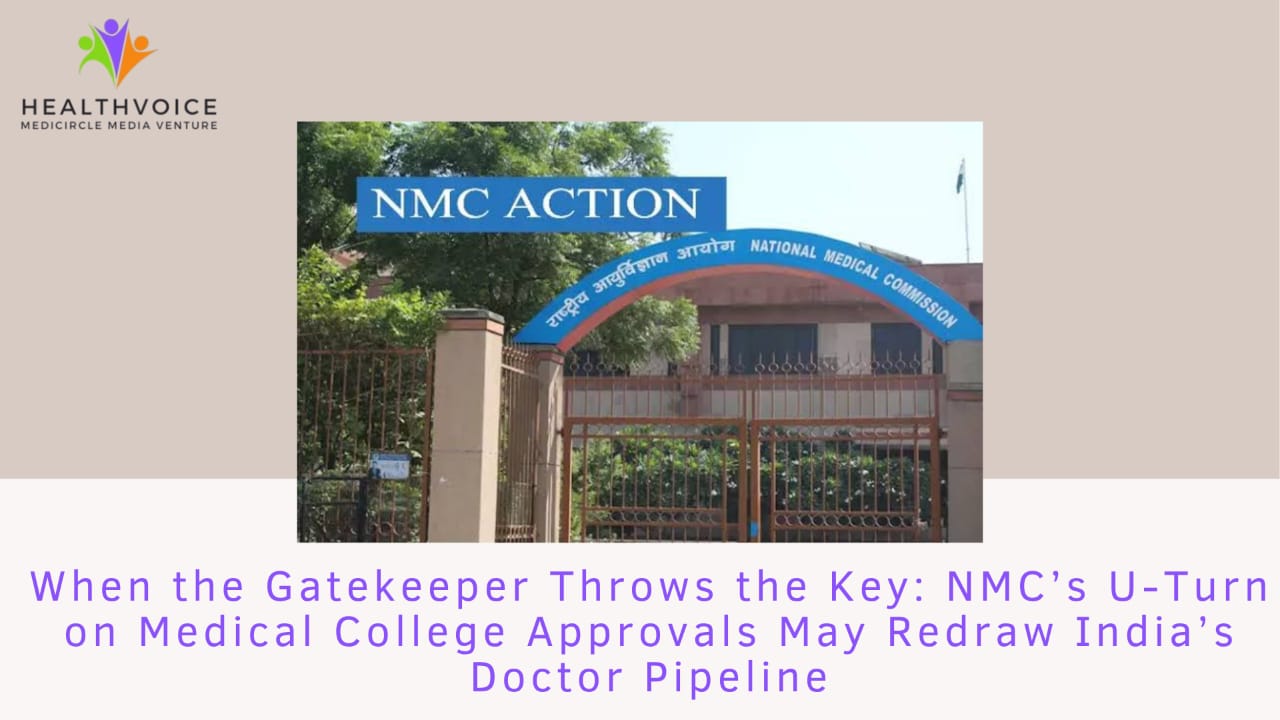
Just days ago, the National Medical Commission (NMC) stunned the medical education world by dramatically reversing its own freeze on new medical colleges and increased MBBS seat intake. The reversal announced on August 2, 2025 comes just weeks after a sweeping ban imposed in mid‑July following damning Central Bureau of Investigation (CBI) reports implicating assessors, officials, and college promoters in a ₹1,000‑crore scandal to issue approvals despite pathetic infrastructure and fake faculty. Though the freeze hit every plan from those waiting to open colleges to those seeking modest expansions the U-turn upheld exclusions of institutions named in the CBI FIR. In Gujarat alone, this pivot could restore and add up to 350 MBBS seats through seat-upgrade applications and one pending new college proposal, reversing NMC’s earlier reductions of about 250 seats across the state.
This incident raises a provocative question, was the freeze too much or the reversal too hasty? If regulation is meant to ensure standards in medical education, then who holds the regulator accountable when it blocks supply in one breath and reopens the gates the next? At stake is India's ambition to build a doctor-secure future without compromising regulatory integrity.
Consider the timeline: on July 14, the NMC issued a blanket halt on licensing new colleges, expanding seat capacity, and even approving routine annual renewals. This action followed raids at over 40 medical colleges across states, some of them in Gujarat and Chhattisgarh, implicating as many as 34 individuals, including several NMC assessors and ministry officials. The probe found leaks of inspection dates, staged patients, proxy faculty, and doctored documents all traded for bribes.
That decision reduced around 6,000 MBBS seats nationwide. In Gujarat alone, discipline saw one college lose its entire 250‑seat intake, while others dropped 50 seats apiece. State capacity plunged from approximately 6,900 to 6,650 seats. This created chaos: final-year students faced accreditation dilemmas, aspiring doctors reconsidered geography, and hospitals in demand-heavy states began seeing internship crunches. The regulator argued that the halt was needed to preserve the sanctity of medical education and stop substandard institutions from producing unqualified doctors.
Then came the reversal: institutions not flagged by CBI would again be allowed to pursue approvals, including conditional permissions based on pending inspections. That shift could offset Gujarat’s losses and exceed them, with roughly 350 new seats on the anvil from two expansion proposals and one new college application.
That makes it fair to ask: did the reversal serve students and the healthcare system, or weaken the message that regulatory violations escalate into structural consequences?
For medical colleges and hospitals, this signals that regulatory risk is real but recovery is possible if compliance is clearly documented. Institutions that weathered inspection cleanly may resume strategic growth. But for administrators, the reversal also underlines urgency: each added seat comes with mandated faculty ratios, hospital bed capacity, teaching hospital workload, clinical audits, and infrastructure norms. The temptation to compromise on standards under pressure is high. Whether this recalibration leads to sub‑par expansion or disciplined build‑out depends on how vigilantly compliance is enforced.
For aspiring doctors this change may ease admission bottlenecks. But they should remain cautious. Seats may reopen fast, but not all institutions have iron‑clad track records; parents and NEET-qualified students must scrutinise faculty credentials, institutional accreditation, clinical bed usage, and internet pointers to NMC-listed sanction statuses. Not all reopened seats are truly safe.
Students and the general public may wonder if NMC’s 180-degree shift undermines its credibility. Turning from zero‑tolerance to calculated exclusions where only accused colleges remain barred opens the door to accusations of political or administrative expediency. But the alternative came at a high cost, too: thousands of students faced cancelled offers, hospitals lost intern capacity, and government programmes counting on fresh batch doctors were rattled. That is no small ripple in India’s healthcare ecosystem.
The question of whether to stand by the regulator or question its clarity is not straightforward. But the way forward demands rigorous enforcement of compliance standards. Surprise re‑inspections, unannounced mid-year audits, biometric authentication, facial‑recognition attendance tracking, and real‑time reporting of hospital bed occupancy are all mechanisms NMC has signalled it will use. Yet these tools must operate without back‑doors, or the cycle of fraud may resume disguised as legitimate expansion.
Doctors at private hospitals now face dual opportunity and risk. Partnering with colleges to secure district hospital rotations or expanding departments to match rising student numbers can be advantageous. But growth must align with quality: do outreach clinics in rural centres share case flow? Are hospital diagnostics up to par? Is ICU occupancy high enough to train interns safely? Without these clinical metrics, student seats are merely labels with limited educational value.
For hospital owners, this moment also offers chance for purpose-driven collaboration. By aligning with approved colleges in states like Gujarat, institutional partners can project referral pathways, engage in faculty exchange, and co-host community health camps. For administrators who previously hesitated to accredit new batches due to uncertainty, a stable regulatory environment opens the door to formal affiliations rooted in protocols and trust.
From a public health perspective, joining hands with medical colleges even at the stage of seat expansion, can strengthen district health systems. Intern-driven outreach camps, early diagnosis screening, and wellness camps can expand coverage. The key is clinical depth: only colleges with clear infrastructure, dedicated internships and monitored rotations can deliver value beyond theory and attendance registers.
As for policy analysts, the central lesson is that regulation cannot afford to swing between extremes. Unyielding freezes are politically stoic but economically punitive; impulsive unfreezes risk diluting norms. The middle path is to release seats systematically based on audit clearance, with granular reporting and accountability loops. Gujarat’s potential gain of 350 seats should come with concurrent growth in faculty numbers, hospital bed counts, forensic labs, and digital compliance systems.
Among medical educators this moment demands recalibration. Faculty recruitment must align with NMC’s updated eligibility norms; contractual staff roles should not be used as a workaround. Research labs, skill labs, simulation centers and rural rotations must scale alongside student numbers. Without synchronised growth, the reputational risk to teaching hospitals escalates.
Ultimately, the regulator’s volte‑face gives us a stark choice: treat regulation as hurdle and evade it, or recognise it as armour and comply openly. Expansion without accountability is expansion without effect. Students may graduate, but if clinical exposure is limited, ethics ignored, and inspection reform remains surface-deep, patient care suffers in the long run.
If the next few months bring transparent disclosures like inspection ratings published per college, faculty‑strength dashboards, clinical‑case load journals and hospital compliance logs then NMC’s re-entry into regulation may yet prove restorative. If compliance becomes external and data‑driven rather than perfunctory paperwork, the reversal may signal learning rather than compromise.
But if expansion proceeds with silent exceptions, forged documentation slips resurfacing through administrative tunnels, or faculty ratios unmet by design, then the cycle resumes and the regulator risks losing credibility once again.
For India’s long-run plan i.e. to build a doctor-scaled workforce, improve healthcare access and deepen medical education, the next phase requires repair, oversight, and patient-centred vision. More MBBS seats are important but they must translate into proficient clinicians, research‑enabled educators, and hospitals that meet international care benchmarks.
NMC’s freeze envisioned integrity. Its reversal offers capacity. Between the two lies the test: can regulation now produce both?
India’s healthcare future depends on that fusion. Patients need quality doctors, hospitals need staffed departments, states need primary care pipelines. Give the system a chance to enforce standards. Make the revived capacity real. Let transparency lead. If the NMC can partner with colleges, empower audits, and sustain accreditation integrity, then this reversal may yet become a reform moment not a loophole redux.
Regulatory memory is short but institutional culture endures. May the next chapters in India’s medical education reframe policy reversals as strengthening and not surrender. May every new batch of doctors entering under resumed approvals carry the weight of clinical discipline and ethical training. Because in the end, the nation’s health depends less on numbers and far more on integrity.
 Sunny Parayan
#MedicalEducation #NMC #MedicalEducationReform #NMCReforms #MedicalFaculty #HealthcareTransformation #MedicalMentorship #FacultyDevelopment #IndiaHealthReform #healthvoice
