Doctor Communication and Litigation Risk in Indian Hospitals
Effective doctor-patient communication is a critical but underappreciated factor in reducing medical litigation risk in Indian hospitals, as evidenced by patterns in medico-legal cases and judicial precedents.
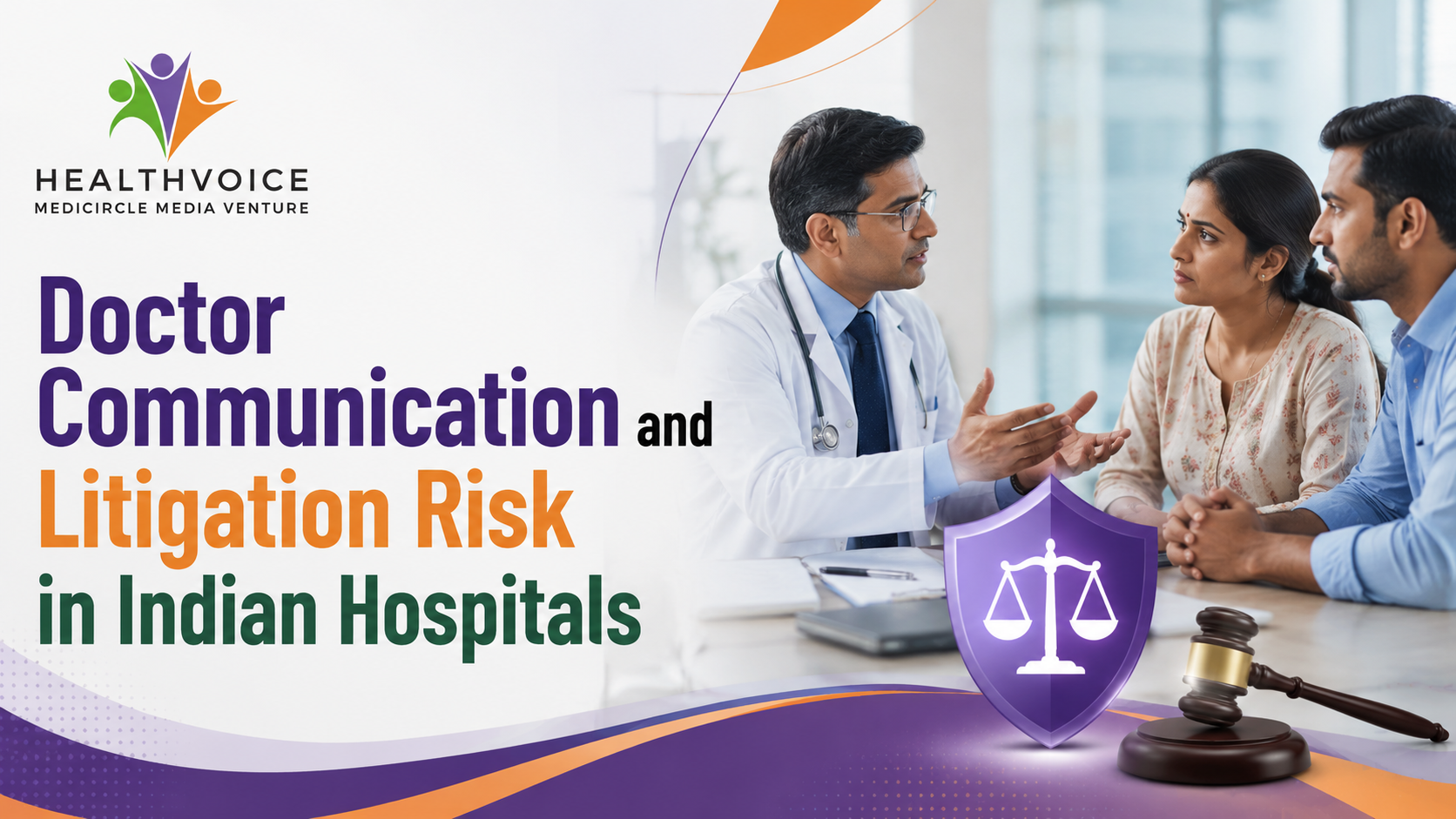
Doctor Communication and Litigation Risk: Lessons from Real Hospital Scenarios
Introduction
Medical litigation in India is no longer a distant concern for doctors practising in corporate hospitals or government institutions. It is an immediate, daily reality. Legal sources indicate that medical negligence litigations in India witnessed a staggering surge in recent years, with some reports citing a 400 percent increase in cases over a relatively short period. The Indian Medical Association has acknowledged in surveys that fear of legal repercussions has become one of the most significant stressors for practising physicians across the country.
Yet, a closer examination of many litigated cases reveals a consistent and deeply instructive pattern. A significant proportion of complaints and lawsuits do not originate from clinical errors alone. They arise from a communication breakdown. Patients and families who felt ignored, uninformed, or disrespected during a hospital stay are far more likely to pursue legal action when an adverse outcome occurs, even in situations where the clinical standard of care was entirely appropriate.
For the medical community in India, understanding the link between communication quality and litigation risk is not merely an academic exercise. It is a professional imperative. The scenarios that follow, drawn from the broader patterns visible in medico-legal literature and Indian hospital practice, offer important lessons for every doctor, department head, and hospital administrator.
The Communication-Litigation Link: Why It Matters in India
The relationship between a doctor and a patient in India is shaped by unique social, cultural, and institutional pressures that are often underappreciated in medico-legal discussions. Patients in Tier 1 cities like Mumbai, Delhi, and Bengaluru are increasingly aware of their rights under the Consumer Protection Act. In Tier 2 cities, healthcare literacy is rising rapidly, and patient families arrive at hospitals with expectations shaped by social media, online health forums, and peer experiences.
Indian courts have consistently reinforced the principle that a medical practitioner has a duty to provide all necessary information to the patient in a language that the patient can understand. The courts have further clarified that a consent form bearing a patient's signature does not automatically constitute valid informed consent if the patient was not meaningfully informed before signing. Consent without substantive communication is, in the eyes of the law, no consent at all.
This legal position places the burden squarely on the treating physician. Documentation of communication is as important as the communication itself. Doctors who engage in thorough pre-procedure discussions but fail to record those conversations in the case file create significant vulnerability for themselves and their institutions.
Common Hospital Scenarios Where Communication Fails, and Litigation Follows
Scenario One: The Undisclosed Surgical Risk
One of the most frequently recurring patterns in Indian medico-legal cases involves surgical complications that were neither disclosed before the procedure nor adequately explained after the event. Consider the general scenario of an elective abdominal procedure carried out in a mid-size private hospital, where the patient develops a known but rare complication. If the treating surgeon never explained the possibility of this complication during the pre-operative consultation, the family, already in distress from the adverse outcome, naturally concludes that something went wrong due to negligence.
The clinical facts of such a case may fully support that the standard of care was maintained. However, the absence of pre-operative risk disclosure creates a narrative vacuum. Families fill that vacuum with suspicion, and grievances escalate into formal complaints before a consumer forum or district court. Studies examining Indian Supreme Court judgments on medical negligence have found that documentation of standard protocol adherence and pre-procedure communication plays a decisive role in case outcomes.
The lesson for practising doctors is clear. Every procedure that carries a meaningful risk profile requires a documented pre-procedure discussion. This includes not just the primary risks but also anticipated recovery timelines, possible complications, and what the patient and family should watch for post-discharge.
Scenario Two: The Family Left in the Dark During Critical Care
Critical care units in India present a particularly challenging communication environment. Patients are often sedated or too ill to engage directly. Families wait in corridors outside ICUs, anxious, uninformed, and in many cases, receiving fragmented or contradictory updates from different members of the medical team.
When a patient dies or suffers permanent disability after a prolonged ICU stay, family members who received poor communication throughout the hospitalization are far more likely to experience their grief through the lens of suspicion. The question they ask is not always "was the right treatment given," but more often "why were we never told what was happening?" That sense of exclusion from the care process becomes the emotional foundation for a legal complaint.
Many NABH-accredited hospitals have recognized this gap and have introduced structured family communication protocols in critical care settings, including twice-daily family briefings, designated communication physicians, and written daily summaries for families. These practices do more than improve family satisfaction scores on audit sheets. They directly reduce the probability of litigation following adverse outcomes.
Scenario Three: Dismissal of Complaints Before Discharge
A third scenario that appears with troubling frequency involves patient complaints made during the admission itself that are not addressed adequately before discharge. A patient who raised concerns about pain management, medication side effects, or a procedure outcome, and felt those concerns were brushed aside or minimized by the treating team, carries that experience home.
When a post-discharge complication arises, that earlier dismissal becomes the narrative anchor for a legal complaint. The patient and family argue, rightly or wrongly, that the hospital failed to listen and therefore failed to act on warning signs that were reported in real time.
Doctors practising in high-volume settings, particularly in government hospitals and busy private facilities in cities like Hyderabad, Chennai, and Pune, face genuine time constraints that make thorough bedside communication difficult. This is where institutional systems must compensate for individual capacity. Discharge summaries that include explained instructions, helpline numbers for post-discharge queries, and follow-up appointment reminders are low-cost interventions that close a significant communication gap.
The Legal Framework: What Indian Courts Expect from Doctors
Indian jurisprudence on medical negligence has evolved significantly over the past two decades. The landmark Jacob Mathew case established that criminal prosecution for negligence requires a showing of gross and reckless disregard for patient safety, not merely a deviation from best practices. This was an important protection for doctors practising under challenging conditions.
However, the same legal framework makes it equally clear that the Bolam test, which asks whether the doctor acted in accordance with a responsible body of medical opinion, does not protect a doctor from liability for communication failures. A surgeon who performed technically excellent work but failed to explain post-operative risks, or a physician who obtained a signature without providing meaningful information, remains legally exposed regardless of clinical competence.
Recent amendments under the Bharatiya Nyaya Sanhita, 2023 have been studied for their implications on the threshold for criminal prosecution in medical negligence cases. While these legislative changes provide some relief, the civil and consumer forum route remains widely accessible to patients and families in India. Medical negligence litigations witnessed through legal sources confirm that the filing and process of such complaints, even when ultimately resolved in the doctor's favour, cause enormous professional and personal distress to the practitioners involved.
Practical Strategies for Doctors to Reduce Litigation Through Better Communication
Document Every Significant Conversation
The single most impactful step a doctor can take is to create contemporaneous records of all significant patient and family communications. This includes the pre-procedure risk discussion, explanations given at the time of diagnosis of a serious condition, and any conversation about a change in treatment plan. The outpatient paper should note the details of information provided with date and time, and these records must be preserved systematically by the hospital.
Use Plain Language That Matches Patient Literacy
India's linguistic and educational diversity means that the same clinical explanation can be completely opaque to one patient and clearly understood by another. Doctors practising in regions with lower health literacy, including many parts of rural Uttar Pradesh, Bihar, Rajasthan, and Madhya Pradesh, must take extra care to confirm that the patient has genuinely understood what has been explained, rather than simply assuming comprehension.
A useful practice is the "teach-back" method, where the patient is asked to summarize in their own words what the doctor has told them. This brief confirmation step, even when done informally, creates a stronger foundation for genuine informed consent and simultaneously signals respect for the patient's agency.
Involve the Family Thoughtfully and Appropriately
Indian patients frequently make medical decisions within a family framework rather than as autonomous individuals. This cultural reality must be acknowledged in communication practice. When a patient faces a serious diagnosis or a high-risk procedure, engaging the appropriate family members with the patient's consent, in a structured conversation, reduces the likelihood of post-outcome conflict.
Doctors who communicate with family members during a hospital admission, rather than leaving them to seek information from nursing staff or hospital administrators, build goodwill that functions as a protective buffer if complications arise.
Respond to Complaints With Genuine Attention
When a patient or family raises a concern during admission, the treating doctor's response in that moment carries disproportionate weight. A response that acknowledges the concern, explains what is being done, and invites further questions creates a positive cycle of trust. A dismissive or defensive response creates the opposite.
Hospital grievance redressal committees, which are required under NABH accreditation standards, exist precisely to provide a structured pathway for managing in-hospital complaints before they escalate. Doctors who direct patients toward these systems, rather than dismissing or arguing with complainants, are protecting both patient welfare and their own professional standing.
The Role of Hospital Systems and Medical Associations
Individual doctors cannot bear the full weight of addressing communication-related litigation risk on their own. Hospital systems must invest in structured communication training for their clinical teams, standardized templates for consent documentation, dedicated family communication spaces in critical care areas, and regular internal audit of grievance data to identify recurring communication failure points.
Medical associations in India, including state branches of the Indian Medical Association and specialty bodies, have an important role to play in creating and disseminating communication standards, organizing training workshops, and advocating for systemic protections for doctors who face frivolous litigation.
Platforms that serve the medical community, such as HealthVoice, which bring together doctors, associations, and healthcare stakeholders, are increasingly significant in this context. Sharing documented experiences, discussing best practices, and building peer networks around patient safety and professional protection are functions that the medical community needs at scale, particularly as litigation risk continues to rise across India.
Conclusion
The evidence from Indian medico-legal practice and broader global healthcare literature points consistently in the same direction. Communication is not a soft skill at the margins of clinical practice. It is a core professional competency that carries real legal, ethical, and professional consequences when it fails.
Doctors in India practise in demanding environments, often with insufficient time, inadequate support systems, and mounting patient loads. These constraints are real and must be addressed at a systemic level. At the same time, the most protective investment a doctor can make against litigation risk is also one of the most fundamental: talking to patients and families clearly, listening to their concerns genuinely, documenting conversations consistently, and treating communication as part of the clinical record rather than a courtesy at the end of a busy ward round.
Every meaningful conversation documented in a case file is a layer of professional protection. Every family briefing in a critical care setting is a step toward trust that endures adverse outcomes. And every patient who leaves a hospital feeling heard and informed is one less source of potential litigation, and one more person who has experienced what ethical, doctor-centred healthcare is designed to deliver.
Frequently Asked Questions
Q1: How does poor communication between doctors and patients lead to litigation in India?
Poor communication creates unmet expectations, misunderstood risks, and a breakdown in trust. When an adverse outcome occurs, patients and families who feel uninformed are far more likely to file complaints or pursue litigation than those who were kept adequately informed throughout the care journey. Research and judicial records from India confirm that many medical negligence complaints originate not from clinical errors but from the patient's sense of being excluded from their own care.
Q2: What is the role of informed consent in reducing medical litigation in India?
Informed consent is both an ethical obligation and a legal safeguard. Indian courts have consistently held that meaningful consent requires substantive communication, not merely a signature on a pre-printed form. Doctors who document proper consent discussions, including the risks, alternatives, and expected outcomes explained, are significantly better protected in medico-legal proceedings before consumer forums and civil courts.
Q3: What are the most common communication failures that lead to hospital litigation in India?
The most commonly observed failures include inadequate pre-procedure risk disclosure, poor explanation of post-operative expectations to patients and families, missing or incomplete documentation of patient conversations, absence of structured family communication during critical care admissions, and dismissive responses to patient complaints raised during the hospital stay.
Q4: How should Indian hospitals train doctors to improve communication and reduce legal risk?
Hospitals should invest in structured communication training programs, simulation-based workshops for handling difficult conversations, standardized informed consent documentation processes with language-adapted templates, and functioning grievance redressal systems aligned with NABH accreditation requirements. Regular internal audits of complaint data help identify recurring failure points before they escalate to formal litigation.
Q5: Can good communication alone prevent all medical litigation in India?
Good communication significantly reduces litigation risk but cannot eliminate it entirely. India has seen a rise in frivolous complaints against doctors, which Indian courts have recognized and addressed through legal protections for medical professionals. However, doctors who maintain thorough communication practices and documentation are better equipped to defend themselves in any medico-legal proceeding, and are also far less likely to face such proceedings in the first place.
 Team Healthvoice
#PatientSafety #MedicalNegligence