Hospital Antibiogram Guide: Using It in Daily Practice
This article explains what hospital antibiograms are, how Indian hospitals build them, and how doctors can correctly apply local susceptibility data to guide safer, more effective empirical antibiotic therapy.
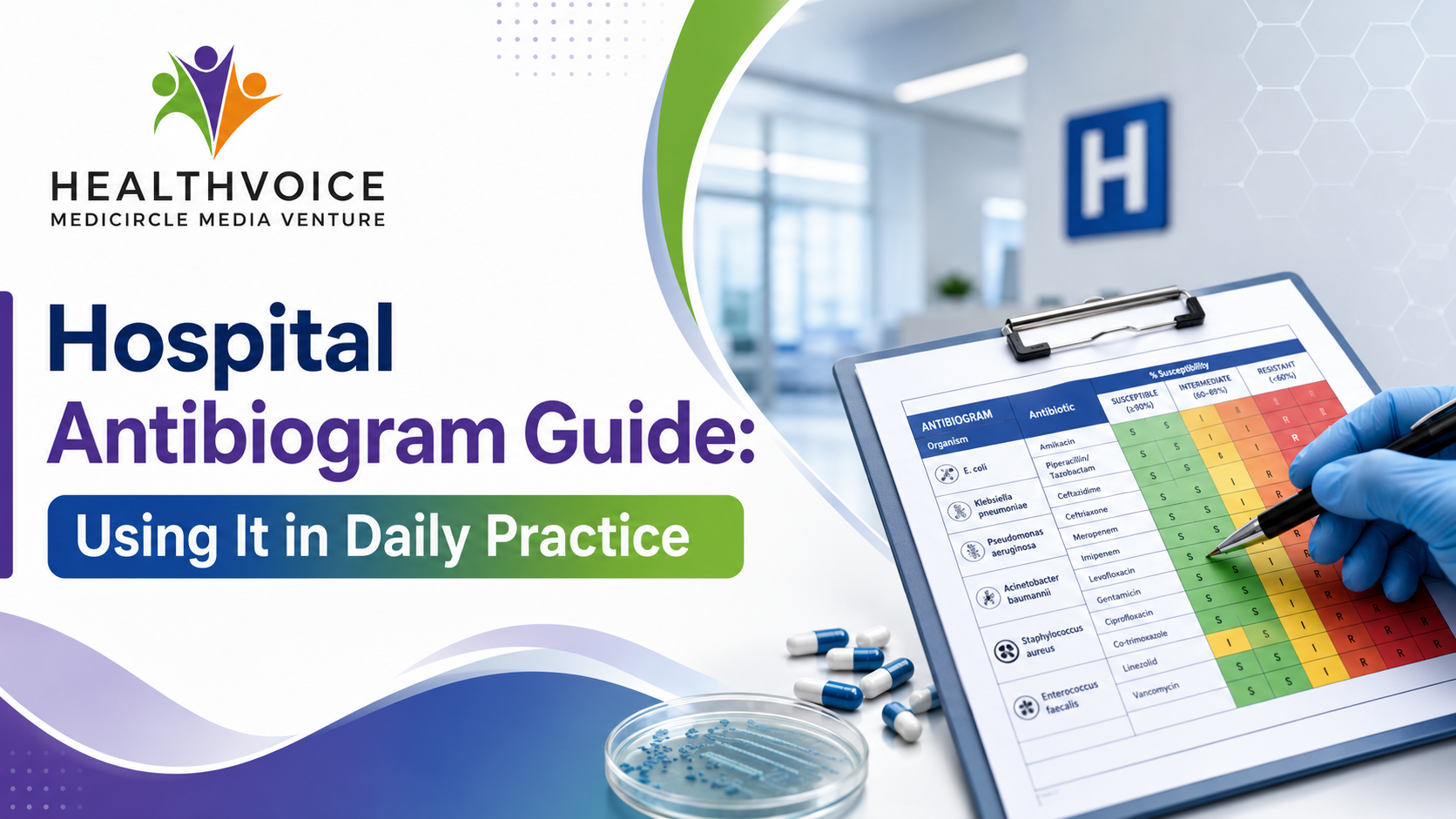
Hospital Antibiogram: How to Use It in Daily Practice
Introduction
Empirical antibiotic therapy decisions are made every day in Indian hospitals before a single culture report comes back from the laboratory. The patient is unwell, the clinical picture suggests an infection, and a decision on antibiotics has to be made within hours, not days. This is precisely the situation a hospital antibiogram is built for. It gives doctors a facility-specific snapshot of which antibiotics are actually working against the organisms commonly found in that hospital, rather than relying on national averages or textbook recommendations that may not reflect local reality.
India carries one of the heaviest burdens of antimicrobial resistance in the world, and this is not a distant statistic. Methicillin-resistant Staphylococcus aureus prevalence in some Indian centres has been reported at levels well above the national average, and surveillance data has shown E. coli susceptibility falling sharply against commonly used agents such as cefotaxime, piperacillin-tazobactam, and ciprofloxacin in recent years. Against this backdrop, the antibiogram is not a document that sits in a microbiology department file. It is a working clinical tool that, when used correctly, directly improves the odds that a patient receives an antibiotic that will actually work the first time.
This article is written for doctors, hospital pharmacists, microbiologists, and healthcare administrators who want a clear, practical understanding of what a hospital antibiogram is, how it is built, and most importantly, how to use it correctly in daily clinical decision making. It also looks at why antibiogram practices in India need stronger standardisation and wider adoption across hospitals of every size, from large tertiary centres in metro cities to district and Tier 2 hospitals.
Understanding the Basics of a Hospital Antibiogram
A hospital antibiogram, also called a cumulative antibiogram or institutional antibiogram, is a periodic report that summarises antimicrobial susceptibility testing results for the bacteria isolated from patients at a given facility over a defined time frame, usually a year. It should not be confused with the susceptibility report a clinician receives for a single patient's individual culture, which reflects one isolate rather than the institution's overall pattern.
Each antibiogram typically lists the organism name, the number of isolates tested, the antibiotics evaluated against that organism, and the percentage of isolates found susceptible to each drug based on standard laboratory breakpoints. These breakpoints are most often defined by the Clinical and Laboratory Standards Institute, known as CLSI, although some Indian laboratories also reference EUCAST breakpoints depending on their testing systems and accreditation requirements under NABH.
Several variations of the antibiogram exist, and recognising the difference matters for correct use:
- Routine or cumulative antibiogram: the standard hospital-wide report compiled from all eligible isolates over the reporting period.
- Abbreviated antibiogram: a simplified version listing only the most clinically relevant organisms and commonly prescribed antibiotics, designed for quick bedside reference.
- Enhanced or syndromic antibiogram: data stratified by infection site, such as urinary isolates only, or by hospital unit, such as the intensive care unit, which often shows different resistance patterns than the hospital-wide average.
- Rolling or real-time antibiogram: built using a moving time window so the data stays current while still maintaining the minimum isolate count needed for statistical reliability.
For an antibiogram to be trustworthy, certain methodological rules need to be followed. CLSI's M39 guidance, now widely regarded as the reference standard, recommends excluding screening cultures such as MRSA or VRE surveillance swabs, counting only the first isolate per patient per period regardless of the result, and requiring a minimum of thirty isolates per organism before that organism's susceptibility percentage is reported. The antibiogram is a report generated from antimicrobial or antifungal susceptibility test results that lists the percentage of organisms isolated that are susceptible to the antimicrobial agents tested, and it typically reflects data from a single facility over a defined period.
Indian hospitals working towards NABH accreditation or aligning with ICMR's National Antimicrobial Resistance Surveillance Network, known as NARS-Net, will find that following these methodological standards also strengthens their broader infection control and antimicrobial stewardship documentation.
Why Antibiograms Matter More in the Indian Context
India's antibiotic resistance situation has specific drivers that make local, facility-level data even more important than it might be elsewhere. Over-the-counter availability of antibiotics, frequent self-medication, variable infection control practices across hospital tiers, and high antibiotic consumption volumes have all contributed to resistance patterns that can shift meaningfully from one institution to the next, even within the same city.
A few points are worth keeping in mind:
- Antibiotic consumption in India rose sharply over the past two decades, and this has been closely linked with rising resistance rates across common pathogens such as E. coli, Klebsiella pneumoniae, and Staphylococcus aureus.
- Resistance patterns can differ significantly between rural and urban centres, and even between two hospitals located close to each other, because case mix, referral patterns, and prior antibiotic exposure of patients vary.
- Multicentric Indian surveillance data have shown clear regional variation, with certain organisms more prevalent in specific zones of the country and high rates of multidrug resistance observed in pathogens such as Klebsiella, Acinetobacter, and Staphylococcus.
This is exactly why a hospital cannot simply borrow another facility's antibiogram, even a well-regarded teaching hospital's data, and apply it to its own empirical prescribing decisions. The antibiogram only works as a clinical tool when it reflects the actual organisms and resistance patterns present in that specific patient population.
How an Antibiogram Is Built: Primary Inputs and Methodology
Building a reliable antibiogram is a collaborative effort that usually involves the microbiology laboratory, the antimicrobial stewardship team, hospital pharmacy, and infection control. The process generally follows these steps.
First, the microbiology laboratory collects susceptibility testing results from all eligible bacterial isolates over the chosen reporting period, typically twelve months. Surveillance and screening cultures are excluded, and duplicate isolates from the same patient are removed so that one patient's repeated cultures do not skew the data.
Second, the data is analysed using either manual methods or, increasingly in well-resourced hospitals, analytical surveillance software. Many Indian institutions participating in NARS-Net use the WHONET platform, a free tool widely adopted for managing microbiology data and generating standardised antibiograms, which also supports integration into national and global resistance surveillance efforts.
Third, the percentage susceptibility for each organism and antibiotic combination is calculated only when the minimum isolate threshold is met. Organisms with fewer than thirty isolates in the period are usually flagged or excluded, since smaller sample sizes produce wider confidence intervals and a less statistically reliable result.
Finally, the report is formatted, reviewed by the antimicrobial stewardship committee, and disseminated. This is the stage many hospitals underinvest in. A technically accurate antibiogram that sits unused in a folder provides no clinical benefit. Dissemination methods that have worked well include posting the antibiogram on the hospital intranet, linking it within the electronic health record, distributing a printed pocket version to physician work areas, and including key figures within institutional treatment protocols and order sets.
How Clinicians Should Read and Apply the Antibiogram
This is the section that matters most for day-to-day practice. An antibiogram is genuinely useful only when read correctly and applied within its limitations.
The general principle most stewardship programmes recommend is straightforward. If an antibiotic shows a resistance rate above twenty percent for a given organism, it should generally be avoided as empirical therapy for serious infections caused by that organism. For critically ill patients, many institutions apply a stricter threshold, avoiding any agent with resistance above five to ten percent. When comparing two reasonable options, both showing acceptable susceptibility, the agent with the higher local susceptibility percentage, combined with an appropriate spectrum, safety profile, and cost, is generally the more rational empirical choice.
A few practical points clinicians should keep in mind when applying antibiogram data:
- Always check the suspected source of infection against any available syndromic or unit-specific antibiogram. An intensive care unit antibiogram can look very different from the hospital-wide figure, particularly for organisms like Pseudomonas aeruginosa and Acinetobacter baumannii.
- Do not select an antibiotic purely because it has the highest susceptibility percentage on paper. The site of infection matters considerably. For instance, nitrofurantoin may show excellent susceptibility for common urinary pathogens, yet it would still be an inappropriate choice for pyelonephritis or systemic infection because it does not achieve adequate tissue concentrations outside the bladder.
- For patients with recent or recurrent infections, the antibiogram becomes less reliable as a sole guide. In these cases, the patient's own prior culture results and antibiotic exposure history usually provide more relevant information than the institutional average.
- Consider the timing of culture collection relative to admission. Standard antibiograms generally do not distinguish between community onset and hospital onset infections, even though resistance patterns for the two can differ substantially.
Limitations Every Prescriber Should Understand
No antibiogram, however well constructed, should be used in isolation. Several limitations are worth keeping in mind so the tool is applied with appropriate clinical judgement rather than treated as an automatic answer.
Antibiograms report susceptibility as a simple percentage and do not capture the underlying minimum inhibitory concentration data. This matters in certain situations, for example, where MIC values close to the breakpoint have been associated with poorer treatment outcomes even though the isolate is technically reported as susceptible. Antibiograms also cannot reliably separate colonising organisms from true pathogens, and culturing practices at a given hospital, such as how frequently uncomplicated infections are cultured at all, can introduce bias into the reported figures. Additionally, antibiograms do not account for patient-specific pharmacological factors such as site of infection, drug penetration, renal or hepatic function, allergy history, or the risk of complications such as Clostridioides difficile infection.
None of this reduces the value of the antibiogram. It simply means the antibiogram should function as one important input within a broader clinical decision, alongside patient history, local infection control data, and the judgment of the treating physician, ideally supported by an antimicrobial stewardship programme where one is available.
Strengthening Antibiogram Use Through Stewardship and Awareness
Even hospitals with a well-prepared antibiogram often struggle with the final and most important step, which is ensuring frontline doctors actually know it exists and use it correctly. Studies among medical residents have repeatedly found that a meaningful proportion either did not know where to access their hospital's antibiogram or did not feel confident applying it to a clinical case. This gap is just as relevant in Indian teaching hospitals, where postgraduate trainees and resident doctors are frequently the first point of empirical prescribing decisions on the ward.
Closing this gap requires a few consistent practices. Antimicrobial stewardship teams should actively educate junior doctors and nursing staff on what the institutional antibiogram shows and how to interpret it, rather than assuming familiarity. Antibiograms should be embedded directly into clinical workflows wherever possible, for instance, linked within order sets in the hospital information system or referenced directly in standard treatment guidelines for common infections. Hospitals without the resources to build a sophisticated in-house antibiogram can still benefit from regional or state-level data, where available through public health departments, as a reasonable interim guide while building local capacity.
This is also where platforms built around doctor communication and association engagement have a meaningful, if understated, role to play. Knowledge sharing between hospitals, professional associations, and individual clinicians about how antibiograms are built, interpreted, and applied helps smaller and Tier 2 city hospitals benefit from the experience of larger institutions, while still respecting that every facility's underlying data remains its own. A connected medical community, where doctors and hospital teams can discuss stewardship practices, ask questions, and share institutional learning, supports exactly the kind of awareness building that antibiogram adoption studies suggest is still lacking in many settings.
Conclusion
A hospital antibiogram is one of the most practical tools available to a prescribing doctor, provided it is built correctly, kept current, and applied with an understanding of its limitations. It will not replace clinical judgement, and it should never be used as a simple lookup table for the antibiotic with the best number on the page. Used well, alongside patient history, infection site, severity of illness, and antimicrobial stewardship input, the antibiogram meaningfully improves the odds of getting empirical therapy right the first time, which matters for patient outcomes and for the slower, larger fight against antimicrobial resistance across Indian healthcare. Hospitals that have not yet built a reliable antibiogram, or that have one sitting unused, have a clear and achievable opportunity to change that, starting with closer collaboration between microbiology, pharmacy, and the clinicians who rely on this data every single day.
Frequently Asked Questions
Q1: What is a hospital antibiogram used for?
A hospital antibiogram summarises the percentage of bacterial isolates at a facility that are susceptible to specific antibiotics over a defined period. Clinicians use it mainly to guide empirical antibiotic selection before culture and sensitivity reports are available, and hospitals use it to track local resistance trends and shape treatment protocols.
Q2: How often should a hospital's antibiogram be updated?
Most hospitals update their cumulative antibiogram annually, in line with Clinical and Laboratory Standards Institute M39 guidance. Larger hospitals, intensive care units, or facilities seeing rapid shifts in resistance may benefit from more frequent or rolling antibiograms updated every six months.
Q3: Can one hospital's antibiogram be used at another hospital?
No. Antibiogram data is facility-specific because patient populations, case mix, infection control practices, and antibiotic usage patterns vary widely between institutions, even within the same city. Borrowing another hospital's antibiogram can lead to inappropriate empirical therapy.
Q4: What is the minimum number of isolates needed for a reliable antibiogram?
CLSI M39 guidance recommends including at least thirty isolates of an organism in a given period before reporting its susceptibility percentage. Fewer isolates widen the statistical confidence interval and reduce the reliability of the reported susceptibility rate.
Q5: Why do antibiograms differ between hospitals in the same city?
Antibiograms differ because each hospital treats a different mix of patients, has different referral patterns, infection control practices, antibiotic formularies, and prior antibiotic exposure among admitted patients. A tertiary care centre handling complex referrals will typically show higher resistance rates than a smaller secondary care hospital.
 Team Healthvoice
#HospitalAntibiogram #AntimicrobialStewardship
