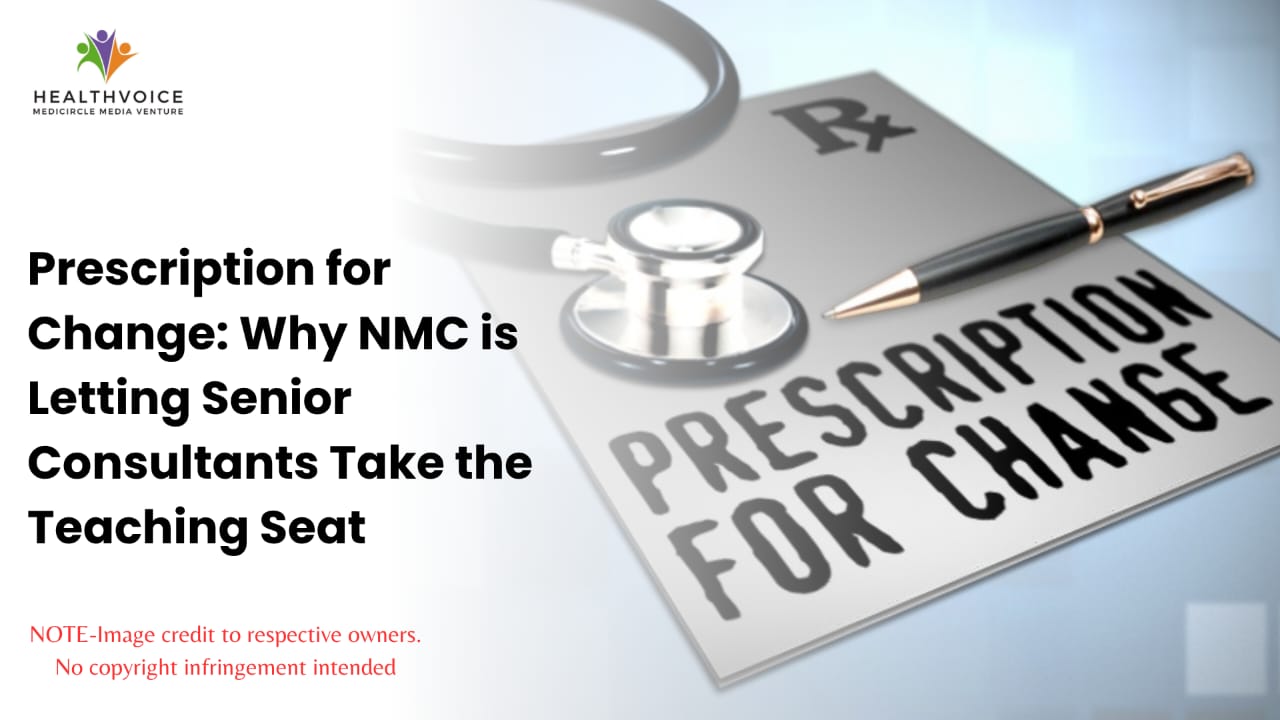
Prescription for Change: Why NMC is Letting Senior Consultants Take the Teaching Seat
The nation’s medical students deserve mentors who embody the full spectrum of medicine, who can teach from textbooks and from the heart of the operating room.
The corridors of India’s medical institutions are witnessing a powerful transformation. Earlier this year, the National Medical Commission (NMC) announced the final Medical Institutions (Qualifications of Faculty) Regulations, 2025, marking one of the most significant shifts in medical academics in recent years. In a move that has stirred intense debate across hospitals and classrooms alike, the NMC declared that senior consultants can now be appointed as faculty in medical colleges. This reform is being seen as both an opportunity to bridge the widening gap in faculty shortage and a bold attempt to integrate clinical expertise into academic teaching.
For decades, the medical education system in India has struggled with a paradox. While hospitals brim with some of the finest clinical minds, medical colleges continue to face faculty shortages that affect both teaching quality and accreditation standards. The 2025 regulations attempt to dissolve this invisible wall between service and academia, allowing experienced consultants to step into classrooms and mentor the next generation of doctors. The NMC’s Postgraduate Medical Education Board (PGMEB) has recently released a detailed FAQ document clarifying the eligibility conditions for doctors aspiring to join medical colleges as senior consultants. These clarifications have brought some structure to what was earlier perceived as a complex reform.
Under the new rule, a consultant or specialist working in an NBEMS-accredited broad or super speciality department of a government institute may be considered for faculty positions if they meet specific qualification and experience criteria prescribed by the National Board of Examinations in Medical Sciences (NBEMS). The intent behind this clause is to ensure that teaching remains in capable and experienced hands. The regulations allow a senior consultant, who is already a postgraduate teacher under NBEMS, to be appointed as a Professor in a recognized medical institution in the same specialty. The only requirement is that they must produce an experience certificate from the government institute where they served as a postgraduate teacher.
What this means in simpler terms is that doctors who have spent years in government hospitals performing complex surgeries, managing critical care units, or leading departments while also guiding postgraduate students can now be absorbed as Professors in medical colleges without starting from scratch. It is a recognition of real-world experience that was often overlooked in traditional academic hierarchies.
The NMC regulations further clarify that any consultant or specialist from an NBEMS-accredited government department running a postgraduate or super speciality teaching program can qualify as a senior consultant if they fulfill the prescribed experience and educational criteria. This move effectively creates a bridge between NBEMS-accredited government hospitals and NMC-regulated medical colleges. It recognizes that patient care and postgraduate training go hand in hand, and those who have excelled in both should have the opportunity to shape medical education formally.
The change comes at a crucial time for India’s healthcare and medical education landscape. The country has seen a rapid expansion in the number of medical colleges over the past decade. New institutions have come up in almost every state, especially in Tier-II and Tier-III cities, in response to the government’s goal of increasing the doctor-to-patient ratio. However, this growth has also created a demand for qualified faculty. Many colleges, especially newly established ones, struggle to meet the faculty norms mandated by NMC. This shortage directly impacts the quality of education, accreditation status, and ultimately the competence of graduating doctors.
By opening the doors for senior consultants to join academics, the NMC hopes to inject new life into the faculty structure. These consultants bring with them years of clinical wisdom, decision-making experience, and a practical understanding of patient care that can significantly enrich the learning experience for students. They represent a generation of practitioners who have seen medicine evolve from paper charts to digital records, from manual surgeries to robotic systems, and from symptomatic treatment to evidence-based precision care.
However, as with any reform, the new rule also comes with its share of concerns and interpretations. Some academic circles argue that while clinical experience is invaluable, teaching in a structured academic setting requires a different skill set. They caution that consultants entering faculty roles must be trained in pedagogy and evaluation methods to ensure consistency in education standards. Others view this as a long-overdue reform that acknowledges the growing role of NBEMS in shaping postgraduate medical education in India.
The National Board of Examinations in Medical Sciences (NBEMS) has, over the years, become a pillar of postgraduate and super speciality training in the country. Its programs have been instrumental in standardizing medical education, particularly in hospitals where traditional university-based programs were not feasible. The new NMC regulations, therefore, represent an alignment of two parallel systems that have been operating for years with overlapping objectives. This collaboration between NMC and NBEMS could eventually lead to a more unified and efficient model of medical education governance.
Another significant aspect of the regulations is the recognition of experience as postgraduate teachers in NBEMS-accredited institutions. According to the NMC’s guidelines, the total years of experience as a postgraduate teacher in such an institution will now be counted as equivalent experience for appointment as Professor in recognized medical colleges. This single clause is being hailed as a practical solution to India’s persistent shortage of senior faculty. It provides a structured pathway for doctors who have contributed to postgraduate teaching in government hospitals to transition into full-fledged academic roles.
For India’s young medical graduates and residents, this reform could mean access to a more diverse and experienced pool of mentors. The presence of senior consultants as faculty can bring more case-based learning, advanced skill demonstrations, and real-world discussions into classrooms and clinical rotations. It could bridge the often-lamented gap between theory and practice that has characterized traditional medical education for years.
Yet, the implementation of this reform will require careful oversight. The eligibility criteria must be applied with transparency to ensure that the quality of faculty appointments remains uncompromised. Experience certificates and documentation should be verified rigorously, and institutions must ensure that the inclusion of senior consultants does not dilute academic accountability. The challenge will lie in balancing inclusivity with excellence.
In the broader picture, this decision by NMC reflects a changing vision for Indian medical education that values applied knowledge as much as academic degrees. It acknowledges that healthcare is evolving faster than textbooks, and the best way to train doctors is to have mentors who are deeply involved in real-time clinical care. It also signifies an increasing shift towards competency-based education, where teaching outcomes matter more than mere designations.
Many healthcare professionals view this reform as a positive step towards integrating India’s fragmented medical education ecosystem. The NBEMS model, which focuses on hands-on training in hospitals, complements the traditional medical college model governed by NMC. By allowing cross-pollination of expertise, India could move closer to a more cohesive and globally competitive system. The change also mirrors global practices, where clinicians actively participate in teaching and research, ensuring that students remain aligned with evolving medical practices.
However, one cannot overlook the challenges that lie ahead. The effectiveness of this policy will depend on its implementation at the institutional level. Colleges will have to adapt their recruitment processes, faculty development programs, and evaluation mechanisms to accommodate this new category of educators. The integration must be seamless to prevent any friction between existing academic staff and newly appointed senior consultants.
Equally important is the question of how these appointments will impact postgraduate training. With senior consultants joining as professors, postgraduate students could gain more structured clinical guidance and exposure. It could also open avenues for collaborative research, as consultants bring rich clinical data and insights from hospital practice that can be translated into academic studies. This synergy between clinical practice and academic research could elevate the standard of Indian medical publications and innovations in the coming years.
From an institutional standpoint, the availability of experienced consultants as eligible faculty could help newly established medical colleges achieve recognition faster. It could also enhance the credibility of departments struggling to meet faculty norms, allowing them to function at full capacity. This reform, therefore, holds the potential to accelerate the expansion of quality medical education without compromising on standards.
The FAQs released by the PGMEB are a step towards ensuring that the policy is understood and applied consistently across institutions. By clearly defining who qualifies as a senior consultant and outlining the required documentation, NMC has attempted to eliminate ambiguity. It is crucial for both administrators and aspirants to familiarize themselves with these clarifications to prevent misinterpretations.
Still, for this system to thrive, it must evolve beyond paperwork. Senior consultants transitioning into academia will need orientation programs in medical education technology, assessment methods, and student engagement. Faculty development initiatives must be expanded to include these professionals so that their vast clinical experience is effectively translated into academic mentorship. This blend of real-world skill and structured teaching could redefine the way future doctors are trained.
The medical fraternity, while welcoming this reform, must also introspect. The goal should not be to merely fill faculty posts but to cultivate educators who inspire confidence, curiosity, and compassion in their students. A senior consultant’s journey from the operating table to the classroom should be guided by purpose, not convenience. Academic leadership in medicine carries immense responsibility, it shapes the values, ethics, and competence of generations of healthcare providers.
As the NMC’s 2025 regulations take root, India stands at a pivotal moment in its medical education journey. The inclusion of senior consultants as faculty members is a philosophical reimagining of what it means to teach medicine. It signals respect for clinical expertise, trust in experience, and belief in integration over isolation.
The real success of this regulation will not be measured in the number of appointments it generates but in the quality of doctors it helps produce. If executed thoughtfully, it could bridge decades of divide between hospitals and colleges, between theory and practice, between learning and healing. The nation’s medical students deserve mentors who embody the full spectrum of medicine, who can teach from textbooks and from the heart of the operating room.
In essence, this reform is a reminder that in medicine, learning never ends. Whether in a ward, a classroom, or a community clinic, the pursuit of knowledge is continuous. The NMC’s new regulation, by welcoming senior consultants into academia, reinforces a timeless truth: the best teachers in medicine are those who never stop being students of life itself.
 Sunny Parayan
#NMC #MedicalEducation #MedicalFaculty #HealthcareReform #MedicalTeaching #DoctorsOfIndia #NMC2025 #MedicalColleges #ClinicalExcellence #AcademicMedicine #FutureOfHealthcare #MedicalPolicy #MedicalTraining #HealthcareTransformation #healthvoice