AI in Pathology: How Digital Slides Transform Diagnosis
Artificial intelligence and digital slide technology are transforming pathology in India by enabling faster, more accurate disease diagnosis and improving access to specialist expertise across geographic boundaries.
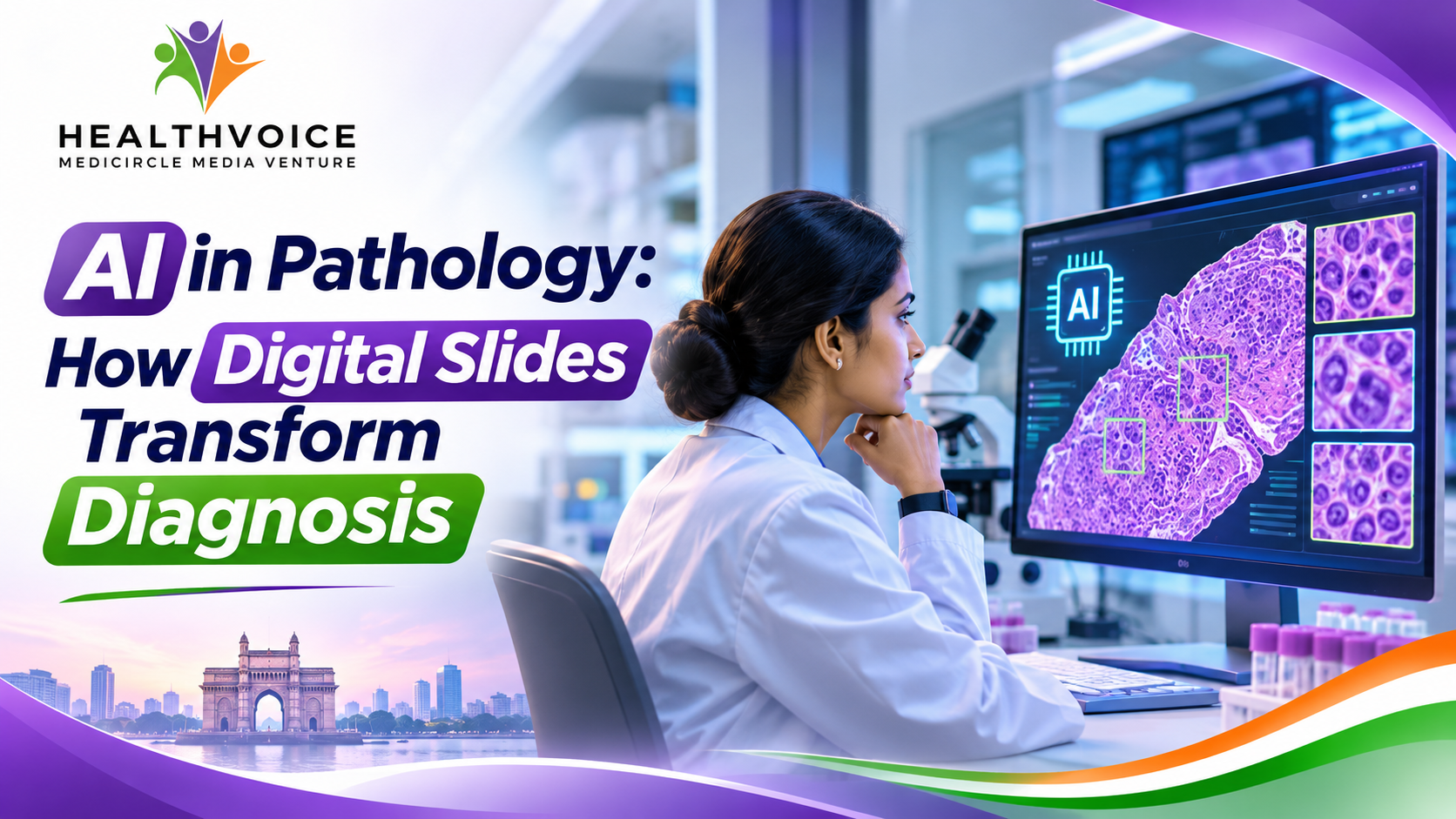
AI in Pathology: How Digital Slides Are Changing Diagnosis in India
Introduction
Pathology has always been the silent backbone of modern medicine. Every cancer diagnosis, every infection confirmation, and every tissue biopsy result passes through the hands of a pathologist before a treatment decision is made. Yet for decades, the tools of pathology remained largely unchanged: a glass slide, a stain, a microscope, and the trained eye of a specialist.
That picture is changing rapidly. Artificial intelligence and digital slide technology are now entering pathology laboratories at a pace that would have seemed extraordinary just a decade ago. Across India and the world, whole slide imaging systems are converting glass slides into high-resolution digital files that AI algorithms can analyze with remarkable precision. The implications for speed, accuracy, accessibility, and healthcare equity are profound.
For a country like India, where the pathologist-to-patient ratio remains critically low and where millions of people in smaller cities and rural areas struggle to access timely diagnostic services, digital pathology powered by AI is not simply a technological upgrade. It is a genuine opportunity to close a long-standing gap in healthcare delivery.
Understanding Digital Pathology and Whole Slide Imaging
Traditional pathology relies on a physical glass slide prepared from a tissue sample. A pathologist examines this slide under a microscope, applying years of training to identify cellular abnormalities. The process is time-consuming, dependent on individual expertise, and limited by geography. A patient in a district hospital in Rajasthan or Odisha may wait days or even weeks for a specialist's report because qualified pathologists are concentrated in major urban centers.
Digital pathology changes this workflow fundamentally. Whole slide imaging, commonly referred to as WSI, is the process of scanning an entire glass slide at high resolution to create a digital image that can be stored, shared, and analyzed on a computer screen. These digital slides, also called virtual slides, preserve the full detail of the original tissue sample and can be viewed at any magnification, shared with any specialist anywhere in the world, and analyzed by AI-powered software.
The resolution of modern WSI scanners is extraordinary. A single digital slide can contain billions of pixels, capturing details at the cellular and sub-cellular level. Pathologists can zoom into any region of interest, annotate findings, and collaborate with colleagues across different hospitals or cities without the slide ever leaving the laboratory.
How Artificial Intelligence Is Reshaping Pathology
The true power of digital pathology is unlocked when AI enters the workflow. Machine learning algorithms, particularly deep learning models trained on tens of thousands of annotated pathology images, can now perform tasks that were once considered exclusively within the domain of human expertise.
AI in computational pathology is currently being applied in several meaningful ways:
- Cancer detection and grading: AI models have demonstrated the ability to detect cancer cells in tissue samples with accuracy that matches or exceeds experienced pathologists in controlled studies. In breast cancer, prostate cancer, colorectal cancer, and lung cancer, AI-assisted analysis is helping pathologists identify malignancies faster and with greater consistency.
- Quantitative analysis: Human visual assessment of features like tumor cell density, mitotic activity, or biomarker expression can be subjective. AI quantifies these features with objective precision, reducing variability between different pathologists reviewing the same slide.
- Rare disease identification: AI systems trained on large datasets can flag patterns associated with rare conditions that a generalist pathologist may encounter infrequently, acting as a support tool that reduces missed diagnoses.
- Workflow prioritization: AI can triage incoming cases by urgency, ensuring that potentially malignant or time-sensitive samples are reviewed first, which is particularly valuable in busy public hospital laboratories.
The Indian Context: Why This Matters More Here
India faces a distinctive challenge in diagnostic pathology. According to available estimates, the country has approximately one pathologist for every 50,000 to 100,000 people in many regions, far below the recommended ratio. The burden of non-communicable diseases, including cancers, diabetes-related complications, and autoimmune conditions, is growing significantly. At the same time, communicable diseases such as tuberculosis, which requires accurate histopathological confirmation in many cases, continue to impose a heavy burden.
Government initiatives including the Ayushman Bharat Digital Mission (ABDM) and the National Health Policy are pushing for a more connected and digitally enabled healthcare ecosystem. Digital pathology aligns directly with this vision. By enabling remote reporting, digital pathology allows a skilled pathologist based in Delhi or Mumbai to review slides from a sample collected in a rural health center in Chhattisgarh or Jharkhand, all within hours.
Several Indian institutions and startups are already making progress in this space. Academic medical centers in Chennai, Hyderabad, and Bengaluru are exploring AI-assisted pathology solutions. Indian healthtech companies are developing algorithms trained specifically on Indian patient populations, which is an important distinction because disease patterns, genetic backgrounds, and tissue characteristics can vary across populations.
The integration of digital pathology with India's growing telemedicine infrastructure creates a compelling model for the future. A technician at a primary health center can prepare and scan a slide, upload the digital image to a cloud platform, and have an AI-assisted preliminary report ready within minutes, with a qualified pathologist reviewing and validating the findings remotely.
Challenges on the Path to Widespread Adoption
Despite the promise, the adoption of digital pathology and AI in Indian laboratories faces real obstacles that require honest acknowledgment.
The cost of whole slide imaging scanners remains a barrier for smaller laboratories and public sector facilities. While prices have been declining, the initial investment, combined with the need for high-bandwidth internet connectivity and digital storage infrastructure, presents a challenge for resource-constrained settings.
Regulatory clarity is still evolving. The Central Drugs Standard Control Organisation (CDSCO) and broader Indian regulatory frameworks are gradually developing guidelines for AI-based medical devices and diagnostic software. Without clear regulatory pathways, hospital administrators and laboratory owners may hesitate to adopt unvalidated tools.
Data privacy and patient consent in digital environments require careful attention. When tissue images are stored and transmitted digitally, robust cybersecurity protocols and clear data governance frameworks become essential.
There is also the matter of training and change management. Pathologists who have spent careers working with microscopes need structured exposure to digital workflows. The Indian Society of Pathology and Bacteriology and other professional bodies have an important role to play in developing continuing medical education programs around digital pathology competencies.
Finally, algorithm bias must be addressed seriously. Many globally available AI pathology tools have been trained predominantly on Western patient datasets. Indian patients may present with disease subtypes, staining characteristics, or population-specific pathological patterns that require locally trained and validated models. Indian hospitals, medical colleges, and research institutions must actively contribute their data to build AI tools that work reliably for Indian populations.
The Future Landscape: Precision Pathology and Beyond
The convergence of digital pathology with genomics, proteomics, and clinical data is pointing toward a future of precision pathology. Rather than simply identifying a tumor, AI-powered systems will increasingly predict how that tumor will respond to specific treatments, estimate patient prognosis, and suggest personalized therapeutic pathways.
Platforms that integrate digital pathology images with molecular diagnostic data, radiology findings, and electronic health records are already being piloted in advanced cancer centers globally. This kind of multi-modal data integration represents the next frontier, one where the pathology report becomes not just a diagnostic document but a comprehensive biological roadmap for treatment decisions.
For India, achieving this future requires a coordinated effort across medical education, healthcare infrastructure, regulatory reform, and industry investment. Platforms such as HealthVoice, which bring together doctors, healthcare leaders, and medical associations, have an important role to play in facilitating this conversation. When pathologists, oncologists, radiologists, and healthcare technologists engage with one another through credible professional communities, the pace of meaningful adoption accelerates.
Conclusion
Artificial intelligence and digital pathology together represent one of the most significant advances in diagnostic medicine in recent decades. By converting glass slides into analyzable digital assets and applying powerful machine learning algorithms to their interpretation, healthcare systems can achieve faster diagnoses, more consistent accuracy, and greater geographic reach.
For India specifically, where diagnostic infrastructure gaps have long limited healthcare outcomes for millions of people, this technology carries transformative potential. The journey from glass to gigabytes is well underway, but realizing its full value will require sustained collaboration between clinicians, technologists, policymakers, and medical professional communities. The laboratory of the future is already taking shape, and Indian pathology is part of that story.
Frequently Asked Questions
Q1: What is digital pathology and how does it differ from traditional pathology?
Digital pathology involves scanning physical tissue slides into high-resolution digital images using whole slide imaging technology. Unlike traditional pathology, where a pathologist examines a glass slide under a microscope in person, digital pathology allows slides to be reviewed on computer screens, shared remotely, and analyzed by AI algorithms, making diagnosis faster and more accessible regardless of location.
Q2: Can AI replace pathologists in diagnosing diseases?
AI in pathology is designed to assist pathologists, not replace them. Current AI tools support tasks such as cancer detection, cell quantification, and slide triage, but final diagnostic decisions require clinical judgment, contextual interpretation, and professional accountability that only a qualified pathologist can provide. AI increases efficiency and reduces error but functions as a decision-support tool.
Q3: Is digital pathology available in India?
Digital pathology is available at select academic medical centers, private hospital networks, and specialized laboratories in Indian cities such as Bengaluru, Hyderabad, Mumbai, and Chennai. Adoption is growing, but widespread availability across smaller cities and rural areas remains a work in progress, partly due to infrastructure and cost considerations.
Q4: How does AI improve cancer diagnosis in pathology?
AI algorithms trained on large annotated datasets can detect cancerous cells, grade tumor severity, quantify biomarker expression, and identify patterns associated with specific cancer subtypes. These capabilities help pathologists work more quickly, reduce diagnostic variability between reviewers, and in some cases identify features that might be missed in routine visual examination.
Q5: What are the main challenges preventing AI adoption in Indian pathology laboratories?
The primary challenges include the high cost of whole slide imaging equipment, limited high-speed internet connectivity in smaller laboratories, evolving regulatory frameworks for AI-based diagnostics, the need for AI models trained on Indian patient data, and the requirement for structured training programs to help practicing pathologists transition to digital workflows.
Resources
- Indian Council of Medical Research (ICMR): Guidelines and research publications on emerging diagnostics and healthcare technology in India
- World Health Organization (WHO): Global reports on pathology workforce gaps, cancer diagnostics, and health system strengthening
- PubMed, National Library of Medicine: Peer-reviewed research on computational pathology, whole slide imaging, and AI-assisted diagnosis
- Ayushman Bharat Digital Mission (ABDM): Official framework and updates on India's national digital health infrastructure and telemedicine integration
- Ministry of Health and Family Welfare, Government of India: Policy documents and national health program updates relevant to diagnostic services and healthcare technology
Interlinking Keywords
AI in pathology India, digital pathology, whole slide imaging, computational pathology, AI diagnostics, pathology automation, cancer diagnosis AI, telemedicine and pathology, ABDM digital health, precision medicine India
Last reviewed by:
Dr. Manthan Tripathi, HealthVoice Editorial and Medical Advisory Team, November 10, 2026.
Disclaimer
The information presented in this article is intended for general awareness and educational purposes only. It does not constitute medical advice, clinical guidance, or a substitute for professional medical consultation. Readers are advised to consult a qualified medical professional or pathologist for any diagnostic concerns or health-related decisions. HealthVoice does not endorse any specific AI platform, diagnostic tool, or laboratory service mentioned or implied in this article.
 Dr. Manthan Tripathi
#AIinPathology #DigitalPathology