Best Healthcare Careers For Students Interested In Technology (2026 Guide)
The rapid convergence of healthcare and technology is reshaping career opportunities, creating strong demand for professionals who can bridge medical knowledge and digital innovation. With AI, EHR systems, data analytics, and wearable technologies transforming patient care, health-tech careers offer a unique combination of job security, high earning potential, and meaningful impact in the modern healthcare ecosystem.
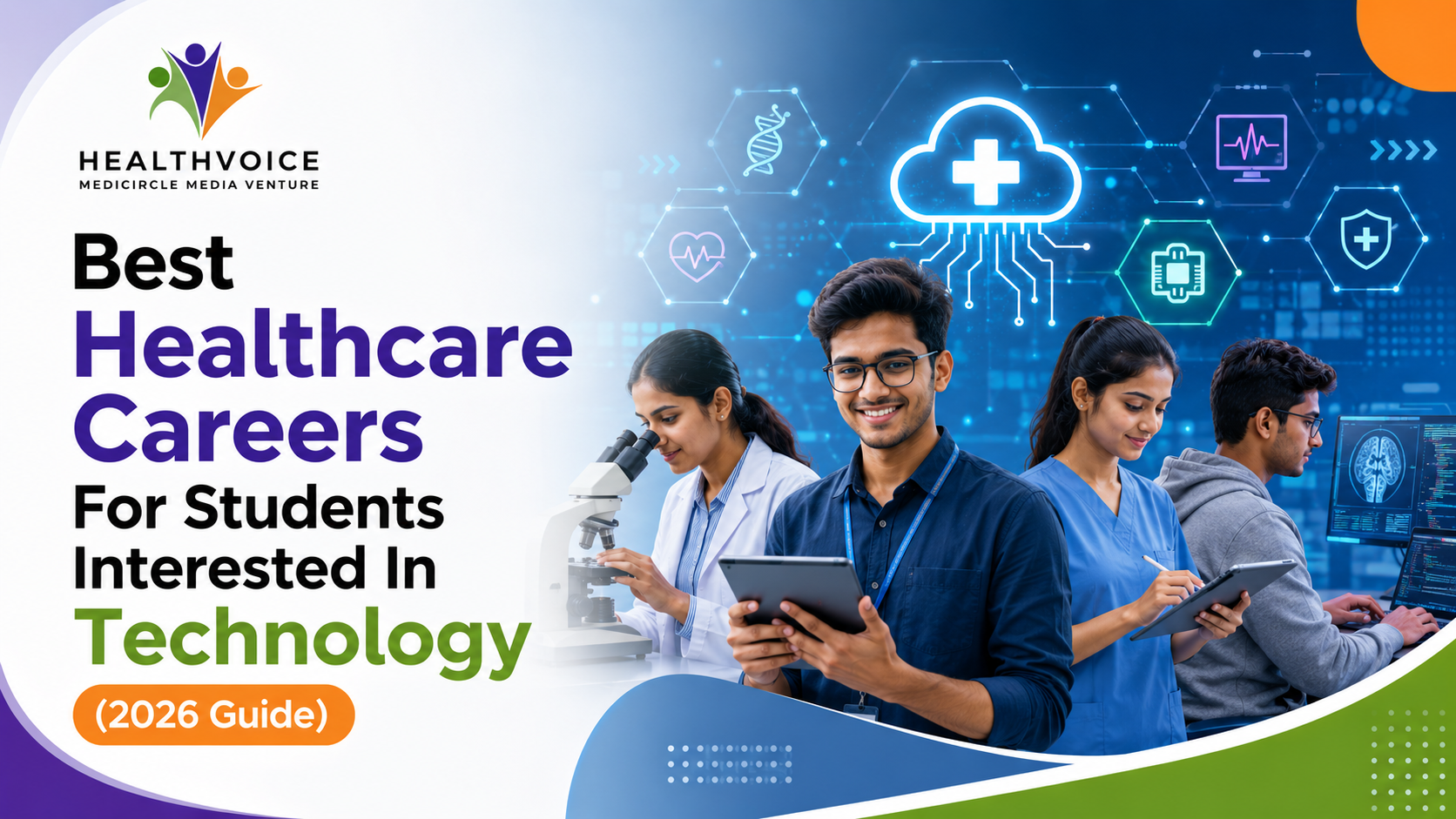
Best Healthcare Careers For Students Interested In Technology
The division between technology sectors and hospital systems has completely collapsed. Historically, choosing a career path required students to make a definitive compromise: follow the biological sciences into traditional bedside medicine or pursue engineering and computer applications in corporate tech parks.
In 2026, that traditional compromise is entirely obsolete. Driven by algorithmic patient screening, cloud-based Electronic Health Record (EHR) systems, ambient speech recognition, and wearable biometric monitoring, the global health-tech economy is expanding rapidly. This digital evolution has created a massive market demand for "Healthcare Translators"—professionals who possess the unique capability to operate at the high-stakes intersection of human biology and digital engineering. For students fascinated by programming, data analytics, or hardware innovation, the medical sector offers some of the highest-paying, most stable, and deeply rewarding career pathways available today.
The Tech-Medicine Integration Layer
Modern clinical environments function like massive digital networks, transforming how raw biological indicators are captured, securely moved, and translated into life-saving operational insights.
Plaintext
[ HUMAN BIOLOGICAL LAYER ]
│
▼ (Real-time Physical Biometrics)
[ DATA INTEGRATION & INTEROPERABLE GATEWAYS ]
│
┌────────────┴────────────┐
▼ ▼
[ TECH PLATFORM FRONTIERS ] [ ADVANCED HARDWARE LAYOUTS ]
- Healthcare Data Science • Biomedical Engineering
- Health Informatics Labs • Medical Imaging Systems
- Algorithmic AI Auditing • Robotic Surgical Controls
Top Tech-Driven Healthcare Career Pathways
Students looking to maximize their future marketability can target several prominent, high-growth sectors where technology directly drives modern patient recovery metrics.
- Healthcare Data Scientist & AI Engineer
Hospitals and global pharmaceutical hubs generate petabytes of raw data daily from clinical trials, electronic logs, and genomic sequencing. Healthcare data scientists build and deploy complex machine learning algorithms and predictive analytics models to make sense of this information.
- The Strategic Focus: Anticipating local disease outbreaks, accelerating drug discovery timelines, and helping doctors design hyper-personalized precision oncology treatments.
- Primary Tech Toolbox: Python or R programming logic, relational databases, neural network modeling, and statistical predictive software.
- Health Informatics Specialist
Health informatics analysts serve as the foundational system architects of modern medical complexes. Their job is to ensure that different high-volume software programs can communicate seamlessly with one another while maintaining absolute information integrity.
- The Strategic Focus: Designing and configuring secure electronic health record (EHR) pipelines, managing health data exchange standards, and ensuring smooth information flow between pharmacies, labs, and surgical suites.
- Primary Tech Toolbox: Standardized data transfer APIs, database architecture mapping, and platform-specific configurations (such as Epic or Cerner).
- Healthcare AI Safety Auditor
As hospitals rapidly adopt artificial intelligence engines to analyze patient scans and pre-sort triage files, a vital need has emerged for human-in-the-loop compliance oversight. AI tools are prone to operational glitches, code flaws, or data bias.
- The Strategic Focus: Conducting systematic quality audits on clinical algorithms to verify that automated outputs match established medical guidelines, ensuring data security compliance, and mitigating legal risks.
- Primary Tech Toolbox: Algorithmic transparency tracking tools, risk-assessment frameworks, and legal compliance registries.
- Biomedical Engineer
If your interests lean more toward physical hardware, engineering prototyping, and machine building rather than pure software coding, biomedical engineering is a premier pathway.
- The Strategic Focus: Designing, building, and testing next-generation clinical devices, such as robotic surgical arms, artificial organs, biometric wearable sensors, and bionic prosthetic limb systems.
- Primary Tech Toolbox: Computer-Aided Design (CAD) modeling software, 3D printing applications, materials stress analyzers, and micro-electronics engineering.
Comparative Blueprint: Tech-Medical Core Tracks
The table below contrasts key features of these distinct technology-driven professions to help you align your academic pursuits with your career goals.
Specialized Career Track
Target Study Timeline
Core Day-to-Day Sandbox
Primary Operational Value
Healthcare Data Scientist
4 to 6 Years
Predictive code repositories, cloud data warehouses
Uncovers hidden clinical trends to enable early disease intervention
Health Informatics Analyst
3 to 4 Years
Relational databases, hospital system networks
Unifies disparate software platforms into a secure ecosystem
AI Safety Auditor
3 to 5 Years
Compliance logs, algorithm monitoring suites
Eliminates algorithmic machine errors to protect patient safety
Biomedical Engineer
4 Years
Prototyping labs, device testing facilities
Creates next-generation life-saving hardware and prosthetics
Medical Imaging Specialist
3 to 4 Years
High-tech scanning rooms, MRI suites
Captures diagnostic-grade internal maps of human anatomy
Actionable Strategy: Your Health-Tech Career Blueprint
- Select Your Tech Domain Early: Meticulously analyze your strengths. Determine whether you prefer working in a digital cloud environment with lines of code and statistics (Data Science, Informatics) or with physical mechanics, electronics, and materials troubleshooting (Biomedical Engineering, Radiologic Technology).
- Prioritize Accredited Professional Credentials: Do not rely solely on generalist tech degrees to clear automated applicant tracking systems (ATS). Update your resume with focused, industry-recognized certificates covering health data privacy regulations, advanced clinical data management, or specialized post-graduate diplomas in intelligent healthcare systems.
- Build Absolute Technical Security Discipline: Modern healthcare technology is a primary target for sophisticated ransomware and cyberattacks. Stand out in interviews by demonstrating flawless commitment to strict data privacy standards and robust multi-factor authentication (MFA) protocols to show you are a low-risk, compliant asset.
Frequently Asked Questions (FAQs)
Q1. Can students without a biology background get into these tech-driven healthcare careers?
Yes, absolutely. Hospital tech hubs and pharmaceutical corporations face consistent shortages of software developers, data scientists, and systems analysts. If your background is in computer science or mathematics, you can smoothly transition into medicine by pursuing short-term certificates covering clinical workflows, medical terminology, and health regulations.
Q2. Is a formal MBBS or nursing degree required to work in Health Informatics?
No. Health informatics is a specialized systems engineering and administrative track. While you work closely with clinicians, your primary training revolves around information architecture, cloud database management, and network security. You do not need a clinical medical license to practice informatics.
Q3. What is a "Digital Scribe" or "Documentation Editor" position?
As hospitals implement ambient AI tools that listen to live doctor-patient consultations and auto-draft clinical notes, a massive need has emerged for human editors. Documentation editors review, audit, and refine the automated transcripts asynchronously from a remote setup, ensuring absolute syntax and clinical data accuracy.
Q4. Are tech-focused medical careers safe from being replaced by AI automation?
Yes, exceptionally safe. AI functions as an efficient co-pilot that automates high-volume, repetitive clerical tasks. However, software lacks human critical thinking, ethical evaluation, and complex clinical judgment. The expansion of technology has actually increased the market demand for skilled human professionals who know how to operate, train, audit, and validate these automated systems safely.
Q5. What are the baseline starting salary packages for fresh healthcare data analysts in India?
Entry-level Clinical Data Analysts or Reporting Associates typically command starting salary packages ranging from ₹4.0 to ₹6.5 Lakhs per annum across premier private hospital chains and global clinical research organizations (CROs). This field offers an accelerated career trajectory into lucrative senior director tracks.
Q6. Do these technical healthcare positions allow for remote or work-from-home schedules?
It depends on the hardware requirements. Software-driven tracks—such as Clinical Data Management, Health Informatics Analysis, and Medical Coding Auditing—revolve entirely around processing cloud-based digital data and are highly compatible with hybrid or fully remote, work-from-home corporate operations.
Q7. What exactly is "Telehealth Platform Engineering"?
Telehealth platform engineers design, scale, and secure the digital infrastructure required to conduct remote medical operations. They build user-friendly mobile health apps, engineer secure real-time video consult gateways, and build backend systems that seamlessly route digital prescriptions directly to local pharmacies.
Q8. What is a "Digital Twin" in healthcare technology systems?
A Digital Twin is an advanced, virtual computer model of a patient’s unique anatomy, physiology, or genetic profile. Built using data from MRIs and wearable devices, it allows surgeons and data engineers to run complex virtual simulations to see exactly how a patient's body will react to a treatment before performing a real procedure.
Q9. Why do health-tech employers place so much emphasis on data privacy regulations during interviews?
Medical records are highly sensitive and heavily protected by global legal frameworks. Since system breaches can trigger massive financial and statutory penalties for an institution, interview panels place an absolute premium on candidates who demonstrate total data safety literacy and a strict commitment to digital security protocols.
Q10. How can a student best showcase their readiness for a health-tech job during an interview?
Avoid generic catchphrases like "good at computers." Instead, build a dedicated "Technical Core Competencies" section on your resume. Explicitly name the specific electronic systems, programming languages, or interactive data dashboards (like Power BI or Tableau) you are certified to operate, and connect your training directly to measurable operational outcomes.
 Team Healthvoice
#HealthTechCareers #HealthcareJobs
