From Research to Policy: How Healthcare Change Happens in India
This article explores how medical research translates into healthcare policy in India, examining the key stakeholders, systemic barriers, success pathways, and the growing role of medical communities in driving evidence-based change.
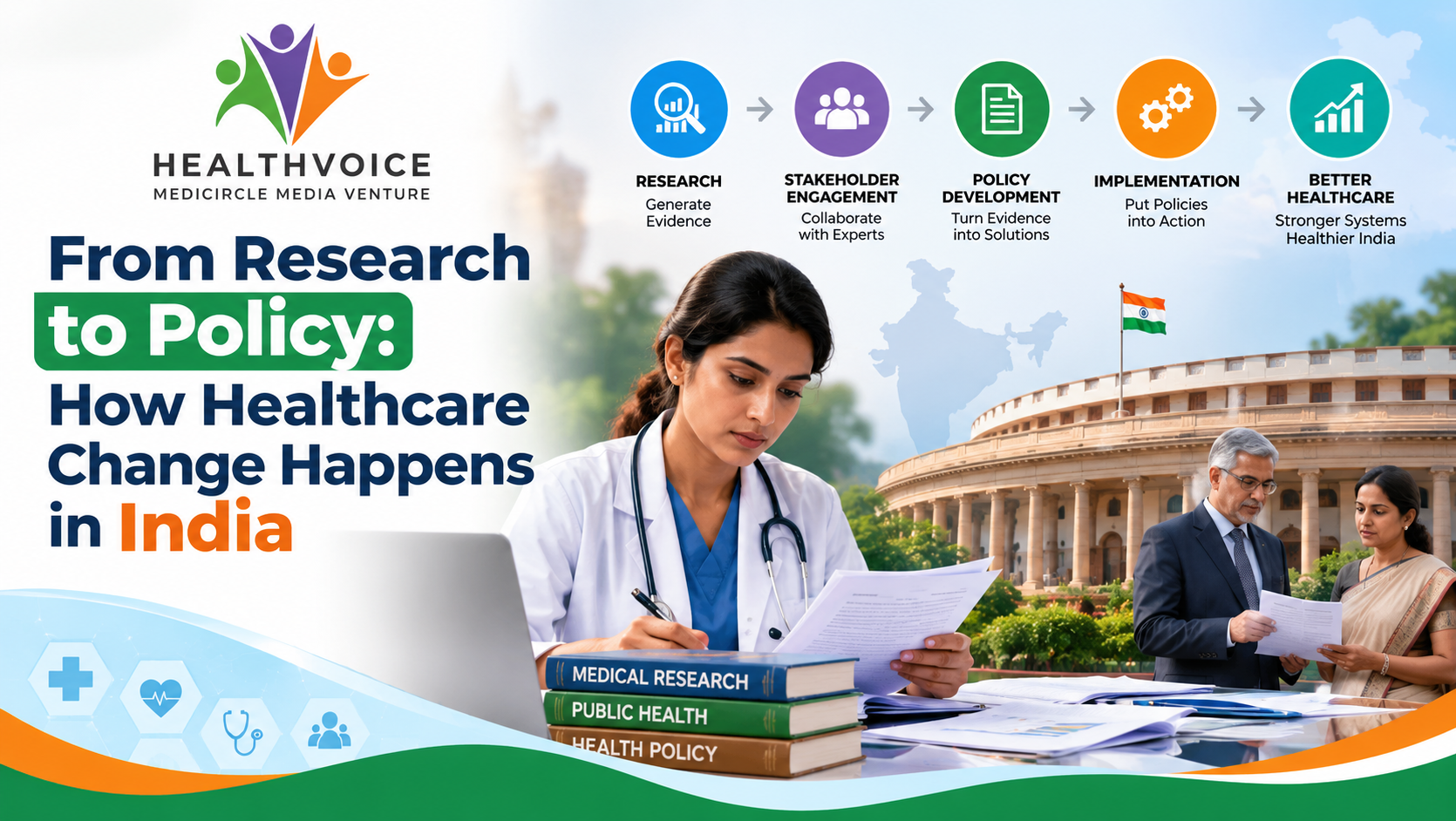
From Research Paper to Healthcare Policy: How Does Change Happen?
Introduction
A groundbreaking research paper is published. It reveals a more effective treatment protocol, a preventable disease burden, or a critical gap in public health delivery. And yet, for years, sometimes decades, the system continues operating exactly as it did before. This is not a failure of science. It is a reflection of how complex, multi-layered, and deeply political the journey from research evidence to healthcare policy truly is.
In India, this challenge carries enormous weight. With a population exceeding 1.4 billion, a diverse disease burden spanning communicable and non-communicable conditions, and a healthcare system that serves both urban hospitals and remote primary health centers, the stakes of evidence-to-policy translation could not be higher. Understanding how change happens, who drives it, what slows it down, and what accelerates it is essential for every doctor, researcher, association leader, and healthcare stakeholder who wants their work to make a lasting difference.
Understanding the Research-to-Policy Pathway
At its core, the journey from a research paper to a working healthcare policy follows a recognizable pathway, even if the timeline and obstacles along the way differ significantly from one issue to another.
It begins with evidence generation. Researchers, often working within academic medical institutions, public health universities, or bodies like the Indian Council of Medical Research (ICMR), identify a problem and design studies to understand it. These studies go through peer review, are published in credible journals, and enter the academic discourse. However, publication alone does not create change.
The next critical phase is evidence synthesis. A single paper, no matter how well designed, rarely moves a policy. What policymakers need is a body of evidence, systematic reviews, meta-analyses, and consistent findings across different settings and populations. In India, institutions like ICMR, the All India Institute of Medical Sciences (AIIMS), the Public Health Foundation of India (PHFI), and various state-level public health departments play a role in synthesizing this evidence into something policymakers can act on.
After synthesis comes advocacy and communication. This is where many well-researched findings stall. Researchers are trained to write for academic audiences. Policymakers need brief, clear, actionable evidence summaries. The absence of a strong bridge between these two worlds has historically been one of India's most significant gaps in health system reform.
Key Stakeholders Who Shape Healthcare Policy in India
Healthcare policy change in India does not emerge from a single source. It is the result of sustained engagement across a broad network of stakeholders, each playing a distinct role.
The Ministry of Health and Family Welfare (MoHFW) sits at the center of national health policy. It drafts, approves, and implements national programs, protocols, and legislative frameworks. The National Health Policy, last revised in 2017, and major flagship initiatives like Ayushman Bharat and the Pradhan Mantri Jan Arogya Yojana (PMJAY) emerge from this ministry, guided by political priorities, fiscal planning, and, increasingly, research evidence.
ICMR functions as India's apex biomedical research body. Its guidelines on disease management, vaccination schedules, drug safety, and clinical practice carry significant authority and often serve as direct inputs into national health programs. ICMR's role in COVID-19 policy during 2020 and 2021 brought this function into sharp public focus.
NITI Aayog, though not a health body in the traditional sense, has become an important influence on health policy through its Health Index reports, state-level assessments, and its work on the National Digital Health Mission and ABDM (Ayushman Bharat Digital Mission). NITI Aayog's research-backed recommendations carry weight in national planning discussions.
The National Medical Commission (NMC) regulates medical education and clinical practice standards. When research reveals gaps in how doctors are trained or how specific conditions are managed, the NMC's curriculum and competency frameworks become important levers for change.
Medical associations, including national bodies and specialty societies, occupy a uniquely influential position. They serve as the voice of the medical profession and can advocate collectively for evidence-based policy changes. When associations formally endorse a guideline or call for policy reform, they signal professional consensus to policymakers, which carries meaningful weight in government consultations.
Civil society organizations, patient advocacy groups, and public health NGOs also contribute to the policy ecosystem, particularly in areas involving preventive care, reproductive health, mental health, and access to medicines for underserved populations.
How Evidence Moves Through the System
The actual mechanics of policy change in India tend to follow certain recognizable patterns, even though no two policy reforms are identical.
One common pathway is through expert committees. The Ministry of Health or ICMR convenes technical working groups comprising specialists, public health professionals, and administrators. These committees review the available evidence, consult stakeholders, and produce recommendations that form the basis of revised national guidelines or program modifications.
Another pathway is through crisis response. Significant public health events, whether a disease outbreak, a rise in maternal mortality in a specific state, or a drug resistance emergency, tend to accelerate evidence-to-policy translation because the urgency forces faster consensus-building. India's response to tuberculosis, with the Revised National TB Control Programme (RNTCP) and its evolution into the National TB Elimination Programme (NTEP), is an example of research and crisis together driving sustained policy change.
Advocacy and public discourse also serve as a pathway. When a research finding gains media coverage, is taken up by medical associations, or is amplified through professional platforms and public forums, it creates social pressure for policy response. This kind of advocacy-driven policy change often involves a coalition of researchers, clinicians, and community voices working together over an extended period.
Lastly, international guidance from bodies like the World Health Organization (WHO) plays a significant role in India's policy environment. India often adapts WHO guidelines to its local context, and ICMR frequently cross-references global evidence when framing national recommendations.
The Barriers That Slow Change
For all the pathways that exist, the reality is that translating research into policy in India remains slow, difficult, and often incomplete. Understanding the barriers is as important as understanding the process.
The most frequently cited barrier is the disconnect between researchers and policymakers. Researchers often do not know how to communicate with government offices. Policymakers often do not have the time or tools to engage with dense academic literature. Without active knowledge brokers sitting between these worlds, strong evidence can languish unnoticed for years.
Political economy is another major factor. Healthcare policy decisions are not made in a vacuum. They are shaped by budget constraints, state-versus-centre dynamics, electoral considerations, pharmaceutical industry interests, and competing bureaucratic priorities. A research paper that challenges an existing program or recommends a costly new intervention faces significant institutional resistance, regardless of the quality of its evidence.
Capacity gaps within the health system also slow implementation even after a policy is formally adopted. A guideline may be updated at the national level, but if district health officers are not trained, if diagnostics are not available, or if the supply chain cannot support the new protocol, the policy change remains largely theoretical.
In India specifically, the heterogeneity across states creates additional complexity. A policy that works in Kerala, with its relatively robust primary healthcare infrastructure, may require substantial adaptation before it is viable in Bihar or Chhattisgarh. Evidence gathered in one region does not always translate cleanly to national policy without accounting for this variation.
What Accelerates Change: Lessons from Indian Healthcare
Despite these challenges, India has examples where research-to-policy translation has succeeded, and these examples offer important lessons.
The evidence for zinc supplementation in managing childhood diarrhea took years to build but eventually became part of India's Integrated Management of Neonatal and Childhood Illness (IMNCI) program. The process worked because:
- Research bodies like ICMR produced high-quality evidence relevant to the Indian context
- International validation from WHO aligned with domestic findings
- Pediatric medical associations advocated consistently for clinical protocol changes
- Health ministry officials were engaged early in translating evidence into training materials
The polio eradication effort similarly succeeded not just because of the oral polio vaccine's efficacy, but because of relentless evidence-based advocacy, political will, international support, and community-level implementation working in concert.
These examples point to a clear pattern: policy change accelerates when evidence is strong and context-specific, when medical professionals advocate actively, when political leadership sees alignment between the evidence and their policy goals, and when implementation infrastructure is addressed as part of the policy design, not as an afterthought.
The Role of Digital Infrastructure and Platforms in Modern Policy Advocacy
In recent years, digital infrastructure has emerged as a meaningful accelerator of research-to-policy dialogue in India. The ABDM platform is creating a data-rich environment where real-world health information can be aggregated, analyzed, and used to refine program design. The integration of telemedicine, electronic health records, and digital pharmacy networks under the National Digital Health Mission is gradually creating feedback loops between service delivery and policy planning.
Beyond government infrastructure, professional digital platforms are changing how doctors, researchers, and association leaders communicate, collaborate, and advocate. When medical communities can share research findings, discuss clinical implications, and coordinate their voices efficiently, the collective advocacy they can produce becomes more organized, more timely, and more impactful. Platforms designed specifically for the medical community, such as HealthVoice, serve this function by enabling doctors and medical associations to share expert perspectives, highlight emerging evidence, and strengthen the professional discourse that ultimately feeds into policy conversations.
The Path Forward for India's Health Policy Ecosystem
India's research-to-policy challenge is real, but it is also solvable. Several directions are worth prioritizing.
First, investment in knowledge translation as a professional discipline is needed. Universities and public health institutions should train researchers not just to publish, but to communicate with policymakers, media, and communities. Similarly, health ministry officials need structured exposure to research literacy.
Second, formal mechanisms for research-policy dialogue should be institutionalized. Expert advisory panels, policy research units embedded within the ministry, and mandated evidence review processes can reduce the dependence on informal networks and individual champions.
Third, medical associations need to more systematically translate research findings into policy positions and advocacy priorities. When a specialty society publishes a clinical guideline, it should accompany that guideline with clear recommendations addressed directly to policymakers, not just to clinicians.
Fourth, India's state-level health departments need research translation support. Creating regional knowledge hubs that synthesize evidence relevant to local disease burdens and health system conditions could dramatically improve state-level policy responsiveness.
Finally, digital platforms that connect the medical community and amplify credible expert voices have a meaningful role to play. The more organized and visible the voice of India's medical profession, the harder it becomes for policymakers to ignore the evidence that community represents.
Conclusion
The distance between a research paper and a healthcare policy is long, and it is rarely crossed by evidence alone. It requires sustained advocacy, institutional commitment, political alignment, community engagement, and the collective voice of medical professionals working with purpose and coordination. In a country as complex and consequential as India, closing this gap is not just an academic aspiration. It is a public health imperative.
Every doctor who shares their clinical insights, every medical association that takes an evidence-based position, and every healthcare platform that amplifies credible medical voices contributes, in ways both visible and subtle, to the larger project of making Indian healthcare more responsive, more equitable, and more grounded in what the evidence actually says.
Frequently Asked Questions
Q1: How does medical research become healthcare policy in India?
Medical research becomes healthcare policy through a structured but often lengthy process that involves generating robust evidence, synthesizing it through bodies like ICMR, engaging expert committees, consulting stakeholders across government and civil society, and finally issuing formal guidelines or program revisions through the Ministry of Health and Family Welfare.
Q2: What is the role of ICMR in shaping health policy in India?
ICMR serves as India's apex biomedical research body and plays a central role in producing evidence, synthesizing findings, and providing technical inputs to the Ministry of Health. Its published guidelines and recommendations often directly inform national health programs, drug approval processes, and clinical management protocols.
Q3: How long does it take for a research finding to become public health policy in India?
The timeline varies considerably. In urgent public health situations, such as an emerging infectious disease outbreak, evidence can influence policy within months. For chronic disease management, nutrition programs, or systemic health reforms, the process can span many years or even decades, depending on the complexity of the evidence and the degree of institutional readiness.
Q4: What are the main barriers to research-to-policy translation in India?
The key barriers include a persistent communication gap between researchers and policymakers, limited capacity for evidence synthesis within health ministries, political economy considerations that resist change, budget and supply-chain constraints that affect implementation, and significant variation across states in health infrastructure and disease burden.
Q5: What role do doctors and medical associations play in healthcare policy change?
Doctors and medical associations are critical actors in the policy ecosystem. They provide clinical credibility to research findings, advocate for evidence-based changes through formal and informal channels, represent the practitioner perspective in government consultations, and help translate new guidelines into clinical practice through professional networks and continuing medical education.
Resources
- Indian Council of Medical Research (ICMR): India's apex biomedical research body, publisher of national health guidelines and policy-relevant clinical evidence.
- Ministry of Health and Family Welfare, Government of India: The nodal ministry responsible for national health policy, program implementation, and legislative frameworks governing Indian healthcare.
- World Health Organization India Country Office: Provides international evidence, technical assistance, and policy guidance relevant to India's public health priorities.
- Public Health Foundation of India (PHFI): A leading institution for public health research, training, and policy advocacy in India.
- NITI Aayog Health Division: Publishes the annual Health Index and provides research-backed policy recommendations relevant to health system strengthening across Indian states.
Interlinking Keywords
healthcare policy India, research to policy translation, evidence-based healthcare India, ICMR guidelines, medical research policy, public health policy India, healthcare advocacy India, ABDM digital health, medical associations India, health system reform India
Last reviewed by:
Dr. Manthan Tripathi, HealthVoice Editorial and Medical Advisory Team, October 24, 2026.
Disclaimer
The information presented in this article is intended for general awareness and professional education purposes only. It does not constitute formal legal, regulatory, or policy advice. Readers are encouraged to consult primary sources, including official government publications and recognized medical bodies, for authoritative guidance on healthcare policy matters. HealthVoice does not claim any affiliation with government health authorities unless explicitly stated.
 Dr. Manthan Tripathi
\#HealthcarePolicyIndia #HealthcareResearchImpact