Public-Private Partnerships in Healthcare: Boon or Bane for Patients?
Public-private partnerships can strengthen healthcare by expanding infrastructure, specialist access, diagnostics, and service efficiency. However, their success depends on strong regulation, affordable care, protected free-bed quotas, transparent pricing, and effective government oversight.
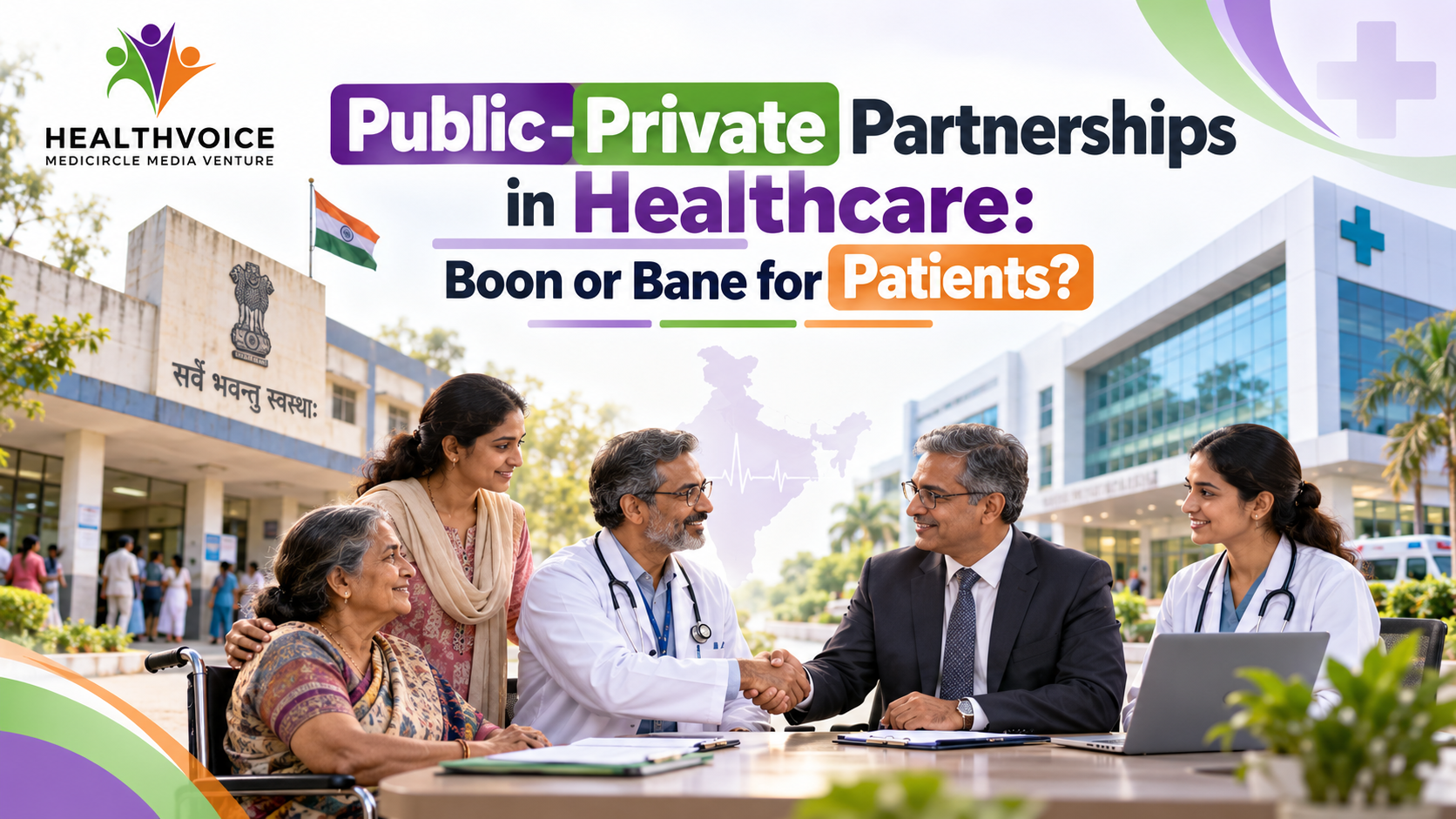
Public-Private Partnerships (PPP) in Healthcare: Boon or Bane for the Common Man?
The delivery of universal healthcare in developing economies faces an ongoing structural challenge. While public health policy envisions comprehensive, cost-free medical coverage for all citizens, the operational reality on the ground frequently involves overcrowded government facilities, lengthy waiting times for specialized interventions, and severe shortages of medical specialists, advanced diagnostics, and operating theatre capacity.
To bridge this operational deficit, governments have increasingly turned to Public-Private Partnerships (PPPs). Supported by initiatives under the National Health Policy and backed by Viability Gap Funding (VGF) frameworks, states are entering long-term concession agreements with private consortiums to build, equip, and operate district hospitals, specialized hemodialysis wings, oncology hubs, and newly planned medical colleges.
For the common man—particularly low-income households and daily-wage earners—this shifting model introduces a complex balance of benefits and risks. While a PPP can deploy advanced medical technology (such as 128-slice CT scanners, 1.5T MRIs, and linear accelerators) into underserved tier-2 and tier-3 districts within months, it also risks transitioning historically free public healthcare into commercial, fee-based spaces.
Evaluating whether healthcare PPPs serve as an outright blessing or an economic burden requires examining their direct impact on out-of-pocket expenditure (OOPE), subsidized bed protections, medical education affordability, and regulatory enforcement.
1. The Operational Divide: Infrastructure Boon vs. Commercial Risk
The structural impact of private capital in public health facilities presents two competing dynamics:
- The Boon: Capital Infusion, Diagnostic Modernization, and Clinical Uptime:
- Addressing the Capital Gap: Modernizing a tertiary district hospital requires substantial upfront capital expenditure. Through Viability Gap Funding (VGF), the central and state governments provide capital grants (often up to 40% to 60% of total project costs), while the private concessionaire finances the remaining infrastructure, medical equipment, and administrative systems.
- High-Uptime Clinical Networks: Private operators establish strict service-level agreements (SLAs), ensuring high uptime for complex biomedical machinery. Under the Pradhan Mantri National Dialysis Programme (PMNDP), over 900 functional dialysis centers operate under PPP models across states, delivering millions of life-saving, cashless hemodialysis sessions to patients who previously had to travel to major metropolitan hubs.
- Expanded Specialized Bed Availability: Structured concession agreements have added thousands of multi-specialty and critical care beds to rural and semi-urban health grids.
- The Bane: Commercial Creep, Medical Inflation, and Out-of-Pocket Strain:
- The Inherent Profit-Public Mission Conflict: While government mandates focus on equitable public welfare, private operators require financial returns to service debt and maintain operations. In several states, transferring district facilities has led to the introduction of tiered user charges or shifting patients toward paid diagnostic services.
- Medical Inflation Compounding: With annual medical inflation tracking between 12% and 14%, unexpected costs impact low-income families significantly.
- The "Subsidized Bed Ceiling" Bottleneck: Most concession contracts mandate reserving a fixed percentage of beds (typically 20% to 40%) for free or deeply subsidized public care. However, when those allocated beds reach capacity, overflow emergency patients face standard commercial billing rates, increasing the risk of catastrophic out-of-pocket health expenditures.
2. Structural Comparison: Traditional Public Health vs. Co-Operative PPP Networks
- Diagnostic Infrastructure Deployment:
- Traditional Public Health System: Frequently experiences extended public procurement cycles and equipment downtime due to maintenance delays.
- Co-Operative Private PPP Network: Rapid private procurement of current-generation imaging (CT, MRI, PET) and pathology equipment with uptime guarantees.
- Impact on Patients: Brings advanced, specialized diagnostic screening directly to rural and district populations.
- Financial Access & Out-of-Pocket Risk:
- Traditional Public Health System: Consultations, basic diagnostics, and generic medicines are completely free or cost nominal amounts.
- Co-Operative Private PPP Network: Utilizes tiered tariff sheets, user co-pays, or insurance-tied billing structures.
- Impact on Patients: Increases out-of-pocket risk for non-covered consumables or when free bed quotas are exhausted.
- Specialist Availability and Staffing Continuity:
- Traditional Public Health System: Struggles with specialist doctor absenteeism and rural posting recruitment gaps.
- Co-Operative Private PPP Network: Competitive compensation packages ensure regular staffing across critical specialties.
- Impact on Patients: Provides 24/7 specialist access for trauma, critical care, and emergency surgeries.
- Medical Training and Education Accessibility:
- Traditional Public Health System: Heavily subsidized state medical college fees keep education accessible to all backgrounds.
- Co-Operative Private PPP Network: Higher tuition rates in public-private medical colleges to recover private capital investment.
- Impact on Patients: Higher training costs can discourage students from low-income families and steer doctors toward lucrative urban specialties.
- Accountability and Governance Frameworks:
- Traditional Public Health System: Hierarchical administrative oversight with slow mechanisms for resolving patient grievances.
- Co-Operative Private PPP Network: Contractual Service Level Agreements (SLAs) with performance-linked penalties.
- Impact on Patients: Ensures higher clinical uptime, but requires vigilant state oversight to prevent contractual deviations.
3. High-Risk Friction Point: The Privatization of Medical Education
A significant shift in recent PPP policy is the transfer of operational district hospitals to private healthcare trusts to establish attached private medical colleges:
- The Operational Model: The state provides an existing, functional 300-to-500-bed public district hospital along with surrounding land on a long-term lease. The private partner builds the medical college campus, invests in advanced clinical infrastructure, and operates the combined facility.
- The Societal Friction:
- Tuition Escalation: Traditional government medical colleges charge nominal annual tuition, keeping medical education accessible. Conversely, private PPP institutions often establish higher fee structures to recoup capital investments, restricting access for underprivileged medical aspirants.
- Erosion of Free Indigent Services: Handing entire district hospitals over to private entities can diminish the volume of completely free beds. Even when contracts mandate free treatment for bottom-of-pyramid patients, auxiliary costs—such as specialized surgical implants, advanced consumables, and specialized diagnostics—are often billed to the patient.
4. Strategic Roadmap: Protecting Public Equity in Healthcare PPPs
To ensure that healthcare Public-Private Partnerships operate as sustainable public support systems rather than commercial access barriers, state health ministries and planning bodies must enforce a structured governance roadmap:
- Phase 1: Institutionalize Independent Contract Monitoring Units: Establish independent, state-level regulatory bodies to audit PPP facilities quarterly. These audits must verify that private concessionaires respect mandatory free-bed allocations, prevent unauthorized user charges, and adhere strictly to contractual uptime and quality benchmarks.
- Phase 2: Enforce Mandatory Cashless Integration with PM-JAY: Require all PPP facilities to accept national and state public health assurance cards (such as Ayushman Bharat PM-JAY). Concession agreements must state that no eligible cardholder can be turned away or charged out-of-pocket for inpatient care, packages, or surgical implants.
- Phase 3: Deploy Hybrid Annuity and Blended Financing Models: Move away from profit-driven concession designs toward Hybrid Annuity Models (HAM). In a HAM structure, the government covers initial capital expenditures and provides fixed, periodic operational annuity payments tied to clinical quality and patient satisfaction metrics. This eliminates the private operator's need to generate margins by billing low-income patients.
- Phase 4: Digital Health Integration and Transparent Audits: Mandate that all PPP facilities connect directly to the Ayushman Bharat Digital Mission (ABDM) ecosystem. Registering clinical encounters and treatments under verified national digital health identifiers ensures transparent clinical audit trails, prevents fraudulent billing, and provides real-time public visibility into bed availability.
10 Frequently Asked Questions (FAQs)
Q1. What is a Public-Private Partnership (PPP) in healthcare?
A healthcare PPP is a long-term contract between a government health authority and a private company. The government typically provides land, physical hospital facilities, or capital grants, while the private partner finances equipment, operates clinical or non-clinical services, and delivers care under agreed performance standards.
Q2. Why do governments adopt PPP models for district hospitals?
Public healthcare systems often face significant capital constraints, prolonged equipment procurement processes, and specialist recruitment shortages. PPP models allow states to rapidly deploy modern medical technologies, expand specialized bed capacity, and improve operational efficiency without absorbing the entire capital cost.
Q3. What is Viability Gap Funding (VGF), and how does it support healthcare PPPs?
Viability Gap Funding is a government grant program that provides capital subsidies (typically up to 40% to 60% of total project cost) for public infrastructure projects that are economically essential and socially necessary, but financially challenging for private operators to fund independently.
Q4. Can low-income patients access free treatment in a PPP-operated hospital?
Yes, provided the concession contract explicitly mandates reserved quotas. Most agreements require operators to provide completely free care for a designated percentage of beds (typically 20% to 40%) and mandate the acceptance of government cashless health insurance cards like PM-JAY.
Q5. What is the difference between an infrastructure PPP and an integrated clinical PPP?
An infrastructure PPP involves a private firm financing, constructing, or maintaining the physical building, while public doctors manage clinical care. An integrated clinical PPP tasks the private partner with the entire operational scope: constructing the facility, employing medical staff, managing diagnostics, and providing direct patient care.
Q6. How does medical inflation impact PPP healthcare delivery?
With medical inflation averaging 12% to 14% annually, private operators experience rising costs for biomedical equipment, maintenance, and supplies. If concession contracts lack clear subsidy mechanisms or price caps, operators may introduce supplemental user charges, transferring financial pressure onto patients.
Q7. Why are there concerns regarding the establishment of medical colleges under PPP models?
Critics emphasize that private concessionaires may charge higher student tuition fees to recover their capital investments. This increases the cost of medical education and can lead to a commercialized healthcare environment that prioritizes revenue generation over traditional public service missions.
Q8. What is the National Dialysis Programme PPP model, and how effective has it been?
The Pradhan Mantri National Dialysis Programme uses a successful PPP model where private partners install and operate hemodialysis machines within public district hospitals. The government covers treatment costs for below-poverty-line patients, providing over 900 functional, cashless dialysis centers nationwide.
Q9. What core metrics determine the success of a healthcare PPP?
Key performance indicators include reduction in patient out-of-pocket costs, utilization rates of reserved free beds, clinical equipment uptime (>= 95%), average patient wait times, infection control benchmarks, and patient satisfaction across income quintiles.
Q10. What actions can health authorities take if a private PPP operator breaches contractual terms?
State health departments can issue formal cure notices, levy financial penalties against the operator's performance bank guarantee, enforce contract-mandated fee caps, or, in cases of severe non-compliance, terminate the concession agreement to bring the facility back under direct public administration.
 Team Healthvoice
#PublicPrivatePartnership #HealthcarePolicy
