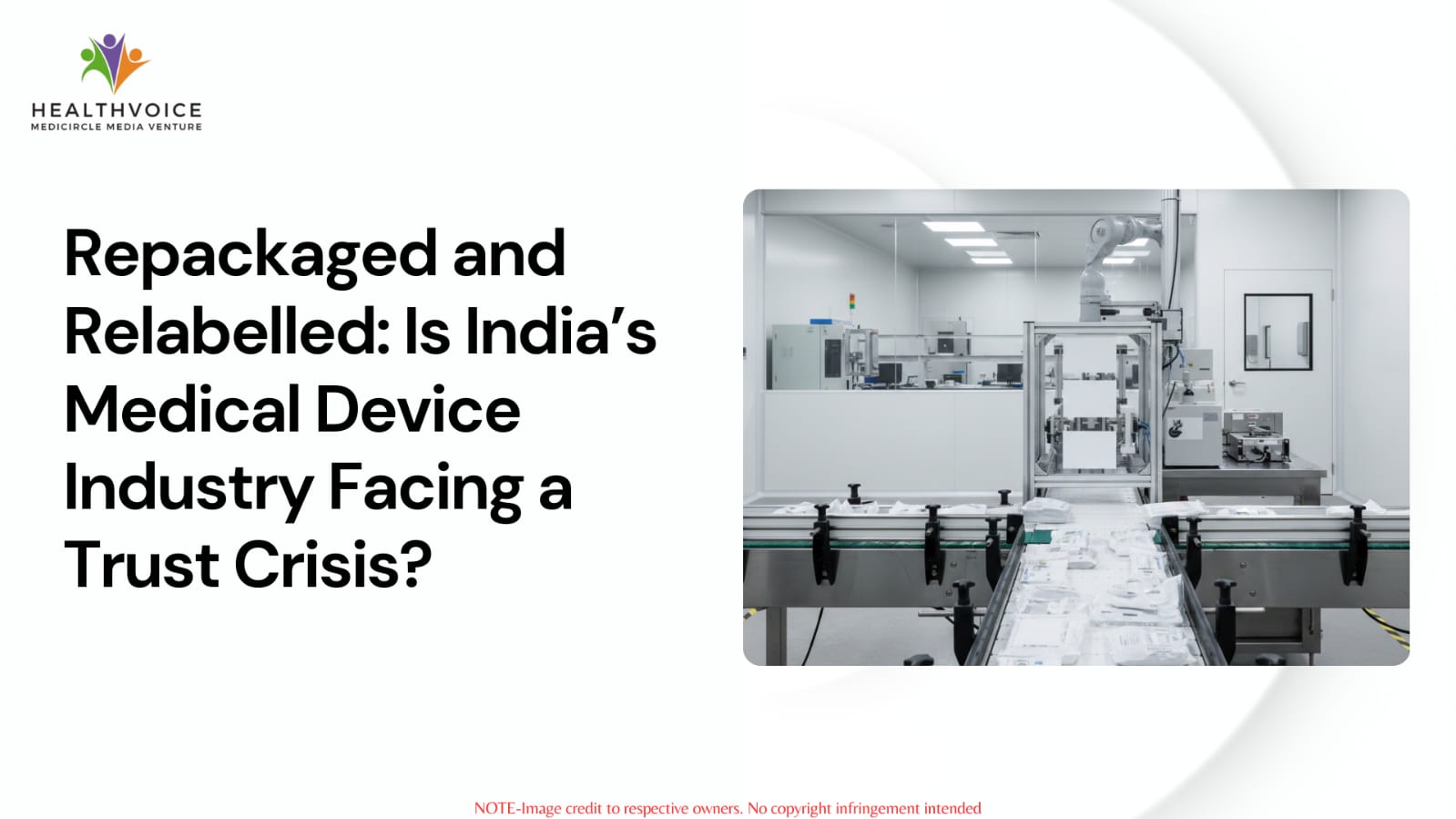
Repackaged and Relabelled: Is India’s Medical Device Industry Facing a Trust Crisis?
If the current debate results in amendments to the Medical Device Rules and enhanced consumer protection norms, the controversy may ultimately prove constructive
At first glance, the controversy at the India AI Impact Summit appeared to be a brief embarrassment. A university accused of presenting a robotic dog developed by a Chinese startup as its own technological breakthrough. The incident involving Galgotias University triggered online outrage and swift administrative action. Yet what seemed like a single episode of misplaced credit has opened a far more serious debate that strikes at the heart of India’s medical device industry, regulatory framework, and patient safety architecture.
Behind the headlines lies a deeper concern voiced by domestic manufacturers: if a high-profile academic event could blur the lines between origin and ownership, what about sectors that directly impact human lives? Industry leaders argue that the same opacity shapes India’s medical device market, where imported equipment particularly from China is allegedly being relabelled and sold as locally manufactured products. The issue has now escalated beyond reputational damage and entered the realm of regulatory reform.
Under the banner of the Association of Indian Medical Device Industry, commonly known as AiMeD, domestic manufacturers are preparing to approach the government with urgent demands for amendments to the Drugs and Cosmetics Act and the Medical Device Rules 2017. Their central grievance is precise: current definitions allow minimal processes such as labelling and repackaging to be categorised as “manufacturing.” In practical terms, this creates space for traders and distributors to import fully manufactured medical equipment, add a local label, and market the product under the powerful and politically significant tag of “Made in India.”
For genuine manufacturers investing in production facilities, quality compliance, skilled labour, and research and development, this regulatory grey zone has become a competitive disadvantage. Industry insiders estimate that a substantial portion of medical devices imported from China are redistributed in the domestic market under Indian branding by entities they describe as “pseudo-manufacturers.” These players, according to industry voices, do not operate large manufacturing plants or invest in indigenous innovation. Instead, they leverage legal loopholes to compete directly with firms that shoulder heavy compliance burdens.
The numbers exposes the scale of the challenge. India imports medical devices worth tens of thousands of crores annually. China remains one of the largest suppliers, second only to the United States. These imports range from everyday consumables such as surgical gloves, syringes, needles, and infusion sets to advanced critical-care equipment including ventilators and ultrasound systems. The dependence on imports has long been acknowledged. What alarms domestic producers now is the alleged masking of origin through white-labelling arrangements and complex trade routes.
Industry representatives point to a growing trend in which devices are routed through intermediary countries such as Malaysia or Singapore before reaching Indian shores. On documentation, they appear as imports from Southeast Asia, although their actual manufacturing base may lie elsewhere. This layered supply chain makes it increasingly difficult for regulators, procurement agencies, and hospitals to trace the true origin of equipment. In a sector where patient safety hinges on stringent quality standards, lack of transparency becomes more than a commercial issue; it becomes a public health concern.
The controversy surrounding the AI summit may have been about robotics and intellectual ownership, yet manufacturers argue that the stakes in the medical device sector are far higher. Equipment used in operating theatres, intensive care units, and diagnostic laboratories must meet strict safety and performance benchmarks. If the identity of the original manufacturer remains obscured, accountability becomes diluted. In case of device malfunction, adverse events, or product recalls, tracing responsibility could become a labyrinthine process.
At the core of the current debate is the definition of “manufacturing” under the Medical Device Rules 2017. Presently, activities such as labelling, packaging, or minor assembly can qualify an entity as a manufacturer. Domestic producers contend that this definition fails to distinguish between genuine value addition and cosmetic alterations. They propose excluding mere relabelling from the scope of manufacturing and introducing mandatory disclosure of the original manufacturer’s name, country of origin, and the extent of domestic value addition.
The issue intersects directly with India’s Public Procurement Order, which grants preference to domestically manufactured goods in government tenders. If imported devices are presented as local products, the objective of encouraging indigenous medical device manufacturing becomes diluted. Industry executives claim that what began as a practice within private hospital procurement has gradually extended into public procurement channels. This development, if accurate, undermines the spirit of self-reliance initiatives in the healthcare sector.
Economic incentives have further complicated the landscape. Low import tariffs on certain categories of medical equipment have made importing an attractive alternative to setting up manufacturing units. Domestic manufacturers must comply with more than 50 state and central regulatory requirements, spanning environmental clearances, labour laws, quality certifications, and factory inspections. Traders who import finished products avoid many of these compliance obligations. The resulting cost disparity creates an uneven playing field.
Medical devices are not ordinary consumer goods. A faulty ventilator, an inaccurate diagnostic machine, or substandard surgical equipment can have life-altering consequences. Transparency in sourcing, manufacturing standards, and quality audits is critical. AiMeD has recommended measures such as QR code-based traceability systems, random audits, and certification of “Make in India” claims through independent bodies like the Quality Council of India. Such steps, industry leaders argue, would strengthen consumer protection and restore confidence in domestic branding.
Regulatory oversight falls under the purview of the Central Drugs Standard Control Organisation, headed by the Drug Controller General of India. Industry sources suggest that despite repeated representations, progress on tightening definitions and disclosure norms has been slow. Whether due to bureaucratic inertia, competing priorities, or the complexity of balancing trade interests, the regulatory response remains a focal point of concern.
The broader narrative touches on India’s aspiration to become a global medtech hub. The country has already established itself as a pharmaceutical powerhouse and vaccine manufacturer. Expanding into high-value medical devices requires sustained investment in innovation, manufacturing infrastructure, and quality assurance systems. If regulatory ambiguities allow imported products to masquerade as local, domestic firms may hesitate to commit long-term capital to manufacturing facilities. The result could be prolonged dependence on foreign supply chains.
Global supply chain disruptions during the COVID-19 pandemic offered a stark lesson. Shortages of ventilators, personal protective equipment, and diagnostic kits exposed vulnerabilities in import-heavy models. Policymakers responded by encouraging local production and reducing reliance on overseas suppliers. The current controversy reignites the debate: does India possess a transparent, enforceable framework that clearly distinguishes indigenous manufacturing from repackaged imports?
There is also an ethical dimension. The “Made in India” label carries emotional weight. It signals national pride, economic self-reliance, and trust in domestic standards. When that label is applied to products without substantive local value addition, the credibility of the entire ecosystem erodes. For healthcare providers, clarity about device origin influences procurement decisions. For patients, it shapes perceptions of safety and reliability.
The industry’s demand for reform extends beyond semantics. Clearer definitions of manufacturing could drive investment into genuine production units. Mandating disclosure of domestic content percentages would create measurable benchmarks. Strengthening audit mechanisms could deter misuse of branding claims. Transparent labelling rules would empower hospitals and procurement agencies to make informed choices.
At the same time, policymakers must balance multiple interests. International trade relationships, affordability of medical devices, and access to advanced technology are critical considerations. Chinese medical equipment, according to industry insiders, often offers competitive pricing and reliable quality. Eliminating imports is neither practical nor desirable. The debate centres on transparency and fair competition rather than isolationism.
As the initial uproar over the AI summit fades, the medical device sector appears determined to keep the conversation alive. Industry leaders view the moment as an opportunity to push for structural reform rather than symbolic action. They argue that ensuring clarity in manufacturing definitions and origin disclosure will protect patients, support genuine Indian manufacturers, and align with broader public health goals.
The controversy serves as a reminder that in healthcare, appearances can mislead. A label is not merely a sticker; it represents accountability, compliance, and quality assurance. When the identity of a medical device becomes ambiguous, the chain of responsibility weakens. In a sector where human lives depend on precision and reliability, ambiguity is a risk few can afford.
India stands at a junction in its medical device journey. Strengthening domestic manufacturing aligns with economic ambitions and healthcare resilience. Yet such ambitions require rigorous regulatory clarity and enforcement. If the current debate results in amendments to the Medical Device Rules and enhanced consumer protection norms, the controversy may ultimately prove constructive.
The episode at the AI summit may have begun as a technological misrepresentation. It has since evolved into a broader examination of authenticity in Indian healthcare manufacturing. Whether this moment becomes a turning point depends on how seriously stakeholders treat the warning signs. In medicine, credibility is built on clarity. If India seeks to strengthen its position as a global healthcare leader, ensuring that “Made in India” genuinely means made in India is a necessary place to begin.
 Team Healthvoice
#MedicalDevices #makeinindia #PatientSafety #animedrawing #CDSCO #PublicProcurement #QualityStandards #ChinaImports #SupplyChainTransparency #healthvoice