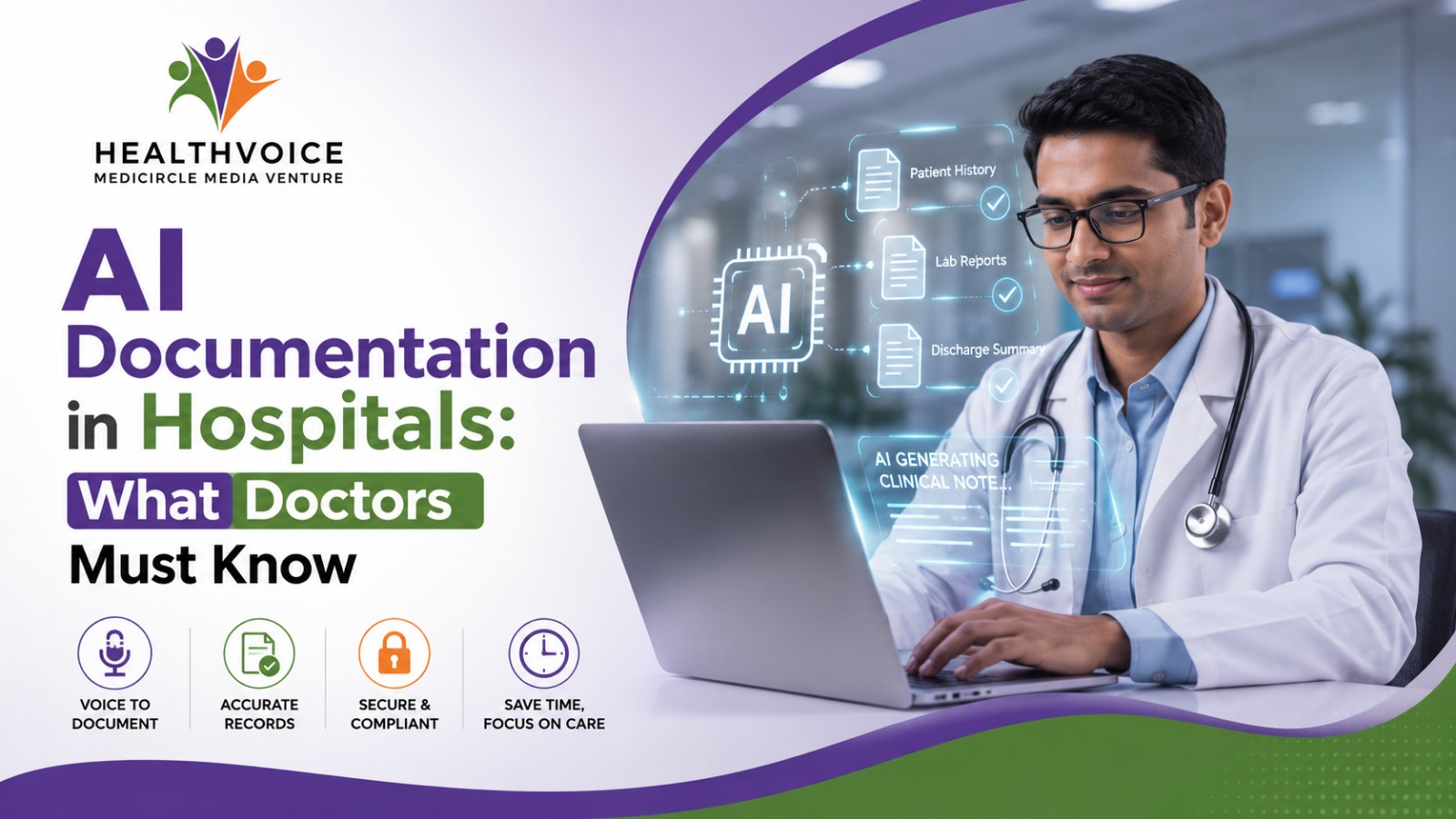
AI Documentation in Hospitals: Transforming Clinical Workflows for Indian Doctors
AI documentation in hospitals uses NLP and ambient AI to reduce physician burden, improve record quality, and support India's ABDM digital health goals through responsible, doctor-supervised implementation.
Ayushman Bharat Digital Mission (ABDM) and the National Health Policy framework, AI-powered documentation is positioned to become a foundational pillar of modern hospital operations.
Understanding AI-Powered Clinical Documentation
Clinical documentation encompasses every record created during a patient's interaction with the healthcare system. This includes admission notes, progress notes, discharge summaries, operative reports, referral letters, prescription records, and nursing care plans. Traditionally, these records have been created manually by doctors, nurses, and clinical staff, either through handwritten notes or data entry into Electronic Health Record (EHR) systems.
The problem is well-documented in global and Indian research. Studies indicate that doctors spend an average of two or more additional hours outside their official working shifts completing documentation tasks. In Indian tertiary care hospitals, where patient loads are exceptionally high, this burden is compounded. A senior consultant managing a ward round in the morning and an outpatient clinic in the afternoon may find that the administrative paperwork from both sessions spills deep into the evening.
AI documentation systems address this through several core technologies:
- Natural Language Processing (NLP): Analyses spoken or written language to extract clinically relevant information such as diagnoses, medications, procedures, and lab values.
- Ambient AI Scribes: Devices or applications that listen passively to patient-doctor conversations and automatically generate structured clinical notes in real time.
- Generative AI and Large Language Models (LLMs): Tools such as those based on ChatGPT architecture that can draft discharge summaries, referral letters, and progress notes based on clinical inputs provided by the doctor.
- Automatic Speech Recognition (ASR): Converts spoken dictation into text, which is then processed and structured by NLP engines.
Together, these technologies form an AI clinical documentation ecosystem that connects seamlessly with hospital EHR systems and health information platforms.
The Documentation Burden in Indian Hospitals
To appreciate why AI documentation matters specifically for Indian healthcare, it is important to understand the scale and nature of the documentation challenge in this context.
India has approximately 1.2 million registered allopathic doctors for a population exceeding 1.4 billion. Government hospitals in metropolitan cities routinely see patient footfalls that would be considered extraordinary by international standards. Doctors at district hospitals in states such as Uttar Pradesh, Bihar, and Madhya Pradesh often manage patient loads exceeding 100 outpatient consultations per day with minimal administrative support.
In this environment, every minute spent on documentation is a minute taken away from clinical care. The consequences are not merely professional. Studies published in journals such as JAMA Internal Medicine and Mayo Clinic Proceedings have linked high documentation burden with physician burnout, emotional exhaustion, reduced patient interaction quality, and increased risk of clinical errors.
The administrative load of clinical documentation has been identified as a leading contributor to healthcare professional burnout, a reality that Indian medical associations including the Indian Medical Association (IMA) have increasingly acknowledged in recent years. For a healthcare system already grappling with shortages of trained professionals, burnout is a compounding crisis that AI documentation technology can meaningfully address.
Furthermore, India's push toward digital health through ABDM requires that health records be interoperable, structured, and accessible across the national digital health ecosystem. Manually created records in varied formats are not compatible with this vision. AI documentation tools that generate standardised, structured records are therefore not just operationally useful but strategically essential.
How AI Documentation Systems Work in Practice
The practical application of AI documentation in hospitals can be understood across three broad categories of use.
Ambient AI Scribes for Real-Time Note Generation
An ambient AI scribe is a tool that listens to the natural conversation between a doctor and patient during a clinical encounter and converts that conversation into a structured clinical note. The doctor does not need to dictate, type, or interrupt the consultation to record information. After the consultation, the generated note is reviewed by the physician, edited if necessary, and then finalised in the EHR.
Studies published in the New England Journal of Medicine Catalyst and the Future Healthcare Journal have demonstrated that ambient AI tools can significantly improve the quality of outpatient clinic letters compared to standard EHR entry, while also reducing the time doctors spend on post-consultation documentation.
In the Indian context, ambient AI scribes face the additional challenge of multilingual patient interactions. Many doctor-patient conversations in India are conducted in regional languages, with clinical terminology often mixed in English. AI tools are increasingly being trained on multilingual datasets to address this, and several health-technology companies are now developing India-specific ambient documentation solutions.
Generative AI for Discharge Summaries and Clinical Letters
Discharge summaries are among the most documentation-intensive outputs in hospital care. A comprehensive discharge summary must capture the patient's presenting complaints, admission diagnosis, clinical course, investigations, treatment provided, final diagnosis, and follow-up instructions. In busy wards, these summaries are often delayed or abbreviated due to time constraints, which can compromise continuity of care.
Generative AI tools trained on clinical data can draft discharge summaries based on structured inputs or even from free-text notes provided by the treating physician. Research published in the Journal of Medical Internet Research has shown that discharge letters generated by large language models were rated by senior clinicians as comparable in quality to those written by junior doctors, with the AI versions often being more structured and complete.
A critical caveat applies here. AI-generated documents are susceptible to a phenomenon known as hallucination, where the model produces plausible-sounding but factually incorrect or fabricated information. Hallucination rates in clinical AI tools have been documented to vary between three percent and twenty-eight percent in current literature. This means that physician review and validation of every AI-generated document is not merely advisable but absolutely essential.
NLP-Based Coding and Billing Optimisation
Clinical coding, which involves assigning standardised diagnostic and procedural codes from systems such as ICD-10 to patient records, is a significant downstream function of clinical documentation. Accurate coding determines reimbursement from insurance schemes including Pradhan Mantri Jan Arogya Yojana (PMJAY) under Ayushman Bharat, and affects revenue cycle management for hospitals across India.
NLP-powered AI tools can analyse clinical notes and automatically suggest appropriate ICD-10 codes, flag documentation gaps that may lead to coding errors, and alert clinical documentation teams to inconsistencies. This application of AI documentation technology has direct financial and regulatory implications for Indian hospitals, particularly those empanelled under government health insurance schemes where claim accuracy is essential.
Benefits, Challenges, and the Quality Question
Benefits for Doctors and Healthcare Systems
The efficiency gains from AI documentation are consistently reported across international research. In studies examining both ambient AI and generative AI tools, documentation time was reduced in every instance. The most significant gains were observed in complex clinical cases, where the volume of information to be recorded is highest.
Beyond time savings, AI documentation has demonstrated potential to improve the structural quality of clinical notes. When AI tools generate notes from natural conversation rather than rushed manual entry, the resulting records tend to be more complete, better organised, and more consistent in format. Standardised documentation formats also support better clinical audits and quality improvement programmes within hospitals.
For doctors, the psychological benefit of reduced administrative burden cannot be overstated. When physicians spend less time on documentation, they report improved professional satisfaction, better engagement during patient consultations, and a greater sense of clinical purpose. These are outcomes that directly serve the well-being of the medical community.
Challenges That Must Be Addressed
Despite the promise, AI documentation is not without significant challenges that Indian hospitals and medical professionals must navigate carefully.
The accuracy and reliability of AI-generated documentation remains variable. A systematic review published in the Journal of Medical Systems in 2025 found that while the majority of studied AI tools produced documentation meeting or exceeding traditional quality standards, a meaningful proportion of cases involving generative AI tools contained fictitious information that was not screened by clinical reviewers. This finding underlines the absolute necessity of physician oversight in any AI documentation workflow.
Data privacy presents another serious concern, particularly in India where health data governance frameworks are still evolving. The Digital Personal Data Protection Act 2023 provides a legislative foundation, and ABDM's Health Data Management Policy outlines principles for health data handling. However, the specific obligations of AI documentation vendors regarding data localisation, consent, encryption, and audit trails require clearer institutional protocols than most Indian hospitals currently possess.
EHR variability is a practical implementation barrier. India's hospital ecosystem includes a wide spectrum of digital maturity, from large private tertiary care institutions with sophisticated EHR systems to government district hospitals still managing paper-based records. AI documentation tools must be adaptable across this varied landscape, which adds complexity to procurement and deployment.
Finally, the linguistic and cultural diversity of India's patient population requires AI documentation systems to be trained on India-specific data, including multilingual clinical conversations, regional diagnostic terminologies, and locally prevalent disease patterns. Generic AI tools trained primarily on Western clinical datasets may not perform adequately without significant customisation.
Implementation Pathways for Indian Hospitals
For hospital administrators, clinical leaders, and medical associations considering AI documentation adoption, a structured implementation approach is essential.
The first step is establishing a clear institutional governance framework that defines who is responsible for reviewing and approving AI-generated documents, how errors will be identified and reported, and how the system will be monitored for accuracy over time. A human-in-the-loop principle must be maintained at all times, meaning that no AI-generated clinical document should enter the patient record without physician review and sign-off.
Pilot programmes should begin with lower-risk documentation types such as discharge summaries or outpatient referral letters, rather than high-stakes operative notes or emergency clinical records where errors carry immediate patient safety implications.
Training programmes for clinical staff must address not only technical operation of the AI tool but also critical evaluation skills. Doctors and nurses need to understand the limitations of AI-generated text, recognise potential hallucinations, and develop the habit of reading AI-generated notes with the same critical attention they would apply to work submitted by a junior trainee.
Engagement with the ABDM ecosystem is essential for institutions operating within the national digital health framework. AI documentation tools must generate records in formats compatible with ABDM's Health Information Exchange standards to ensure interoperability with the Unified Health Interface and ABHA (Ayushman Bharat Health Account) record-linking systems.
Medical associations such as the IMA, state medical councils, and specialty bodies have an important role in setting standards and providing guidance to their member physicians on responsible AI documentation adoption. Platforms like HealthVoice, which connect doctors and medical associations within a credible professional community, serve as important channels for sharing evidence-based guidance, facilitating peer learning, and amplifying the voice of clinicians in shaping how these technologies are implemented.
The Road Ahead: AI Documentation in India's Healthcare Future
India's healthcare system is at a pivotal moment. The convergence of ABDM's digital health infrastructure, growing private investment in healthtech, increasing smartphone and internet penetration even in Tier 2 and Tier 3 cities, and a post-pandemic acceleration in digital adoption among both providers and patients creates conditions that are genuinely favourable for responsible AI integration.
AI documentation technology is not a distant future development. It is already being piloted in hospitals across India's major metros, and international evidence supporting its effectiveness continues to grow rapidly. A systematic review encompassing eleven studies, nine of which were published in 2024, highlighted the unprecedented pace at which this field is evolving.
For Indian doctors, the message is not that AI will replace clinical judgment. The message is that AI can take the weight of administrative documentation off physicians' shoulders, allowing them to do what they were trained to do: listen to patients, examine them carefully, and make informed clinical decisions. That is a future worth building toward, with appropriate caution, rigorous oversight, and the collaborative involvement of India's medical community every step of the way.
Frequently Asked Questions
Q1: What is AI documentation in hospitals?
AI documentation in hospitals refers to the use of artificial intelligence technologies such as natural language processing, ambient listening tools, and large language models to automate the creation, structuring, and management of clinical records. These tools reduce the manual burden on doctors and improve documentation accuracy.
Q2: Is AI documentation safe to use in Indian hospitals?
AI documentation tools can be used safely when proper oversight protocols are in place. Doctors must review all AI-generated notes before finalisation. Concerns around AI hallucinations and data privacy must be addressed through validated, ABDM-compliant systems and institutional governance frameworks.
Q3: How does AI reduce physician burnout in hospitals?
Research shows that doctors spend an average of two or more hours outside working hours on documentation tasks. AI tools that automate transcription, note generation, and record structuring significantly reduce this burden, freeing doctors to spend more time on direct patient care.
Q4: What types of AI documentation tools are available for hospitals?
The main categories include ambient AI scribes that listen to patient-doctor conversations and generate notes in real time, generative AI tools such as large language models that draft clinical summaries and discharge notes, and NLP-powered platforms that extract and code clinical data from existing records.
Q5: How does AI documentation align with India's ABDM framework?
India's Ayushman Bharat Digital Mission promotes interoperable digital health records across the country. AI documentation systems that comply with ABDM standards can directly feed structured clinical data into the Health Data Management Policy framework, supporting the vision of a unified national health ecosystem.
RESOURCES
- Ayushman Bharat Digital Mission (ABDM): Official government platform governing India's digital health ecosystem, health data standards, and ABHA-linked record management.
- Indian Council of Medical Research (ICMR): Leading national body for biomedical research in India, publishing guidelines and policy documents relevant to AI adoption in clinical practice.
- World Health Organization (WHO) India Country Office: Reports and guidance on digital health, healthcare workforce wellbeing, and technology integration in low-to-middle-income health systems.
- National Health Authority (NHA), Government of India: Oversees Pradhan Mantri Jan Arogya Yojana (PMJAY) and Ayushman Bharat scheme operations, including digital records and empanelment standards for hospitals.
- PubMed, National Library of Medicine: Repository of peer-reviewed medical research on AI in clinical documentation, NLP in healthcare, and physician burnout studies referenced in this article.
INTERLINKING KEYWORDS
AI in healthcare India, physician burnout, clinical documentation, ABDM digital health, ambient AI scribes, electronic health records, hospital technology, medical documentation burden, natural language processing in medicine, Ayushman Bharat
Last medically reviewed by:
HealthVoice Medical Editorial Board on 30 July 2026
Medical Disclaimer:
This article is intended for informational and educational purposes only and is directed at healthcare professionals, medical administrators, and health technology stakeholders. It does not constitute medical advice, clinical guidance, or a recommendation to adopt any specific technology or product. Decisions regarding the implementation of AI documentation systems in clinical settings should be made by qualified institutional leaders in consultation with relevant regulatory, clinical, and data privacy experts. HealthVoice does not endorse any specific AI tool, vendor, or platform mentioned or implied in this article.
 Team Healthvoice
#AIHealthcare #DigitalHealthIndia