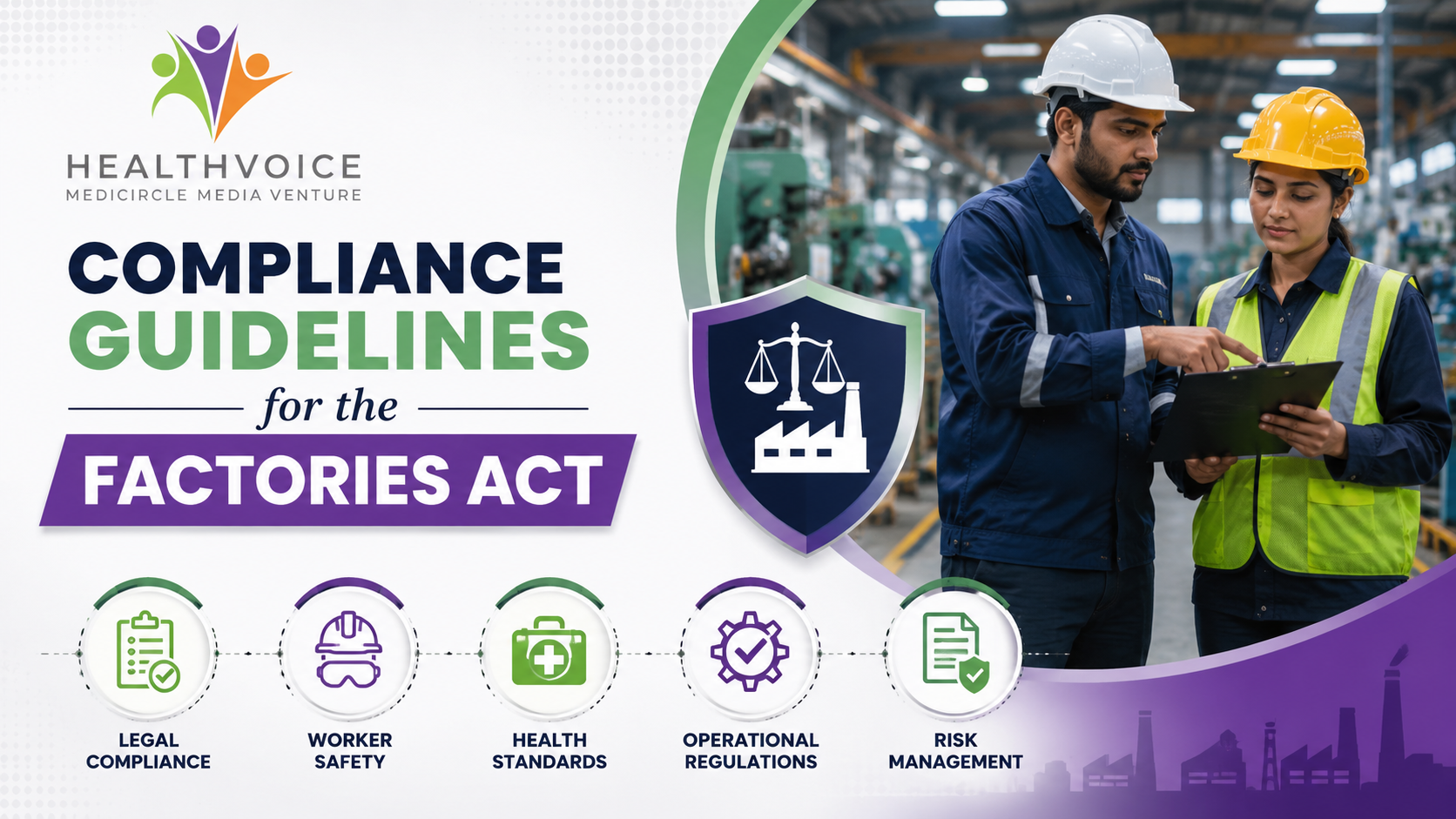
Compliance Guidelines for the Factories Act: Safety Regulations and Shift Rules for Indian Plants
This article explains key factory compliance requirements under India's Factories Act, 1948 and the OSH Code, 2020, covering workplace safety, machine guarding, working hours, overtime, women’s night shifts, statutory obligations, and practical compliance strategies to help manufacturing organizations reduce legal and operational risks.
For manufacturing operations in India, compliance with statutory labor laws is a fundamental prerequisite for operational continuity, worker welfare, and risk mitigation. Governed primarily by The Factories Act, 1948—and increasingly aligned with the Occupational Safety, Health and Working Conditions (OSH) Code, 2020—industrial units must enforce rigorous standards regarding physical safety, machine maintenance, working hours, shift rotations, and gender-specific employment safeguards.
- Machine guarding (S.21)
- 48-hr weekly ceiling
- Express written consent • Pressure plant testing
- 9-hr daily cap
- Door-to-door transport • Hazardous process SOPs
- Double overtime pay
- POSH Act integration
Non-compliance exposes plant managers, occupiers, and directors to severe legal liabilities—including operational stoppage orders, escalated financial fines, and criminal prosecution under state-specific Factory Rules.
1. Statutory Safety Regulations and Machine Guarding
Under Chapter IV (Sections 21 to 41) of the Factories Act, occupiers must implement comprehensive engineering and administrative controls to prevent industrial injuries:
Machine Guarding and Moving Parts (Section 21)
Every dangerous part of a machine—including prime movers, flywheels, transmission shafts, gears, and belts—must be securely fenced with durable guards while in motion. Unfenced machinery work is strictly restricted to trained adult male workers wearing tightly fitted protective clothing.
Pressure Plants and Heavy Lifting Gear (Sections 28, 29, & 31)
- Hoists, Lifts, and Cranes: Must be of sound mechanical construction, examined by a certified competent person at least once every 12 months, and clearly marked with Safe Working Loads (SWL).
- Pressure Vessels: Any plant operated above atmospheric pressure must be fitted with pressure-reducing valves, safety valves, and pressure gauges, undergoing annual hydrostatic testing.
Hazardous Processes and Material Safety (Sections 41A–41H)
Factories handling toxic, explosive, or corrosive substances must establish Safety Committees featuring equal management and worker representation, publish material safety data sheets (MSDS), conduct environmental exposure audits, and maintain mandatory health registers (Form 20).
2. Working Hours, Shift Limits, and Overtime Framework
Chapter VI (Sections 51 to 66) governs working hours and shift schedules for adult workers in industrial plants:
- Weekly Ceiling (Section 51): No adult worker shall be required or allowed to work in a factory for more than 48 hours in any week.
- Daily Limits (Section 54): Maximum working hours are capped at 9 hours per day, inclusive of regular work duties.
- Rest Intervals (Section 55): Workers must receive a mandatory rest interval of at least 30 minutes after 5 continuous hours of work.
- Spread-Over Limits (Section 56): The total spread-over period—including work hours and rest intervals—cannot exceed 10.5 hours on any day (extendable to 12 hours under specific state exemptions).
- Overtime Wages (Section 59): Any work performed beyond 9 hours in a day or 48 hours in a week must be compensated at twice the ordinary rate of wages (2\times \text{basic} + \text{DA}). Total quarterly overtime cannot exceed state-prescribed ceilings (typically 50 to 115 hours).
3. Women in Night Shifts: Compliance & Safeguards
While Section 66(1)(b) historically restricted female employment between 7:00 PM and 6:00 AM, state amendments and Section 43 of the OSH Code permit night shifts for women subject to strict statutory preconditions:
Statutory Prerequisites for Female Night Shifts
- Written Voluntary Consent: Female employees cannot be forced into night shifts without explicit, written consent.
- Secure Transportation: Employers must provide free, dedicated door-to-door transportation equipped with GPS tracking and female security escorts.
- Group Deployment: Women must be deployed in groups of no fewer than four female workers per department or floor during night hours.
- POSH Act Integration: The plant must maintain an active Internal Complaints Committee (ICC) under the Sexual Harassment of Women at Workplace (POSH) Act, 2013, with prominent display of emergency contact protocols.
- Welfare Facilities: Dedicated restrooms, well-lit passages, CCTV coverage in non-private areas, and female supervisors must be provided during night hours.
4. Structural Comparison: Legacy Factories Act vs. OSH Code Framework
The transition from the legacy Factories Act, 1948 toward the unified OSH Code, 2020 introduces key operational shifts for manufacturing plants:
- Factory Applicability Thresholds: The legacy framework applies to units employing 10+ workers (with power) or 20+ workers (without power). The OSH Code elevates this threshold to 20+ workers (with power) and 40+ workers (without power).
- Women in Night Shifts: The legacy Act prohibited night work by default unless exempted by special state notifications. The OSH Code permits night work across all sectors, provided mandatory consent, safety, and transport protocols are met.
- Overtime Limits: Legacy rules capped quarterly overtime at 50–75 hours across states. The unified code raises the quarterly overtime ceiling up to 125 hours, subject to state notifications.
- Health Audits & Medical Examinations: Legacy rules mandated medical check-ups primarily for hazardous process units. The OSH Code mandates free annual health examinations for all factory workers exceeding specified age thresholds.
- Penalty Structures: Legacy non-compliance carried minor statutory fines (₹2,000 to ₹10,000). Updated state rules and the OSH Code drastically escalate financial penalties up to ₹1,00,000–₹2,00,000 per violation, with corporate liability extending to directors.
5. High-Performance Action Plan for Plant Managers
To establish full legal compliance across safety and shift operations, factory management can execute a three-phase operational roadmap:
- Execute EHS Safety Audits and Machine Guarding UpgradesPhase 1: Infrastructure & Machine AuditAudit all prime movers, lifting tackle, pressure vessels, and hazardous chemical lines. Install interlock guards, emergency stop switches, and verify annual certification by a state-empaneled competent person.
- Standardize Shift Rosters and Overtime RegistersPhase 2: Shift Scheduling & Overtime ControlsConfigure automated HRIS rosters enforcing the 48-hour weekly ceiling and 9-hour daily limits. Implement automated overtime tracking registers (Form 10) to calculate 2\times wage payouts and prevent quarterly overtime cap breaches.
- Deploy Female Night Shift Protections & Digital FilingsPhase 3: Night Shift & Regulatory FilingsObtain written consents for female night shifts, finalize vendor contracts for GPS-tracked transport, deploy CCTV infrastructure, and submit statutory returns (Form 21 / annual returns) on state labour portals.
Actionable Strategy: Digital Governance & Compliance Integration
- Integrate Digital Health Profiles for Factory Workers: Maintain worker health logs, pre-employment fitness checks, and periodic medical check-ups on national digital health networks—such as the ABHA ID (Ayushman Bharat Health Account) pipeline—ensuring occupational health records remain accessible across plant locations.
- Verify Safety Officer & Competent Person Credentials: Ensure all plant safety officers, medical officers, and competent persons verifying pressure vessels maintain verified certifications logged through national academic repositories like the APAAR ID system within the Academic Bank of Credits (ABC) network.
- Automate Inspection Portal Sync: Maintain digitized registers (Form 12 for adult workers, Form 10 for overtime, accident logs) to interface seamlessly with state-specific digital labor portals (such as Shram Suvidha, MAITRI, or RajFAB) for transparent regulatory inspections.
Frequently Asked Questions (FAQs)
Q1. What defines a "Factory" under the Factories Act, 1948?
A factory is defined as any premises where 10 or more workers are employed with the aid of power, or 20 or more workers are employed without power, engaged in a manufacturing process during the preceding 12 months.
Q2. What is the maximum permissible daily and weekly working limit for adults?
Adult workers cannot be required to work for more than 9 hours per day or 48 hours per week.
Q3. How is overtime calculated under Section 59 of the Act?
Overtime is triggered when a worker exceeds 9 hours in a day or 48 hours in a week. It must be paid at twice the normal rate of wages (including basic pay and Dearness Allowance).
Q4. Are female employees legally permitted to work night shifts in manufacturing plants?
Yes. While historically restricted, female night shifts (7:00 PM to 6:00 AM) are permitted across most Indian states provided employers obtain written consent, supply free GPS-monitored transport, ensure female security, deploy group shifts, and comply with POSH guidelines.
Q5. What is the mandatory interval for testing lifting machines and pressure vessels?
Lifting tackle, hoists, and cranes must be examined by a certified competent person every 12 months. Pressure vessels require annual external inspection and hydrostatic testing based on pressure limits.
Q6. What is the maximum spread-over permitted under law?
The daily spread-over—inclusive of work hours and rest intervals—cannot exceed 10.5 hours on any day, though specific state exemptions allow up to 12 hours under strict conditions.
Q7. What welfare facilities are mandatory based on workforce thresholds?
Mandatory welfare facilities include: First Aid boxes (1 per 150 workers), Crèche (30+ female workers), Canteen (250+ workers), Restrooms/Lunchrooms (150+ workers), and a dedicated Welfare Officer (500+ workers).
Q8. Who is classified as the "Occupier" of a factory?
The "Occupier" is the person who has ultimate control over the affairs of the factory. In the case of a company, one of the active directors must be designated as the Occupier for statutory accountability.
Q9. How does an APAAR ID assist EHS and compliance personnel?
An APAAR ID provides a lifetime, verified digital record of academic degrees, EHS certifications, and safety training credentials, streamlining credential checks for safety officers and factory medical personnel.
Q10. What are the penalties for non-compliance under updated state factory rules?
Penalties include financial fines up to ₹1,00,000–₹2,00,000 per violation, imprisonment up to 2 years for general offenses, and up to 7 years imprisonment for severe violations in hazardous process units causing fatal accidents.
 Team Healthvoice
#FactoryCompliance #WorkplaceSafety