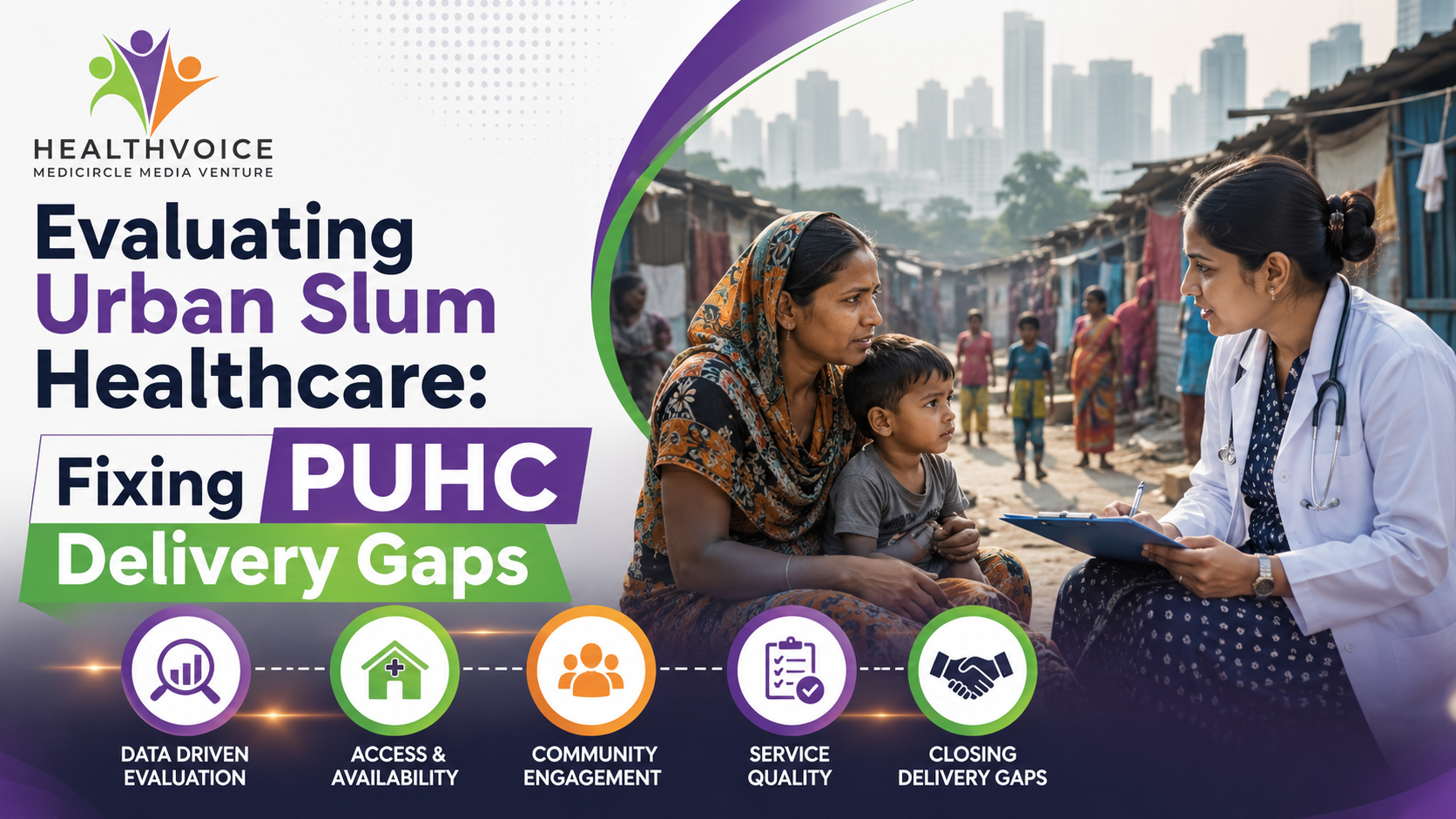
Evaluating Urban Slum Healthcare: Fixing PUHC Delivery Gaps
Evaluating primary healthcare delivery in urban slums reveals a critical structural paradox. While cities contain the highest concentration of medical infrastructure, residents of informal settlements often experience worse health outcomes and higher out-of-pocket health expenditures than rural populations.
Evaluating primary healthcare delivery in urban slums reveals a critical structural paradox. While cities contain the highest concentration of medical infrastructure, residents of informal settlements often experience worse health outcomes and higher out-of-pocket health expenditures than rural populations.
Established under the National Urban Health Mission (NUHM), Primary Urban Health Centres (PUHCs) serve as the frontline defense for urban slum populations. However, deep-seated operational, spatial, and socio-economic gaps continue to impair their service delivery.
1. Key Structural & Operational Gaps in PUHCs
Evaluating PUHC performance highlights severe operational mismatches between primary care infrastructure and the actual needs of slum dwellers:
- Exclusion of Unlisted and Migrant Settlements: Official government norms dictate one PUHC per 50,000 residents. However, health mapping often targets only notified or officially recognized slums. Non-notified squatter settlements, construction worker colonies, and seasonal migrant clusters are regularly left out of catchment boundaries, rendering thousands invisible to routine primary health coverage.
- Temporal Mismatch in Operating Hours: Most PUHCs operate during standard government office hours (e.g., 9:00 AM to 4:00 PM). Slum residents—who primarily work in the informal sector as daily wage laborers, domestic workers, street vendors, or construction workers—cannot visit a health center during these hours without forfeiting a day's income. This forces reliance on informal private practitioners ("quacks") or late-night pharmacy self-medication.
- Inadequate Physical Infrastructure & Rental Vulnerability: Unlike rural Primary Health Centres (PHCs) built on dedicated government land, many urban health centers operate out of small, rented, dilapidated buildings deep inside or on the periphery of slums. They frequently lack adequate waiting areas, clean water, private examination rooms for maternal care, and proper cold-chain storage for vaccines.
- Human Resource Shortages & High Attrition: Recruiting and retaining full-time medical officers, staff nurses, and lab technicians for slum-based PUHCs remains a systemic challenge. Poor working conditions, low urban incentive allowances compared to private practice, and safety concerns lead to high staff turnover and understaffed facilities.
- Fragmentation Between Municipal Bodies & Health Departments: In many metropolitan cities, public health functions are split between Municipal Corporations (urban local bodies) and State Health Departments. Lack of inter-agency coordination leads to duplicated budgets, delayed supply chains for essential medicines, and neglected disease surveillance (such as dengue, malaria, and tuberculosis control).
2. Structural Evaluation: Standard PUHC vs. Integrated Slum Health Framework
Comparing traditional PUHC operations against an integrated framework highlights how targeted structural shifts improve healthcare delivery across five key operational areas:
- Catchment & Target Mapping: Traditional models focus strictly on notified slums, excluding floating migrant populations. An integrated framework uses vulnerability-mapped catchments covering unlisted slums, construction sites, and street dwellers to ensure universal coverage regardless of tenure status.
- Facility Timings & Accessibility: Standard morning OPDs (9:00 AM – 4:00 PM) conflict directly with daily working hours. Transitioning to split-shift and evening OPDs (e.g., 8:00 AM – 12:00 PM and 4:00 PM – 8:00 PM) prevents lost wages and encourages early consultation.
- Outreach Mechanics: Passive, facility-based care relies entirely on walk-in patients. An integrated model uses active community mobilization via ASHAs, Mahila Arogya Samitis (MAS), and mobile health units to drive early prevention, immunization, and disease tracking.
- NCD Management: Traditional facilities focus primarily on acute care with limited chronic follow-up. An integrated approach embeds structured NCD screening protocols (for hypertension and diabetes) paired with doorstep medicine delivery, preventing costly emergency tertiary care.
- Digital & Health Record Mobility: Paper register logging often results in lost records during intra-city migration. Utilizing digitized health accounts linked via universal IDs preserves patient history across urban-rural migration cycles.
3. Actionable Reform Plan for Urban Health Administrators
To bridge PUHC operational gaps and deliver equitable healthcare across urban informal settlements, urban local bodies (ULBs) and health departments can execute a three-phase reform strategy:
- Execute GIS Vulnerability Mapping Beyond Notified SlumsPhase 1: Spatial & Coverage MappingConduct comprehensive Geographic Information System (GIS) mapping across all urban wards to identify unlisted slums, seasonal worker camps, and industrial clusters. Redraw PUHC catchment boundaries to ensure every vulnerable cluster is formally linked to a dedicated health center.
- Transition to Evening OPDs & Mobile Health UnitsPhase 2: Operational AdjustmentRestructure PUHC operational hours into split shifts or dedicated evening clinics (4:00 PM – 8:00 PM). Deploy well-equipped Mobile Medical Units (MMUs) to perform scheduled weekly outreach camps deep within high-density, inaccessible slum pockets.
- Empower Mahila Arogya Samitis & Digital TrackingPhase 3: Community & Digital IntegrationStrengthen slum-level Mahila Arogya Samitis (community women's health groups) with untied funds to drive local health awareness. Digitally equip frontline ASHAs and ANMs with mobile platforms to track antenatal care, child immunizations, and chronic NCD medication adherence in real time.
Actionable Strategy: Digital Governance & Health Record Mobility
- Sync Slum Resident Profiles via Universal Digital ID Pipelines: Enable seamless tracking of migrant and daily-wage patients by registering slum households on national health portals—such as the ABHA ID (Ayushman Bharat Health Account) network. This ensures medical histories, diagnostic reports, and prescription records remain accessible even when families relocate between slums or travel to home villages.
- Verify Healthcare Worker Credentials via Central Academic Repositories: Ensure all medical officers, staff nurses, and lab technicians deployed across PUHCs maintain verified credentials and ongoing clinical certifications logged natively through national education registries like the APAAR ID system within the Academic Bank of Credits (ABC) framework.
- Establish Monthly Multi-Sectoral Convergence Audits: Convene monthly ward-level coordination meetings bringing together PUHC medical officers, municipal sanitation engineers, and clean water representatives to address broader environmental determinants of health—such as stagnant drainage, safe drinking water access, and vector control.
Frequently Asked Questions (FAQs)
Q1. What is the standard population coverage norm for a Primary Urban Health Centre (PUHC)?
Under National Urban Health Mission (NUHM) guidelines, one PUHC is established for every 50,000 residents. In areas with dense, concentrated slum populations, this threshold can be adjusted down to 30,000 to 45,000 residents to ensure adequate access.
Q2. Why are health indicators in urban slums often worse than in rural areas?
Slum residents face unique urban hazards: high population density, severe air/water pollution, lack of sanitation infrastructure, high exposure to infectious and lifestyle diseases (NCDs), financial strain from high cost-of-living, and an unregulated private medical market that inflates out-of-pocket health expenses.
Q3. How do "unlisted" or non-notified slums impact public healthcare delivery?
Unlisted slums lack formal government recognition, which often excludes them from municipal water supply, sanitation services, and official PUHC health catchment maps. As a result, frontline health workers (ASHAs/ANMs) do not conduct routine home visits or immunization drives in these areas.
Q4. What role do Mahila Arogya Samitis (MAS) play in urban slum healthcare?
Mahila Arogya Samitis are community-level women's collectives formed in urban slums under NUHM. They receive small untied grants to lead local sanitation drives, organize health awareness camps, assist ASHAs during immunization drives, and act as community advocates for better PUHC services.
Q5. What is the difference between a UPHC and a UCHC?
An Urban Primary Health Centre (UPHC) delivers outpatient care, basic diagnostics, maternal/child health services, and preventive programs. An Urban Community Health Centre (UCHC) functions as a secondary-level referral facility (often 30–50 beds) providing inpatient care, minor surgeries, 24/7 delivery services, and specialist consultations for a population of 250,000 to 500,000.
Q6. How does an ABHA ID assist urban slum dwellers seeking healthcare?
Because urban slum residents frequently relocate or lack physical document storage, an ABHA ID digitizes their complete health record. Doctors at any public facility or empaneled private hospital can access their past diagnoses, lab reports, and medication histories instantly via a secure mobile verification code.
Q7. How can local urban bodies prevent high out-of-pocket healthcare costs for slum residents?
Urban local bodies can reduce out-of-pocket costs by ensuring PUHCs maintain a reliable supply of free essential medicines and diagnostic tests, extending facility operating hours to evenings, and establishing clear referral pathways to free tertiary public hospitals.
Q8. What is the impact of non-communicable diseases (NCDs) on urban slum populations?
Rapid urbanization and altered dietary patterns have led to a surge in hypertension, diabetes, and cardiovascular diseases among the urban poor. Because primary screening at PUHCs is often underutilized, NCDs frequently go undiagnosed until severe, costly complications arise.
Q9. How do split-shift OPD hours improve PUHC service utilization?
Operating PUHCs in split shifts (e.g., 8:00 AM – 12:00 PM and 4:00 PM – 8:00 PM) allows daily wage workers, domestic helpers, and office laborers to seek medical consultations before or after their work shifts without sacrificing their daily income.
Q10. What immediate action should an urban health officer take to improve slum health delivery?
Conduct a ward-level audit of PUHC operating hours, essential drug stock levels, and staff attendance, while organizing weekly evening mobile clinic outreach sessions targeted directly at unlisted slum clusters.
 Team Healthvoice
#UrbanHealthcare #PublicHealthIndia