AI in Radiology Beyond Image Reading: What's Next?
Artificial intelligence in radiology is evolving beyond image reading into workflow automation, clinical decision support, predictive analytics, and multimodal integration, offering India transformative diagnostic potential.
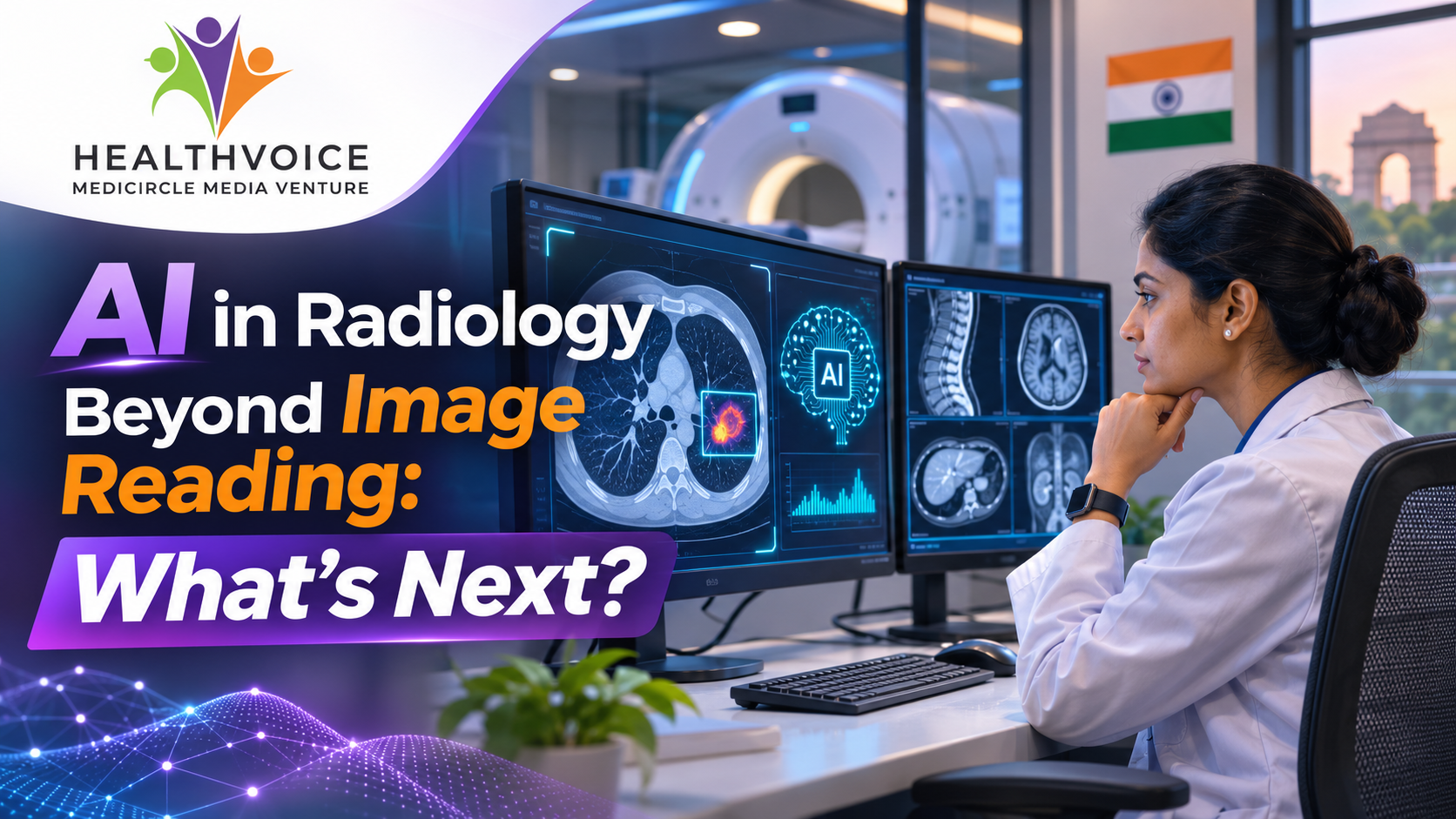
AI in Radiology Beyond Image Reading: What Comes Next?
Introduction
Artificial intelligence entered the field of radiology with a singular, well-publicized promise: to read medical images faster and more accurately than the human eye. For several years, the conversation around AI in radiology remained anchored to this single capability. Detecting nodules on a chest X-ray, flagging diabetic retinopathy in fundus images, identifying fractures on musculoskeletal scans. These were the demonstrations that filled conference halls and research publications alike.
That chapter, however, is now closing. Or rather, it is becoming only the opening chapter of a much longer story.
Across the global radiology ecosystem, and increasingly within India's rapidly digitizing healthcare infrastructure, artificial intelligence is quietly expanding its reach. It is moving from the reading room into the scheduling desk, the clinical ward, the pathology lab, and the hospital's administrative backbone. The question for Indian radiologists, hospital leaders, and healthcare technologists today is no longer whether AI can read an image. The question is: what else can AI do, and how quickly is India ready to absorb it?
The Expanding Role of AI in Modern Radiology
For a long time, AI in radiology was essentially a synonym for computer-aided detection, or CAD. The technology would assist radiologists in spotting anomalies, reduce the chance of a missed finding, and sometimes provide a second opinion on ambiguous cases. This model of AI as a "second reader" has clear value, but it represents a relatively narrow application of a technology with far broader capabilities.
The current generation of AI tools being deployed across academic medical centers and health systems worldwide approaches radiology as an end-to-end clinical workflow, not just a single diagnostic step. This shift carries significant implications for how radiology departments are structured, how radiologists allocate their time, and how patient care pathways are designed.
In India, where the radiologist-to-population ratio remains critically low, with estimates suggesting fewer than one radiologist per 100,000 people in many states, this expanded vision of AI is particularly relevant. The potential is not to replace radiologists but to dramatically amplify what each radiologist can accomplish within a given day.
Workflow Automation: The Invisible Revolution
One of the most consequential applications of AI in radiology today has nothing to do with reading images at all. It involves the complex, time-intensive administrative and operational tasks that consume a significant portion of a radiologist's working hours.
AI systems are now being deployed to automate:
- Radiology report generation through structured natural language processing, which converts findings into draft reports that radiologists review and approve
- Intelligent worklist prioritization that uses clinical data to surface the most urgent cases first, ensuring that a critical finding from an emergency department reaches a radiologist before a routine outpatient scan
- Automated quality checks that flag incomplete or inconsistent reports before they are signed off and sent to referring clinicians
- Scheduling optimization tools that reduce appointment wait times and improve equipment utilization across CT and MRI units
For a busy government hospital in Lucknow or a multi-specialty chain in Bengaluru, these workflow tools can translate into measurably faster turnaround times and fewer administrative errors. The India Health Stack and the Ayushman Bharat Digital Mission (ABDM), which are building a unified digital health infrastructure across the country, create a natural foundation for deploying such AI-powered workflow systems at scale.
Clinical Decision Support Beyond the Scan
AI is also evolving into a genuine clinical decision support tool, one that integrates radiology findings with broader patient data to assist not just the radiologist, but the entire treating team.
Consider what this looks like in practice. A patient presents at a tertiary care center in Chennai with chest pain. The AI system, integrated with the hospital's electronic health record, pulls together the patient's imaging history, lab reports, risk factor profile, and presenting symptoms. By the time the radiologist opens the CT pulmonary angiogram, an AI-generated clinical summary is already waiting, contextualizing the scan within the patient's complete medical picture.
This kind of integrated decision support moves radiology from an isolated diagnostic service into an active participant in clinical reasoning. It supports the radiologist in providing a more nuanced and actionable report, one that speaks not just to what is visible on the scan but to what it means for this particular patient.
In the context of India's growing burden of non-communicable diseases, including cardiovascular disease, diabetes, and lung conditions driven by air pollution, AI-assisted decision support in radiology holds particular promise. The National Programme for Prevention and Control of Cancer, Diabetes, Cardiovascular Diseases and Stroke (NPCDCS) has made early detection a national priority, and AI tools that surface clinically meaningful patterns from imaging data can directly support this agenda.
Predictive Analytics: From Diagnosis to Prognosis
Perhaps the most transformative shift underway in AI-enabled radiology is the move from diagnosis to prognosis. Traditional radiology answers the question: what does this patient have? The emerging frontier of AI-powered predictive analytics begins to answer a different question: what is likely to happen next?
Radiomics, the extraction of large volumes of quantitative features from medical images, is enabling AI models to identify patterns in imaging data that are invisible to the human eye but are statistically associated with disease progression, treatment response, or recurrence risk. Research published in leading oncology and radiology journals has demonstrated that radiomics models can predict outcomes in lung cancer, glioblastoma, and colorectal cancer with clinically meaningful accuracy.
For oncology centers in India, many of which handle very high patient volumes and face constrained access to molecular diagnostics, the ability to derive prognostic information from imaging data alone represents a significant clinical opportunity. Institutions like the Tata Memorial Centre in Mumbai and the All India Institute of Medical Sciences in New Delhi are already engaged in research that explores these applications in Indian patient populations.
AI in Interventional Radiology and Procedure Planning
AI's reach is extending into interventional radiology as well, an area where precision and planning are critically important. AI-assisted tools are being developed and deployed to support:
- Pre-procedure planning for complex interventions such as transarterial chemoembolization, thermal ablation, and endovascular procedures
- Intraoperative guidance using real-time AI image analysis to assist navigation during minimally invasive procedures
- Post-procedure assessment to evaluate treatment response more objectively and consistently than traditional visual inspection
These applications are still maturing, but their trajectory is clear. As interventional radiology expands in India, particularly in the management of hepatocellular carcinoma, peripheral vascular disease, and uterine fibroids, AI tools that enhance procedural precision will find a growing clinical market.
Multimodal AI: Integrating Imaging With Pathology and Genomics
One of the most exciting directions in research-stage AI for radiology is multimodal integration. Rather than analyzing a single type of data, multimodal AI models learn from combinations of imaging data, pathology slides, genomic profiles, clinical notes, and laboratory values simultaneously.
The goal is to create a more holistic and accurate picture of disease. Early research suggests that multimodal models outperform single-modality models in predicting treatment response in cancer and in characterizing lesions that are indeterminate on imaging alone.
For the Indian healthcare system, this direction carries both opportunity and challenge. Genomic data infrastructure in India is still developing, and the interoperability between imaging systems, pathology labs, and hospital information systems remains inconsistent outside major urban centers. However, initiatives under the ABDM and the National Digital Health Blueprint are building the digital scaffolding that could eventually support multimodal AI at a population level.
The Radiologist's Evolving Identity
It would be incomplete to discuss the future of AI in radiology without addressing how it reshapes the professional identity and practice of the radiologist. Concerns about AI displacing radiologists have circulated for nearly a decade, but the emerging evidence suggests a more nuanced reality.
As AI takes over repetitive, high-volume, pattern-recognition tasks, radiologists are increasingly called upon to function as clinical consultants, data interpreters, AI supervisors, and interdisciplinary communicators. The radiologist of the next decade will likely spend less time reading routine normal studies and more time engaging with complex, ambiguous, and high-stakes cases where human judgment and clinical context remain irreplaceable.
For Indian radiologists, particularly those practicing in Tier 2 and Tier 3 cities where specialist support is limited, AI tools offer the chance to expand diagnostic capabilities and reduce professional isolation. Platforms like HealthVoice, which connect radiologists and medical professionals across geographies for knowledge exchange and community engagement, reflect exactly the kind of professional ecosystem that will help Indian doctors navigate this transition thoughtfully and confidently.
Regulatory and Ethical Considerations in India
The deployment of AI in radiology in India is not without its regulatory and ethical complexities. The Central Drugs Standard Control Organisation (CDSCO) has begun developing a regulatory framework for AI and software as a medical device, but clear and comprehensive guidelines are still evolving.
Key concerns include:
- Validation of AI algorithms on Indian patient populations, since models trained predominantly on Western datasets may underperform on Indian patients due to differences in disease prevalence, comorbidities, and imaging characteristics
- Data privacy and patient consent in the context of AI training data, particularly as ABDM creates large-scale health data repositories
- Liability frameworks when AI-assisted decisions contribute to diagnostic errors
- Equitable access, ensuring that the benefits of AI in radiology do not remain confined to private hospitals in metropolitan cities
These are not reasons to slow the adoption of AI in Indian radiology. They are reasons to adopt it thoughtfully, with robust clinical validation, transparent governance, and genuine involvement of the radiologist community in shaping its trajectory.
Conclusion
The story of AI in radiology was never going to end with image reading. What began as a tool to detect abnormalities on a scan is evolving into a comprehensive clinical intelligence layer that touches every dimension of the radiology workflow, from scheduling and reporting to prognosis and procedure planning.
For India, this evolution arrives at a moment of significant opportunity. The country's vast unmet diagnostic need, its digital health infrastructure ambitions, and its large and skilled radiologist community all position it to benefit enormously from these advances. What is needed now is a combination of regulatory clarity, institutional investment in AI validation on Indian data, and a professional community that is well-informed, well-connected, and ready to lead.
That professional community already exists. It needs platforms, conversations, and credible information to help it navigate what comes next.
Frequently Asked Questions
Q1: How is AI in radiology different from traditional computer-aided detection?
Traditional computer-aided detection, or CAD, was designed to flag specific abnormalities on images as a secondary alert for radiologists. Modern AI in radiology goes much further by integrating clinical data, automating workflow steps, generating draft reports, prioritizing worklists, and providing predictive prognostic insights, making it a comprehensive clinical intelligence tool rather than just a detection aid.
Q2: Will AI replace radiologists in India?
No, AI is not expected to replace radiologists. It is designed to assist them by automating high-volume routine tasks, allowing radiologists to focus on complex cases, clinical consultation, and interdisciplinary collaboration. In India, where there is a significant shortage of radiologists, AI is more likely to extend the reach and capacity of existing radiologists rather than reduce the need for them.
Q3: What is radiomics and why does it matter for Indian patients?
Radiomics is the process of extracting large numbers of quantitative features from medical images using AI. These features can reveal disease patterns invisible to the human eye. For Indian patients, particularly in oncology settings where access to molecular diagnostics may be limited, radiomics offers the possibility of deriving prognostic and predictive information from standard imaging studies, potentially improving cancer management outcomes.
Q4: Is there a regulatory body in India overseeing AI tools used in radiology?
The Central Drugs Standard Control Organisation (CDSCO) is the primary regulatory body responsible for overseeing medical devices in India, including AI-based diagnostic software. India is currently in the process of developing more comprehensive guidelines for AI as a medical device, and radiologists and healthcare institutions should follow CDSCO updates closely as this regulatory landscape matures.
Q5: How can Indian radiologists stay updated on AI developments in their field?
Indian radiologists can stay informed through professional bodies such as the Indian Radiological and Imaging Association (IRIA), through continuing medical education programs, international journals focused on radiology and AI, and community platforms like HealthVoice that bring together medical professionals for knowledge sharing, expert discussions, and updates on emerging technologies in healthcare.
Resources
- Indian Radiological and Imaging Association (IRIA): The national professional body for radiologists in India, offering guidelines, educational resources, and updates on imaging technology.
- Ayushman Bharat Digital Mission (ABDM): The Government of India's initiative to build a unified digital health ecosystem, relevant to AI integration across healthcare including radiology.
- Central Drugs Standard Control Organisation (CDSCO): The regulatory authority for medical devices and AI-based diagnostic tools in India, with evolving guidelines for software as a medical device.
- PubMed Central (National Institutes of Health): A repository of peer-reviewed research on AI in radiology, radiomics, and clinical decision support with global and India-specific studies.
- World Health Organization (WHO) Digital Health: WHO resources on the responsible deployment of artificial intelligence in health systems, applicable to the Indian regulatory and clinical context.
Interlinking Keywords
AI in radiology India, clinical decision support radiology, radiomics and cancer prognosis, radiology workflow automation, ABDM digital health infrastructure, interventional radiology AI, radiologist role in AI era, multimodal AI imaging, CDSCO medical device regulation, Indian healthcare AI adoption
Last reviewed by:
Dr. Manthan Tripathi, HealthVoice Editorial and Medical Advisory Team, November 11, 2026.
Disclaimer
The information provided in this article is intended for general informational and educational purposes only. It is directed at medical professionals, healthcare administrators, and informed readers. This article does not constitute medical advice, clinical guidance, or a recommendation for any specific diagnostic tool, technology, or treatment approach. Readers are advised to consult qualified medical professionals and relevant regulatory authorities before making clinical or institutional decisions based on information presented here. HealthVoice and its editorial team do not endorse any specific AI product, vendor, or technology mentioned in the context of this article.
 Dr. Manthan Tripathi
#AIinRadiology #MedicalImaging