Breaking Bad News: Communication Skills Doctors Need
This article examines why breaking bad news is a critical, under trained skill for doctors, explores the SPIKES protocol, and offers practical guidance for Indian doctors navigating this challenge.
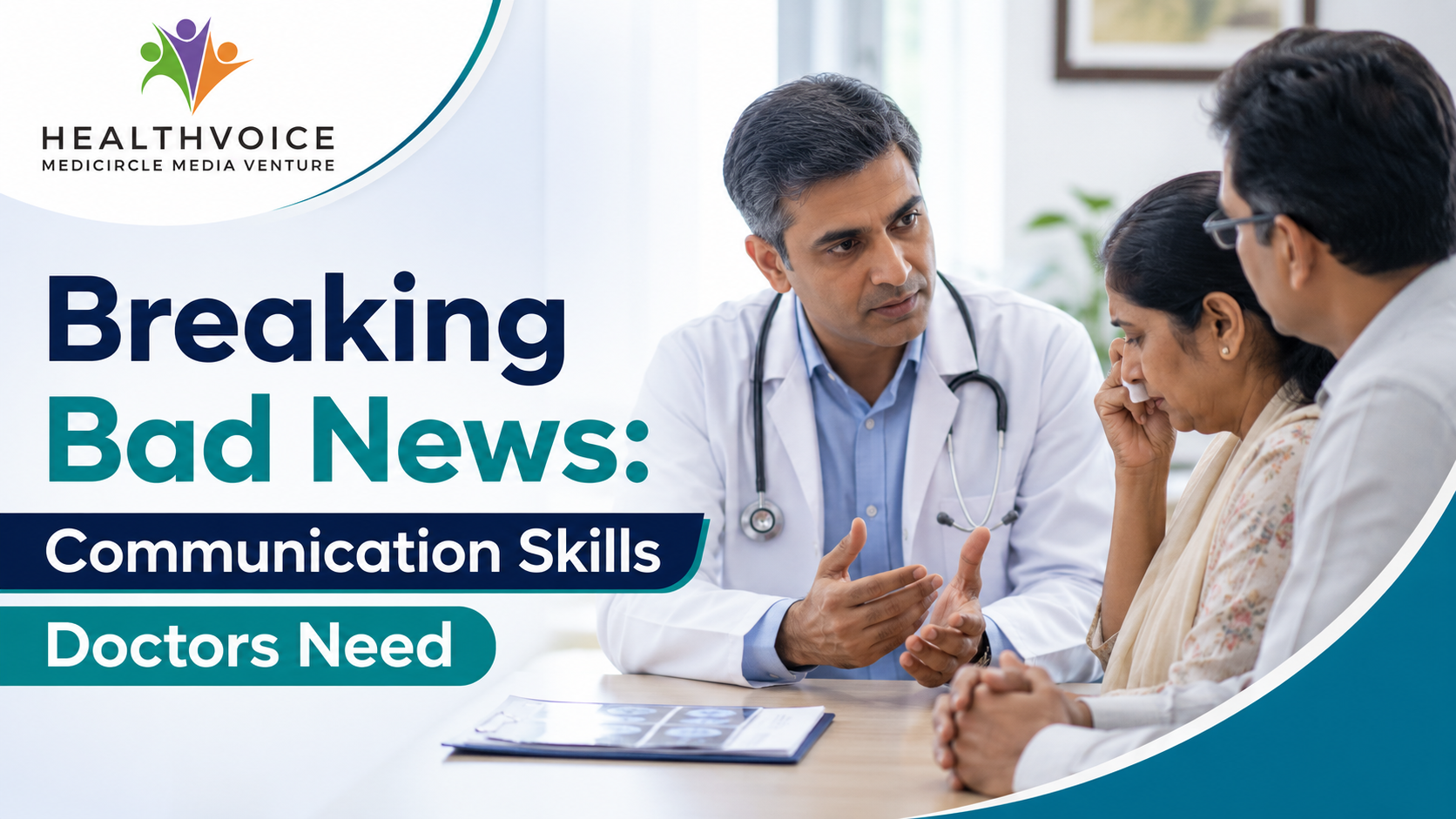
Breaking Bad News: Communication Skills Every Doctor Needs
Introduction
Every doctor, regardless of specialty, will one day have to tell a patient or family something they do not want to hear. It may be a cancer diagnosis, a failed treatment, a poor prognosis, or the loss of a loved one. This moment, often called breaking bad news, is one of the most demanding parts of clinical practice, and yet it receives strikingly little attention during formal medical training.
For doctors across India, this gap is particularly relevant. Medical colleges have traditionally focused heavily on technical and clinical competence, while communication skills training has remained optional, informal, or absent altogether. Many doctors report learning how to break bad news simply by watching seniors, without any structured feedback or guidance. This is not a small oversight. Research from Pakistan found that while 74 percent of doctors regularly delivered difficult news as part of their daily work, only 9 percent had received any formal training to do so. The consequences of this gap show up in patient dissatisfaction, complaints, and in some documented cases, even hostility directed at healthcare workers.
This article looks closely at why breaking bad news well matters so much, what makes it difficult, and how doctors can build this skill deliberately rather than leaving it to chance. It also outlines the SPIKES protocol, the most widely used framework globally for structuring these conversations, and discusses how Indian doctors can adapt these principles to the realities of local practice, from crowded outpatient departments to strong family involvement in medical decisions.
Understanding What Bad News Really Means
Bad news, in a clinical context, is any information that negatively changes a patient's view of their future. This could be a new diagnosis of a chronic or life-limiting illness, news that a treatment has not worked, a change in prognosis, or an unexpected complication. What makes something "bad news" is not the medical fact itself, but the impact it has on the person receiving it. A diagnosis of diabetes may be routine for a doctor to deliver but life-altering for the patient hearing it for the first time.
Historically, medicine took a paternalistic approach to this kind of information. Physicians often withheld diagnoses, particularly of cancer, believing that the truth would cause more harm than good. Older surveys found that a large majority of doctors routinely withheld cancer diagnoses from patients, often using vague terms instead of naming the condition directly. This approach has changed considerably. Most patients today, in India as elsewhere, want to know the truth about their condition, even when that truth is difficult. Being denied this information can increase anxiety rather than reduce it, and it undermines the trust that forms the foundation of the doctor-patient relationship.
For Indian doctors working within the National Medical Commission's competency-based framework, communication has increasingly been recognised as a core clinical skill rather than a soft add-on. This shift reflects a broader global understanding that technical excellence alone does not define good medical care.
Why Breaking Bad News Well Actually Matters
Good communication during difficult moments is not simply about being kind, though kindness matters. It has measurable effects on patient outcomes, satisfaction, and even legal risk for doctors.
Research has shown that how a clinician delivers bad news directly affects a patient's understanding of their condition, their emotional adjustment, and their satisfaction with care. When done poorly, the effects extend well beyond the immediate conversation. Ineffective communication is a well-documented driver of formal complaints and malpractice litigation. Studies from Japan and other countries have found that a substantial proportion of medical litigation cases involved insufficient or poorly delivered explanations rather than actual clinical error. In Pakistan, a contributing factor to violence against healthcare providers was found to be poor communication of bad news, an issue that resonates uncomfortably with incidents reported in Indian hospitals over the years.
On the positive side, when doctors communicate difficult news with empathy and structure, both patients and doctors benefit. Patients report better coping, greater trust, and improved treatment adherence. Doctors, in turn, report less emotional burnout and greater professional confidence. This is a skill worth building deliberately, not one to be left to instinct or chance exposure.
Common Barriers Indian Doctors Face
Several recurring barriers make breaking bad news difficult, and many of these are amplified in Indian healthcare settings.
Time pressure is one of the most significant. Outpatient departments in many Indian government and busy private hospitals see extremely high patient volumes, leaving little room for the unhurried, private conversation that difficult news deserves. Doctors are often forced to choose between spending adequate time with one patient and attending to dozens of others waiting outside.
Lack of formal training is another major factor. As the Pakistan-based study referenced earlier illustrates, the overwhelming majority of doctors rely on personal experience rather than structured education for this specific skill. Similar patterns have been observed in studies from Brazil, Ethiopia, and other lower and middle-income countries, suggesting this is a global gap in medical education rather than a uniquely Indian one, though the scale of patient volume in India makes the problem more visible.
Family dynamics add a layer of complexity that is especially relevant in the Indian context. It remains common practice in many parts of India for family members to be informed before, or sometimes instead of, the patient. Family members may request that a patient not be told the full truth, out of a desire to protect them from distress. Doctors are often caught between respecting patient autonomy, a principle strongly emphasised in modern medical ethics, and honouring family wishes that are deeply rooted in cultural norms of care and protection. Navigating this sensitively, rather than defaulting to either extreme, is one of the more nuanced skills a doctor develops over time.
Language and communication style also matter enormously in a country with as much linguistic diversity as India. A patient from a Tier 2 or Tier 3 city may feel far more comfortable receiving difficult news in their regional language, using simple and relatable terms, than in clinical English or Hindi medical jargon. Doctors working across diverse patient populations need to consciously adapt their language to the person in front of them.
Infrastructure-related barriers, such as a lack of private consultation spaces in busy wards, also make it harder to follow best practice guidance around privacy and setting, even when doctors are aware of what good practice looks like.
The SPIKES Protocol: A Structured Approach
Among the various frameworks developed globally for breaking bad news, the SPIKES protocol remains the most widely taught and used. Developed by oncologists Walter Baile, Robert Buckman, and Michael Levy, it breaks the conversation into six manageable steps.
Setting up refers to preparing the physical and emotional environment before the conversation begins. This means finding a private space wherever possible, sitting rather than standing, minimising interruptions such as phone calls or pagers, and ensuring enough time has been set aside. Even in resource-constrained Indian hospital settings, small adjustments, such as stepping into an available side room or timing the conversation for a quieter part of the day, can make a meaningful difference.
Perception involves finding out what the patient already understands about their condition before sharing new information. A simple question, such as asking what they have been told so far helps the doctor gauge the patient's existing knowledge and correct any misunderstandings before proceeding.
Invitation is about seeking the patient's permission to share information and understanding how much detail they want. Some patients want every detail explained; others prefer a more general picture. Asking directly, rather than assuming, respects the patient's autonomy and comfort level.
Knowledge is the core moment where the actual information is shared. This should be done gradually, using plain language rather than technical terms, checking in periodically to confirm the patient is following. Avoiding both excessive bluntness and false optimism is important here.
Emotions addresses the human response that follows difficult news, whether it is silence, tears, anger, or denial. Naming the emotion the doctor observes, and allowing space for it rather than rushing past it, is a core part of empathetic care. A brief pause after delivering the news, sometimes called a warning shot before the full information, can help the patient prepare emotionally.
Strategy and summary closes the conversation by outlining next steps, treatment options, and a follow-up plan, while checking that the patient has understood what has been discussed. This step reassures the patient that they are not being left alone with the news, and gives them a concrete sense of what happens next.
Studies evaluating doctors trained in SPIKES consistently show improved confidence and more structured, patient-centred conversations compared to those relying purely on instinct.
Building This Skill: What Actually Works
Communication skills for breaking bad news do not develop automatically with clinical experience. Research has specifically found that these skills do not reliably improve simply through years of practice unless there is deliberate training involved. This is an important distinction for both individual doctors and the institutions training them.
Structured workshops, ideally beginning at the undergraduate level and continuing through postgraduate training, have been shown to meaningfully improve doctors' comfort and skill. Role-play exercises, where trainees practise difficult conversations in a safe environment and receive constructive feedback, are particularly effective because they allow doctors to make mistakes and refine their approach before facing a real patient in distress.
Observing experienced colleagues remains valuable, but it works best when paired with the opportunity to ask questions and discuss what worked and what did not, rather than as a passive, one-time exposure. Some Indian medical institutions have begun incorporating communication skills modules into MBBS and postgraduate curricula, though coverage remains inconsistent across colleges. Continuing medical education sessions, workshops organised through professional associations, and peer learning groups offer additional avenues for doctors already in practice to strengthen this competency.
This is also where platforms built around doctor community and professional development have a role to play. Associations and medical communities that create space for doctors to discuss real-world challenges like breaking bad news, share approaches that have worked in their own practice, and access structured learning resources contribute meaningfully to closing this training gap. A profession that shares knowledge collectively tends to raise standards faster than one where each doctor learns in isolation.
Cultural Sensitivity in the Indian Context
Delivering bad news in India cannot be a direct copy of Western communication models, even though frameworks like SPIKES translate well in principle. Indian doctors regularly navigate situations where extended family plays an active role in decision-making, where religious and regional beliefs shape how illness and mortality are discussed, and where socioeconomic factors influence what treatment options are realistically available to discuss.
A doctor delivering a difficult diagnosis in a Tier 1 city hospital with a well-informed, English-speaking family faces a very different conversation from one delivering the same diagnosis in a smaller town where health literacy may be lower and family involvement more central to every decision. Recognising and adapting to this range, rather than applying a single rigid script, reflects genuine communication skill rather than rote protocol following.
Doctors should also remain conscious of the emotional toll this work takes on them personally. Repeatedly delivering difficult news without adequate support or reflection contributes to professional burnout, a growing concern among Indian healthcare professionals, particularly in high-volume specialties such as oncology, critical care, and emergency medicine. Peer support, mentorship, and open professional dialogue about these challenges are not indulgences; they are part of sustaining a doctor's ability to keep doing this difficult work well over a long career.
Conclusion
Breaking bad news is not a peripheral skill for doctors; it is a core part of clinical practice that shapes patient trust, treatment outcomes, and the doctor's own professional wellbeing. The evidence is consistent across countries and contexts: doctors who receive structured training and practice in this area feel more confident and deliver more compassionate, effective care than those left to rely on instinct alone.
For Indian doctors, this means recognising the gap that still exists in formal training, seeking out workshops and structured learning opportunities where available, and being willing to discuss and learn from colleagues about what genuinely works in practice. As medical education in India continues to evolve toward competency-based, patient-centred models, communication skills like these deserve the same seriousness and attention as any clinical procedure. The goal is not perfection in every conversation, but a doctor who walks into that difficult moment prepared, present, and genuinely equipped to support the person in front of them.
Frequently Asked Questions
Q1: What is the SPIKES protocol in breaking bad news?
SPIKES is a six-step communication framework used by doctors worldwide to deliver difficult news in a structured and empathetic manner. It stands for Setting up, Perception, Invitation, Knowledge, Emotions, and Strategy and summary.
Q2: Why do doctors in India often struggle with breaking bad news?
Most Indian medical curricula have historically given limited formal attention to communication skills training, so many doctors learn breaking bad news through observation and personal trial and error rather than structured teaching.
Q3: Should family members be told before the patient in Indian settings?
Family involvement is common and culturally significant in India, but the patient's autonomy and right to information should remain the guiding principle. Doctors should sensitively negotiate this with both patient and family wherever possible.
Q4: Can communication skills for breaking bad news actually be taught?
Yes. Research consistently shows that structured training, role play, and supervised practice significantly improve a doctor's comfort and competence in breaking bad news, regardless of specialty or years of experience.
Q5: What happens when bad news is delivered poorly?
Poorly delivered bad news can damage patient trust, increase anxiety and distress, contribute to complaints or litigation, and in some documented cases has been linked to violence against healthcare providers.
 Team Healthvoice
#DoctorCommunication #PatientCenteredCare
