ICU Early Warning Scores: Do Digital Systems Help Outcomes?
Digital and AI-based ICU early warning systems show mixed but promising results, with continuous monitoring and thoughtful alert design driving earlier deterioration detection over simple digitization alone.
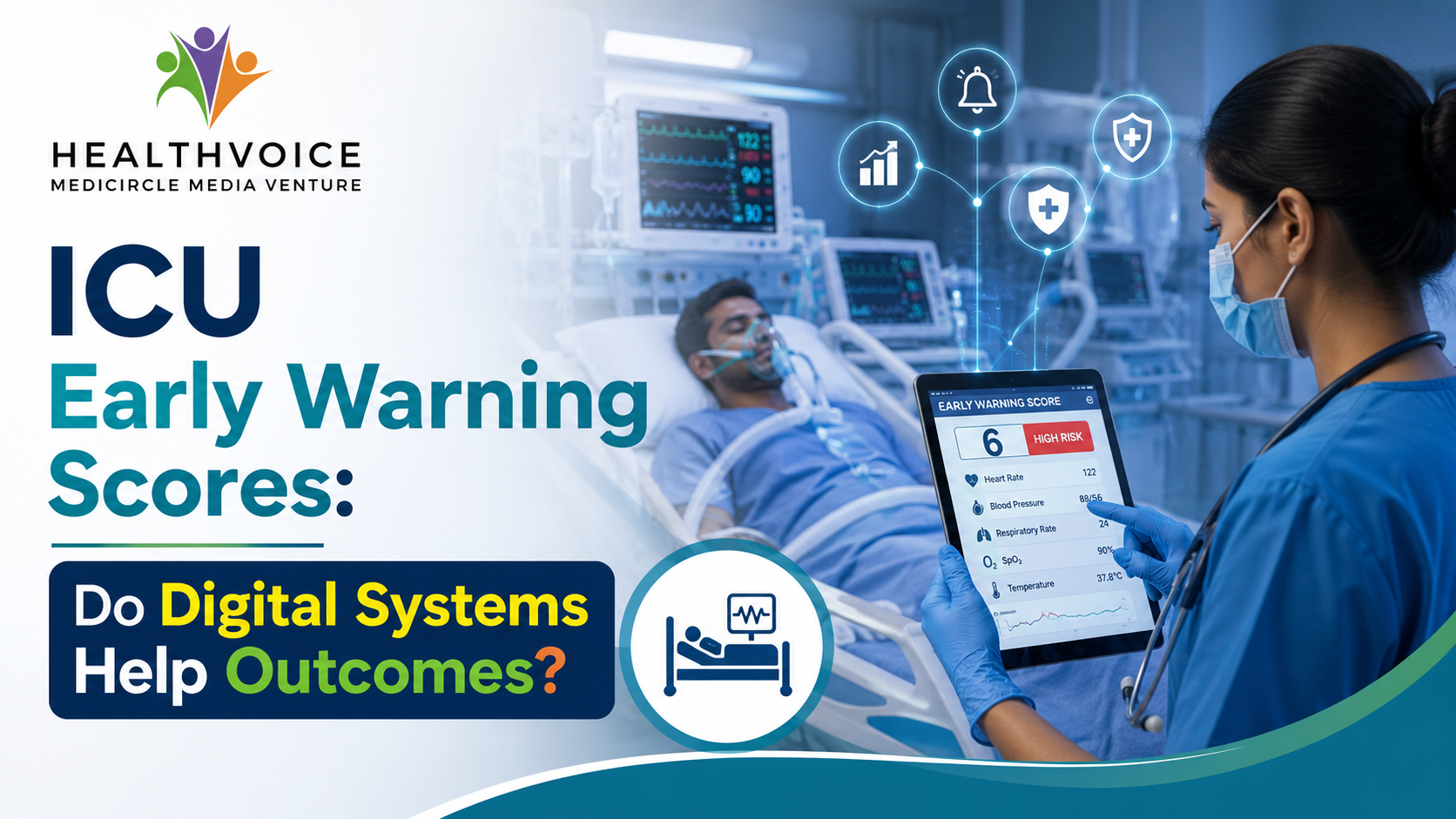
ICU Early Warning Scores: Can Digital Monitoring Improve Patient Outcomes?
Introduction
Recognizing a deteriorating patient before a crisis point is one of the oldest challenges in hospital medicine, and it remains just as pressing in the era of connected health technology. Early warning scores, commonly known as EWS, were designed to give this recognition a structure. They convert vital signs into a single number that signals rising risk and, ideally, prompts timely clinical review. Over the past decade, hospitals worldwide, including a growing number in India, have shifted from paper-based EWS charting to digital and increasingly AI-driven systems. The question that matters most to doctors, hospital administrators, and healthcare policymakers is whether this shift genuinely changes what happens to patients, or whether it simply changes how information is recorded.
This article examines what the current body of evidence says about digital early warning systems in ICU and general ward settings, why the results are more nuanced than marketing materials often suggest, and what this means for hospitals in India that are evaluating these technologies.
Understanding Early Warning Scores and Why They Exist
An early warning score aggregates several vital signs, typically heart rate, respiratory rate, blood pressure, oxygen saturation, temperature, and level of consciousness, into a composite score. Each parameter is assigned a subscore based on how far it deviates from a normal range, and the subscores are summed. When the total crosses a defined threshold, an escalation protocol is triggered, which usually means more frequent observations and a mandatory review by a senior clinician or doctor.
Systems such as the National Early Warning Score, widely used in the United Kingdom, and the Modified Early Warning Score, common across many hospitals internationally, follow this basic logic. In India, versions of MEWS and NEWS are used in several corporate and academic hospital settings, alongside locally adapted scoring protocols, particularly in ICUs and high dependency units.
The rationale is straightforward. Unrecognized deterioration is a preventable cause of harm, and a structured score reduces reliance on subjective judgment alone. However, structure on paper does not automatically translate into better bedside behavior, which is precisely where the debate around digital systems begins.
The Shift From Paper to Digital: What Changed and What Did Not
Digitizing an early warning score does three things reliably. It removes calculation errors, since the system computes the score automatically rather than relying on manual arithmetic under time pressure. It creates a permanent, timestamped record that supports audit and quality review. It also allows the data to be visualized centrally, so a nurse in charge of a ward or a rapid response team can see which patients are trending toward risk without walking to every bedside.
What digitization does not automatically guarantee is behavior change. A widely cited stepped wedge study conducted across four hospitals in the United Kingdom compared a digital early warning system against paper charting in over 12,000 admissions. The researchers found no significant difference in the time to the next observation after a triggering score, and no significant difference in hospital mortality, length of stay, or unplanned intensive care transfers between the two arms, despite strong clinical engagement with the digital tool and a good system usability score. This finding is important precisely because it complicates the assumption that going digital is inherently protective. The researchers suggested that reminders and automated calculations alone may not be sufficient to change nursing workflow unless the system also addresses timing, context, and competing clinical demands.
This does not mean digital systems are ineffective. It means the mechanism by which they help, if they help at all, is more complex than simply removing paper from the process.
Where Digital and AI-Based Systems Have Shown Real Benefit
Several other studies point to a more encouraging picture, particularly where digitization is combined with continuous monitoring or predictive modeling rather than simple automation of an existing paper score.
An Australian hospital implemented a machine learning-derived Deterioration Index alongside its existing two-tiered alert system across general wards. In a pre-post comparison involving more than 28,000 patients, the intervention group showed a statistically significant reduction in the composite outcome of death, unplanned ICU admission, or medical emergency team activation, along with a modest but significant reduction in length of hospital stay. Notably, the machine learning model also generated far fewer false alerts than the existing threshold-based system, addressing one of the most persistent criticisms of automated alerting.
A retrospective cohort study from a tertiary hospital examined a remote patient monitoring system with an automated early warning layer, comparing it against simulated versions of a conventional intermittent scoring method and a simple threshold alert system. The continuous monitoring-based system detected deterioration at least eighteen hours before ICU transfer on average, compared to roughly eleven hours for the intermittent method, while producing a more clinically manageable number of alerts per patient than a pure threshold system. This is a meaningful distinction for Indian hospitals, many of which operate with nurse-to-patient ratios that make frequent manual spot checks difficult to sustain consistently across every ward.
More recent research exploring transformer-based deep learning architectures on large ICU datasets has reported improved predictive accuracy and earlier warning windows for events such as sepsis and respiratory failure compared to both traditional scoring systems and older recurrent neural network models. These approaches remain largely at the research and validation stage rather than widespread clinical deployment, but they indicate where ICU monitoring technology is heading.
Why the Evidence Is Mixed: Three Underlying Explanations
Taken together, these studies point to three explanations for why digital early warning systems do not uniformly improve outcomes.
The first is implementation fidelity. A digital system that simply replicates an existing paper protocol, without addressing when and how alerts reach the right clinician, is unlikely to change behavior meaningfully. The UK stepped wedge study illustrates this directly, since the digital tool was well liked and usable, yet did not alter the frequency of subsequent observations.
The second is the monitoring frequency itself. Intermittent scoring, whether on paper or digitally recorded, is fundamentally limited by the gaps between observations. Continuous monitoring closes this gap and appears, across multiple studies, to detect deterioration earlier. The tradeoff is a higher raw volume of alerts, which brings the third explanation into focus.
The third is alarm design. A system with excellent sensitivity but poor specificity, as seen with simple threshold-based continuous alerting, generates so many false alerts that alarm fatigue becomes a genuine safety concern in itself. The more successful implementations, including tiered alerting with cool down periods and machine learning models that balance sensitivity against specificity, appear to preserve early detection while keeping the alert burden manageable for clinical staff.
Relevance for Indian Hospitals and the Broader Healthcare Ecosystem
India's critical care and inpatient monitoring landscape faces specific pressures that make this evidence particularly relevant. Nurse-to-patient ratios in many general wards remain below international benchmarks, and intermittent manual monitoring every four to six hours, the current standard of care in most hospitals, has been shown in the literature to carry sensitivity as low as forty percent for detecting deterioration. Tier 1 city hospitals with high patient turnover and tier 2 city hospitals, often working with leaner staffing structures, both stand to benefit from monitoring approaches that reduce dependence on manual, time-bound spot checks.
The push toward digital health infrastructure under the Ayushman Bharat Digital Mission, along with growing NABH accreditation requirements around patient safety protocols, is creating an environment where hospitals are actively evaluating electronic health record integration and clinical decision support tools. Early warning systems fit naturally into this broader digitization effort, provided hospitals approach adoption with realistic expectations rather than assuming that any digital system automatically outperforms paper-based practice.
This is also where structured knowledge sharing among doctors, hospital administrators, and medical associations becomes valuable. Understanding which implementation choices actually correlate with better outcomes, rather than adopting technology based on vendor claims alone, requires exactly the kind of peer-to-peer clinical dialogue and association-level engagement that platforms built around doctor communities are positioned to support.
Practical Considerations Before Adoption
Hospitals considering a digital or AI-enabled early warning system should look closely at a few specific factors rather than treating "digital" as a single category of intervention. It is worth examining whether the system uses continuous or intermittent data capture, since the evidence favors continuous monitoring for earlier detection. It is equally worth examining the alerting design, since a system that floods nursing staff with alerts is unlikely to be sustainable, regardless of its underlying sensitivity. Finally, integration with existing electronic medical record systems and clear escalation protocols matter as much as the underlying algorithm, since even the most accurate model provides no benefit if its alerts do not reach the right clinician at the right time.
Conclusion
The evidence on digital early warning scores does not support a simple verdict of success or failure. Some rigorously designed trials show no measurable improvement in outcomes when digitization merely replicates an existing paper process. Other studies, particularly those combining continuous monitoring with thoughtfully designed alerting or machine-learning-based risk models, show meaningful reductions in major adverse events and earlier detection of deterioration. For Indian hospitals navigating staffing constraints and an expanding digital health mandate, the practical takeaway is that the value of these systems lies less in the fact of digitization itself and more in how thoughtfully monitoring frequency, alert design, and clinical workflow are integrated together.
Frequently Asked Questions
Q1: What is an early warning score in ICU and ward settings?
An early warning score is a scoring system that converts vital sign measurements such as heart rate, respiratory rate, blood pressure, oxygen saturation, temperature, and level of consciousness into a single numerical value. A higher score indicates higher risk of clinical deterioration and typically triggers a defined escalation protocol involving more frequent observations or senior clinical review.
Q2: Do digital early warning score systems actually improve patient outcomes?
The evidence is mixed. Some large trials found no significant difference in outcomes between paper and digital charting. Other studies, particularly those using continuous monitoring or machine learning based scores, reported meaningful reductions in major adverse events and length of stay. The benefit appears to depend on implementation and workflow integration rather than digitization alone.
Q3: What is the difference between intermittent and continuous vital sign monitoring?
Intermittent monitoring involves periodic manual spot checks, typically every four to six hours. Continuous monitoring uses sensors or wearable devices to capture vital signs constantly, allowing trends to be tracked in real time. Research suggests continuous monitoring detects deterioration earlier, though it also tends to generate more alerts.
Q4: Are digital early warning systems relevant for Indian hospitals?
Yes. India's critical care burden, uneven nurse to patient ratios, and the push toward digital health infrastructure under the Ayushman Bharat Digital Mission make these systems relevant across tier 1 and tier 2 hospitals. Indian studies using remote patient monitoring have shown promising results in identifying deteriorating patients earlier than conventional spot check methods.
Q5: What is alarm fatigue and why does it matter for early warning systems?
Alarm fatigue occurs when healthcare staff are exposed to a high volume of alerts, many of which are false positives, leading to desensitization and slower response times. Well designed systems use tiered alerting and cool down periods to reduce unnecessary alerts while preserving sensitivity to genuine deterioration.
 Team Healthvoice
#ICUCare #DigitalHealth
