Why Every Doctor Needs a Digital Identity: The New Pillar of Medical Professionalism in India
Indian doctors must build credible digital identities to ensure professional visibility, patient trust, and meaningful participation in India's rapidly evolving digital healthcare ecosystem.
Introduction
A doctor's reputation has always been the foundation of a thriving practice. For generations in India, that reputation was built slowly, through word of mouth in a neighbourhood, through referrals between colleagues, through years of clinical service within a hospital or community. That foundation still matters. But it is no longer sufficient on its own.
Today, a patient in Bengaluru searching for a neurologist, a family in Jaipur looking for a trusted paediatrician, or a young professional in Pune researching a cardiologist before making an appointment. All of them begin the same way. They search online. They read profiles, check credentials, look at reviews, and form a judgment before any consultation has ever taken place. The doctor who does not have a credible, visible, and well-structured digital identity risks being overlooked entirely, regardless of how qualified or experienced they are.
This is not a trend limited to metro cities. With India's internet user base crossing 900 million and smartphone penetration deepening into Tier 2 and Tier 3 cities, the shift in how patients discover and evaluate doctors is widespread and accelerating. For the Indian medical community, building a digital identity is no longer a choice between traditional practice and modern technology. It is the new standard of professional credibility.
Understanding What a Doctor's Digital Identity Actually Means
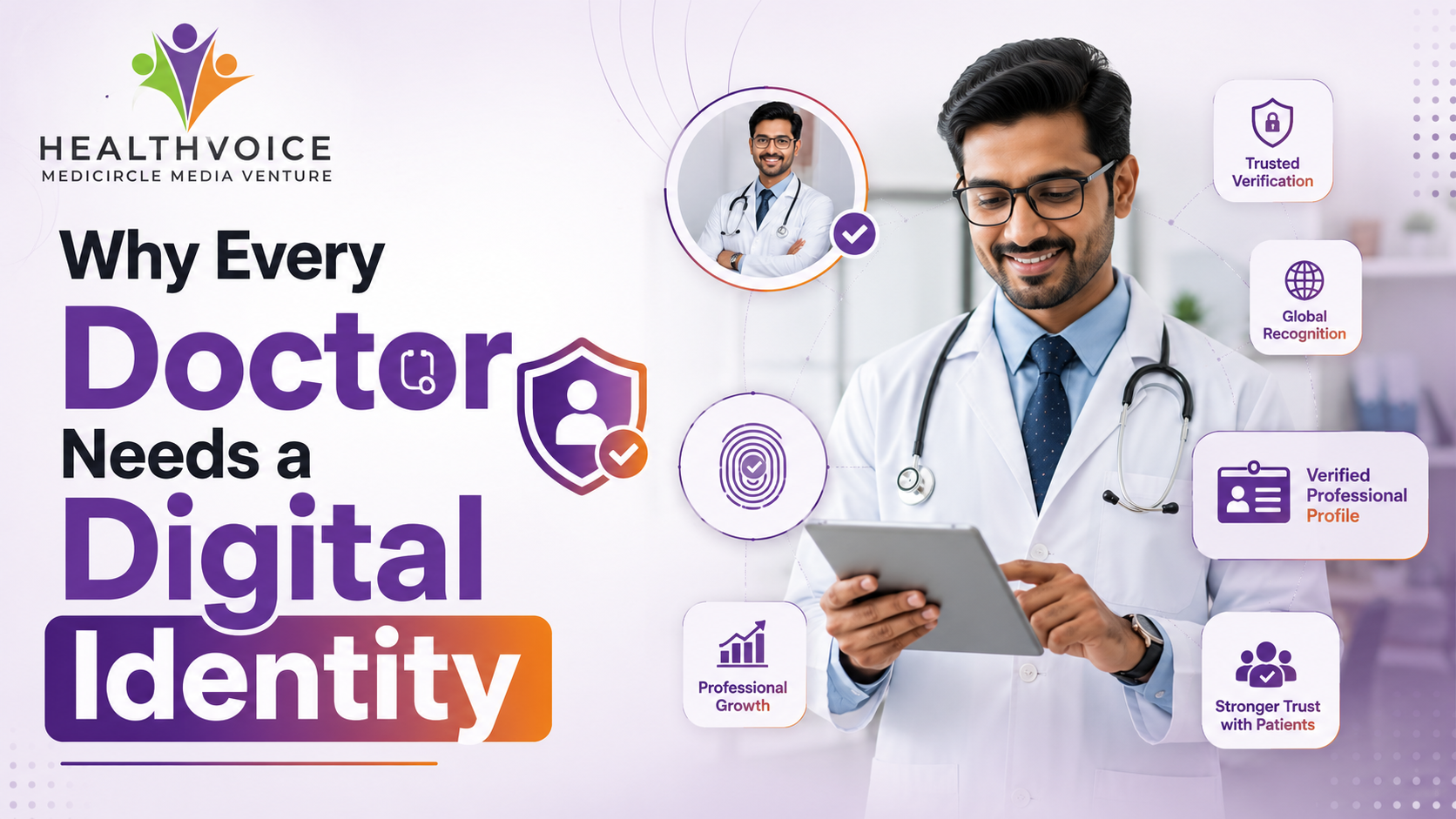
The phrase "digital identity" is often misunderstood as simply having a social media account or appearing on a directory listing. In reality, a doctor's digital identity is the complete, structured representation of their professional existence across online platforms. It encompasses verified credentials, published expertise, patient-facing communication, institutional affiliations, and the consistency with which all of this information appears when someone searches for the doctor's name or specialisation.
A well-built digital identity for a doctor in India typically includes a verified profile on the Ayushman Bharat Digital Mission (ABDM) Healthcare Professionals Registry (HPR), a professional listing on recognised healthcare platforms, a personal or practice website that reflects qualifications and services, consistent presence across medical communities and professional networks, and published content that demonstrates clinical knowledge and thought leadership.
Each of these components reinforces the others. Verification from the HPR adds authority to a listing. A professional article adds depth to a profile. A patient testimonial adds trust to a credential. Together, they create a digital footprint that is comprehensive, credible, and discoverable by those who need it most.
Why the Indian Healthcare Environment Makes This Urgent
Several forces specific to India make the case for digital identity particularly compelling for doctors practising in this country.
The National Medical Commission (NMC) has been progressively tightening standards around medical communication and professional conduct, including in digital spaces. At the same time, the ABDM is building a national digital health ecosystem in which verified practitioners are identifiable, linkable to health records, and accessible through unified platforms. Doctors who register with the HPR and maintain updated profiles are not just complying with an emerging framework; they are positioning themselves at the centre of where Indian healthcare is heading.
The burden of non-communicable diseases (NCDs) in India is also driving a surge in patients who research conditions and specialists before seeking care. According to data from the Indian Council of Medical Research (ICMR), conditions like diabetes, hypertension, cardiovascular disease, and mental health disorders are among the most searched health topics by Indian users. Specialists in these areas, in particular, face growing patient expectations around accessible information and visible expertise.
Beyond patient discovery, there is the matter of professional recognition. Doctors in India who contribute to medical associations, publish clinical insights, present at conferences, or mentor colleagues often do so without any sustained digital record of that contribution. A digital identity changes that. It allows a doctor's professional life to be documented, searchable, and shareable in ways that serve both their reputation and the broader medical community.
The Role of Credibility and EEAT in a Doctor's Online Presence
Google's search quality guidelines place significant weight on what are known as EEAT signals: Experience, Expertise, Authoritativeness, and Trustworthiness. For health-related searches, these standards are applied with particular scrutiny because the consequences of inaccurate or misleading information are serious.
What this means practically is that a doctor's online profile is not just a marketing tool. It is an information asset that search systems evaluate for credibility. A profile that includes verified qualifications, links to institutional affiliations, peer-reviewed publications or citations, and consistent engagement with reputable platforms is more likely to appear in relevant searches and be presented to patients as a trustworthy source.
This is a significant shift from the earlier model of healthcare marketing, where being listed in a printed directory or receiving referrals from a general practitioner was enough. The digital environment rewards consistency, verification, and demonstrated expertise. A doctor who has built a digital identity aligned with these principles is not just easier to find. They are more likely to be trusted before the first appointment is ever made.
Key Dimensions of a Strong Doctor Digital Identity
Building a meaningful digital identity is not a single action but a layered process. The following dimensions reflect what a credible and well-structured doctor profile should address.
Professional Verification and Registry Presence
The starting point for any doctor in India should be completing their registration with the ABDM HPR. This provides a nationally recognised, government-backed verification of qualifications, registration number, and specialisation. It is the digital equivalent of a board certification and forms the trust foundation that everything else builds upon.
Consistent Presence Across Relevant Platforms
A doctor's name, qualifications, and contact information should appear consistently across all platforms where they are listed, including healthcare directories, hospital websites, professional associations, and community networks. Inconsistencies across platforms reduce search credibility and create confusion for patients.
A Platform for Professional Voice
Perhaps the most underutilised dimension of digital identity for Indian doctors is the opportunity to publish and share expertise. Whether it is a clinical perspective on a public health issue, a commentary on a recent development in their specialisation, or an explanation of a procedure written for patients, doctors who contribute content establish themselves as authoritative voices in their field. This is precisely the space that platforms like HealthVoice are designed to support, offering doctors a structured, credible, and community-oriented environment to express their professional perspective.
Association and Community Affiliation
Medical associations in India play a vital role in professional development, advocacy, and community building. When a doctor's digital identity includes visible and active association with bodies such as the Indian Medical Association (IMA), state medical councils, or speciality societies, it adds a layer of institutional credibility that individual listings cannot provide on their own.
The Professional and Career Implications of Visibility
Digital identity is not only about patient acquisition. For many doctors in India, the implications of professional visibility extend well into career development, research collaboration, academic recognition, and leadership opportunities.
Consider the experience of doctors who present papers at national and international conferences, but whose work never reaches a broader audience because it is not shared digitally. Or practitioners in Tier 2 cities who are recognised as leaders within their local medical community but remain unknown to national institutions or pharmaceutical research partners. Or young doctors completing super-specialisation who struggle to establish themselves because they have no visible record of their training, interests, or early contributions.
A digital identity addresses each of these gaps. It allows a doctor's career to be documented progressively, with each achievement, publication, association role, or speaking engagement adding to a professional record that is searchable and shareable. In a medical landscape where recognition increasingly travels through digital channels, this matters enormously.
What Doctors Risk Without a Digital Identity
The absence of a digital identity carries specific, measurable risks for medical professionals in India.
- Patients who cannot find a doctor online may simply choose a competitor with a visible profile, regardless of whether the visible doctor is more or less experienced.
- Without a verified registry presence, doctors may be excluded from digital health platforms, telemedicine networks, or insurance empanelment processes that increasingly require ABDM-linked credentials.
- Misinformation can fill the vacuum left by an absent digital identity. If a doctor does not control their own professional narrative online, others may do it for them, inaccurately.
- Younger doctors and medical students who look for mentors, collaborators, or institutional references may overlook senior practitioners who are not discoverable in professional networks.
Each of these is a concrete, avoidable cost of digital invisibility.
How HealthVoice Supports Doctor Digital Identity
HealthVoice was built with an understanding of exactly these challenges. As a doctor-focused community platform, it provides Indian medical professionals with a structured, credible, and professionally appropriate space to build their digital presence, publish their perspectives, connect with peers and associations, and engage with the healthcare ecosystem in ways that protect and enhance their professional standing.
For individual doctors, HealthVoice offers visibility, recognition, and a platform to share knowledge and leadership. For medical associations, it provides tools for community engagement, member communication, and collective representation. The platform is not designed to replace clinical work but to ensure that the professional value of that work is visible, documented, and connected to the broader medical community.
In a time when India's healthcare system is being digitally transformed through initiatives like the ABDM and the National Health Stack, HealthVoice serves as the professional communication layer that helps doctors and associations participate meaningfully in that transformation.
Conclusion
Medical excellence has always been the core of a doctor's professional identity. But in the India of today and tomorrow, excellence alone is not enough if it remains invisible. A doctor who is skilled, dedicated, and deeply experienced but absent from the digital landscape is, in very real terms, inaccessible to a growing portion of the patient population and professional community that could benefit from their work.
Building a digital identity is not about self-promotion in the superficial sense. It is about ensuring that a doctor's professional contribution, verified credentials, clinical insights, and community leadership are represented accurately, consistently, and credibly in the spaces where people increasingly look for them. It is about giving a doctor's voice the reach it deserves.
India's medical community is at an important threshold. The infrastructure is in place through ABDM and the HPR. The patient expectation is already there. The professional opportunity is wide open. The question for every doctor is no longer whether a digital identity matters. The question is how soon they will begin building one.
Frequently Asked Questions
Q1: What is a digital identity for a doctor, and how is it different from just having a social media account?
A doctor's digital identity is a comprehensive, verified professional presence across relevant online platforms. It includes credentials registered with bodies like the ABDM Healthcare Professionals Registry, consistent listings on healthcare directories, published clinical content, and active association affiliations. A social media account is only one optional component. The core of a digital identity is verification, consistency, and professional credibility, not follower counts or post frequency.
Q2: Is registration with the ABDM Healthcare Professionals Registry mandatory for doctors in India?
As of the current framework under the Ayushman Bharat Digital Mission, registration with the HPR is strongly encouraged and is increasingly becoming a condition for participation in digital health platforms, telemedicine networks, and insurance empanelment processes. While the formal mandate continues to evolve, doctors who register early gain a verified digital identity that positions them within India's emerging national health ecosystem and builds patient trust significantly.
Q3: How does a doctor's digital identity affect patient trust and appointment decisions?
Research consistently shows that a large proportion of Indian patients now research doctors online before making an appointment, particularly in urban and semi-urban areas. A well-maintained digital identity, with verified credentials, professional affiliations, and accessible information about specialisation and services, gives patients the confidence to choose and trust a doctor before they even arrive at the clinic. Doctors without any visible digital presence often lose potential patients to less experienced but more visible competitors.
Q4: Can publishing articles or expert opinions online help a doctor professionally?
Publishing clinical insights, public health commentary, or patient education content through credible platforms is one of the most effective ways for a doctor to build topical authority and professional recognition in the digital space. It satisfies the EEAT standards that search engines apply to health content, strengthens association with professional communities, and demonstrates active engagement with the field. Platforms like HealthVoice provide a structured and editorially appropriate environment for Indian doctors to publish their professional voice.
Q5: Is building a digital identity relevant only for doctors in metro cities, or does it apply across India?
Digital identity is relevant for doctors across all locations in India. With smartphone penetration and internet access now extending well into Tier 2 and Tier 3 cities and rural areas, patients everywhere are increasingly using online platforms to discover and evaluate healthcare providers. Additionally, telemedicine has expanded the potential patient base of any doctor beyond their immediate geography, making digital visibility relevant regardless of where a doctor is based. Doctors in smaller cities who build their digital presence early often find themselves with a significant advantage over peers who have not yet done so.
RESOURCES
- Ayushman Bharat Digital Mission (ABDM): Official platform for Healthcare Professionals Registry (HPR) registration and India's national digital health ecosystem framework
- National Medical Commission (NMC): Regulatory body governing medical education and professional conduct standards for doctors in India
- Indian Council of Medical Research (ICMR): Primary body for biomedical research in India; publishes disease burden data and clinical evidence used in healthcare communication
- Ministry of Health and Family Welfare (MoHFW), Government of India: Policy updates, national health schemes, and regulatory guidelines relevant to Indian medical professionals
- World Health Organization (WHO) India Country Office: International health standards, digital health frameworks, and evidence-based guidance applicable to the Indian healthcare context
INTERLINKING KEYWORDS
doctor personal branding India, ABDM Healthcare Professionals Registry, medical association engagement, doctor thought leadership, professional visibility for doctors, telemedicine and digital health India, HealthVoice doctor community
DISCLAIMER
The information presented in this article is intended for general educational and informational purposes directed at medical professionals and healthcare stakeholders. It does not constitute legal, regulatory, or clinical advice. Doctors are advised to consult the official guidelines issued by the National Medical Commission (NMC), the Ayushman Bharat Digital Mission (ABDM), and other relevant regulatory authorities before making decisions related to their digital presence, professional registration, or compliance requirements. HealthVoice is committed to providing accurate and responsible information to the medical community.
 Team Healthvoice
#DoctorDigitalIdentity #HealthVoiceIndia