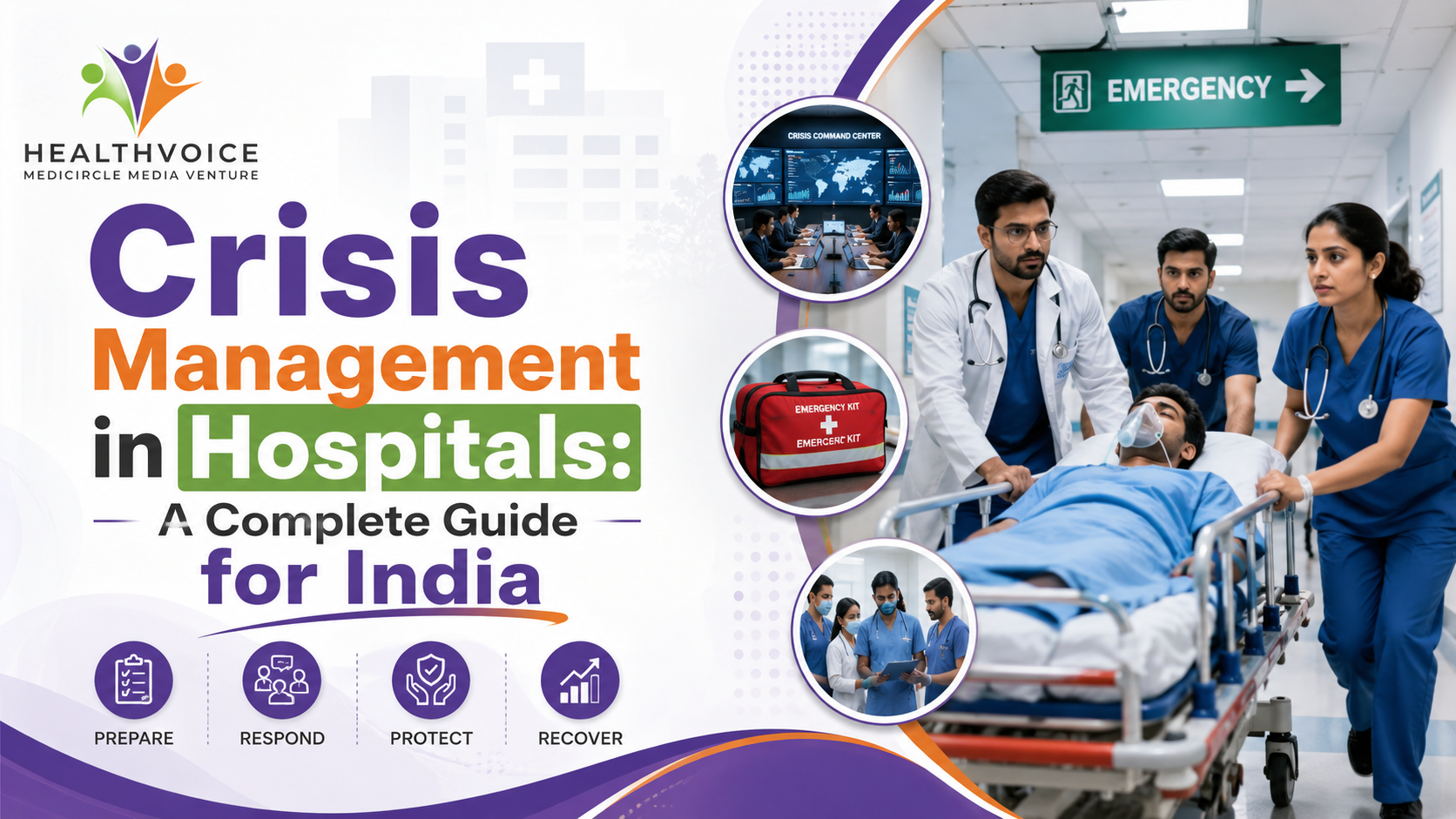
Crisis Management in Hospitals: Building Resilience Across the Indian Healthcare System
This article examines crisis management in Indian hospitals, covering preparedness, leadership response, NABH and NDMA compliance, and recovery strategies that strengthen patient safety and institutional resilience.
Introduction
Hospitals in India operate under constant pressure. A sudden building fire, a flood that cuts off access to a facility, a disease outbreak that overwhelms emergency wards, or even a prolonged power failure can disrupt patient care within minutes. Crisis management in hospitals is the structured discipline that prepares healthcare institutions to anticipate, respond to, and recover from these disruptive events without compromising patient safety or organisational stability.
For doctors, hospital administrators, and healthcare associations, crisis management is no longer an optional add-on to operations. It has become a core leadership responsibility. The COVID-19 pandemic demonstrated how quickly even well-resourced hospitals can be stretched beyond their limits, and recurring incidents such as hospital fires, cyberattacks on health information systems, and seasonal disease surges continue to test the readiness of healthcare facilities across Tier 1 and Tier 2 cities. This article examines what effective hospital crisis management looks like in the Indian context, the regulatory expectations that govern it, and the practical steps healthcare leaders can take to strengthen their institutions against future shocks.
Understanding Crisis Management in the Hospital Context
Crisis management in a hospital setting refers to the systematic approach of identifying potential threats, preparing response mechanisms, executing coordinated action during an emergency, and learning from the event afterward. It differs from routine hospital operations because it deals with low-probability, high-impact events where the usual rules of resource allocation, staffing, and communication may no longer apply.
A useful way to understand this discipline is through the concept of health system resilience, which the World Health Organization describes as the capacity of a health system to absorb, adapt, and change in response to a shock while maintaining its core functions. In practical terms, this means a resilient hospital does not simply survive a crisis. It continues functioning, adapts its processes to the new reality, and emerges better prepared for the next disruption.
In India, this concept is closely tied to two regulatory frameworks. The Disaster Management Act of 2005 established the National Disaster Management Authority, which is mandated to lay down policies and guidelines for disaster preparedness across sectors, including healthcare. Alongside this, the National Accreditation Board for Hospitals and Healthcare Providers has built specific standards that accredited hospitals must follow, covering fire safety, emergency preparedness, evacuation procedures, and staff training.
Common Triggers of Hospital Crises in India
Healthcare facilities in India face a distinct set of risks shaped by the country's geography, climate, and infrastructure realities. Recognising these triggers is the first step toward building a relevant crisis management plan.
Natural disasters remain a persistent concern, particularly in flood-prone states, cyclone-affected coastal regions, and earthquake-sensitive zones in the north and northeast. Hospital fires have also emerged as a recurring and serious threat, especially during the summer months when electrical load increases. This concern is significant enough that the Union Health Ministry and the National Disaster Management Authority have jointly issued advisories directing state health departments to strengthen fire safety compliance, and NABH has designated January as Fire Safety Month to reinforce preparedness through drills and system upgrades.
Beyond natural and physical hazards, hospitals must also prepare for public health emergencies such as disease outbreaks, mass casualty incidents following accidents or civil disturbances, cyberattacks that compromise electronic health records, and prolonged utility failures affecting oxygen supply, water, or electricity. Each of these scenarios requires a distinct but overlapping set of preparedness measures, which is why comprehensive planning rather than single-hazard planning tends to serve hospitals better in the long run.
Building an Effective Hospital Crisis Management Framework
A hospital crisis management framework generally moves through three overlapping phases: before the crisis, during the crisis, and after the crisis. Each phase demands distinct leadership actions.
Pre-Crisis Planning and Preparedness
The foundation of hospital crisis management lies in preparation that happens long before any emergency occurs. This includes conducting a vulnerability assessment specific to the hospital's location and infrastructure, drafting a written disaster management plan that covers fire, flood, mass casualty, and utility failure scenarios, and establishing a dedicated crisis management team comprising representatives from clinical departments, administration, human resources, facilities, and communications.
Regular mock drills form an essential part of this phase. A plan that exists only on paper offers little protection during an actual emergency. Hospitals accredited under NABH are expected to conduct fire evacuation drills, test backup power systems, and rehearse mass casualty triage protocols at defined intervals. Training should extend beyond doctors and nurses to include security staff, housekeeping teams, and administrative personnel, since a coordinated response depends on every member of the institution understanding their role.
Response During an Active Crisis
When a crisis unfolds, the speed and clarity of the hospital's response often determines the outcome as much as the clinical care itself. Effective response requires immediate activation of the crisis management team, a clear chain of command that avoids confusion about decision-making authority, and a triage system that sorts patients according to the urgency of their medical needs rather than order of arrival.
Communication during this phase deserves particular attention. Hospital leadership should ensure that accurate information reaches staff, patients, families, and where relevant, the media and regulatory authorities, through consistent and repeated messaging across multiple channels. Ambiguity or delayed communication during a crisis tends to generate more distress than the crisis itself, so transparency paired with calm, factual updates helps maintain trust across all stakeholder groups.
Resource management is equally critical. Hospitals need pre-identified backup arrangements for essential supplies such as oxygen, medicines, blood products, and emergency equipment, along with mutual aid agreements with neighbouring facilities that can absorb overflow patients if the primary site becomes overwhelmed.
Post Crisis Recovery and Evaluation
Once the immediate emergency has passed, hospitals must shift focus toward recovery and honest evaluation. This includes restoring normal operations, addressing the physical and psychological wellbeing of staff who worked through the crisis, and conducting a structured after-action review to identify what worked well and what needs improvement.
This evaluation phase should feed directly back into the pre-crisis planning stage, creating a continuous cycle of learning rather than a one-time response document that gathers dust until the next emergency. Hospitals that treat each crisis as a source of institutional learning tend to show measurably stronger preparedness scores in subsequent assessments.
Leadership and the Human Side of Crisis Management
Strong crisis management in hospitals depends heavily on leadership behaviour, not only on written protocols. Healthcare leaders are expected to remain visible and accessible during emergencies, make decisions under uncertainty without excessive delay, and balance the operational demands of the crisis with genuine concern for the wellbeing of frontline staff.
Burnout among doctors and nurses is a well-documented consequence of prolonged crisis response, and leadership that ignores staff exhaustion risks compounding the crisis rather than resolving it. Encouraging peer support systems, ensuring adequate rest rotations even during emergencies, and acknowledging the emotional toll of crisis work are practices that experienced hospital administrators increasingly build into their response plans.
Ethical dilemmas also surface frequently during healthcare crises, particularly around the allocation of limited resources such as ventilators, intensive care beds, or medicines. Hospitals benefit from establishing ethical guidelines and triage frameworks in advance, so that difficult decisions during an actual crisis are guided by pre-agreed principles rather than made under pressure without any reference point.
Regulatory and Institutional Support in India
Indian hospitals do not need to build crisis management frameworks in isolation. Several institutional structures exist to support this work. The National Disaster Management Authority, headed by the Prime Minister of India, is mandated to lay down policies and guidelines for disaster management across the country, including detailed guidelines for medical preparedness and mass casualty management developed with clinical experts. NABH accreditation standards similarly require hospitals to maintain fire detection systems, evacuation procedures, and structured emergency preparedness programmes as a condition of accreditation.
Despite these frameworks, studies assessing hospital preparedness across India point to inconsistent compliance. Research examining tertiary care hospitals in eastern India found that a considerable share of institutions do not maintain updated disaster preparedness protocols, with meaningful variation in preparedness linked to accreditation status and hospital size. This gap between regulatory expectation and on-ground implementation is precisely where healthcare leadership, association-level advocacy, and continued professional education can make a measurable difference.
Healthcare associations and professional bodies have an important role to play here as well, by facilitating knowledge sharing among member hospitals, organising joint training programmes, and creating platforms where doctors and administrators can discuss real preparedness challenges openly. Communities such as HealthVoice, which connect doctors, associations, and healthcare institutions, offer a natural space for this kind of collaborative learning, allowing hospitals to learn from each other's crisis experiences rather than repeating the same preventable gaps in isolation.
Practical Steps Hospitals Can Take Today
While comprehensive crisis management frameworks take time to build, several practical steps can strengthen preparedness in the near term.
- Conduct a documented fire and structural safety audit at least once a year, with particular attention during the summer months when electrical load and fire risk both increase.
- Form a named crisis management team with clearly assigned roles, rather than an informal group that only comes together during an actual emergency.
- Schedule mock drills for fire evacuation, mass casualty triage, and power failure response, and document the outcomes to identify recurring weaknesses.
- Maintain updated contact lists, backup communication channels, and mutual aid arrangements with nearby hospitals.
- Review the crisis management plan after every real incident, however minor, and update it based on lessons learned.
These steps will not eliminate risk entirely, but they meaningfully reduce the chances of confusion and delay when an actual crisis occurs.
Conclusion
Crisis management in hospitals is ultimately about protecting two things at once: patient safety and institutional trust. Indian healthcare facilities face a genuinely wide range of risks, from fires and floods to disease outbreaks and cyber threats, and no single template can address every scenario. What consistently distinguishes better prepared hospitals is not the absence of risk but the presence of structured planning, trained leadership, honest post-crisis evaluation, and a culture that treats preparedness as an ongoing responsibility rather than a compliance checkbox. As India's healthcare system continues to grow in scale and complexity, the hospitals that invest seriously in crisis management today will be the ones best placed to protect their patients, their staff, and their communities when the next emergency arrives.
Frequently Asked Questions
Q1: What is crisis management in hospitals?
Crisis management in hospitals refers to the structured planning, response, and recovery processes that healthcare facilities use to manage sudden emergencies such as natural disasters, mass casualty events, disease outbreaks, or infrastructure failures while continuing to deliver patient care.
Q2: Why is crisis management important for Indian hospitals?
India faces frequent natural disasters, disease outbreaks, and infrastructure challenges. Effective crisis management helps hospitals maintain patient safety, comply with NABH and NDMA requirements, and protect staff and community trust during emergencies.
Q3: What is the role of NABH in hospital crisis preparedness?
The National Accreditation Board for Hospitals and Healthcare Providers requires accredited hospitals to maintain fire safety systems, disaster management plans, evacuation procedures, and regular staff training as part of their preparedness standards.
Q4: Who should be part of a hospital crisis management team?
A hospital crisis management team typically includes hospital administrators, medical and nursing leadership, human resources, communication officers, facility and engineering staff, and representatives from the board or governing body.
Q5: How often should hospitals in India test their crisis management plans?
Hospitals should conduct mock drills, fire safety evaluations, and disaster simulation exercises at least twice a year, with additional drills during high-risk periods such as summer months or monsoon season.
Resources
- National Disaster Management Authority (NDMA): Guidelines for Medical Preparedness and Mass Casualty Management
- National Accreditation Board for Hospitals and Healthcare Providers (NABH): Fire Safety and Emergency Preparedness Standards
- World Health Organization: Guidance on Health System Resilience
- Disaster Management Act, 2005, Government of India
- BMC Emergency Medicine Study on Hospital Disaster Preparedness Using the WHO Safety Index in Eastern India
Interlinking Keywords
hospital disaster management, NABH accreditation standards, healthcare crisis leadership, hospital fire safety, patient safety protocols, healthcare emergency preparedness, hospital administration India, medical association engagement
Last medically reviewed by:
Editorial Team, HealthVoice on August 10, 2026
Medical Disclaimer:
This article is intended for general informational and educational purposes only and does not constitute medical, legal, or regulatory advice. Hospital administrators and healthcare leaders should consult official NABH and NDMA guidelines and qualified professionals before implementing any crisis management protocol. HealthVoice does not assume responsibility for outcomes resulting from the application of information contained in this article.
 Team Healthvoice
#HospitalCrisisManagement #HealthcareEmergencyPreparedness