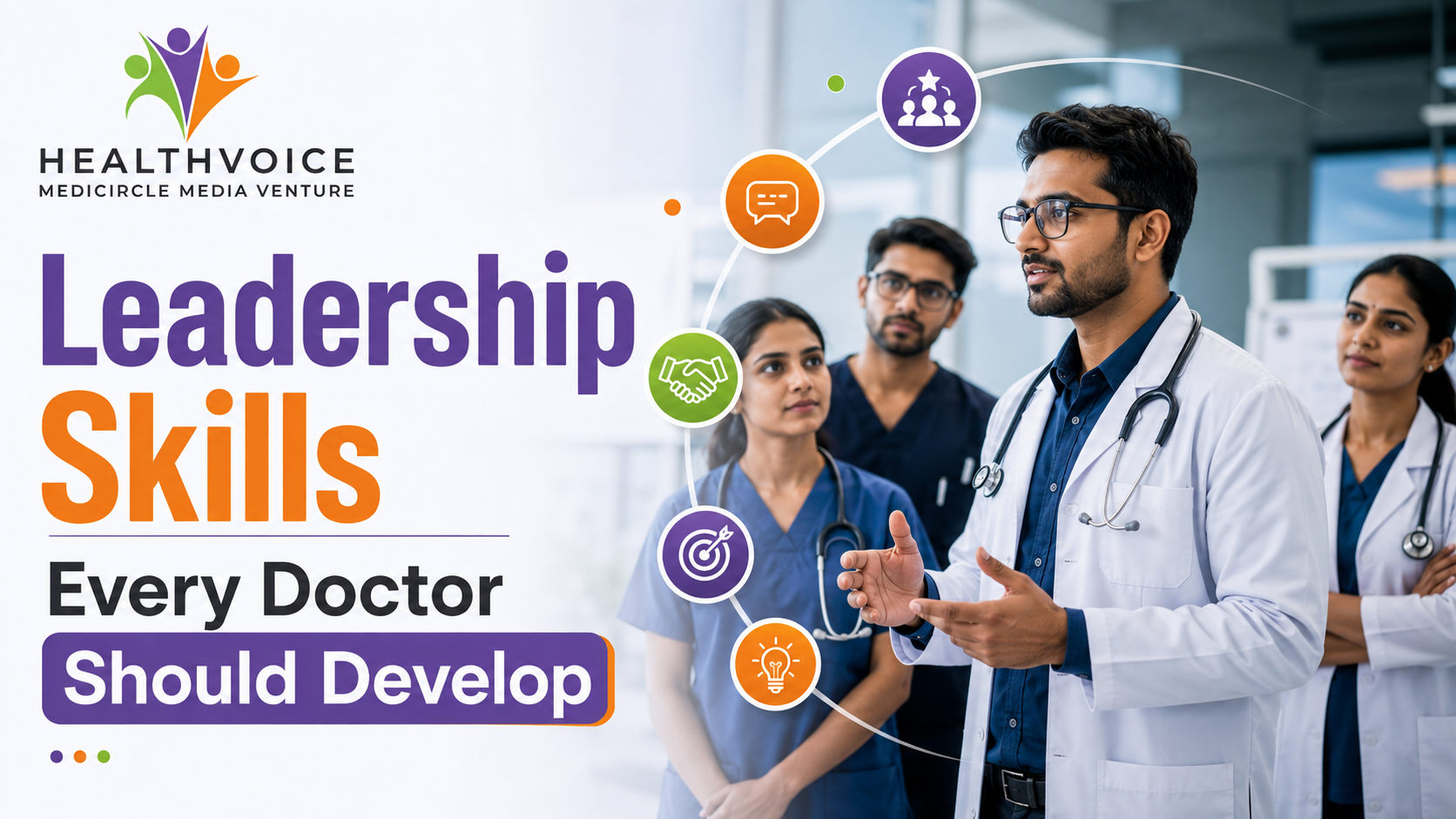
Leadership Skills Every Doctor Should Develop: A Professional Guide for the Modern Indian Physician
This article explores the essential leadership skills every Indian doctor should develop, covering communication, emotional intelligence, strategic thinking, team leadership, and digital adaptability for modern medical practice.
Introduction
The role of a doctor has never been purely clinical. From the moment a physician enters a consultation room, a ward, or an operating theatre, they are exercising influence, making decisions under uncertainty, and shaping outcomes for patients who are often at their most vulnerable. In India, where the healthcare system serves over 1.4 billion people and is rapidly transforming through initiatives such as Ayushman Bharat and the Ayushman Bharat Digital Mission (ABDM), the expectations placed on doctors extend well beyond diagnostic accuracy and procedural skill.
Today, doctors are expected to lead. They coordinate multidisciplinary teams, navigate institutional systems, communicate with administrators, engage with patient families, and contribute to the quality and safety culture of their hospitals and clinics. Yet, as research consistently shows, medical education across the world, including in India under the National Medical Commission (NMC) curriculum, has traditionally prioritised clinical training over leadership development. The result is that many talented, hardworking doctors reach senior positions without the structured leadership competencies they need to thrive.
This article addresses that gap. It outlines the leadership skills that every doctor should develop, explains why these skills matter in the Indian healthcare context, and offers a practical perspective on how medical professionals can begin building them intentionally.
Understanding Medical Leadership: What It Means for Doctors Today
Before exploring specific skills, it is worth clarifying what leadership actually means for a doctor. Leadership in medicine is not confined to those who hold administrative titles, serve as department heads, or sit on hospital boards. Every doctor who coordinates a care team, mentors a junior colleague, communicates a difficult diagnosis, or advocates for a patient's treatment plan is exercising leadership.
The Medical Leadership Competency Framework (MLCF), developed in the United Kingdom's National Health Service and widely referenced in global medical education literature, identifies five core domains of medical leadership: demonstrating personal qualities, working with others, managing services, improving services, and setting direction. These five domains together offer a useful structure for thinking about what it means to lead well as a physician.
In India, the relevance of these domains is amplified by the scale and complexity of the healthcare environment. Public hospitals in metro cities such as Delhi, Mumbai, and Chennai routinely manage patient volumes that far exceed their designed capacity. Tier 2 cities are seeing rapid growth in private healthcare infrastructure. Rural doctors often function as the only available medical authority across vast areas. In every one of these contexts, leadership is not optional. It is a daily necessity.
Core Leadership Skills Every Doctor Should Build
Effective Communication Across Clinical and Non-Clinical Contexts
Communication is at the heart of medical leadership. A doctor who can communicate clearly, compassionately, and with precision creates the conditions for better care at every level of the system. Effective medical communication extends across multiple directions.
With patients and their families, it means explaining diagnoses, treatment plans, and prognoses in language that is honest, accessible, and respectful of cultural and emotional context. In India's diverse linguistic landscape, this also means being sensitive to regional language preferences, health literacy levels, and family decision-making structures. With clinical teams, it means issuing clear instructions, maintaining situational awareness, and creating an environment where team members feel safe raising concerns. With hospital administrators, it means articulating clinical priorities in terms that align with operational and financial realities.
Doctors who do not invest in communication skills often find that clinical excellence alone is not enough to earn the trust of patients, the respect of colleagues, or the confidence of institutions. Poor communication is also one of the most cited causes of medical errors and patient dissatisfaction in both global and Indian healthcare literature.
Emotional Intelligence and Self-Awareness
Emotional intelligence, often abbreviated as EI, refers to the capacity to recognise, understand, and manage one's own emotional responses while also being attuned to the emotions of others. For doctors, this is an extraordinarily practical skill. Clinical environments are inherently stressful. High patient loads, end-of-life care, family conflict, resource shortages, and professional pressure all create emotional demands that accumulate over time.
A doctor with high emotional intelligence approaches these situations differently. They remain composed under pressure, resolve interpersonal conflicts constructively rather than escalating them, and sustain empathy even in the face of system fatigue. Research by Daniel Goleman, whose work on emotional intelligence has been widely applied in healthcare leadership education, identifies self-awareness, self-regulation, motivation, empathy, and social skill as the five components of EI. Each of these has direct application in medical practice.
In the Indian context, where doctor-patient ratios remain low relative to global benchmarks, where burnout rates among resident doctors have attracted increasing attention, and where professional hierarchies can sometimes discourage open communication, emotional intelligence is particularly valuable. Doctors who develop it are not only more effective leaders. They are also more resilient professionals.
Decision-Making Under Pressure and Uncertainty
Doctors make decisions under pressure every day. But leadership-level decision-making involves more than clinical judgment. It requires the ability to weigh multiple factors simultaneously, including patient welfare, team capacity, resource availability, institutional policy, and ethical obligations.
Consider the situations faced by doctors at the frontlines of the COVID-19 pandemic in India during 2020 and 2021. Physicians in both public and private hospitals had to make real-time decisions about ventilator allocation, team safety protocols, resource prioritisation, and patient communication, often without adequate information and under conditions of acute stress. The doctors who navigated those situations most effectively were those who combined clinical competence with clear decision-making frameworks, calm under pressure, and the ability to communicate decisions transparently to their teams.
Building this kind of decision-making capability requires deliberate practice. Simulation training, structured case discussions, and involvement in clinical governance processes are all effective ways for doctors to develop their capacity for high-stakes decision-making.
Team Leadership and Collaborative Management
Modern healthcare delivery is fundamentally a team-based enterprise. No single doctor, however skilled, can provide comprehensive care for a patient without the contribution of nurses, pharmacists, laboratory technicians, physiotherapists, social workers, and administrative staff. In India, where health workforce shortages are a documented challenge and multidisciplinary care is expanding, particularly in oncology, cardiology, and critical care, the ability to lead teams effectively is a critical professional competency.
Effective team leadership in medicine involves several distinct capacities:
- Delegating tasks appropriately based on the skills and confidence of each team member
- Creating a psychologically safe environment where team members raise concerns without fear
- Providing constructive feedback that builds competence rather than creating anxiety
- Recognising and acknowledging the contributions of every member of the care team
The ability to build cohesive, high-performing clinical teams has a measurable impact on patient outcomes. Studies consistently show that hospitals with stronger team cultures have lower rates of medical errors, hospital-acquired infections, and staff turnover.
Strategic Thinking and Systems Awareness
Doctors who develop strategic thinking skills are able to look beyond the immediate clinical encounter and understand how their decisions interact with the broader healthcare system. This includes awareness of health policy, institutional operations, quality improvement processes, and the economic realities of healthcare delivery.
In India, this kind of systems thinking has become increasingly valuable as the government expands health coverage through programmes such as Ayushman Bharat Pradhan Mantri Jan Arogya Yojana (AB-PMJAY) and as National Accreditation Board for Hospitals and Healthcare Providers (NABH) accreditation becomes a more common benchmark for hospital quality. Doctors who understand how accreditation processes work, how quality metrics are measured, and how clinical decisions translate into resource implications for their institutions are far better positioned to contribute meaningfully to organisational leadership.
Conflict Resolution and Negotiation
Healthcare environments generate conflict. Disagreements arise between specialists over treatment approaches, between clinical teams and administrative teams over resource allocation, and between doctors and patient families over care decisions. The ability to navigate these situations without damaging relationships or compromising patient care is an important leadership skill.
Doctors who approach conflict with curiosity rather than defensiveness, who listen before responding, and who seek solutions that respect the legitimate concerns of all parties, build institutional trust over time. In the Indian context, where hierarchical norms can sometimes suppress open disagreement, doctors who model constructive conflict resolution set a standard that benefits their entire team.
Mentoring and Teaching as Leadership in Action
Every senior doctor who invests in the development of a junior colleague is exercising leadership. Mentoring is one of the oldest and most effective leadership development methodologies in medicine. Research cited in the Medical Leadership Competency Framework literature identifies mentoring as a key driver of career development, professional identity formation, and institutional knowledge transfer.
In India, where the ratio of experienced medical educators to students and residents is under pressure, structured mentoring is particularly important. Doctors who take the time to guide MBBS students, interns, and postgraduate residents through clinical challenges, professional decisions, and career planning are contributing directly to the quality of the next generation of the medical workforce.
Adapting to Technology and Digital Healthcare
India's healthcare system is undergoing a significant digital transformation. The ABDM is building a national digital health ecosystem, telemedicine has expanded dramatically following its formalisation through the Telemedicine Practice Guidelines issued by the Ministry of Health and Family Welfare and the Board of Governors in supersession of the Medical Council of India in 2020, and artificial intelligence is beginning to demonstrate real-world applications in radiology, pathology, and early disease detection.
Doctors who develop digital literacy, not necessarily as technology experts but as informed users and advocates, are better placed to contribute to this transformation. This includes understanding how electronic health records function, how telehealth platforms can extend access to care in underserved areas, and how AI-supported diagnostic tools should be used responsibly within clinical workflows. Leadership in this space means neither uncritical adoption nor reflexive resistance. It means informed, evidence-based engagement.
How Doctors Can Develop Leadership Skills
Leadership development for doctors is not a one-time intervention. It is a continuous process that builds over the course of a career through a combination of experience, reflection, mentorship, and structured learning.
Postgraduate management programmes, such as those offered by institutions combining clinical and management education, provide formal grounding in healthcare leadership theory and practice. Professional communities and platforms that bring doctors together to share knowledge, engage in peer discussion, and build institutional relationships also play a vital role. Platforms such as HealthVoice offer doctors a structured environment in which to build their professional voice, engage with medical associations, and participate in conversations that shape the direction of healthcare in India. This kind of structured professional engagement is itself a form of leadership development, one that builds confidence, visibility, and the kind of networked influence that modern medical careers require.
Participation in quality improvement committees within hospitals, engagement with medical associations, involvement in clinical audit processes, and mentoring relationships with senior doctors all contribute meaningfully to leadership growth. The common thread across all of these is deliberate engagement: leadership skills do not develop by accident.
Conclusion
The doctor of the twenty-first century is more than a healer. In India's rapidly evolving healthcare landscape, doctors are being called upon to lead teams, build systems, shape policy, and serve as the most trusted voices in one of the most consequential fields of human endeavour. Leadership skills are not supplementary to this role. They are integral to it.
Communication, emotional intelligence, strategic thinking, team leadership, conflict resolution, mentoring, and digital adaptability are competencies that can be learned, practised, and refined. Doctors who invest in them do not become less clinical. They become more effective clinicians, because they understand the full context in which good clinical care happens.
HealthVoice is built for doctors who want to develop this kind of professional depth. A platform dedicated to amplifying doctor voices, supporting association engagement, and building meaningful healthcare communities, HealthVoice offers medical professionals in India a space where leadership is not just encouraged but practised every day.
Frequently Asked Questions
Q1: Why is leadership important for doctors in India?
Indian healthcare systems are growing rapidly in complexity. Doctors today lead multidisciplinary teams, manage limited resources, and interact with hospital administrators, regulatory bodies, and patients at the same time. Without leadership skills, even clinically brilliant doctors can struggle to achieve consistent, high-quality outcomes in institutional settings.
Q2: Can leadership skills be formally learned by doctors?
Yes. Leadership skills are learnable competencies, not fixed personality traits. Doctors can develop them through mentoring relationships, structured leadership programmes, postgraduate management courses, clinical team experiences, and professional communities such as HealthVoice that facilitate knowledge sharing and peer engagement.
Q3: What is the most important leadership skill for a doctor?
While all leadership competencies matter, effective communication stands out as foundational. It influences patient trust, team coordination, and institutional relationships. A doctor who communicates clearly reduces errors, builds stronger care relationships, and creates a more collaborative environment for the entire healthcare team.
Q4: How does emotional intelligence contribute to a doctor's leadership effectiveness?
Emotional intelligence helps doctors understand their own reactions and empathise with patients, families, and team members. In high-pressure clinical situations, emotionally intelligent doctors remain composed, resolve conflicts constructively, and build a team culture based on mutual respect and trust, which directly improves care delivery and staff retention.
Q5: How can HealthVoice support doctors in developing their leadership identity?
HealthVoice provides doctors with a credible digital platform to share their expertise, engage with peer communities, participate in professional conversations, and build visibility within medical associations and the broader healthcare ecosystem. This kind of structured professional engagement is itself a meaningful part of leadership development.
Resources
- National Medical Commission (NMC): Regulatory body for medical education in India; publishes competency-based medical education frameworks applicable to leadership development in undergraduate and postgraduate curricula.
- PubMed / National Library of Medicine (pubmed.ncbi.nlm.nih.gov): Peer-reviewed research on medical leadership, including studies on leadership competency frameworks, emotional intelligence in medicine, and leadership education outcomes.
- World Health Organization (WHO), India Country Office (who.int/india): Publishes reports on healthcare workforce development, health system strengthening, and leadership capacity building in low and middle-income countries.
- National Accreditation Board for Hospitals and Healthcare Providers (NABH) (nabh.co): Sets quality and safety standards for Indian hospitals; awareness of NABH processes is directly relevant to doctors developing systems-level leadership thinking.
- Ayushman Bharat Digital Mission (ABDM) (abdm.gov.in): India's national digital health initiative; essential reference for doctors developing competency in digital healthcare leadership.
Interlinking Keywords
doctor professional development, medical leadership in India, healthcare team management, clinical communication skills, emotional intelligence in medicine, NABH accreditation for doctors, Ayushman Bharat Digital Mission, mentoring in medicine, doctor career growth, healthcare quality improvement
Last reviewed by:
HealthVoice Editorial and Medical Advisory Team on August 05, 2026
Medical Disclaimer:
This article is intended for informational and professional development purposes only. It does not constitute medical advice, clinical guidance, or a substitute for formal medical education or training. Doctors and healthcare professionals are advised to seek accredited programmes and qualified mentors for structured leadership development. HealthVoice does not endorse any specific institution, course, or programme unless explicitly stated.
 Team Healthvoice
#MedicalLeadership #DoctorLeadership