Exams or Evacuation? The Impossible Choice Facing Indian Medical Students in Iran
If this episode leads to durable reforms in how India manages overseas medical education during geopolitical crises, it may serve as a turning point
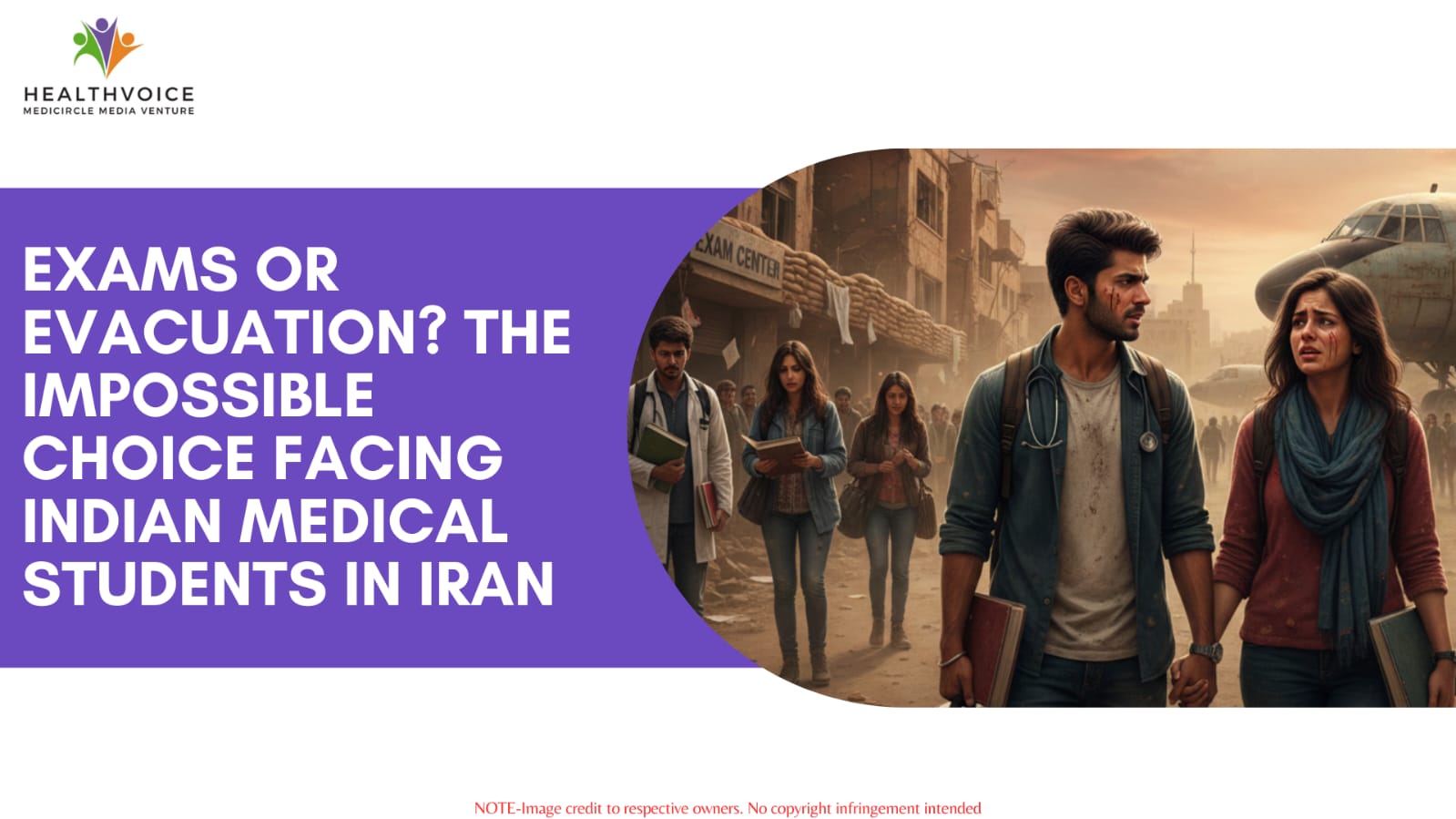
For thousands of Indian medical students pursuing their MBBS degrees overseas, the white coat has always symbolised aspiration, discipline, and service. In recent weeks, however, that aspiration has been overshadowed by anxiety. As geopolitical tensions escalate in parts of West Asia, Indian students studying medicine in Iran find themselves confronting a question no young professional should ever have to answer: should they stay back for university examinations or prioritise personal safety and return home?
The All India Medical Students Association–Foreign Students Wing has now appealed to the Union government to intervene decisively. The organisation has sought urgent coordination between the Indian Embassy in Tehran and Iranian universities to defer upcoming examinations for Indian students. At the same time, it has called for structured evacuation support and assurances that academic progression will not be derailed by circumstances beyond a student’s control. The request, addressed to Prime Minister Narendra Modi, reflects a wider concern within India’s medical education community about the fragile intersection of international mobility, medical training abroad, and student safety.
The situation gained urgency after the Embassy of India in Tehran advised Indian nationals to leave the country in view of evolving security conditions. When a government advisory recommends departure, it places students in an impossible position. Medical education abroad is already a demanding path. It involves substantial financial investment, cultural adjustment, language adaptation, and compliance with regulatory requirements set by both the host country and Indian authorities such as the National Medical Commission. Adding a security crisis to this equation creates layers of stress that extend far beyond examination halls.
Iran has long been one of the destinations for Indian students seeking affordable medical education overseas. Several universities in cities such as Tehran, Shiraz, and Isfahan host Indian cohorts pursuing MBBS-equivalent degrees. For many middle-class families, studying medicine abroad is a calculated decision shaped by limited government medical seats in India, high private college fees, and competitive entrance examinations. Students who choose this route often do so with a clear plan: complete their degree, clear the Foreign Medical Graduate Examination or National Exit Test in India, and return to serve in the Indian healthcare system. The current crisis interrupts that carefully constructed roadmap.
This development cannot be viewed in isolation. India already faces a complex healthcare workforce challenge. While the doctor–patient ratio has improved over the years, distribution remains uneven, particularly in rural and semi-urban areas. Overseas-trained Indian medical graduates constitute a meaningful segment of the future medical workforce. Disruptions in their training have long-term implications for healthcare delivery, medical manpower planning, and specialist pipelines. When examinations are delayed or semesters are disrupted, the ripple effects extend to internship schedules, licensure eligibility, postgraduate entrance timelines, and ultimately, patient care capacity.
The psychological burden on students deserves equal attention. Medical education is inherently rigorous. Add geopolitical uncertainty, news alerts, family distress back home, and logistical confusion, and the emotional toll intensifies. Many students report difficulty concentrating on study material when evacuation advisories are circulating. Parents, already stretched financially to support overseas education, struggle with fear for their children’s safety. In such circumstances, insisting that examinations proceed as scheduled risks prioritising procedural continuity over human security.
The appeal from the All India Medical Students Association–Foreign Students Wing expresses that safety must precede assessment. Academic calendars can be recalibrated. Examination timetables can be revised. Supplementary exams, online proctored assessments, or deferred schedules can be designed. What cannot be restored easily is life or physical well-being. In global higher education, contingency planning has become standard practice. Universities worldwide have developed emergency academic frameworks during pandemics, conflicts, and natural disasters. The COVID-19 era demonstrated that large-scale digital examination models, hybrid learning systems, and flexible evaluation policies are possible when institutions are willing to adapt.
The request for government coordination is therefore a growing expectation that host institutions and home governments collaborate when international students face security threats. Diplomatic engagement can facilitate dialogue with university administrations to ensure that Indian students are neither penalised for leaving nor compelled to remain in high-risk zones. Such coordination can also establish mechanisms for rescheduled exams once stability returns, thereby protecting academic continuity without compromising safety.
Each year, thousands of Indian students travel to countries such as Russia, Ukraine, China, the Philippines, and Iran to pursue medical degrees. Recent geopolitical events in different parts of the world have repeatedly exposed the vulnerability of this model. Evacuations during conflict situations have required massive logistical efforts. Students have faced disruptions in coursework, clinical exposure gaps, and uncertainty about degree recognition. The present developments in Iran are part of a pattern that demands structural policy thinking.
One approach involves creating pre-emptive academic contingency agreements between the Government of India and countries hosting large numbers of Indian medical students. Such agreements could outline protocols for exam postponement, remote assessments, academic credit transfer, and emergency repatriation. Another strategy involves strengthening domestic medical education capacity so that dependence on overseas seats reduces over time. Expansion of government medical colleges, rationalisation of private medical college fees, and transparent entrance processes are steps already underway, yet the demand–supply gap persists.
The call for evacuation support is equally pressing. When embassies issue advisories urging departure, students often scramble to secure flights, manage finances, and coordinate with local authorities. A structured evacuation plan, similar to previous government-led operations in other crisis zones, provides reassurance and order. Safe repatriation is not merely a travel arrangement; it is a public health intervention. Students returning from high-tension regions may require counselling support, academic guidance, and logistical assistance to re-integrate temporarily into Indian systems while awaiting clarity on their academic future.
Critics may argue that postponing examinations disrupts host universities and sets complex precedents. Yet extraordinary times demand adaptive leadership. Universities benefit from international student enrolment in multiple ways, including cultural diversity and financial contributions. Ensuring their safety reinforces institutional credibility. Academic institutions in conflict-sensitive regions must acknowledge that foreign students face additional pressures, including family expectations and government advisories from their home countries. Collaborative problem-solving strengthens long-term educational partnerships.
The emotional narrative behind policy debates should not be ignored. A medical student studying anatomy, pharmacology, or internal medicine is preparing to treat patients, often in under-resourced settings. That student’s journey is built on perseverance. Forcing such a student to remain in a volatile environment to sit for an examination undermines the very ethos of healthcare, which prioritises life and well-being. The medical profession teaches triage: address immediate threats before attending to routine matters. By that standard, security risks demand precedence over semester assessments.
Another important element is communication. Students and families need clear, authoritative updates. Mixed messages fuel panic. If the Embassy advises departure while universities maintain exam schedules without revision, confusion deepens. Joint statements from diplomatic missions and university administrations can align expectations. A transparent timeline for re-evaluation of exam dates, coupled with clear assurances that students will not face academic penalties, would reduce anxiety significantly.
India’s healthcare ecosystem depends on a steady inflow of trained doctors. Discussions around doctor shortage, rural healthcare gaps, specialist deficits, and public health infrastructure often dominate policy forums. Overseas-trained doctors represent a segment of this workforce pipeline. Protecting their educational continuity during international crises aligns with national healthcare planning. The present appeal by the student association therefore intersects with long-term health system resilience.
It is also a moment to reflect on the ethical responsibilities of medical education institutions. Medical ethics emphasises beneficence and non-maleficence. Universities that train future physicians must embody these principles in their administrative conduct. Asking students to prioritise examinations over personal safety conflicts with the foundational values of the profession they aspire to join. Flexibility during crises does not dilute academic standards; it demonstrates moral clarity.
The involvement of Prime Minister Narendra Modi in such appeals highlights the high stakes perceived by the student community. Government intervention at the highest level signals that student welfare is a national priority. It also reinforces the message that Indian citizens studying abroad remain under the protective umbrella of their country’s diplomatic machinery. In previous international emergencies, coordinated evacuations have demonstrated the state’s logistical capacity. The current scenario calls for similar decisiveness combined with academic diplomacy.
There is a subtle but significant lesson for healthcare leadership in India. Global mobility in medical education is now a structural feature of the system. As long as domestic seats remain limited relative to demand, students will continue to seek opportunities abroad. That reality requires a robust framework for crisis preparedness. Ministries of External Affairs, Health and Family Welfare, and Education must collaborate to design protocols that activate automatically when security advisories are issued. Such preparedness reduces reactive policymaking and protects students from prolonged uncertainty.
The narrative unfolding in Iran is therefore larger than an examination schedule. It is about safeguarding young doctors-in-training, preserving the integrity of international medical education, and reaffirming that human safety outranks procedural rigidity. For the students awaiting clarity, the days feel long. For their families, the distance amplifies worry. For policymakers and healthcare leaders, the moment demands calm, coordinated action.
If this episode leads to durable reforms in how India manages overseas medical education during geopolitical crises, it may serve as a turning point. The present appeal is a call for empathy backed by administrative action. It urges governments and universities to recognise that future doctors deserve security and certainty while they pursue their calling. In the balance between syllabus and safety, the choice should be clear.
 Team Healthvoice
#SafetyFirst #OverseasEducation #MBBSAbroad #IranCrisis #MedicalEducation #HealthcareIndia #FutureDoctors #IndianEmbassy #GeopoliticalRisk #StudentSafety #MedicalExams #EmergencyEvacuation #InternationalStudents #StudentWelfare #MedicalTraining #healthvoice