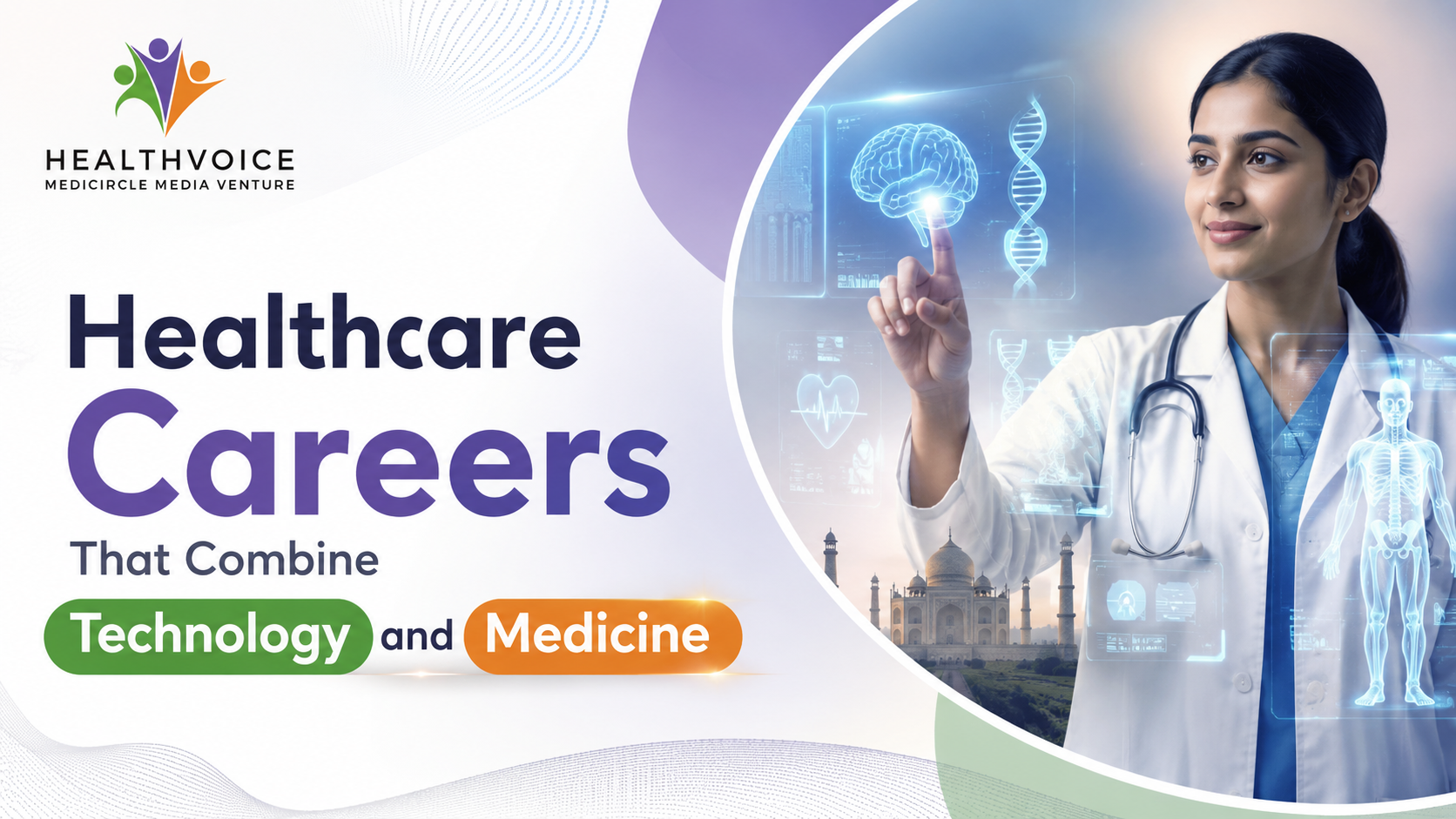
Healthcare Careers That Combine Technology and Medicine
The convergence of healthcare and technology is transforming the way medical services are delivered, creating exciting opportunities beyond traditional clinical roles. From artificial intelligence and medical software to biomedical engineering and data analytics, health-tech professionals are driving innovation, improving patient outcomes, and shaping the future of healthcare. This rapidly growing sector offers rewarding, high-demand careers for those passionate about both medicine and technology.
Healthcare Careers That Combine Technology and Medicine
The traditional boundaries between tech hubs and hospital wards have completely collapsed. We are living through a massive health-tech revolution. Healthcare delivery is no longer just about stethoscopes and prescription pads; it relies on complex medical software, artificial intelligence diagnostic screening, automated data handling, and sophisticated biomedical engineering.
This rapid digital evolution has created an entirely new category of high-paying, recession-proof careers. For professionals who are fascinated by the human body but equally passionate about software, databases, or hardware engineering, the intersection of tech and medicine offers an incredible landscape. These modern paths allow you to optimize systemic care, drive medical breakthroughs, and improve patient health outcomes on a global scale.
1. Data & Software Infrastructure Tracks
If you prefer analyzing numbers, tracking software workflows, and managing complex databases over performing direct bedside procedures, the information technology sector of healthcare is a massive growth arena.
Health Informatics Analyst
Health informatics specialists are the primary information architects of modern medicine. They design, maintain, and optimize the digital data systems—such as large-scale Electronic Health Records (EHRs)—that allow doctors, labs, and pharmacies to share critical patient health metrics securely across independent networks.
- The Tech-Medicine Blend: Informatics professionals translate raw data matrices into highly intuitive, actionable clinical dashboards. They work closely with software developers and hospital board directors to ensure data compliance and streamline throughput.
- Primary Skill Set: Data architecture, system interoperability standards, and relational database management.
Clinical Data Scientist
While an informatics analyst builds and manages database systems, a clinical data scientist applies advanced machine learning models, natural language processing, and deep analytics directly to that data. Their goal is to build predictive algorithms that forecast disease outbreaks, detect early cellular markers for cancer, or optimize ICU bed occupancy rates.
- The Tech-Medicine Blend: Merging biostatistics, programming logic, and clinical trial pharmacology to assist in the deployment of personalized precision medicine.
- Primary Skill Set: Data modeling, predictive analytics tools, and medical pattern recognition.
2. Advanced Imaging & Hardware Engineering
For individuals who enjoy physical technology, engineering design, or hands-on troubleshooting with advanced mechanical and electrical equipment, hardware-centric paths offer immense long-term career stability.
Biomedical Engineer
Biomedical engineers design and build the cutting-edge hardware and medical tools that doctors rely on to save lives. Their designs span everything from artificial internal organs and robotic surgical arms to customized bionic prosthetic limbs and advanced cellular diagnostic arrays.
- The Tech-Medicine Blend: Applying mechanical, electrical, and materials engineering principles directly to human biology, anatomy, and biomechanics.
- Primary Skill Set: CAD design software, product testing, and biomechanical materials validation.
Radiologic & Magnetic Resonance Imaging (MRI) Technologist
Imaging technologists operate some of the most sophisticated computing and magnetic arrays on earth, utilizing multi-planar scanning modalities to capture high-definition internal views of the human body.
- The Tech-Medicine Blend: Translating an understanding of cross-sectional anatomy and radiation physics into precise, diagnostic-grade visuals for interpreting clinical consultants.
- Primary Skill Set: Operating complex scanning equipment, cross-sectional anatomy mapping, and patient safety management.
Comparative Matrix: High-Growth Med-Tech Professions
The table below contrasts key operational metrics across these high-demand healthcare technology sectors to help you align your personal career roadmap.
Career Track
Target Study Timeline
Core Work Setting
Primary Technological Focus
Health Informatics Analyst
3 to 4 Years
Corporate Desks / Hybrid Hubs
EHR interoperability, data registries
Biomedical Engineer
4 Years
Research Labs, Manufacturing
Robotic prosthetics, surgical devices
Clinical Data Scientist
4 to 6 Years
Data Studios, Pharma Wings
Machine learning, predictive models
Radiology Technologist
3 to 4 Years
Diagnostic Imaging Suites
MRI, CT, and advanced software arrays
Biomedical Equipment Tech
2 to 3 Years
Multi-Department Hospital Wards
Calibration tools, hardware maintenance
Actionable Strategy: How to Enter the Med-Tech Field
- Identify Your Preferred Sandbox: Determine whether your talents align better with analytical numbers, programming logic, and cloud-based architecture (Data Science, Informatics) or hands-on mechanical building and hardware manipulation (Biomedical Engineering, Radiology Tech).
- Pursue Targeted Accreditations: Update your resume with focused, short-term upskilling certifications or post-graduate diplomas. Look for specialized certificates in healthcare data security regulations, data analytics dashboard software, or platform-specific EHR management.
- Develop a "Healthcare Translator" Mindset: To stand out during public sector or corporate recruitment, practice communicating technical software requirements in plain, patient-focused terms, proving you can bridge the gap between pure engineering and medical practice.
Frequently Asked Questions (FAQs)
Q1. Can someone with a pure software development background transition into healthcare tech?
Yes, absolutely. The healthcare industry faces an acute shortage of software developers, cybersecurity experts, and cloud architects. Tech professionals can pivot smoothly by completing short-term certifications that cover medical terminology, health data privacy laws, and interoperability frameworks.
Q2. What is the difference between a Biomedical Engineer and a Biomedical Equipment Technician?
A Biomedical Engineer focuses primarily on the R&D side, designing, prototyping, and testing brand-new medical hardware and devices inside manufacturing labs. A Biomedical Equipment Technician (BMET) works on the frontline inside hospitals, installing, calibrating, maintaining, and repairing those devices to ensure they function safely during daily surgeries.
Q3. Do I need a medical license or an MBBS degree to work as a Clinical Data Scientist?
No, a medical license is not required. Clinical data science is an analytical, tech-driven role. While you need a deep, functional understanding of medical jargon, clinical trial structures, and anatomical metrics, your primary training focus is on advanced mathematics, statistics, and machine learning models.
Q4. What are the baseline starting salaries for health informatics analysts?
Entry-level Health Informatics Analysts or Junior Reporting Associates typically command starting salary packages ranging between ₹3.8 to ₹5.5 Lakhs per annum within leading hospital chains and corporate healthcare consultancies. This track features a steep growth trajectory as you move into senior health system director roles.
Q5. Are med-tech and informatics jobs compatible with remote or work-from-home schedules?
Yes. Because roles like Health Informatics, Clinical Data Management, and Medical Coding Analysis focus entirely on processing digitized records stored inside secure, cloud-based networks, employers routinely offer hybrid or fully remote, work-from-home schedules.
Q6. What is a "Digital Twin" in modern healthcare technology?
A Digital Twin is a highly advanced, virtual computer simulation of an individual patient's anatomy or organ function. Built using data from MRIs, genetic sequencing, and biometric sensors, it allows clinicians to test different virtual treatment strategies or surgical procedures to see how the patient's body will react before performing the actual operation.
Q7. What are the primary data security regulations that healthcare tech professionals must follow?
Because healthcare data is highly sensitive and a primary target for cyberattacks, professionals must build systems that comply with strict global data privacy regulations. These rules mandate absolute patient confidentiality, multi-factor authentication (MFA) discipline, and secure end-to-end data encryption.
Q8. What does a Telehealth Integration Specialist do?
A Telehealth Integration Specialist manages the technical logistics behind remote clinical consultations. They ensure that remote biometric sensors (such as cellular blood pressure cuffs used by patients at home) sync securely and seamlessly with the hospital’s primary electronic health record database.
Q9. Is artificial intelligence replacing radiology and imaging technologists?
No. While AI algorithms are exceptional at flag-matching minute anomalies or pre-sorting images, software cannot physically interact with a patient, position a fractured limb safely inside a scanner, or configure machinery parameters under pressure. AI acts as an efficient co-pilot, increasing the market demand for tech-fluent operators.
Q10. How can a candidate best prepare for a career combining tech and medicine?
Focus on developing a balanced skill set. If your background is clinical, enroll in short courses covering data visualization tools like Power BI or Tableau. If your background is technical, read up on hospital infrastructure, clinical revenue cycles, and basic medical classification registries to demonstrate immediate strategic value.
To learn more about the specific opportunities exploding in this landscape, check out this guide on In-Demand Health-Tech Careers. This resource breaks down the essential skills and rapidly growing sectors where technology directly drives modern patient care.
 Team Healthvoice
#HealthTechCareers #DigitalHealthcare