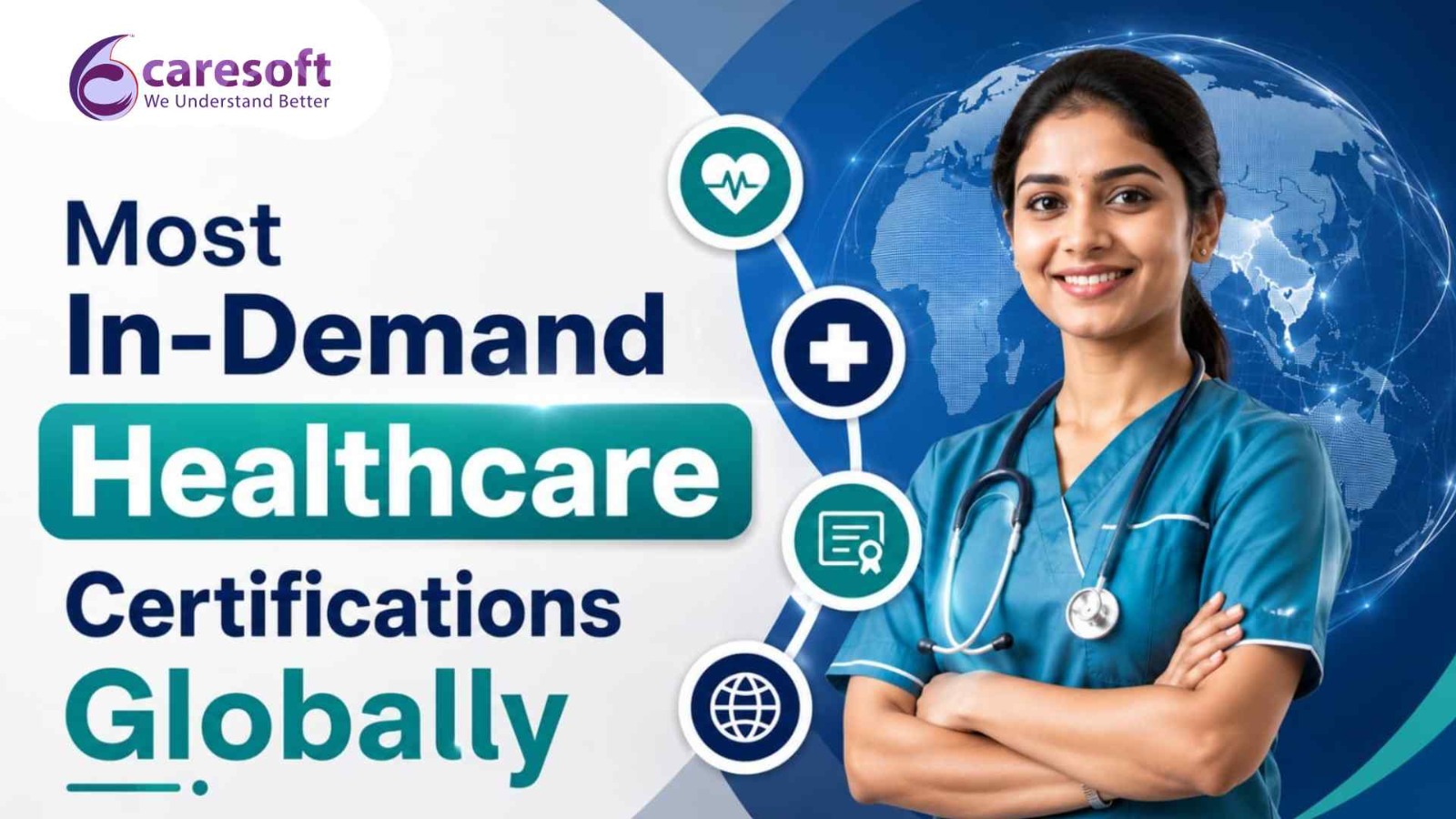
Most In-Demand Healthcare Certifications Globally
The rapid integration of AI and cross-border commerce is fundamentally reshaping global healthcare infrastructure. In this evolving landscape, professional certification has become a critical driver for career mobility, validating specialized technical skills and institutional trust.
The modern landscape of global medicine is undergoing an unprecedented operational and technological evolution. From the systemic integration of domain-specific artificial intelligence and machine learning to the rapid adoption of cross-border medical commerce, the global healthcare infrastructure is expanding far past conventional hospital walls (Dershem, 2026).
With this acceleration comes an intense demand for highly specialized talent. Professional certification has emerged as a powerful engine for upward career mobility, providing a standardized mechanism to validate technical skills, increase annual earnings, and build operational trust across borderless networks. Whether you are an aspiring allied health professional or an administrative specialist navigating health informatics, holding a recognized credential significantly influences institutional hiring decisions.
Top 5 Most In-Demand Healthcare Certifications Globally
Choosing the right certification depends heavily on whether your career path trends toward clinical patient interaction, healthcare technology frameworks, or administrative governance.
1. Certified Clinical Medical Assistant (CCMA)
Medical assistants are the backbone of primary care clinics, outpatient surgical wards, and multi-specialty practices. The CCMA, granted by the National Healthcareer Association (NHA), certifies a professional’s competence in executing both administrative tasks and ground-level clinical workflows—such as taking patient vitals, administering injections, and assisting in minor surgical procedures (Bouchrika, 2026).
- Global Demand Factor: Accelerated globally by widespread workforce shortages, making certified medical assistants a critical asset for enhancing institutional operational throughput.
- Average Timeline: Many fast-track certificate programs can be cleared in as little as 3 to 6 months (Bouchrika, 2026).
2. Certified Professional in Healthcare Quality (CPHQ)
Administered by the National Association for Healthcare Quality (NAHQ), the CPHQ is widely considered the premier global benchmark for clinical governance and systematic risk management. Professionals holding this credential focus heavily on reducing process variations, analyzing Electronic Health Record (EHR) datasets, and ensuring strict compliance with international healthcare safety domains.
- Global Demand Factor: The rapid international transition from a volume-based healthcare model to a value-based model (where institutions are strictly compensated based on positive patient outcomes) makes clinical quality experts highly sought after.
3. Registered Health Information Administrator (RHIA)
Offered by the American Health Information Management Association (AHIMA), the RHIA credential places professionals at the intersection of clinical care, institutional budgeting, and advanced data systems. RHIAs specialize in managing comprehensive digital architectures, implementing security protocols, and analyzing multimodal data to inform hospital administration decisions.
- Global Demand Factor: As over 95% of acute care institutions now utilize integrated digital records systems, the ability to manage complex databases while upholding data privacy standards is in high demand.
4. Certified Professional Compliance Officer (CPCO)®
Issued by the AAPC (American Academy of Professional Coders), this credential is engineered specifically for professionals managing risk, medical coding accuracy, and operational integrity within outpatient clinical spaces. A CPCO ensures that provider networks operate strictly within national anti-fraud laws and medical billing mandates.
- Global Demand Factor: As insurance reimbursements utilize increasingly complex automated code tracking, having an internal compliance auditor prevents costly overbilling penalties and audit failures.
5. Certified Nursing Assistant (CNA) / State-Tested Nurse Aide
Operating as a critical layer of foundational healthcare systems worldwide, certified nursing assistants provide direct, frontline personal care to patients in acute hospitals, long-term care facilities, and rehabilitation hubs.
- Global Demand Factor: The rapid demographic shift toward an aging global population has triggered an unprecedented, structural vacancy rate for licensed and certified support staff internationally.
Evolving Ecosystems: Tech and Sustainability Credentials
As we advance through 2026, the boundaries of “healthcare certifications” are broadening. Two major macroeconomic trends are shifting what credentials hospitals value most:
- Agentic AI & Compliance Credentials: Emerging technologies are moving from experiments into core infrastructural elements (Dershem, 2026). Organizations are heavily prioritizing data privacy certifications (such as certified HIPAA privacy experts) as legacy systems evolve to leverage machine learning and natural language processing (Kumar, 2026).
- Green-Certified Healthcare Systems: Modern healthcare networks are actively pursuing structural sustainability. Specialized administrators are securing credentials related to global green building certification systems—such as LEED-Healthcare or BREEAM-Healthcare—to optimize energy efficiency and indoor environmental quality in medical facilities (Buyukcinar, 2025).
Global Healthcare Certifications: 10 Frequently Asked Questions
1. Why are healthcare certifications so highly valued globally?
Certifications provide immediate, standardized proof of technical competency that basic academic degrees often cannot convey. Because healthcare systems handle human lives and strict legal parameters, employers depend heavily on credentials to verify that an individual is fully trained to operate specific medical equipment, manage private records securely, or execute complex clinical tasks from day one.
2. What is the fastest healthcare certification program that pays well?
Fast-track certifications like the Phlebotomy Technician or Certified Clinical Medical Assistant (CCMA) can be completed in approximately 3 to 6 months (Bouchrika, 2026). These programs offer an accelerated route into the clinical environment, establishing reliable entry-level wages with an immediate ladder to climb into management (Bouchrika, 2026).
3. Do healthcare IT and informatics certifications require a medical degree?
No, clinical medical degrees are not required. Health information systems and tech management branches actively recruit professionals with strong backgrounds in data science, computer applications, or general administration. Earning credentials like the RHIA bridges the gap, allowing tech specialists to safely navigate medical database architecture.
4. What is the difference between the CPHQ and general hospital administration?
General hospital administration centers heavily on commercial business logistics—handling human resources, corporate marketing, facility finances, and daily commercial facilities operations. CPHQ professionals focus strictly on clinical governance, data-driven workflow improvements, patient safety protocols, and ensuring institutional compliance with international health safety standards.
5. Can a certification earned in one country be used internationally?
It depends on the specific credential. Flagship administrative and tech credentials—such as the CPHQ (Quality), CHC (Compliance), or various health informatics badges—enjoy high prestige and recognition globally across modern hospital networks. However, frontline clinical certifications (like a CNA or Dental Assistant) are closely tied to regional state or national licensing boards and usually require cross-validation testing when relocating across international borders.
6. What role does artificial intelligence play in modern healthcare credentials?
Artificial intelligence is rapidly shifting the core competencies tested within high-level certifications. Earning administrative and technical healthcare credentials requires modern professionals to understand how to leverage machine learning tools for automated patient record screening, predictive billing analysis, and utilizing AI-driven decision support tools directly within live clinical workflows (Dershem, 2026; Kumar, 2026).
7. How much do Certified Clinical Medical Assistants make on average?
While baseline compensation fluctuates depending on your regional location and specialized facility setting, certified clinical medical assistants globally earn highly competitive wages within the allied health tier, with average baseline values starting around $42,000 annually and scaling up with years of experience and additional multi-tasking capabilities (Bouchrika, 2026).
8. What are the prerequisites to sit for the CPHQ exam?
The National Association for Healthcare Quality (NAHQ) does not enforce rigid educational or employment prerequisites to apply for the CPHQ exam. However, because the test evaluates highly complex real-world situational analysis, clinical audit techniques, and compliance tracking, the board highly recommends that candidates possess at least two years of experience inside a healthcare quality management sector before sitting for the exam.
9. What is the main difference between a CCMA and a CNA?
The core distinction lies in their operational scope. A CNA (Certified Nursing Assistant) focuses heavily on inpatient bedside personal care, mobility management, and basic daily living assistance inside long-term care facilities or hospitals. A CCMA (Clinical Medical Assistant) balances an explicitly dual role—executing clinical work (like blood draws and vitals tracking) alongside front-desk administrative logistics (like scheduling and electronic health record data entry) (Bouchrika, 2026).
10. How often do top global healthcare certifications require renewal?
To maintain absolute professional integrity and protect patient populations, nearly all top-tier global credentials require renewal every two years. To renew successfully, certified professionals must document between 20 to 40 hours of Continuing Education Units (CEUs) within their specific cycle to prove they are staying sharp on changing medical technologies and legal updates.
 Team Healthvoice
#HealthcareCertification #FutureOfMedicine