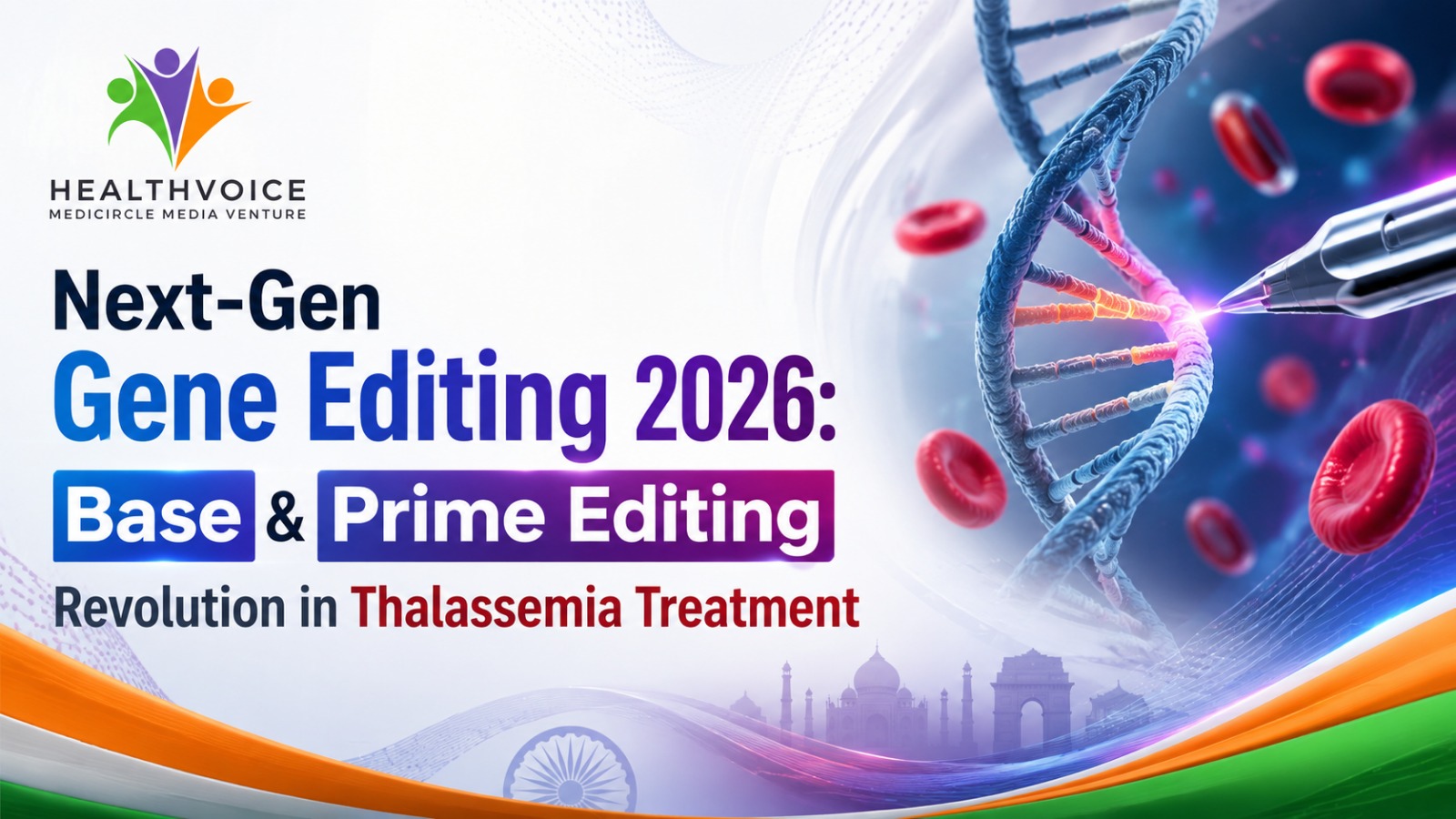
Next-Gen Gene Editing 2026: Base & Prime Editing Revolution in Thalassemia Treatment
Next-generation gene editing technologies such as base editing and prime editing are transforming hematology by enabling precise DNA correction without double-strand breaks. These advancements are particularly significant for treating β-thalassemia in India, where mutation-specific therapies and fetal hemoglobin reactivation strategies show strong clinical promise. The field is now shifting toward scalable in vivo delivery systems that could make curative treatments more accessible.
Beyond the Double-Strand Break: Next-Gen Gene Editing Reaches the Clinical Frontline
How Base Editing and Prime Editing Are Transforming Hematology and Thalassemia Treatment in 2026
Gene editing in hematology is entering a new clinical era in 2026. While first-generation CRISPR-Cas9 therapies have already demonstrated transformative outcomes in diseases like β-thalassemia and sickle cell disease, the reliance on double-strand DNA breaks (DSBs) has limited precision and introduced risks such as genomic instability.
Now, next-generation gene editing technologies—Base Editing and Prime Editing—are moving from experimental labs into clinical practice, offering a safer, more precise, and mutation-specific approach to genetic disease correction.
For countries like India, where hemoglobinopathies represent a major public health burden, these advancements are particularly significant.
Understanding Next-Generation Gene Editing Technologies
From Molecular Scissors to Precision DNA Writers
Traditional CRISPR-Cas9 functions like molecular scissors, cutting both strands of DNA to disable or modify genes. While effective, this process depends on the cell’s unpredictable repair mechanisms.
Next-generation tools eliminate this limitation entirely.
Base Editing: Precision Without DNA Breaks
Base editing enables direct conversion of one DNA base into another without cutting both DNA strands.
How it works:
* Uses a modified Cas9 enzyme (nickase Cas9)* Fuses with a deaminase enzyme* Performs single-base chemical conversion
Key capabilities:
* Converts A→G or C→T mutations* Repairs pathogenic point mutations* Avoids double-strand breaks entirely
Clinical advantage:
Base editing provides high-precision correction of single-nucleotide diseases, significantly reducing genomic instability risks.
Prime Editing: The “Search-and-Replace” System
Prime editing represents a more advanced and flexible system.
How it works:
* Combines nickase Cas9 with reverse transcriptase* Uses a pegRNA (prime editing guide RNA)* Writes new genetic sequences directly into DNA
Key capabilities:
* All base-to-base conversions* Insertions and deletions* Complex multi-base corrections
Clinical advantage:
Prime editing acts as a universal DNA repair tool, capable of fixing a broader range of genetic mutations than base editing.
India’s Thalassemia Burden and the Clinical Imperative
Why Next-Gen Gene Editing Matters for Indian Hematology
India carries one of the world’s highest burdens of β-thalassemia, with an estimated 10,000–15,000 transfusion-dependent births annually.
Current standard of care includes:
* Lifelong blood transfusions* Iron chelation therapy* High-risk bone marrow transplantation
Despite progress with CRISPR-based fetal hemoglobin (HbF) reactivation therapies, outcomes vary significantly depending on mutation type, especially in β⁰/β⁰ genotypes.
Mutation-Specific Correction: A Major Breakthrough
Base Editing for β-Thalassemia
Recent clinical data shows that adenine base editors (ABE systems) can directly repair common mutations such as:
* CD39* IVS2-1
Clinical impact:
* Restores functional adult hemoglobin (HbA)* Preserves natural globin regulation* Offers predictable, genotype-specific correction
This approach is especially relevant for India’s highly diverse mutation landscape.
Prime Editing and Fetal Hemoglobin Reactivation
Prime editing enables multiplex genetic modifications in the promoters of fetal globin genes (HBG1/HBG2).
Mechanism:
* Introduces multiple benign HPFH-like mutations* Enhances γ-globin expression* Produces additive increases in fetal hemoglobin levels
Clinical benefit:
This strategy offers a stronger and more stable HbF reactivation effect, particularly useful for severe thalassemia variants.
Ex Vivo to In Vivo: The Next Clinical Bottleneck
The Scalability Challenge in Gene Editing Therapies
Currently, both base editing and prime editing rely on an ex vivo workflow:
Process:
1. Harvest hematopoietic stem cells (HSPCs)2. Edit cells in specialized labs3. Apply conditioning chemotherapy4. Reinfuse modified cells into the patient
Key limitation:
* Highly resource-intensive* Requires advanced transplant centers* Limited scalability in low-resource healthcare systems
The Future Shift: In Vivo Gene Editing
The next major milestone in gene therapy is direct in vivo delivery.
Emerging approaches:
* Lipid nanoparticles (LNPs)* Engineered viral vectors* Targeted stem cell delivery systems
Potential breakthrough:
If successful, gene editing could transition from:
* Complex transplant procedures→ to simple intravenous or outpatient treatments
This would dramatically improve accessibility in high-burden regions like India.
Clinical and Public Health Impact
Transforming Hemoglobinopathy Treatment in 2026 and Beyond
Next-generation gene editing is expected to:
* Reduce dependency on blood transfusions* Eliminate transplant bottlenecks* Enable mutation-specific cures* Improve long-term hematologic outcomes* Expand access in developing healthcare systems
For India, this represents a shift from lifelong disease management to curative molecular medicine.
Conclusion
The evolution from CRISPR-Cas9 to base and prime editing technologies marks a fundamental shift in genomic medicine. By eliminating double-strand breaks and enabling precise DNA rewriting, these tools are redefining the future of hematology.
While ex vivo therapies remain the current standard, the transition toward in vivo gene editing could make definitive cures for thalassemia and sickle cell disease more accessible, scalable, and clinically practical worldwide.
 Team Healthvoice
#GeneEditing #PrecisionMedicine