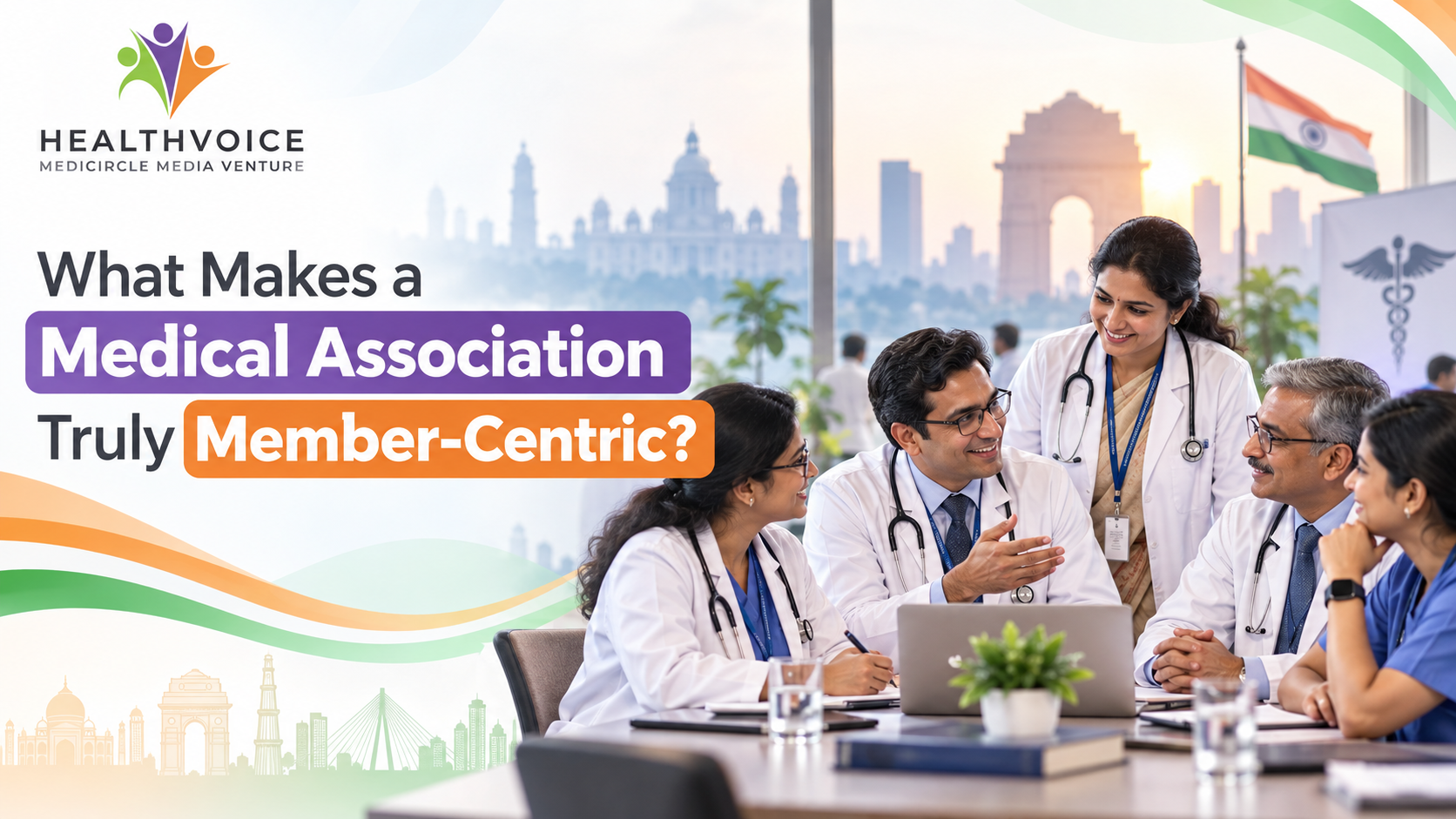
What Makes a Medical Association Truly Member-Centric?
This article examines the principles, practices, and structural qualities that define a truly member-centric medical association, with particular relevance to India's diverse and evolving healthcare professional community.
Introduction
Medical associations across India carry a responsibility that extends far beyond formal registration and annual conferences. They exist, at least in their highest form, to serve the doctors who constitute them. Yet a quiet but persistent conversation within India's medical community reveals that many associations have drifted from this foundational purpose. Doctors, particularly those in the early and mid stages of their careers, frequently describe their association membership as a professional obligation rather than a professional advantage.
This is a significant problem. When a doctor does not feel genuinely supported, heard, or valued by the association that represents their profession, the association loses more than a subscription fee. It loses trust, relevance, and the very energy that makes a professional community thrive.
The question, therefore, is not simply whether a medical association has members. The more important question is whether those members feel that the association genuinely works for them. Being truly member-centric is not a tagline. It is a philosophy that must be reflected in every governance decision, every communication, every program, and every interaction that an association undertakes on behalf of its doctors.
Understanding What Member-Centric Actually Means
The term "member-centric" is used frequently in association leadership conversations, but it is often misunderstood. Many associations believe that providing services to members is the same as being member-centric. It is not. Providing services is transactional. Being member-centric is relational.
A truly member-centric medical association designs its entire existence around the professional reality of its doctors. It understands what challenges a doctor in a Tier 2 city in India faces that a metro-based specialist does not. It recognizes that a general practitioner and a super-specialist cardiologist have different informational needs, different continuing education requirements, and different professional vulnerabilities. It acknowledges that female doctors, young doctors, and doctors in underserved regions often require different forms of institutional support than the broad membership average.
Member-centricity begins with listening. Not occasional listening through an annual general body meeting, but continuous, structured, and responsive listening. Associations that genuinely place members at their center create formal mechanisms for member feedback, act on that feedback visibly, and communicate back to members what changed because of their input. This cycle of listening, responding, and communicating is what transforms a passive membership base into an active professional community.
Meaningful Advocacy That Doctors Can Feel
One of the clearest indicators of whether a medical association is truly member-centric is the quality and impact of its advocacy work. Doctor welfare is under sustained pressure in India. Issues such as violence against healthcare professionals, medico-legal uncertainty, burnout, contractual employment insecurity, and inadequate regulatory protection affect doctors across all specialties and geographies.
A member-centric association does not restrict its advocacy to press statements and delegation meetings. It fights with consistency, transparency, and visible outcomes. When a doctor in rural Maharashtra faces violence from a patient's family, a truly member-centric national association responds with urgency and follows through with systemic pressure on law enforcement and state governments. When new regulations from bodies such as the National Medical Commission create ambiguity or hardship for practicing doctors, a member-centric association engages with detailed, evidence-based counterarguments rather than symbolic protests.
Advocacy must also extend to lesser-discussed issues. Insurance reimbursement disputes, the growing complexity of telemedicine regulations under Indian law, and the professional standing of doctors who offer services across state boundaries are all areas where members need their association's voice. The depth and consistency of this advocacy is a true measure of how member-centric an organization really is.
Education and Professional Development as a Core Commitment
For most doctors, a medical association's most tangible value proposition lies in continuing medical education. CME programs, workshops, and clinical conferences give doctors the opportunity to stay updated in an era where medical science advances rapidly. However, the quality, accessibility, and relevance of these programs vary considerably across India's medical association landscape.
A member-centric association treats professional development not as a revenue activity but as a core mission. This means designing CME programs that reflect what members actually need to know rather than what is easiest to organize. It means ensuring that doctors in smaller towns and district hospitals have access to educational content, not just those who can afford to attend metropolitan conferences. It means embracing digital learning platforms so that a busy clinician can access a recorded expert session at 10 pm after a long day in the outpatient department.
Key elements of a strong member education commitment include:
- Nationally accredited CME programs available in both in-person and digital formats
- Specialty-specific workshops designed with clinical input from active practitioners
- Access to peer-reviewed journal resources and evidence summaries relevant to Indian clinical practice
- Mentorship programs that connect experienced senior doctors with those in the early stages of their careers
- Career development guidance for doctors transitioning into leadership, research, or healthcare administration roles
When doctors feel that their professional growth is a genuine priority for their association, membership becomes something they seek out rather than something they feel obligated to maintain.
Communication That Respects the Doctor's Time and Intelligence
Communication is one of the most underestimated dimensions of member-centric association leadership. Many associations communicate with members the way institutions communicate with their subjects, through formal circulars, administrative announcements, and event invitations that arrive with little context and even less personal relevance.
A member-centric association communicates differently. It treats every communication as an opportunity to deliver value. Before sending a newsletter, the association leadership asks whether the content genuinely serves the member or merely serves the association's visibility. Before organizing a webinar, it asks whether the topic addresses a real gap in member knowledge or simply reflects the organizing committee's convenience.
Communication must also be two-directional. A medical association that only broadcasts information and never creates structured opportunities for members to respond, challenge, or contribute is not member-centric regardless of how frequently it communicates. Member-centric associations maintain active digital engagement through platforms that allow peer discussion, professional debate, and knowledge sharing among members across geographic and specialty boundaries.
In the Indian context, this also means communicating in a manner that reflects the diversity of the membership. Doctors practicing in states across South India, the Northeast, and the Hindi heartland have different professional contexts, and the association that acknowledges this diversity in its communication is far more likely to build genuine member loyalty than one that communicates as though all Indian doctors share identical experiences.
Governance That Is Transparent and Representative
Leadership structure and governance practices reveal more about an association's member-centricity than any mission statement ever could. Associations that concentrate decision-making power in small circles of long-serving leaders, that rotate leadership without genuine democratic processes, or that fail to include diverse voices from across specialties and geographies are not truly member-centric, regardless of their stated values.
Transparent governance means that members know how decisions are made, how funds are allocated, and how the association's leadership is held accountable for its performance. It means that financial reports are accessible and intelligible, that leadership elections are fair and competitive, and that members have meaningful pathways to raise concerns and expect substantive responses.
Representative governance goes further. A national medical association that has an overwhelmingly metropolitan leadership council cannot fully serve doctors in district hospitals and primary healthcare centers across rural India. An association whose leadership does not reflect gender diversity cannot claim to represent the professional interests of the growing number of female doctors entering the Indian medical workforce. Addressing these representational gaps is not a matter of symbolic inclusivity. It is a functional requirement of genuine member-centricity.
Recognition and Visibility for Every Member
Doctors invest deeply in their profession. Years of education, residency, clinical practice, and continuing learning represent an extraordinary personal commitment. A member-centric association recognizes and celebrates this commitment, not just for those in positions of leadership or those who win formal awards, but for the broader membership.
Recognition takes many forms. It can be as formal as a national award for clinical excellence or as simple as prominently featuring a young doctor's published research in the association's newsletter. What matters is the consistent signal that the association sees its members as individuals with meaningful professional contributions rather than as a nameless constituency to be mobilized when needed.
Digital platforms have created new and accessible opportunities for professional recognition. Associations that maintain active professional profiles, feature member achievements, and create visibility for clinical insights and expert opinions shared by their members are doing something genuinely valuable. They are turning membership into a source of professional identity and credibility rather than merely an institutional affiliation.
This is an area where platforms like HealthVoice play an increasingly important role in the Indian healthcare ecosystem. By providing doctors and medical associations with organized, credible, and community-oriented digital visibility, such platforms extend the reach of association-driven recognition far beyond what print newsletters and annual events can achieve.
The Role of Technology in Building Member-Centric Associations
Technology is no longer optional for associations that wish to remain relevant and genuinely member-centric. The expectations of doctors, particularly those who qualified in the last decade, are shaped by the digital services they use in every area of their professional and personal lives. They expect timely information, personalized experiences, and accessible digital tools as a baseline rather than as a premium feature.
Member-centric associations are investing in association management systems that allow members to manage their profiles, access resources, register for events, and connect with peers through a single integrated platform. They are using data analytics to understand member engagement patterns and identify doctors who may be at risk of disengaging, intervening proactively to maintain the relationship before it erodes.
Artificial intelligence is beginning to play a role in this space as well. According to the MGI Association Outlook Report, nearly 44 percent of associations globally are already exploring or implementing artificial intelligence to personalize and improve member services. For Indian medical associations, this signals an opportunity to move beyond generic communication and toward engagement that reflects the individual professional context of each member.
Conclusion
A truly member-centric medical association is not defined by the size of its membership rolls, the scale of its national conferences, or the frequency of its press engagements. It is defined by whether individual doctors feel that their association works for them every day, not just during election seasons or moments of professional crisis.
In India, where the medical community is large, diverse, geographically dispersed, and facing extraordinary professional pressures, the call for member-centric associations has never been more urgent. Doctors deserve institutions that listen with genuine attention, advocate with unwavering consistency, educate with real relevance, communicate with respect, govern with transparency, and recognize with sincerity.
The associations that embrace this philosophy will not simply retain their members. They will inspire them, mobilize them, and build communities of professionals who are proud to belong. That is the difference between an association that exists and one that truly matters.
Frequently Asked Questions
Q1: What does it mean for a medical association to be member-centric?
A member-centric medical association places the professional needs, career growth, wellbeing, and voice of its doctor members at the center of every decision, policy, and communication strategy. It listens actively, responds visibly, and measures its success by whether members feel genuinely served.
Q2: How can medical associations in India improve member engagement?
Indian medical associations can improve member engagement by offering relevant CME programs, enabling two-way communication, providing digital platforms for peer interaction, recognizing member contributions across specialties, and creating meaningful leadership pathways for young and mid-career doctors.
Q3: Why do many doctors feel disengaged from their medical associations?
Many doctors feel disengaged because associations communicate one-way, rarely seek member input, focus more on institutional visibility than member value, and fail to address the day-to-day professional challenges doctors actually face, particularly those practicing in smaller towns and district-level hospitals.
Q4: What role does digital communication play in a member-centric association?
Digital communication is central to modern association engagement. It enables timely updates, peer networking, online CME access, and a visible platform for member achievements, all of which strengthen the doctor-association relationship and extend the association's reach to members across geographies.
Q5: How does a medical association demonstrate trustworthiness to its members?
Trust is built through transparent governance, consistent advocacy for doctor rights, honest communication during professional crises, fair representation of all specialties and geographies, and a visible track record of acting on issues that members raise through formal and informal channels.
Resources
- Indian Medical Association (IMA): Official governing body for allopathic doctors in India, offering guidelines on professional conduct, member welfare, and association governance
- National Medical Commission (NMC): India's apex regulatory body for medical education and professional standards, relevant for understanding the regulatory environment that associations must navigate on behalf of members
- World Medical Association (WMA): International federation of national medical associations, providing global frameworks for member-centric professional association governance
- American Society of Association Executives (ASAE): Leading global resource for association management best practices, including member engagement frameworks applicable to healthcare associations
- Marketing General Incorporated (MGI): Publishes the annual Association Outlook Report, offering data-driven insights on membership growth, engagement trends, and innovation in professional associations worldwide
Interlinking Keywords:
medical association leadership, doctor professional development, CME programs India, doctor community platform, healthcare association engagement, member advocacy India, digital health communication, doctor visibility platform, NMC regulations India, IMA member benefits
Last reviewed by:
HealthVoice Editorial and Medical Advisory Team, September 4, 2026
Disclaimer:
This article is intended for informational and professional development purposes only. It does not constitute legal, regulatory, or institutional advice. Medical association governance practices vary significantly across organizations and jurisdictions. Readers are encouraged to consult the specific governing documents, bylaws, and leadership of their respective associations for guidance relevant to their membership context.
 Dr. Manthan Tripathi
#MemberEngagement #MedicalAssociation