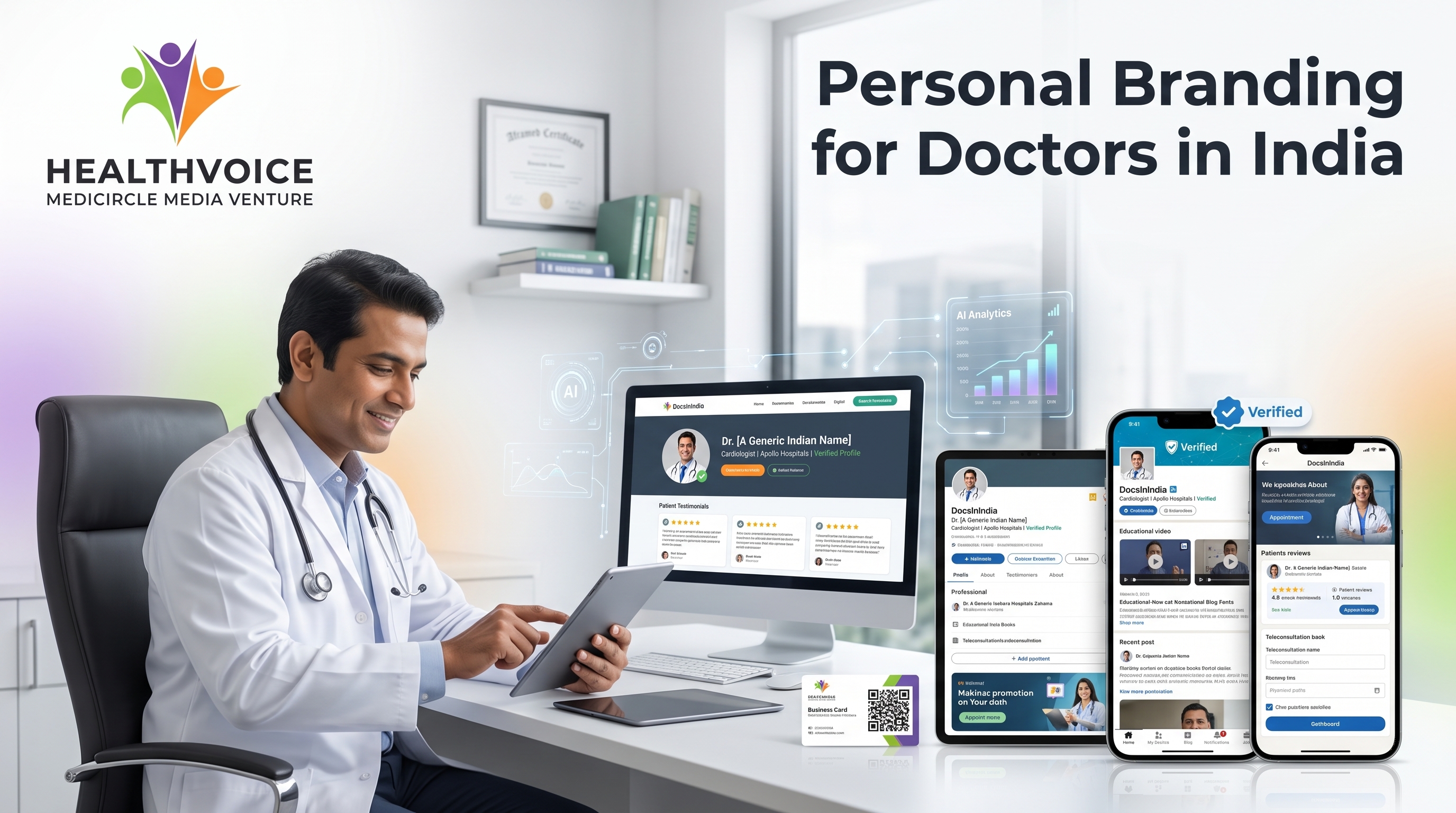
Personal Branding for Doctors in India: Building Trust, Credibility, and Professional Visibility
This article explains how doctors in India can build ethical, NMC-compliant personal branding through education, consistency, and association engagement to earn lasting patient and peer trust.
Introduction
A medical degree establishes competence, but it no longer determines how a doctor is perceived before a patient ever enters the consultation room. Across Indian cities, from established metros to fast-growing tier-two towns, patients now research a doctor online well before booking an appointment. They check credentials, read about areas of expertise, look for patient experiences, and try to understand the doctor as a person and a professional, not just a name on a clinic board.
This shift has made personal branding for doctors in India an important part of professional life, not a marketing add-on reserved for a few well-known specialists. Done correctly, personal branding is not about self-promotion. It is about communicating expertise honestly, building patient trust ethically, and strengthening a doctor's standing within the wider medical community. Done carelessly, it can drift into territory that conflicts with the ethical guidelines set by the National Medical Commission, or NMC, which govern how doctors in India may present themselves publicly.
This guide explains what personal branding genuinely means for doctors in India, why it matters more than ever, and how it can be built in a way that respects both patient trust and professional ethics.
Understanding Personal Branding in the Indian Medical Context
Personal branding, in the context of a doctor's career, refers to the consistent and credible way a physician communicates their expertise, values, and approach to patient care. It is built through the content a doctor shares, the way they engage with patients and peers, the recognition they receive from professional bodies, and the overall impression patients form when they encounter that doctor's name online.
It is important to separate personal branding from advertising. Advertising typically involves persuasion, comparison, or promotional claims designed to attract business. Personal branding, when done ethically, is rooted in education, transparency, and professional credibility. A doctor who regularly shares accurate health information, participates in association events, or contributes to public awareness campaigns is building a brand. A doctor who claims to be the "best" in a specialty or promises guaranteed outcomes is not building a brand responsibly, and is very likely stepping outside NMC guidelines.
For Indian doctors specifically, this distinction matters because the regulatory environment is stricter than in many other countries. The NMC Code of Medical Ethics restricts direct solicitation of patients and outcome-based claims, while explicitly permitting educational content, professional achievements, association activities, and factual credentials to be shared. Understanding where that line sits is the foundation of any sustainable personal branding effort.
Why Personal Branding Has Become Essential for Doctors in India
The patient journey in India has changed considerably over the past several years. A typical urban or semi-urban patient today follows a pattern that looks something like this: a search on Google or social media, a comparison of a few doctors, a check of available information or reviews, and only then a decision to book a consultation. This pattern holds across many Indian cities, and increasingly in tier two towns where internet access and smartphone use have expanded rapidly.
A few forces are driving this shift specifically in India. First, the sheer number of qualified doctors entering the profession each year has intensified competition, particularly in urban centres such as Bengaluru, Pune, Hyderabad, and the National Capital Region. Second, national digital health initiatives such as the Ayushman Bharat Digital Mission, or ABDM, have accelerated the digitisation of healthcare records and patient interactions, making the digital footprint of a doctor more visible and more relevant than before. Third, patients across income groups increasingly expect some form of health education before committing to a consultation, particularly for chronic and lifestyle-related conditions that carry a heavy burden of disease in India, such as diabetes and hypertension.
For doctors, this means that visibility without credibility does little good, while credibility without any visibility often goes unnoticed. Personal branding, built thoughtfully, bridges that gap. It allows a doctor's genuine expertise to reach the patients and peers who would benefit from it, rather than relying solely on word-of-mouth referrals or physical proximity to a clinic.
Core Elements of a Credible Personal Brand for Doctors
Building a personal brand as a doctor in India rests on a few consistent elements, each of which reinforces the others over time.
Clarity of specialisation and voice. Patients and peers respond well when a doctor has a clear and specific area of focus, communicated in accessible language. A cardiologist who consistently addresses questions relevant to working professionals managing heart health, for instance, builds recognition faster than one who tries to speak to every possible audience at once.
Consistent, evidence-based content. Sharing accurate, well-sourced health information, whether through written articles, short explainers, or association newsletters, positions a doctor as a dependable source rather than an occasional presence. Consistency matters more than volume. A doctor who publishes thoughtful content once every two weeks over a year will typically build stronger recognition than one who posts intensely for a month and then disappears.
Professional and association engagement. Involvement with medical associations, whether through speaking at events, contributing to newsletters, or participating in continuing medical education discussions, adds a layer of credibility that individual self-promotion cannot replicate. Peer recognition tends to carry more weight with both patients and other professionals than independent claims.
Transparent patient communication. How a doctor explains conditions, answers questions, and handles concerns, both in clinic and in any public-facing content, shapes the overall brand as much as any article or profile does. Patients frequently describe trust in terms of how clearly a doctor communicated with them, not simply the outcome of treatment.
A dependable digital presence. This does not require doctors to be active on every available platform. It requires that wherever a doctor does maintain a presence, whether a professional profile, an association page, or a platform built specifically for healthcare professionals, the information is accurate, current, and consistent with how that doctor practices medicine.
Staying Within Ethical and Regulatory Boundaries
Any discussion of personal branding for doctors in India must address the regulatory framework directly, because this is where many well-intentioned efforts go wrong. The NMC Code of Medical Ethics restricts individual physicians from advertising in ways that solicit patients, make comparative claims such as claiming to be the best in a field, or guarantee treatment outcomes. These restrictions exist because patients seeking medical care are often in a vulnerable position, and the law aims to prevent that vulnerability from being exploited through aggressive marketing.
What remains firmly permitted, and in fact encouraged, is educational content. Explaining a medical condition, describing treatment options in general terms, sharing factual credentials and qualifications, discussing public health awareness topics, and participating in association activities all fall within acceptable practice. The distinction often comes down to intent and framing: content that helps a reader understand a health topic is education, while content designed primarily to persuade a reader to choose a specific doctor over another is advertising.
Doctors building a personal brand in India would do well to treat this distinction as a working principle for every piece of content or public communication, whether it is a LinkedIn post, an article, or a comment during a health awareness event. When in doubt, favour the educational framing, cite credible sources such as the Indian Council of Medical Research or the World Health Organization for factual claims, and avoid language that implies certainty of outcome or superiority over peers.
Practical Steps to Build a Personal Brand the Right Way
Doctors do not need to overhaul their entire professional life to begin building a credible brand. A few practical, sustainable steps tend to work well within the Indian context.
Start by defining a specific area of focus within the broader specialty, and communicate it consistently across whatever platforms are used. Share content that answers real questions patients frequently ask, since this tends to perform better than generic health tips and demonstrates genuine engagement with patient concerns. Participate actively in professional associations, since association-backed visibility, such as being featured for a clinical contribution or speaking at a conference, often carries more credibility than independent self-promotion. Maintain accuracy above all else, since a single factual error in public health content can undo months of credibility building. Finally, treat the process as a long-term professional habit rather than a short campaign, since recognition in the medical community tends to build gradually and compounds over time rather than appearing overnight.
Platforms built specifically for the medical community, such as HealthVoice, can support this process by giving doctors a space designed around professional credibility rather than general social engagement. Because such platforms are structured around doctor voice, association activity, and healthcare-specific communication, they naturally reduce the risk of drifting into promotional territory, while still giving doctors visibility among peers, associations, and healthcare stakeholders who value that credibility.
Common Mistakes Doctors Should Avoid
A few recurring patterns tend to undermine otherwise well-intentioned branding efforts. Overpromising on outcomes, even subtly, damages both credibility and regulatory standing. Inconsistency, where a doctor posts intensely for a short period and then disappears for months, prevents the kind of steady recognition that personal branding is meant to build. Trying to appeal to every possible patient segment at once, rather than maintaining a clear area of focus, tends to dilute rather than strengthen recognition. Ignoring association and peer engagement in favour of only patient-facing content misses an important source of professional credibility. Doctors who are mindful of these patterns tend to build more durable, trustworthy brands over time.
The Role of Associations and Communities in Doctor Branding
Individual effort matters, but much of the credibility in personal branding for doctors in India comes from association and community backing. Medical associations play a significant role in validating a doctor's expertise, whether through recognising contributions, organising continuing education sessions, or providing a platform for members to discuss clinical and professional issues.
This is precisely where community-driven platforms add meaningful value. HealthVoice, for instance, is built around the idea that doctors, associations, and healthcare stakeholders benefit from a shared, organised space to communicate, rather than fragmented individual efforts across unrelated channels. When associations actively engage their members and highlight achievements, and when doctors participate meaningfully in that community, the resulting visibility tends to feel earned rather than manufactured, which is precisely the kind of credibility patients and peers respond to.
Conclusion
Personal branding for doctors in India has moved from being an optional consideration to a meaningful part of professional life. It is not about chasing visibility for its own sake, and it is certainly not about making claims that stretch beyond what medical ethics allow. It is about communicating genuine expertise clearly, staying engaged with the professional community, and building the kind of trust that patients look for before they ever step into a consultation room.
Doctors who approach personal branding with consistency, accuracy, and respect for NMC guidelines tend to find that recognition follows naturally, both from patients and from peers. The doctors who use platforms and communities built specifically for this purpose, where the focus remains on professional credibility rather than promotional noise, are often the ones who sustain that recognition over the long term.
Frequently Asked Questions
Q1: Is personal branding allowed for doctors under NMC guidelines in India?
Yes. The National Medical Commission permits educational and awareness-based content. What it restricts is direct solicitation of patients, comparative claims, and guaranteed outcome statements.
Q2: What is the difference between personal branding and self-promotion for a doctor?
Personal branding communicates expertise, values, and patient care philosophy through educational and professional content. Self-promotion focuses on claims and persuasion. Ethical branding stays within the boundaries of education and awareness.
Q3: How much time does it take for a doctor to build a credible personal brand in India?
Most doctors notice meaningful recognition within six to twelve months of consistent, credible content and community engagement. Personal branding is a long-term professional investment rather than a quick campaign.
Q4: Which platforms are most suitable for doctors in India to build a personal brand?
LinkedIn works well for professional visibility and association engagement, YouTube supports patient education through video, and platforms built specifically for doctors, such as HealthVoice, help maintain a focused, credible, and community-driven presence.
Q5: Can medical associations help doctors build their personal brand in India?
Yes. Associations provide doctors with a platform to share achievements, participate in events, and be recognised by peers. This association-backed visibility often carries more credibility than independent self-promotion.
Resources
- National Medical Commission (NMC) Code of Medical Ethics, official guidelines on professional conduct and advertising restrictions for registered medical practitioners in India.
- Ayushman Bharat Digital Mission (ABDM), government initiative on digital health infrastructure relevant to doctors' online presence and patient interaction.
- Indian Council of Medical Research (ICMR), authoritative source for evidence-based medical guidelines and public health data referenced in patient education content.
- World Health Organization (WHO), India Country Office, global and India-specific health data and awareness resources for content accuracy.
- National Health Portal (NHP), Ministry of Health and Family Welfare, government resource for verified public health information relevant to Indian patients.
Interlinking Keywords
personal branding for doctors, doctor personal brand India, medical association engagement, doctor digital presence, NMC guidelines for doctors, healthcare community platform, doctor visibility India, ethical medical marketing
Last medically reviewed by:
Editorial and Medical Advisory Team, HealthVoice on 14 July 2026
Medical Disclaimer:
This article is intended for general informational and educational purposes only and does not constitute medical, legal, or professional advice. It should not be used as a substitute for guidance from a qualified medical professional or a review of the applicable National Medical Commission (NMC) guidelines. Readers should consult relevant regulatory bodies or legal counsel before making decisions related to professional conduct, advertising, or patient communication.
 Team Healthvoice
#DoctorPersonalBranding #HealthVoice