Code Blue Audits: What Hospitals Can Learn Fast
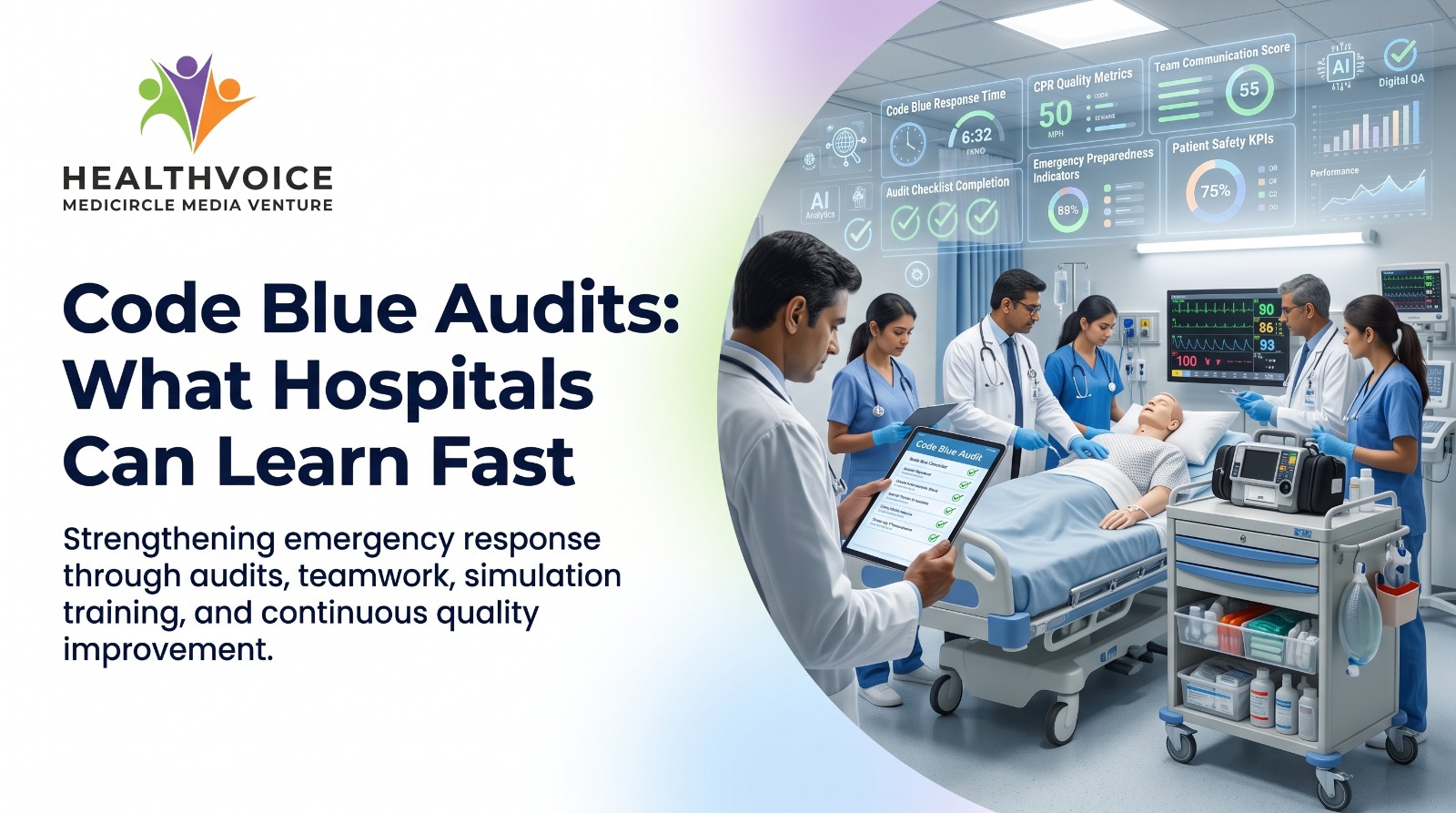
Code Blue audits help Indian hospitals analyse resuscitation timing, team performance, and outcomes, turning every cardiac emergency into a structured opportunity for measurable, lasting patient safety improvement.
Introduction
Every Code Blue call in a hospital represents a moment where seconds decide outcomes. Yet the value of that event does not end when the resuscitation attempt concludes. What happens afterward, through structured review and honest analysis, often determines whether the next patient in cardiac arrest has a better chance of survival. This is the quiet, essential work of Code Blue audits, and it deserves far more attention than it typically receives in day-to-day hospital operations.
For doctors, nursing leaders, and hospital administrators across India, Code Blue audits are not a bureaucratic formality. They are a diagnostic tool for the hospital itself, revealing where systems function well and where they quietly fail. Indian studies on in-hospital cardiac arrest consistently report survival rates that vary widely between institutions, often shaped less by clinical skill and more by response time, equipment readiness, and team coordination. Understanding why some hospitals achieve stronger outcomes than others starts with understanding how they audit and act upon every single Code Blue event.
This article examines what a meaningful Code Blue audit looks like, what data it should capture, what Indian and international evidence reveals about resuscitation outcomes, and how hospitals can convert audit findings into genuine, measurable improvement.
Understanding the Code Blue System and Why Audits Matter
A Code Blue is the internationally recognised alert used to summon a trained resuscitation team the moment a patient, visitor, or staff member experiences cardiac or respiratory arrest. The concept originated decades ago at a hospital in Kansas, and it has since become one of the few emergency codes used almost uniformly across hospitals worldwide, including in India.
Behind every Code Blue call lies a system with three interconnected components: a communication mechanism that alerts the response team, a trained multidisciplinary team equipped to deliver advanced life support, and the equipment, drugs, and monitoring tools necessary to sustain resuscitation efforts. When any one of these three components falters, patient outcomes suffer, regardless of how skilled individual clinicians may be.
This is precisely why auditing matters. A Code Blue audit is a systematic, retrospective or ongoing review of resuscitation events that examines timing, clinical decisions, team performance, and final outcomes. Rather than treating each cardiac arrest as an isolated clinical episode, an audit treats it as a data point in a larger pattern. Over months and years, that pattern reveals whether a hospital's resuscitation system is truly reliable or merely appears functional on paper.
Indian research on this subject has been growing steadily. A tertiary care audit published in the Saudi Journal of Anaesthesia, conducted in India, analysed over 600 true Code Blue calls across two years and found an overall survival rate of around 26 percent, dropping to roughly 11 percent among patients who had an actual cardiac arrest at the time of the call. Age, the initial cardiac rhythm, and the duration of cardiopulmonary resuscitation all showed a statistically significant relationship with survival. These findings are not unique to one institution. They reflect patterns seen repeatedly across Indian secondary and tertiary hospitals, which is exactly why systematic auditing, rather than anecdotal impression, is the only reliable way to understand institutional performance.
What a Comprehensive Code Blue Audit Should Capture
The quality of any audit depends entirely on the quality of the data feeding into it. Hospitals that treat Code Blue documentation as a checkbox exercise inevitably produce audits with limited value. A comprehensive audit form should capture several categories of information.
Demographic and clinical details form the foundation, including the patient's age, sex, admission diagnosis, and relevant comorbidities. Timing data is equally critical: the exact time of arrest, the time the Code Blue was activated, and the time the response team physically reached the patient. Even a delay of two or three minutes can meaningfully change survival probability, which is why many Indian audits specifically track response time in seconds rather than minutes.
Clinical intervention data should include the initial cardiac rhythm observed on arrival, whether the rhythm was shockable, the total duration of chest compressions, the chest compression fraction, airway management steps such as intubation, medications administered, and whether defibrillation was used. Outcome data should record whether the patient achieved return of spontaneous circulation, survived to shift out of the resuscitation area, survived twenty-four hours, or survived to hospital discharge.
A few points are worth using selectively as bullets, since they capture recurring findings from published Indian audits rather than a narrative flow:
- Non-shockable rhythms such as asystole and pulseless electrical activity dominate Indian Code Blue events, often accounting for more than eighty percent of cases, which tends to correlate with lower survival compared to shockable rhythms.
- Survival is consistently higher during working hours than during nights and weekends, pointing to staffing density as a modifiable factor.
- Response times below three minutes are associated with meaningfully better outcomes than delayed activation, reinforcing the importance of accessible alert systems on every floor.
Beyond the immediate clinical data, hospitals conducting mature audits also document systemic issues encountered during the event. A pilot audit from a secondary care hospital found that response delays were often linked to crash cart accessibility, staff unfamiliarity with equipment location, or confusion about team roles rather than clinical knowledge gaps. This distinction matters enormously, because a training problem and a logistics problem require completely different solutions.
Recognising Patterns Across Repeated Audits
A single audit tells a hospital what happened once. Repeated audits, conducted consistently over months, tell a hospital what is likely to happen again unless something changes. This is where the real diagnostic power of Code Blue auditing lies.
One recurring pattern across Indian hospital audits is the disproportionate concentration of Code Blue events in intensive care units and emergency departments compared to general wards. This is expected given patient acuity, but it also means that survival outcomes in these high-acuity areas are shaped heavily by the patient's underlying condition rather than solely by response quality. Hospitals that fail to separate ward-based arrests from ICU-based arrests in their analysis risk drawing misleading conclusions about their own performance.
Another pattern relates to false activations, calls made due to syncope, misinterpretation of a patient's condition, or system malfunction. While false calls understandably draw concern about alert fatigue, most published literature, including Indian studies, suggests hospitals should not discourage cautious activation. A slightly higher rate of false calls is generally preferable to delayed recognition of a genuine arrest, and audits should track false call rates as a monitoring metric rather than a performance failure.
A more recent and encouraging development in Indian hospital auditing involves the use of digital Code Blue monitoring platforms. A 2025 clinical audit from a tertiary hospital in Mumbai documented the implementation of an in-house digital system that tracked turnaround times for each resuscitation step, including time to first chest compression, time to rhythm identification, and chest compression fraction throughout the event. Over the audit period, this hospital observed return of spontaneous circulation rates improving from roughly thirty-eight percent to over fifty-six percent, with ward-specific rates rising even more sharply. The same audit introduced a pre-Medical Emergency Team tier, allowing nursing staff to escalate early signs of deterioration before a full cardiac arrest occurred, which corresponded with a measurable reduction in Code Blue activations over time.
This example illustrates an important principle for Indian healthcare institutions: audits become genuinely transformative not when they simply record outcomes, but when their findings feed directly into system redesign, staff training, and earlier intervention protocols.
Turning Audit Findings Into Institutional Learning
Collecting audit data is only the first step. The harder, more consequential work is translating findings into changes that stick. Hospitals that do this well tend to follow a few consistent practices.
Regular multidisciplinary review meetings, ideally monthly, bring together intensivists, emergency physicians, nursing leadership, and quality assurance teams to examine aggregated audit data rather than individual cases in isolation. This protects clinical staff from the discomfort of feeling personally scrutinised while still surfacing systemic issues that need correction. Immediate post-event debriefs, held within hours of a resuscitation attempt, allow the responding team to reflect on what went well and what created friction while memories are still fresh.
Equipment and crash cart checks deserve particular attention, since several Indian audits have identified missing supplies or non-functional defibrillators as recurring, entirely preventable problems. A simple checklist audit, conducted daily or per shift, closes this gap at minimal cost. Simulation-based training and mock drills, conducted quarterly in many accredited hospitals, help translate audit findings about delayed response or role confusion into rehearsed, muscle-memory level competence among staff.
Hospitals pursuing or maintaining NABH accreditation will recognise that structured resuscitation audits, documented action plans, and evidence of continuous quality improvement are already embedded expectations within India's healthcare quality framework. Code Blue auditing, therefore, is not an additional burden layered onto compliance requirements. It is one of the clearest, most measurable ways a hospital can demonstrate that its patient safety culture extends beyond documentation and into actual clinical practice.
It is in this broader effort, connecting clinical teams, quality leadership, and the wider medical community around shared learning, that platforms built for doctor-first dialogue have a role to play. When intensivists, emergency physicians, and hospital quality leaders have a credible space to discuss resuscitation outcomes, share audit-driven improvements, and learn from peer institutions across India, the pace of collective improvement accelerates well beyond what any single hospital can achieve in isolation.
Conclusion
Code Blue audits are, in many ways, a hospital's honest mirror. They do not measure how skilled a team felt during a resuscitation attempt; they measure what the data actually shows about timing, decisions, and outcomes. For Indian hospitals working within constraints of variable staffing, infrastructure, and training resources, this honest, evidence-based review process is one of the most powerful tools available to close the gap between intention and outcome.
The hospitals that consistently improve their resuscitation outcomes are rarely the ones with the most advanced equipment alone. They are the ones that treat every Code Blue event, successful or not, as a source of institutional learning, and that have the discipline to act on what the data reveals. As more Indian institutions adopt structured audit protocols, digital monitoring tools, and tiered escalation systems, the collective knowledge available to the broader medical community continues to grow, benefiting patients well beyond the walls of any single hospital.
Frequently Asked Questions
Q1: What is a Code Blue audit in a hospital?
A Code Blue audit is a structured review of resuscitation events in a hospital, examining response times, clinical interventions, team performance, and patient outcomes to identify gaps and improve future emergency response.
Q2: Why is Code Blue auditing important for Indian hospitals?
Indian hospitals face variable resuscitation outcomes due to differences in staffing, training, and infrastructure. Regular audits help standardise protocols, reduce response delays, and align practices with national accreditation standards such as NABH.
Q3: What data should a Code Blue audit collect?
A comprehensive audit should capture activation time, response time, initial cardiac rhythm, duration of CPR, chest compression fraction, drugs administered, team composition, and final patient outcome.
Q4: How often should hospitals conduct Code Blue audits?
Most tertiary and secondary care hospitals in India benefit from continuous data logging with monthly or quarterly formal audit reviews, supplemented by an immediate debrief after every resuscitation event.
Q5: Who should be involved in reviewing Code Blue audit findings?
Effective review involves intensivists, emergency physicians, nursing leadership, quality assurance teams, and hospital administration, since resuscitation outcomes depend on both clinical and system-level factors.
Resources
- Saudi Journal of Anaesthesia: Peer-reviewed study analysing Code Blue system functioning and survival outcomes at an Indian tertiary care hospital.
- Medical Research Archives, European Society of Medicine: Clinical audit on pre-Medical Emergency Team implementation and digital Code Blue monitoring at a Mumbai tertiary hospital.
- National Accreditation Board for Hospitals and Healthcare Providers (NABH): Accreditation standards covering patient safety, emergency response, and continuous quality improvement.
- Indian Council of Medical Research (ICMR): Guidelines and publications relevant to clinical audit methodology and patient safety in Indian healthcare settings.
- World Health Organization: Global patient safety and emergency care resources relevant to in-hospital resuscitation systems.
Interlinking Keywords
Code Blue audit, in-hospital cardiac arrest, hospital resuscitation protocol, NABH accreditation, patient safety in Indian hospitals, rapid response team, chest compression fraction, hospital quality improvement, cardiac arrest survival rate India, medical emergency team
Last medically reviewed by:
Editorial Medical Review Team, HealthVoice on July 11, 2026
Medical Disclaimer:
This article is intended for informational and educational purposes for healthcare professionals and institutions. It does not constitute clinical, legal, or accreditation guidance. Hospitals should refer to current NABH standards, institutional protocols, and consult qualified medical and quality assurance professionals when designing or revising resuscitation and audit systems.
 Team Healthvoice
#FutureOfMedicine #DigitalHealthcare
