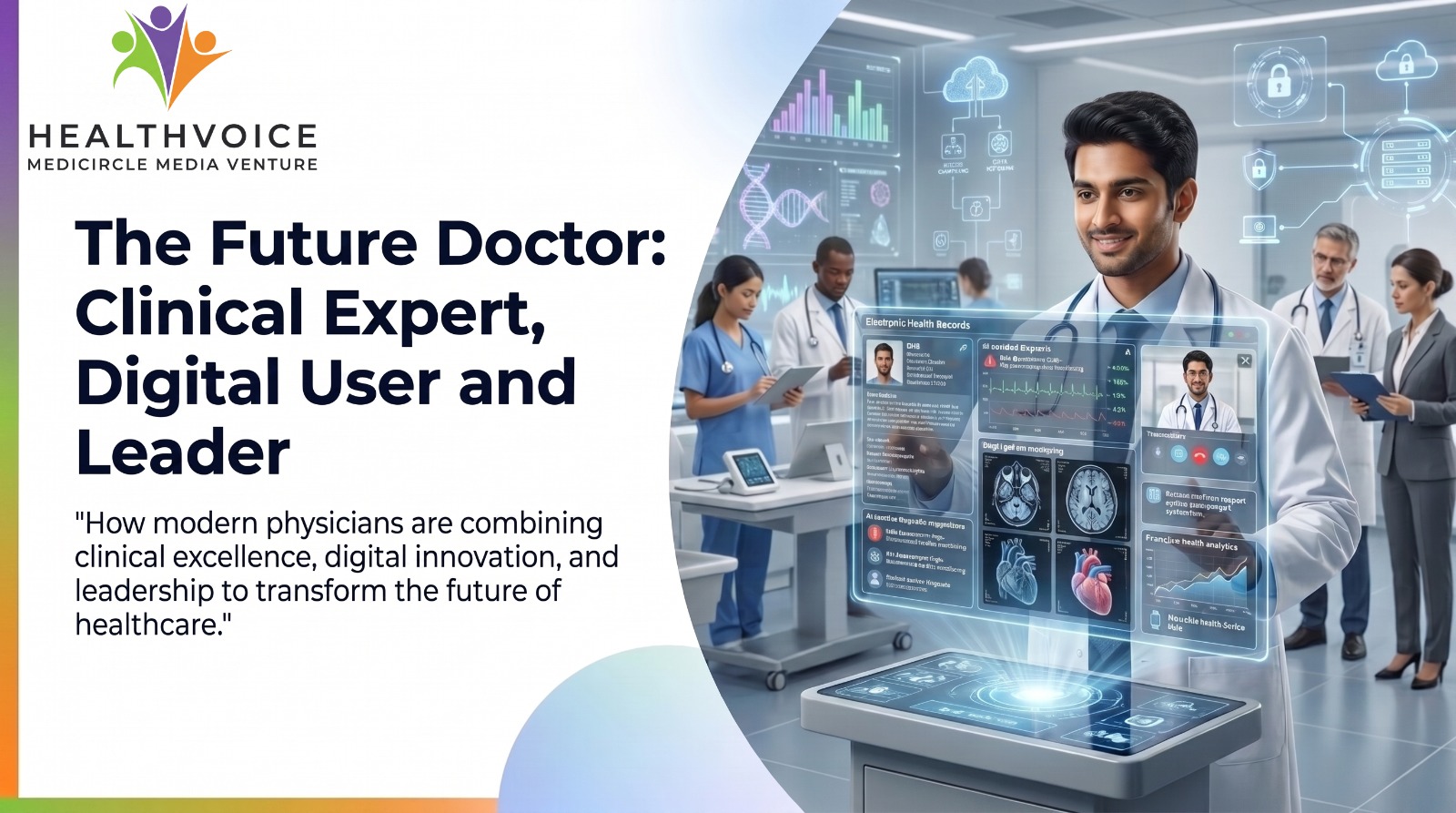
The Future Doctor: Clinical Expert, Digital User, Research Contributor and Healthcare Leader
The future doctor in India must simultaneously excel as a clinical expert, responsible digital health user, research contributor, and community-driven healthcare leader to meaningfully transform medicine.
Introduction
Medicine in India is undergoing a transformation unlike anything seen in the last century. The doctor who graduates today enters a world defined not just by stethoscopes and clinical rounds but by telemedicine platforms, artificial intelligence tools, digital health records, and an increasingly informed patient population. The India of 2026 looks very different from the India that shaped earlier generations of doctors, and the expectations placed on the medical professional have grown in both depth and complexity.
The National Medical Commission has been reshaping medical education through competency-based frameworks. The Ayushman Bharat Digital Mission is digitizing health records for hundreds of millions of citizens. Private and public hospitals are adopting AI-assisted diagnostics. And patients in Tier 2 and Tier 3 cities are arriving at consultations with printed articles and health app summaries in hand. Against this backdrop, the question is no longer whether doctors need to evolve. The question is how, and in which direction.
The future doctor in India will not simply be a more technically skilled clinician. That person will be a thoughtful digital user, a contributor to research and knowledge, and a visible leader in the healthcare community. These four roles are not separate identities. They are the interwoven pillars of the modern medical professional, and understanding them is critical for every doctor, association, and institution that cares about the long-term strength of Indian healthcare.
The Foundation That Cannot Be Compromised: Clinical Expertise
Before any conversation about digital tools, research roles, or leadership responsibilities begins, clinical expertise must be firmly established as the irreplaceable core of what makes a doctor a doctor. Technology can assist, data can inform, and platforms can amplify, but the capacity to examine a patient carefully, think critically through a differential diagnosis, communicate findings with clarity, and make sound clinical decisions under pressure is the non-negotiable foundation.
In India, where a single doctor may serve hundreds of patients a week in public health settings, and where disease presentations are often shaped by local dietary patterns, occupational exposures, and delayed health-seeking behavior, clinical excellence is not a baseline. It is the highest professional obligation.
The future doctor will be one who continuously builds on that clinical foundation through structured learning, peer engagement, case-based reflection, and specialty updates. Continuing Medical Education is increasingly important not because the NMC mandates it but because medicine itself demands it. Drug resistance patterns are evolving. Surgical techniques are advancing. Guidelines from ICMR and international bodies are being updated regularly. A clinician who stopped learning five years ago is already practicing with an outdated knowledge set.
What distinguishes the future doctor is the recognition that clinical expertise is not a destination. It is a habit of sustained, disciplined professional growth, pursued throughout an entire career.
The Digital Layer: Tools, Literacy, and Responsible Adoption
Across Indian hospitals and clinics, digital health tools are becoming a daily reality. Electronic Health Records are now standard in accredited facilities. The ABDM has introduced Health IDs, DigiLocker-integrated health records, and interoperable data sharing frameworks. Telemedicine reached millions of patients during and after the pandemic, particularly through the eSanjeevani platform, which has logged over 300 million teleconsultations.
The future doctor does not need to be a software engineer or a data scientist. However, digital literacy is no longer optional. Doctors who understand how platforms work, how patient data flows through systems, how to use AI-assisted diagnostic tools responsibly, and how to engage with patients through digital channels are already at a professional advantage.
There are important nuances here that the Indian medical community must engage with thoughtfully. AI-assisted clinical tools, including radiology support systems, ECG interpretation software, and predictive risk scoring algorithms, are increasingly present in hospital workflows. A growing body of research, including recent comparative studies, has shown that widely available large language models can perform competitively with specialized physician-facing tools on medical knowledge assessments. This does not reduce the role of the doctor. It actually increases the importance of the doctor's judgment, because someone must evaluate, interpret, and take responsibility for the clinical decisions that AI tools inform.
Doctors in India should approach digital tools by asking a set of disciplined questions:
- Does this tool have clinical validation relevant to the Indian patient population?
- Is the platform compliant with patient data privacy standards under Indian law?
- Does it reduce my administrative burden without compromising the quality of my clinical attention?
- Am I using this as a decision support tool or am I allowing it to replace my reasoning?
These are questions of professional maturity, and they define the difference between a doctor who uses digital health responsibly and one who either avoids it entirely or over-relies on it uncritically.
The ABDM ecosystem, telemedicine guidelines issued by the Ministry of Health and Family Welfare, and NMC's evolving position on digital medical practice all point in the same direction. Doctors who engage proactively with these frameworks will be better positioned professionally and will serve their patients more effectively.
The Research Imperative: From Consumer to Contributor
India carries a disproportionate burden of global disease. It accounts for a significant share of the world's tuberculosis cases, cardiovascular deaths, diabetes patients, and maternal health challenges. And yet, the majority of clinical research that informs global treatment guidelines is conducted outside India, in populations with different genetic profiles, dietary habits, environmental exposures, and healthcare access patterns.
This gap is not just a scientific problem. It is a patient safety problem. When an Indian doctor applies a treatment protocol derived entirely from Western clinical trials to a patient from a rural district in Uttar Pradesh or a coastal community in Kerala, there is an inherent uncertainty about how well that evidence translates.
The future doctor in India must move from being a passive consumer of research published elsewhere to an active contributor to the evidence base relevant to the Indian context. This does not require every doctor to run large randomized controlled trials. Research contribution takes many forms.
A general physician in a district hospital who carefully documents outcomes for a particular patient population over time and contributes that data to a registry is contributing to research. A specialist who presents an unusual case at a medical association meeting, publishes a case report, or participates in a multicenter audit is contributing to research. An association that organizes structured data collection across its member doctors is building a research infrastructure.
The ICMR actively supports community-based health research. Several medical associations have developed research cells that facilitate participation even for busy practicing doctors. Academic hospitals are increasingly looking for community physician partners for epidemiological studies.
The future doctor does not need to wear the identity of a researcher as a separate hat. Research engagement is simply part of the professional responsibility that comes with the privilege of practicing medicine in a country where so many clinical questions remain unanswered.
Healthcare Leadership: The Responsibility Beyond the Clinic
Leadership in medicine is sometimes misunderstood as being reserved for those who hold administrative titles or occupy institutional positions. This is a limiting and ultimately unhelpful perspective. Healthcare leadership, in its most meaningful sense, is the willingness to take responsibility for outcomes that extend beyond the immediate clinical encounter.
A doctor who speaks at a community awareness event about early cancer detection is exercising healthcare leadership. A specialist who mentors a junior resident through a difficult case is exercising healthcare leadership. A doctor who raises concerns about sanitation standards in a public health facility, who advocates for better resource allocation in a government scheme, or who educates fellow professionals about the risks of antimicrobial resistance is exercising healthcare leadership.
In the Indian context, where public trust in healthcare institutions is fragile and where health literacy remains uneven, the doctor's voice carries enormous social weight. That voice, used thoughtfully and ethically, is one of the most powerful instruments of healthcare improvement available.
Medical associations play an essential role in channeling individual leadership capacity into collective professional impact. When doctors engage with their specialty associations, contribute to policy consultations, and participate in continuing education activities, they strengthen the entire ecosystem of organized medicine. Platforms that support doctor visibility, association engagement, and community communication are responding to a genuine and growing need in Indian healthcare.
HealthVoice exists precisely to support this dimension of the doctor's professional identity. It provides doctors and associations a credible, organized space to share expert perspectives, highlight professional achievements, amplify community awareness efforts, and engage meaningfully with the healthcare stakeholders who matter to them.
Bringing the Four Roles Together
The clinical expert, the digital user, the research contributor, and the healthcare leader are not four different doctors. They are four aspects of the same doctor, operating simultaneously at different scales and in different contexts. A cardiologist who treats patients with precision, uses a validated AI tool to flag arrhythmias in remote monitoring data, contributes to a national heart failure registry, and mentors young doctors through her association's fellowship program is living all four roles without necessarily labeling them.
What India needs, and what the healthcare system is increasingly demanding, is for more doctors to consciously invest in all four dimensions of their professional identity. Medical education must evolve to make this possible from the earliest stages of training. The NMC's competency-based curriculum is a step in this direction, but it needs sustained investment in faculty capacity, institutional culture, and professional community support.
Individually, the future doctor must be willing to step outside the boundaries of clinical practice and ask: How do I stay current? How do I engage with the digital transformation of my profession responsibly? How do I contribute something lasting to the medical knowledge base? And how do I use my professional standing to improve health outcomes beyond my clinic walls?
These are not rhetorical questions. They have practical, achievable answers, and the doctors who pursue those answers consistently are already shaping the future of Indian healthcare.
Frequently Asked Questions
Q1: What skills will define the future doctor in India?
The future doctor in India must combine strong clinical skills with digital health literacy, research awareness, ethical communication, and healthcare leadership. Familiarity with platforms like ABDM, telemedicine tools, and AI-assisted diagnostics will be equally important as medical expertise.
Q2: How is AI changing the role of doctors in India?
Artificial intelligence is assisting Indian doctors with diagnostic support, administrative efficiency, drug interaction alerts, and predictive health analytics. However, AI tools are designed to support clinical judgment, not replace it. The doctor remains central to patient care.
Q3: Why is research contribution important for practicing doctors?
Research participation allows doctors to contribute to evidence-based medicine, address India-specific health challenges, and drive clinical innovation. Even small-scale case studies, audits, or data contributions strengthen the medical knowledge base and advance the profession.
Q4: What does healthcare leadership mean for a doctor today?
Healthcare leadership extends beyond patient care to include public health advocacy, policy engagement, mentoring junior doctors, community awareness, professional association involvement, and contributing to institutional quality improvement.
Q5: How can doctors build a credible digital presence in India?
Doctors can build a credible digital presence by sharing verified medical information, engaging with professional healthcare communities, participating in platforms like HealthVoice, and using digital tools that align with NMC guidelines on ethical medical communication.
Resources
- Indian Council of Medical Research (ICMR): Guidelines, research publications, and clinical evidence relevant to Indian patient populations and healthcare challenges.
- National Medical Commission (NMC): Official regulatory body overseeing medical education standards, competency-based curriculum frameworks, and ethical guidelines for Indian doctors.
- Ayushman Bharat Digital Mission (ABDM): Government of India initiative digitizing health records, enabling Health IDs, and building interoperable digital health infrastructure across India.
- Ministry of Health and Family Welfare, Government of India: Telemedicine practice guidelines, national health policy updates, and doctor-facing regulatory communications.
- World Health Organization, India Country Office: Global and India-specific health data, disease burden reports, and guidelines informing clinical practice and public health strategy.
Interlinking Keywords
doctor digital health India, medical leadership India, ABDM for doctors, AI in clinical practice, telemedicine guidelines India, continuing medical education India, healthcare association engagement, future of medicine India, doctor research contribution, NMC competency framework
education India
Last medically reviewed by:
Editorial Medical Review Team, HealthVoice on July 11, 2026
Medical Disclaimer:
The information provided in this article is intended for educational and informational purposes only and should not be considered a substitute for professional medical advice, diagnosis, or treatment. While every effort has been made to ensure the accuracy and relevance of the content, medical knowledge and clinical guidelines continue to evolve. Healthcare professionals should rely on their clinical judgment, current evidence-based guidelines, and applicable regulatory recommendations when making patient care decisions. Patients should consult a qualified healthcare provider regarding any medical concerns and should not delay or disregard professional medical advice based on information presented in this article. Neither the authors nor the publisher accept responsibility for any outcomes resulting from the use or interpretation of the information contained herein.
 Team Healthvoice
#FutureOfMedicine #DigitalHealthcare
