The Future of Healthcare Management: What India's Medical Leaders Must Know
Healthcare management in India is being transformed by digital innovation, AI adoption, value-based care models, and doctor-led leadership, with ABDM and NABH driving systemic reform across the sector.
Introduction
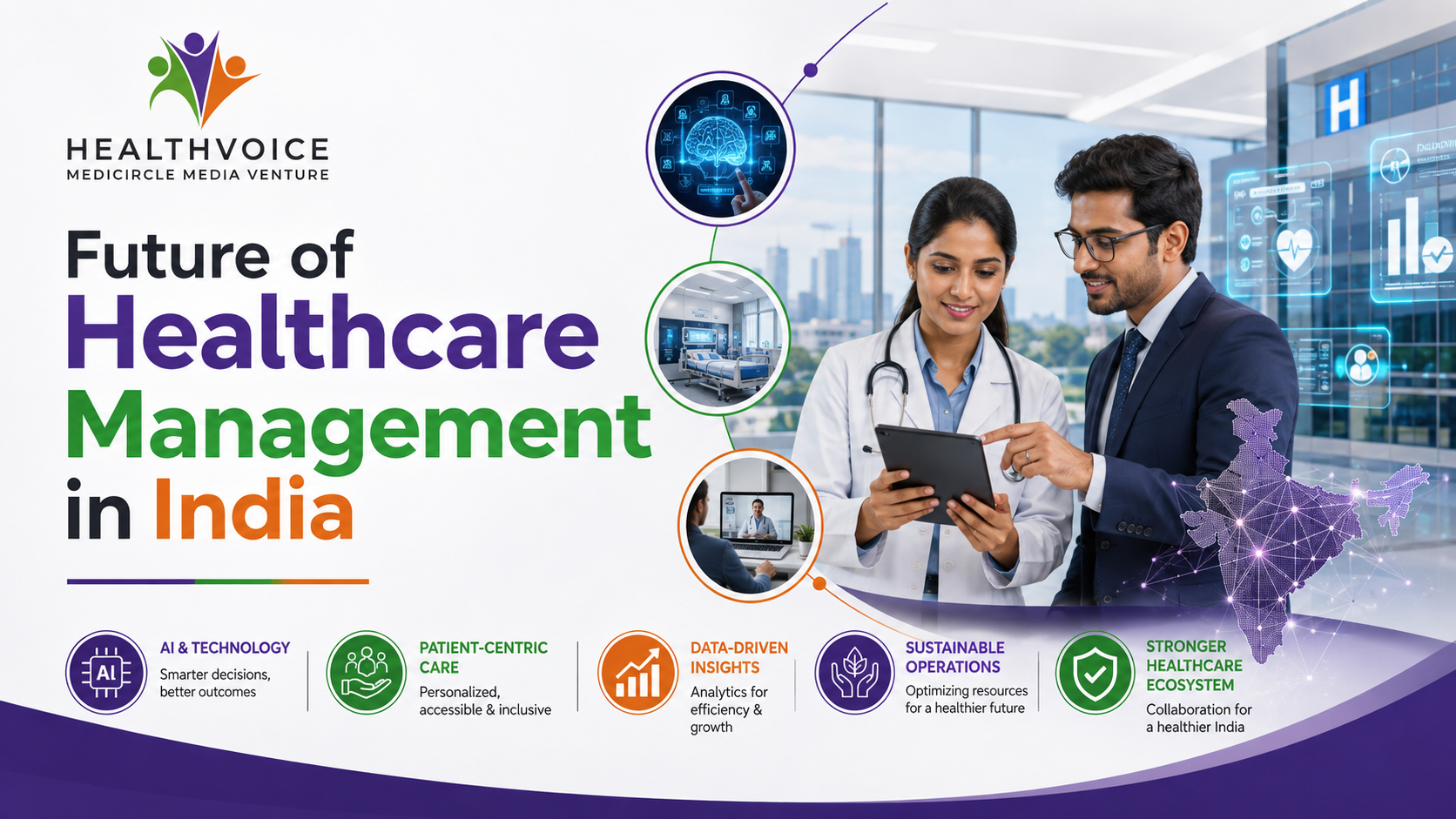
Healthcare management in India is standing at a turning point. The country's health system, long stretched thin by the weight of a 1.4 billion-person population, growing chronic disease burdens, and infrastructure gaps between urban and rural settings, is now being asked to do far more than it was ever designed to handle. At the same time, a wave of policy reform, digital innovation, and clinical leadership is beginning to reshape how healthcare organisations are run, how doctors engage with health systems, and how patients experience care.
This is no longer a conversation limited to hospital administrators or government officials. Doctors, medical association leaders, healthcare institutions, and health technology companies are all becoming central participants in a transformation that will define the next decade of Indian healthcare. Understanding what lies ahead is not just professionally relevant. It is essential for anyone committed to improving the quality and reach of medical care in this country.
For platforms like HealthVoice, which exist to amplify the voices of doctors and healthcare communities, this moment carries a specific importance. The future of healthcare management will be shaped by those who lead from the front, and that includes the medical professionals who must be heard, engaged, and empowered to drive meaningful change.
Understanding Healthcare Management and Why It Matters
Healthcare management is the discipline of planning, organising, coordinating, and overseeing the delivery of health services within an institution, system, or community. It sits at the intersection of clinical expertise, administrative function, financial sustainability, public health strategy, and regulatory compliance.
In the Indian context, healthcare management spans a remarkably wide range of settings. It includes large multispeciality hospital networks in metro cities, district hospitals run by state governments, primary health centres in rural areas, private clinics, diagnostic chains, pharmaceutical companies, medical device firms, and increasingly, digital health platforms and health technology startups.
What unites all of these settings is a core challenge that has remained consistent for decades: how to deliver high-quality, equitable, and financially sustainable care to a population that is both growing and changing rapidly. India's disease burden has shifted significantly. Non-communicable diseases such as diabetes, hypertension, cardiovascular conditions, and cancer now account for a majority of deaths and disability-adjusted life years. At the same time, infectious diseases, maternal health challenges, and nutritional deficiencies continue to demand attention, particularly in lower-income and rural populations.
Healthcare management is the mechanism through which these complex demands are translated into organised, effective, and accountable systems of care. When management is strong, health outcomes improve. When it is weak or absent, even the best clinical talent operates below its potential.
The Key Forces Reshaping Healthcare Management in India
Digital Transformation and the Rise of Health Technology
The most visible force reshaping healthcare management today is digital transformation. Across India, the adoption of electronic health records, telemedicine platforms, hospital information systems, and digital diagnostic tools is accelerating. The Ayushman Bharat Digital Mission (ABDM), launched by the Ministry of Health and Family Welfare, has created the foundational infrastructure for a nationally interoperable digital health ecosystem. Through the Ayushman Bharat Health Account (ABHA), citizens can now have a unique health identifier that links their medical records across providers, states, and time.
For healthcare managers, this shift has profound implications. Data that was once scattered across paper files, siloed systems, and disconnected departments is becoming accessible, traceable, and actionable. Population health management, which requires analysing patterns across large patient groups to prevent disease and allocate resources efficiently, becomes possible only when this kind of integrated data infrastructure exists.
Telemedicine, accelerated by the COVID-19 pandemic and formalised through the Telemedicine Practice Guidelines issued by the National Medical Commission (NMC), has extended the reach of healthcare management into homes and villages that were previously unreachable. Platforms connecting patients in Tier 2 and Tier 3 cities with specialist doctors in urban centres are reducing the longstanding gap in healthcare access that has defined Indian medicine for generations.
Artificial Intelligence and Data-Driven Decision Making
Artificial intelligence is entering healthcare management not as a future possibility but as a present-day operational reality. In India, AI applications are already being deployed in radiology for automated image analysis, in pathology for digital slide interpretation, in clinical decision support for drug prescriptions, and in hospital operations for patient flow management and bed allocation.
For healthcare managers, AI offers something genuinely transformative: the ability to make faster, better-informed decisions using real-time data rather than retrospective reports. Predictive analytics tools can identify patients at high risk of readmission, flag deteriorating clinical conditions before they become critical, and model resource requirements based on seasonal disease patterns.
However, the responsible integration of AI into healthcare management requires careful governance. Data privacy, algorithmic bias, clinical validation, and patient consent are all concerns that healthcare institutions must address thoughtfully. India's Personal Data Protection framework and the health data governance policies emerging from the ABDM ecosystem will play an important role in shaping how AI is deployed across the sector.
Value-Based Care and the Shift Away from Volume
One of the most significant structural changes underway in global healthcare management, and one that is gaining traction in India as well, is the shift from volume-based care to value-based care. Traditional healthcare financing has rewarded providers for the number of consultations, procedures, and admissions they generate. Value-based models, by contrast, link payment and performance to patient outcomes, care quality, and cost efficiency.
Under schemes like Ayushman Bharat Pradhan Mantri Jan Arogya Yojana (PM-JAY), which provides health insurance coverage of up to five lakh rupees per year to over 500 million beneficiaries from economically vulnerable sections, India has begun moving toward outcomes-oriented health financing. Healthcare managers working within this framework must develop new competencies in quality measurement, care coordination, preventive health programming, and cost analysis.
The National Accreditation Board for Hospitals and Healthcare Providers (NABH) has been instrumental in pushing Indian healthcare institutions toward quality standards that align with value-based principles. NABH accreditation is increasingly seen not just as a mark of institutional prestige but as a practical tool for improving clinical governance, patient safety, and operational efficiency.
Workforce Development and Addressing Clinical Burnout
India faces a significant and growing shortage of trained healthcare professionals. According to data from the Ministry of Health and Family Welfare and the World Health Organization, India has approximately 0.7 physicians per 1,000 population, well below the WHO-recommended ratio of 1 physician per 1,000 people. The shortage is even more acute for nurses, allied health professionals, and specialist physicians in fields such as oncology, psychiatry, and geriatrics.
This workforce gap has direct consequences for healthcare management. Existing clinical staff are frequently overburdened, leading to burnout, errors, lower patient satisfaction, and high attrition rates. Healthcare managers must develop institutional strategies that address these realities through:
- Workload redistribution and task delegation to appropriately trained allied health professionals
- Mental health and wellness support programmes for clinical teams
- Reduced administrative burden through digital automation
- Structured mentorship and continuing medical education opportunities
- Competitive compensation frameworks that retain skilled professionals
The NMC's ongoing reform of undergraduate and postgraduate medical education is also relevant here. Competency-based medical education, which focuses on producing clinically capable and practically skilled graduates rather than purely examination-focused outcomes, will shape the quality and readiness of the next generation of doctors who enter healthcare management roles.
Strengthening Healthcare Governance and Regulatory Compliance
Effective healthcare management cannot exist without strong governance frameworks and regulatory compliance. In India, the regulatory landscape for healthcare has been undergoing significant reform. The NMC replaced the Medical Council of India in 2020 and has introduced a range of changes to medical education, professional conduct standards, and institutional oversight. The Clinical Establishments Act, adopted by several states, provides a framework for regulating the registration, standards, and accountability of healthcare facilities.
Healthcare managers must navigate this evolving regulatory environment with precision. Non-compliance carries financial, legal, and reputational risks. More importantly, strong governance protects patients, ensures ethical standards are maintained, and builds the institutional trust that is essential for long-term credibility.
The Indian Council of Medical Research (ICMR) plays a critical role in setting evidence-based research standards that inform clinical guidelines and public health policy. For healthcare managers, alignment with ICMR research priorities and the integration of evidence-based protocols into institutional practice is a marker of credible, responsible management.
Community-Centred and Equity-Driven Healthcare
Perhaps the most underappreciated dimension of healthcare management transformation in India is the growing recognition that clinical care alone cannot address the country's health challenges. The social determinants of health, including income, education, sanitation, nutrition, housing, and social support, profoundly influence health outcomes, particularly for populations in lower-income states and rural districts.
Forward-thinking healthcare managers are beginning to look beyond the walls of their institutions. Community health worker programmes, such as the Accredited Social Health Activists (ASHA) network under the National Health Mission, represent a model of community-integrated health delivery that has demonstrably improved maternal and child health outcomes. Integrating such community-level actors into institutional healthcare management frameworks is one of the most powerful and cost-effective strategies available.
Platforms that connect doctors, medical associations, and healthcare communities to these broader conversations play an important role in strengthening this ecosystem. HealthVoice, as a community built around doctor engagement and meaningful healthcare communication, is positioned to support the kind of professional dialogue and knowledge exchange that makes community-centred management approaches more effective and widely understood.
Prevention, Technology, and the Road Ahead
The future of healthcare management in India will increasingly be defined by a shift from reactive, hospital-centred care to proactive, prevention-focused health systems. National programmes such as the National Programme for Prevention and Control of Cancer, Diabetes, Cardiovascular Diseases and Stroke (NPCDCS) represent the policy direction, but their effectiveness depends on the management systems that implement them at the ground level.
Wearable health technology, mobile health applications, and remote patient monitoring tools are beginning to give healthcare managers access to continuous, real-world health data from patients outside clinical settings. This data, when integrated with hospital information systems and analysed intelligently, can enable earlier interventions, reduce emergency admissions, and support the management of chronic conditions more effectively than periodic consultations alone.
Healthcare institutions that invest now in building digital maturity, training clinically informed managers, and developing strong community partnerships will be better positioned to lead in this environment. Those that delay will find the gap increasingly difficult to close.
Frequently Asked Questions
Q1: What is the future of healthcare management in India?
The future of healthcare management in India is being shaped by digital health adoption, AI-powered tools, the Ayushman Bharat Digital Mission, value-based care models, and a growing emphasis on doctor leadership and healthcare equity across Tier 1 and Tier 2 cities.
Q2: How is artificial intelligence changing healthcare management?
AI is helping healthcare managers make better decisions through predictive analytics, automated administrative workflows, early disease detection, and real-time population health monitoring. In India, AI tools are being applied in radiology, pathology, and chronic disease management.
Q3: What role does the Ayushman Bharat Digital Mission play in healthcare management?
The Ayushman Bharat Digital Mission (ABDM) creates a unified digital health infrastructure in India, enabling interoperable health records, telemedicine access, and data-driven public health management. It is one of the most significant policy drivers of healthcare management transformation in India.
Q4: What skills will future healthcare managers need in India?
Future healthcare managers in India will need a combination of clinical understanding, digital health literacy, financial acumen, regulatory knowledge, and leadership competencies. Familiarity with NMC guidelines, NABH standards, and government health schemes will be equally important.
Q5: How can doctors contribute to better healthcare management?
Doctors bring irreplaceable clinical insight into healthcare management decisions. When doctors are actively involved in system design, policy planning, and institutional leadership, the quality of care and the efficiency of healthcare operations improve significantly.
Resources
- Ayushman Bharat Digital Mission (ABDM): Official government platform for India's national digital health infrastructure, interoperable health records, and ABHA identity system
- Indian Council of Medical Research (ICMR): India's apex body for biomedical and health research, providing evidence-based clinical guidelines and public health data
- National Accreditation Board for Hospitals and Healthcare Providers (NABH): Standards authority for healthcare quality accreditation in India, relevant to institutional governance and patient safety
- World Health Organization India Country Office (WHO India): Data, reports, and policy recommendations on India's health system performance and healthcare workforce
- Ministry of Health and Family Welfare (MoHFW), Government of India: Source for national health policy, programme guidelines, and healthcare regulation updates
Interlinking Keywords
Ayushman Bharat Digital Mission, healthcare management in India, value-based care, NABH accreditation, AI in Indian healthcare, doctor leadership, telemedicine India, ICMR guidelines, NMC reforms, community health workers
Medical Disclaimer:
This article is intended for informational and educational purposes only. It does not constitute medical advice, clinical guidance, or a substitute for professional medical consultation. Readers are advised to consult qualified healthcare professionals for any health-related decisions. The information presented reflects publicly available data and general knowledge of the healthcare sector as of the date of publication.
Last reviewed by:
HealthVoice Editorial and Medical Review Team on 1 August 2026
 Team Healthvoice
#HealthcareManagementIndia #DigitalHealthTransformation
