Why Evidence Appraisal Must Start in Medical College
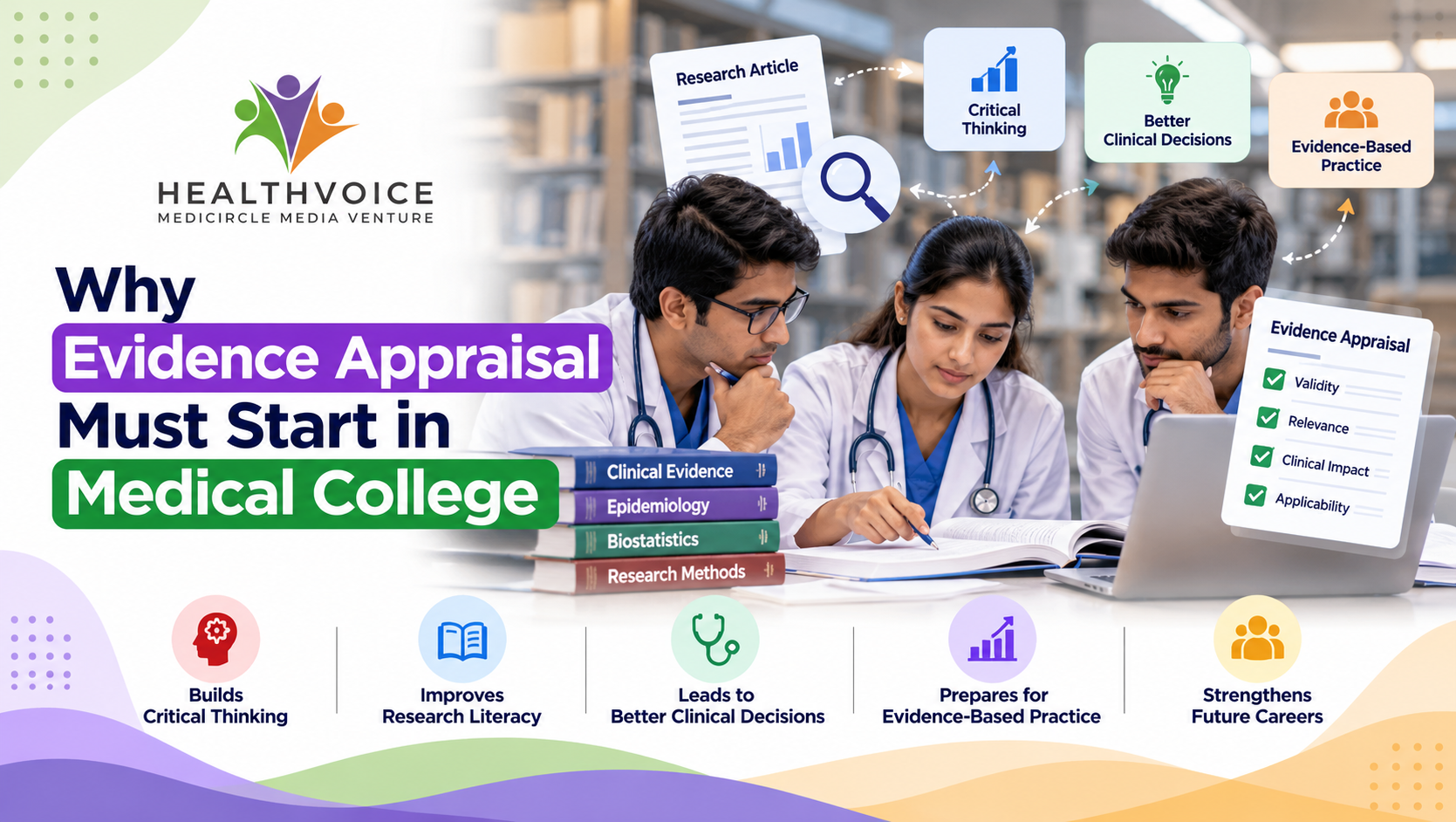
Evidence appraisal must begin in medical college to build lifelong critical thinking, improve clinical decision-making, and prepare Indian doctors to evaluate evolving medical research with confidence and accuracy.
Why Evidence Appraisal Should Begin in Medical College
Introduction
Medical education in India has always placed enormous value on clinical knowledge, practical exposure, and the ability to make sound decisions under pressure. Yet one foundational skill continues to receive far less attention than it deserves during undergraduate training: the ability to critically appraise evidence. Evidence appraisal, which is the structured process of evaluating research findings to determine their validity, relevance, and applicability, is not a postgraduate luxury. It is a clinical necessity that doctors must develop early.
Every day, medical professionals encounter new studies, updated treatment protocols, pharmaceutical claims, and public health advisories. Without the ability to assess these critically, even well-meaning clinicians risk adopting practices that are either ineffective or harmful. For Indian medical students entering a healthcare environment that is rapidly evolving, learning to appraise evidence in college is not optional. It is foundational.
Understanding Evidence Appraisal and What It Means in Practice
At its core, evidence appraisal refers to the ability to evaluate published medical research and clinical data using a structured framework. It sits at the heart of evidence-based medicine, a practice model introduced internationally in the early 1990s and now considered the global standard for clinical decision-making.
For a medical student, appraisal involves asking three essential questions about any piece of evidence:
- Is the research valid, meaning was it conducted using sound methodology?
- Are the results reliable, and what do the numbers actually mean for patients?
- Is the evidence applicable to the specific patient or population being treated?
These questions may appear simple, but answering them accurately requires familiarity with research design, statistical literacy, understanding of bias, and the ability to interpret confidence intervals, p-values, and effect sizes. These are not skills that develop overnight, and they certainly do not develop through passive exposure alone. They need to be taught, practiced, and reinforced throughout undergraduate training.
The Problem with Deferring Evidence Appraisal to Postgraduate Training
One of the most persistent assumptions in Indian medical education is that evidence appraisal is a postgraduate concern. The thinking is that MBBS students are too early in their learning journey to engage meaningfully with research literature, and that clinical skills and theoretical knowledge should take priority during undergraduate years.
This assumption has significant consequences. When students spend five and a half years in medical college without learning to engage with primary literature, they graduate with a critical gap in their professional toolkit. They have been trained to absorb information rather than interrogate it.
The result becomes visible in clinical practice. Doctors who have not developed appraisal skills tend to rely heavily on pharmaceutical representatives for drug information, accept clinical guidelines without understanding the evidence behind them, struggle to evaluate new therapies emerging in their speciality, and find it difficult to counsel patients who arrive with information sourced from the internet or social media.
In a country like India, where unverified health claims circulate widely across platforms such as WhatsApp and YouTube, the inability to critically evaluate information is not merely an academic shortcoming. It is a public health risk.
Why Medical College Is the Right Starting Point
The undergraduate years of medical education represent a unique window of intellectual development. Students are forming the cognitive habits and professional identities that will stay with them throughout their careers. Introducing evidence appraisal at this stage allows the skill to become a natural part of how students think about clinical problems, rather than an additional technical burden acquired later in training.
There are several strong reasons why evidence appraisal training should begin in medical college.
First, early exposure builds fluency over time. Just as clinical examination skills improve with repeated practice across clinical postings, the ability to appraise research improves with regular engagement. A student who begins reading journal articles and evaluating study designs in the second year of MBBS will be far more capable by the time they enter a residency programme than one who encounters the concept for the first time after graduation.
Second, undergraduate students are often highly motivated. The early years of medical college, particularly before the weight of clinical responsibilities sets in, offer significant time for self-directed learning. Channelling that motivation toward evidence appraisal builds intellectual habits that serve students for decades.
Third, the National Medical Commission has been moving toward competency-based medical education under the CBME framework, which formally places emphasis on critical thinking, research awareness, and self-directed learning. Incorporating evidence appraisal into this framework at the undergraduate level is aligned with the direction the regulator has already set.
What Evidence Appraisal Training Should Look Like in Indian Medical Colleges
Introducing evidence appraisal into undergraduate training does not require dismantling the existing curriculum. It requires thoughtful integration. Several practical approaches can make this transition effective.
Journal clubs, which are structured sessions where students read, present, and discuss a published research paper together, are among the most effective methods. When guided by a faculty member who models critical questioning, journal clubs build research literacy in a collaborative and low-pressure setting. Many postgraduate programmes use them extensively, and there is no reason they cannot be adapted for undergraduates.
Foundation modules in research methodology and biostatistics, which already exist in the MBBS curriculum to varying degrees, can be explicitly connected to evidence appraisal skills rather than taught as standalone theory. Understanding what a randomised controlled trial is becomes far more meaningful when a student can immediately apply that knowledge to evaluate whether a given trial's results should change clinical practice.
Bedside teaching offers another underutilised opportunity. When a faculty clinician refers to evidence while discussing a patient case, and then shows students how to locate and evaluate that evidence, the connection between research and clinical reality becomes tangible. This kind of teaching models exactly the behaviour that evidence-based medicine requires.
The Indian Context: Why This Matters More Than Ever
India's healthcare landscape presents specific challenges that make evidence appraisal skills particularly valuable for doctors practising here. The country carries one of the world's highest burdens of both communicable and non-communicable diseases, and the evidence base informing treatment decisions in many Indian disease contexts remains underdeveloped relative to high-income countries.
Clinical guidelines used in India are frequently adapted from studies conducted in Western populations, with different genetic profiles, disease presentations, dietary habits, and comorbidity patterns. A doctor with strong appraisal skills can recognise when a guideline may not translate directly to an Indian patient and can seek out local research or make informed clinical judgements accordingly.
India also has a rapidly growing biomedical research output. Institutions such as the All India Institute of Medical Sciences, the Indian Council of Medical Research, and multiple government research councils have significantly expanded research activity in recent years. For Indian doctors to engage meaningfully with this growing body of home-grown evidence, they need to be trained to read and evaluate it with confidence.
Additionally, the rise of digital health information has created an environment where both patients and doctors are exposed to an enormous volume of health content, much of which is poorly substantiated. A generation of doctors trained in evidence appraisal is the most reliable safeguard against the spread of medical misinformation within clinical settings.
The Role of Medical Communities and Platforms in Supporting This Shift
The responsibility for building evidence appraisal culture in Indian medicine does not rest with colleges alone. Medical associations, professional communities, and healthcare platforms have a meaningful role to play in normalising this practice and supporting doctors at every stage of their careers.
Platforms that connect doctors across specialities and career stages, such as HealthVoice, create spaces where evidence-based discussion can become part of professional culture. When senior clinicians model critical appraisal in their public communication, when associations host workshops on research literacy, and when healthcare communities recognise and amplify voices that engage thoughtfully with evidence, the entire ecosystem shifts.
Young doctors who receive mixed messages during their training, where evidence appraisal is valued in theory but ignored in practice, are unlikely to carry it forward into their work. But when they see respected colleagues and associations actively engaging with research, the value of the skill becomes professionally visible and motivating.
Conclusion
Evidence appraisal is not a skill reserved for researchers or academics. It is a fundamental clinical competency that every doctor needs and one that must be built early. For Indian medical students, beginning this journey during undergraduate training means graduating with not just clinical knowledge but the intellectual tools to keep that knowledge current, accurate, and critically evaluated throughout an entire career.
The conversation around reforming medical education in India often focuses on clinical exposure, infrastructure, and faculty development. All of these are essential. But alongside them, building a generation of doctors who know how to interrogate evidence, understand its limitations, and apply it thoughtfully is one of the most important investments Indian medical education can make. The time to start is in college, not after.
Frequently Asked Questions
Q1: What is evidence appraisal in medicine?
Evidence appraisal is the process of systematically evaluating medical research to determine whether its findings are valid, reliable, and applicable to clinical practice. It forms the foundation of evidence-based medicine and helps doctors make informed decisions grounded in current and credible science.
Q2: Why should evidence appraisal be taught in MBBS and not just postgraduate courses?
Teaching evidence appraisal during MBBS ensures that doctors develop critical thinking habits early in their careers. By the time they enter postgraduate training or independent clinical practice, they are already equipped to evaluate research, question assumptions, and engage meaningfully with evolving medical literature.
Q3: How does evidence appraisal affect patient care in India?
Doctors with strong evidence appraisal skills can better evaluate whether clinical guidelines apply to their specific patient population, identify claims that are not supported by solid research, and counsel patients more accurately. In India, where patients are increasingly arriving with information from unverified sources, this skill directly improves the quality and safety of patient care.
Q4: What methods can Indian medical colleges use to teach evidence appraisal?
Indian medical colleges can integrate evidence appraisal through structured journal clubs, biostatistics modules linked to real research papers, case-based teaching that references primary literature, and faculty-led bedside discussions that model critical engagement with evidence. These approaches fit within the competency-based medical education framework recommended by the National Medical Commission.
Q5: Is evidence appraisal relevant to all medical specialities?
Yes, evidence appraisal is relevant across every medical speciality. Whether a doctor practises surgery, internal medicine, paediatrics, psychiatry, or public health, clinical decisions must be informed by the best available evidence. The ability to evaluate that evidence is therefore a universal clinical skill rather than a niche academic one.
Resources
- National Medical Commission (NMC): The official regulatory body overseeing undergraduate and postgraduate medical education standards in India, including the competency-based medical education framework.
- Indian Council of Medical Research (ICMR): India's apex body for biomedical research, publishing guidelines, clinical data, and evidence relevant to Indian disease burden and healthcare practice.
- World Health Organization (WHO) India: Provides evidence-based guidance on global and regional health priorities, research methodology, and clinical practice standards applicable to Indian healthcare settings.
- PubMed, National Library of Medicine: A comprehensive database of peer-reviewed biomedical literature, widely used by clinicians and researchers globally to locate primary research and systematic reviews.
- BMJ Best Practice: An internationally recognised clinical decision support tool grounded in systematic evidence appraisal, useful for both training and clinical practice.
Interlinking Keywords
Evidence-based medicine India, critical appraisal skills, MBBS curriculum reform, medical education in India, NMC competency-based education, clinical research literacy, journal club for medical students, biostatistics for doctors, undergraduate medical training, research methodology in MBBS, HealthVoice medical community, doctor professional development India
Last reviewed by:
Dr. Manthan Tripathi, HealthVoice Editorial and Medical Advisory Team, October 26, 2026.
Disclaimer
The content published in this article is intended for informational and educational purposes only. It is directed at medical professionals, medical students, and healthcare educators. This article does not constitute clinical advice, a substitute for formal medical education, or a recommendation of any specific curriculum framework. Readers are encouraged to consult official regulatory bodies such as the National Medical Commission and institutional academic committees for guidance on curriculum design and implementation. HealthVoice is committed to publishing credible, evidence-informed content that supports the professional development of doctors and the broader medical community in India.
 Dr. Manthan Tripathi
#EvidenceBasedMedicine #MedicalEducation