Zero Trust Healthcare: What It Means for Hospitals
Zero Trust Healthcare requires hospitals to continuously verify every access request, protect patient data, and build resilient cybersecurity frameworks suited to India's expanding digital health infrastructure.
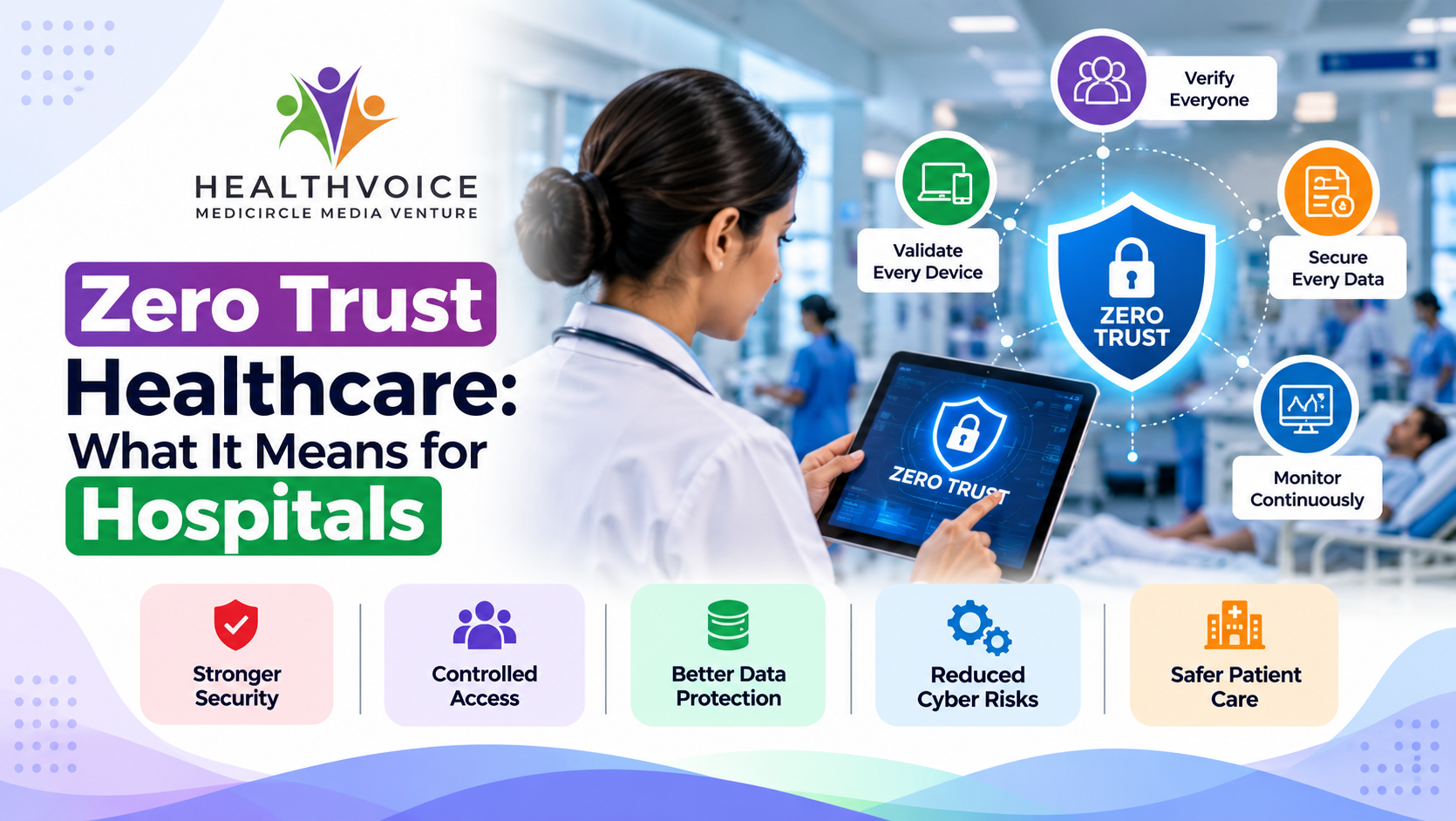
Zero Trust Healthcare: What It Means for Hospitals and Why It Can No Longer Wait
Introduction
Hospitals today are not just places of healing. They are complex digital ecosystems handling enormous volumes of sensitive patient data every hour of every day. From electronic health records and diagnostic imaging files to insurance information and prescription histories, the data flowing through a modern hospital system is among the most valuable and vulnerable data in existence.
In India, this digital transformation has accelerated significantly. The Ayushman Bharat Digital Mission (ABDM) is connecting millions of patients to a unified health identity system. Hospitals across Tier 1 and Tier 2 cities are adopting electronic medical record platforms, telemedicine solutions, and connected diagnostic equipment. This progress is commendable, but it comes with a serious and growing risk: cyberattacks targeting healthcare institutions are rising sharply, and traditional cybersecurity models are no longer adequate to contain them.
This is exactly where the concept of Zero Trust Healthcare enters the conversation. For hospital administrators, healthcare IT teams, medical association leaders, and healthcare policy professionals, understanding what Zero Trust means and why it matters is no longer optional. It is a professional and ethical responsibility.
Understanding Zero Trust: The Principle Behind the Framework
Zero Trust is a cybersecurity philosophy built on one foundational idea: never trust, always verify. Unlike older security models that assumed everything inside a hospital's internal network was safe and everything outside was dangerous, Zero Trust operates with a fundamentally different assumption. It treats every user, every device, and every access request as potentially compromised, regardless of whether it originates from inside or outside the hospital premises.
The term was formally introduced by Forrester Research analyst John Kindervag in 2010, and it has since been adopted by leading technology organizations, government agencies, and increasingly, healthcare systems around the world.
In a traditional hospital IT setup, once a doctor or administrator logs into the hospital's internal network, they may have broad access to multiple systems. A single compromised credential in such an environment can allow an attacker to move laterally across systems, accessing patient records, financial data, and even connected medical devices. Zero Trust eliminates this risk by requiring continuous verification at every step.
The three core pillars of Zero Trust are:
- Verify explicitly: Every access request must be authenticated and authorized based on all available data points, including user identity, device health, location, and behavior patterns.
- Use least privilege access: Users and systems are granted only the minimum level of access required to complete their specific task.
- Assume breach: The architecture is designed with the assumption that a breach is always possible, so damage containment and rapid detection are built into the system from the ground up.
Why Healthcare Is a High-Value Target for Cyberattacks
Healthcare data is extraordinarily valuable on the black market. A single complete patient health record can fetch significantly more than a stolen credit card number, because health data contains a combination of personal identifiers, insurance details, and medical history that cannot be easily changed or cancelled the way a credit card can be.
Globally, the healthcare sector has consistently ranked among the most targeted industries for cyberattacks. In India, this threat is becoming alarmingly real. Several Indian hospitals and health networks have reported ransomware attacks and data breaches in recent years. The All India Institute of Medical Sciences (AIIMS), New Delhi experienced a major ransomware attack in November 2022 that disrupted hospital operations for weeks. This was a wake-up call for the entire Indian healthcare ecosystem.
The factors that make Indian hospitals particularly vulnerable include:
- Rapid digitization without proportional investment in cybersecurity infrastructure
- Legacy IT systems that were never designed with modern security requirements in mind
- A shortage of trained healthcare cybersecurity professionals
- Inconsistent enforcement of data protection and security policies across hospital departments
- The growing use of personal devices and remote access by clinical and administrative staff
As ABDM continues to link patient records across healthcare providers, pharmacies, and insurers, the surface area for potential cyberattacks expands. Protecting this ecosystem is not just a technical challenge. It is a public health imperative.
How Zero Trust Works Inside a Hospital Environment
Implementing Zero Trust in a hospital setting involves rethinking how access, identity, and data flow are managed across the entire institution. It is not a single product or software tool. It is a comprehensive security architecture that requires coordinated changes across people, processes, and technology.
Identity and Access Management
At the heart of Zero Trust is robust identity verification. Every clinician, nurse, technician, administrative staff member, and vendor accessing hospital systems must be verified through multi-factor authentication (MFA). Role-based access controls ensure that a billing executive cannot access surgical records, and that a physician in cardiology cannot retrieve records from an unrelated department without a specific clinical reason.
Micro-Segmentation of Hospital Networks
Traditional hospital networks are often flat, meaning that once a device is connected, it can potentially communicate with most other systems. Zero Trust requires hospitals to segment their networks into smaller, isolated zones. The radiology department's imaging systems, the pharmacy management software, the ICU monitoring equipment, and the administrative database should each operate as separate segments with restricted cross-communication. A breach in one zone does not automatically compromise the others.
Device Trust and Endpoint Security
In a Zero Trust model, every device seeking network access must prove it is secure and compliant before being granted entry. This applies to hospital-issued laptops, connected medical devices, tablets used during ward rounds, and even physician smartphones used for telemedicine consultations. Devices with outdated software, missing security patches, or unusual behavior patterns are flagged or denied access automatically.
Continuous Monitoring and Threat Detection
Zero Trust is not a set-and-forget framework. It requires real-time monitoring of all network activity. Behavioral analytics tools observe patterns and flag anomalies. If a nurse's credentials are suddenly used to access a large volume of records in an unusual sequence or at an unusual time, the system can automatically trigger an alert or lock the session pending verification.
Zero Trust and Patient Data Privacy in the Indian Context
India's healthcare sector is undergoing a regulatory evolution alongside its digital one. The Digital Personal Data Protection Act (DPDPA) 2023 has introduced formal obligations around the collection, storage, and processing of personal data, including health data. The ABDM framework requires health information providers and fiduciaries to maintain strict data access controls.
Zero Trust aligns naturally with these regulatory requirements. When access to patient data is governed by continuous verification, least privilege principles, and audit trail logging, hospitals are better positioned to demonstrate compliance with DPDPA obligations. They can show exactly who accessed a patient's record, when, from which device, and for what purpose.
For patients, the practical benefit is meaningful. The confidence that their diagnosis reports, prescription history, and insurance information are not freely accessible to anyone within a hospital's internal network is a genuine improvement in the dignity and safety of their healthcare experience.
Challenges Indian Hospitals Face in Adopting Zero Trust
Acknowledging the importance of Zero Trust is one thing. Successfully implementing it across a busy tertiary care hospital or a district-level public health facility is considerably more complex.
The cost of implementation is a real barrier, particularly for smaller private hospitals and government healthcare facilities operating on constrained budgets. Zero Trust requires investment in identity management platforms, endpoint detection tools, network segmentation infrastructure, and ongoing monitoring systems.
Hospitals also face a significant human capital challenge. India has a pronounced shortage of cybersecurity professionals with healthcare-specific expertise. Many hospital IT teams are small and primarily focused on keeping systems running rather than actively monitoring for threats.
There is also the challenge of clinical workflow disruption. Clinicians and nurses work in high-pressure environments where speed matters. Additional authentication steps or access delays, even brief ones, can feel like obstacles when a patient requires immediate attention. Zero Trust implementation must be sensitive to clinical workflows and designed in a way that security does not compromise patient care.
Finally, legacy medical equipment poses a structural problem. Many hospitals operate MRI machines, patient monitors, and laboratory analyzers that run on outdated operating systems and were not designed with network security in mind. Integrating these devices into a Zero Trust architecture requires creative solutions and, in some cases, significant capital investment in equipment upgrades.
A Practical Path Forward for Hospital Leaders
Hospital administrators and healthcare IT leaders do not need to implement Zero Trust overnight. A phased, risk-prioritized approach is both realistic and recommended.
The process should begin with a thorough assessment of the hospital's current security posture: where sensitive data lives, who has access to it, how devices are managed, and where the most significant vulnerabilities exist. From this baseline, a roadmap can be developed that prioritizes the highest-risk areas first, such as patient data repositories, connected clinical devices, and systems with external access points.
Partnering with cybersecurity vendors who understand the healthcare environment and the specific regulatory context of India is valuable. Equally important is investing in staff training so that clinical and administrative teams understand why new security measures are in place and how to follow them efficiently.
Medical associations and healthcare bodies in India have an important role to play here. By developing and disseminating Zero Trust guidance tailored to the Indian healthcare context, associations can support member institutions in building stronger cybersecurity cultures without having to start from scratch individually.
Conclusion
Zero Trust Healthcare is not a distant concept reserved for large technology companies or global hospital chains. It is a necessary evolution in how Indian hospitals think about protecting patient data, maintaining institutional integrity, and fulfilling their duty of care in a digital age.
As India's healthcare infrastructure grows more connected through ABDM, telemedicine expansion, and digital health records, the stakes of inadequate cybersecurity grow with it. A data breach in a hospital does not only cause financial damage and reputational harm. It can delay care, expose vulnerable patients, and erode the public trust that healthcare institutions depend upon.
The Zero Trust framework offers a rigorous, principled, and scalable answer to this challenge. For doctors, hospital administrators, healthcare associations, and policy professionals, the time to understand and advocate for Zero Trust in healthcare is now.
Frequently Asked Questions
Q1: What is Zero Trust Healthcare?
Zero Trust Healthcare is a cybersecurity framework that requires continuous verification of every user, device, and system attempting to access hospital data or networks. It operates on the principle of never trust, always verify, and assumes that threats can exist both inside and outside the hospital's infrastructure.
Q2: Why do Indian hospitals need Zero Trust security?
Indian hospitals are rapidly digitizing patient records and connecting to national platforms like ABDM, making them attractive targets for cybercriminals. Traditional security models are insufficient to protect this expanding digital surface. Zero Trust provides a more resilient defense by ensuring that access is always verified and limited to what is strictly necessary.
Q3: What are the core principles of Zero Trust in healthcare?
The core principles are verify explicitly, use least privilege access, and assume breach. In practice, this means requiring multi-factor authentication, segmenting hospital networks into isolated zones, granting users only the minimum access they need, and monitoring all network activity in real time to detect unusual patterns.
Q4: How does Zero Trust affect patient data privacy?
Zero Trust significantly strengthens patient data privacy by limiting who can access health records, from which devices, and under what circumstances. Every access event is logged and monitored. This reduces the risk of unauthorized access, insider misuse, and external data breaches, giving patients greater confidence in the security of their sensitive health information.
Q5: What challenges do Indian hospitals face in adopting Zero Trust?
The primary challenges include high implementation costs, limited availability of trained healthcare cybersecurity professionals, legacy medical equipment that is difficult to secure, potential disruption to fast-paced clinical workflows, and inconsistent awareness among hospital leadership about modern cybersecurity frameworks.
Resources
- Ayushman Bharat Digital Mission (ABDM): Official platform for India's national digital health ecosystem, providing guidelines on health data management and interoperability.
- Ministry of Health and Family Welfare, Government of India: Source for national health policy, digital health regulations, and cybersecurity advisories for healthcare institutions.
- Indian Computer Emergency Response Team (CERT-In): India's national nodal agency for cybersecurity, issuing alerts and guidelines relevant to healthcare sector threats.
- World Health Organization (WHO): Global Cybersecurity in Health guidelines and resources for health system resilience and data protection.
- National Health Authority (NHA) of India: The implementing body for ABDM and Ayushman Bharat PM-JAY, offering documentation on data standards, health information exchange, and privacy compliance.
Interlinking Keywords
Zero Trust security in hospitals, hospital cybersecurity India, patient data privacy India, ABDM data protection, healthcare data breach prevention, electronic health records security, medical data compliance India, digital health security framework, healthcare network segmentation, DPDPA healthcare compliance
Last reviewed by:
Dr. Manthan Tripathi, HealthVoice Editorial and Medical Advisory Team, October 26, 2026.
Disclaimer
The information provided in this article is intended for general awareness and educational purposes only. It does not constitute legal, technical, or medical advice. Hospitals and healthcare institutions should consult qualified cybersecurity professionals and legal advisors before making decisions related to their data security infrastructure. Regulatory requirements may vary and should be verified with the relevant authorities.
 Dr. Manthan Tripathi
#ZeroTrustHealthcare #HospitalCybersecurity