AI Copilots in Medical Education: How XR Simulation is Transforming Clinical Training (2026 Guide)
AI-powered copilots, XR simulations, and patient-specific digital twins are transforming medical education from apprenticeship-based learning to competency-based training. By enabling safe practice, objective assessment, and personalized feedback, these technologies are improving clinician readiness while enhancing patient safety and surgical outcomes.
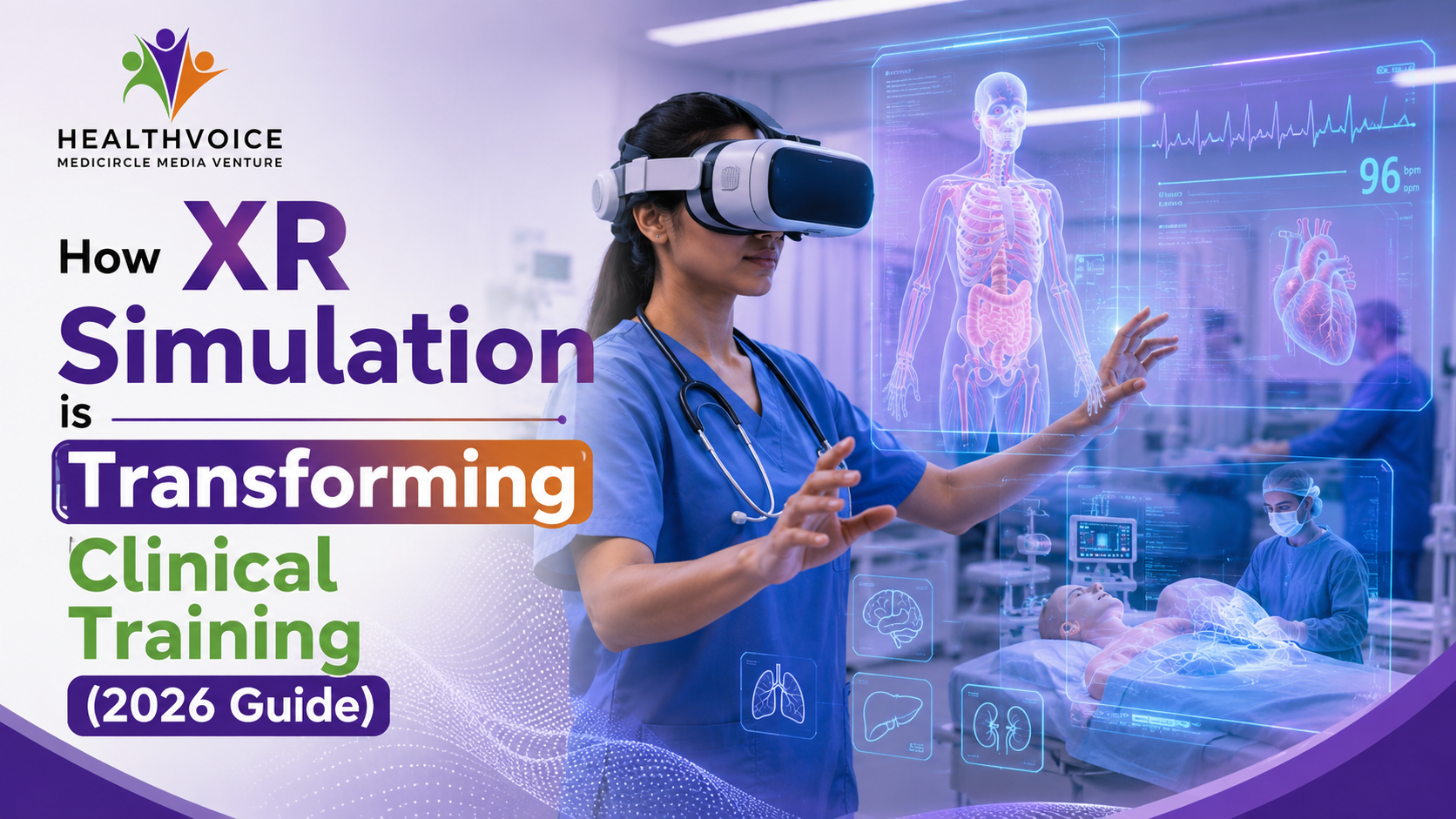
AI Copilots and Immersive Medical Simulation: How the Future of Medical Education is Being Rewritten
Medical education is rapidly moving beyond the traditional "see one, do one, teach one" model. AI-powered copilots, Extended Reality (XR) simulations, and patient-specific digital twins are enabling clinicians to practice complex procedures in risk-free environments while receiving objective, real-time feedback. This shift is improving competency, patient safety, and surgical precision before doctors ever enter the operating room.
AI Copilots and Immersive Medical Simulation: The Future of Competency-Based Medical Training
For decades, medical education relied heavily on apprenticeship, where experience came directly from treating patients. While this approach produced skilled clinicians, today's healthcare environment demands greater precision, safety, and technological expertise.
With advancements in Artificial Intelligence (AI), Virtual Reality (VR), Augmented Reality (AR), Mixed Reality (MR), and simulation-based medical education (SBME), training is becoming data-driven rather than experience-driven. AI copilots now assist learners in molecular research, surgical planning, technical skill assessment, and competency validation.
Why Traditional Medical Training Needed an Upgrade
Modern medicine has become increasingly complex with innovations such as:
- Gene editing using CRISPR
- Robotic-assisted surgery
- Personalized medicine
- Multi-omics diagnostics
- Advanced minimally invasive procedures
Learning these technologies solely on real patients presents ethical, financial, and patient safety challenges. AI-powered simulation bridges this gap by allowing unlimited practice without clinical risk.
AI Copilots in Molecular Medicine: Transforming CRISPR Training
AI-Assisted CRISPR Guide RNA Design
One of the earliest applications of AI in medical education is in genomic medicine.
Designing a safe CRISPR guide RNA (gRNA) traditionally requires extensive laboratory validation and bioinformatics expertise. AI copilots now automate much of this workflow by analyzing billions of genomic sequences within seconds.
Key Capabilities
- Predict optimal guide RNA sequences
- Estimate on-target editing efficiency
- Identify potential off-target mutations
- Evaluate chromatin accessibility
- Improve genomic safety before laboratory testing
This allows researchers and clinicians to learn advanced gene-editing strategies significantly faster while minimizing experimental errors.
Immersive XR Medical Simulation: Building Safer Surgeons
Patient-Specific Digital Twins
Modern simulation platforms convert real patient CT and MRI scans into highly detailed 3D digital replicas.
Instead of practicing on generic anatomical models, trainees rehearse procedures using the exact anatomy of future patients.
Benefits include:
- Personalized surgical planning
- Better understanding of anatomical variations
- Improved procedural confidence
- Reduced intraoperative surprises
AI Surgery Copilots in XR Operating Rooms
Advanced platforms now integrate AI-driven surgery copilots that monitor every stage of a simulated operation.
Real-Time AI Assistance Includes
Surgical Route Optimization
AI continuously evaluates instrument positioning and recommends safer anatomical pathways.
Computer Vision Tracking
Algorithms monitor tissue handling, incision placement, and instrument movement throughout the procedure.
Cognitive Load Management
The system tracks:
- Blood loss
- Patient vitals
- Instrument usage
- Workflow efficiency
allowing surgeons to focus on clinical decision-making rather than information overload.
Objective Surgical Skill Assessment Using AI
Traditional surgical evaluations often depended on mentor observations, which could vary between instructors.
AI-based simulation introduces objective performance measurement.
Motion and Force Analysis
Haptic sensors measure:
- Instrument path length
- Motion smoothness
- Applied force
- Precision of movement
This helps prevent tissue damage and improves surgical efficiency.
Eye Tracking and Attention Analysis
Integrated XR eye-tracking systems evaluate:
- Visual focus
- Situational awareness
- Attention distribution
- Decision-making patterns
The result is a comprehensive competency report based entirely on measurable performance.
Implementation Roadmap for AI-Based Medical Training
Phase 1: AI-Assisted Molecular Education
Objective
Develop safer CRISPR designs using AI-guided genomic analysis.
Phase 2: Patient-Specific Surgical Rehearsal
Objective
Use XR-based digital twins for preoperative planning and anatomical familiarization.
Phase 3: Technical Skills Development
Objective
Improve motor precision through haptic simulation and AI-guided feedback.
Phase 4: Decision-Making Simulation
Objective
Train surgeons to manage complex intraoperative scenarios using AI-powered surgery copilots.
Phase 5: Competency-Based Credentialing
Objective
Replace subjective evaluations with standardized AI-generated performance metrics.
Benefits of AI Copilots in Medical Education
Improved Patient Safety
Doctors refine complex skills before performing procedures on actual patients.
Personalized Learning
AI identifies individual weaknesses and generates customized improvement plans.
Faster Skill Acquisition
Simulation accelerates learning by allowing unlimited repetition without clinical risk.
Standardized Assessment
Performance is evaluated using objective metrics rather than instructor opinion.
Better Surgical Outcomes
Improved technical accuracy leads to fewer complications and greater procedural efficiency.
The Future of Competency-Based Medical Education
Medical education is rapidly transitioning from time-based training toward competency-based certification.
Instead of completing a fixed number of years or procedures, future clinicians may need to demonstrate measurable proficiency inside AI-supervised simulation environments before treating patients independently.
With AI copilots, immersive XR platforms, digital twins, and objective performance analytics, hospitals and medical schools are building a safer, more efficient training ecosystem that prepares clinicians for increasingly complex healthcare environments.
Conclusion
Artificial intelligence is redefining medical education by combining molecular design assistance, immersive simulation, and objective competency assessment into a unified learning ecosystem. As AI copilots become integral to clinical training, future healthcare professionals will enter practice better prepared, more confident, and capable of delivering safer, higher-quality patient care.
 Team Healthvoice
#MedicalEducationAI #XRSimulation
