Beyond the Opioid: The Sodium-Channel Revolution in Pain Management | Suzetrigine & NaV1.8 Explained
This article explores selective sodium-channel analgesics, especially suzetrigine, and examines their potential to transform pain management with effective non-opioid alternatives
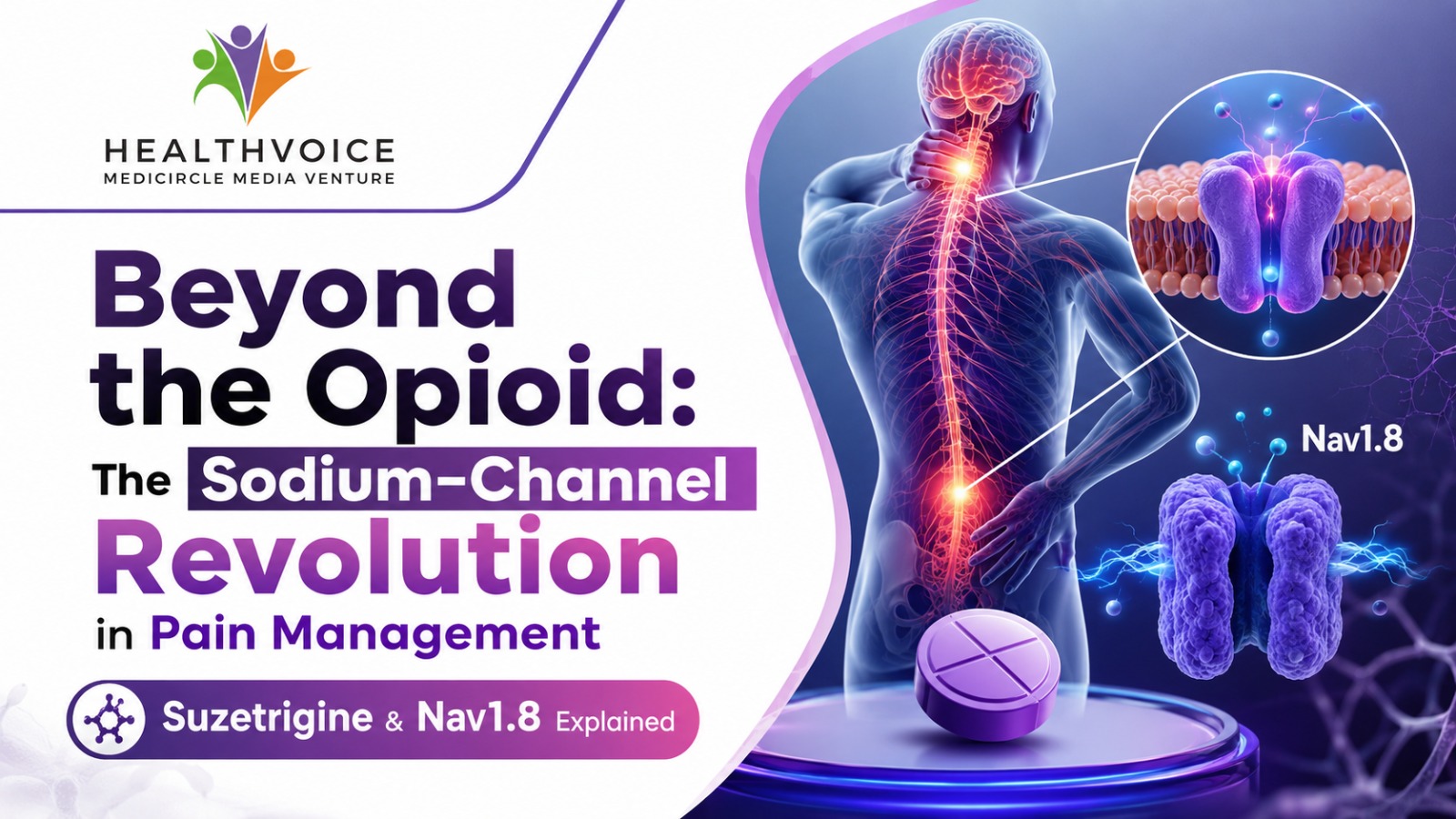
Beyond the Opioid: The Sodium-Channel Revolution in Pain Management
A new generation of non-opioid pain medicines, led by suzetrigine and emerging NaV1.7 modulators, is reshaping the future of acute and chronic pain management. For India, where chronic pain remains widely undertreated and opioid access is limited, sodium-channel-targeting therapies could mark one of the biggest advances in analgesia in decades.
Introduction: Why Pain Management Needs a New Direction
Pain remains the leading reason patients seek medical care worldwide. Yet despite decades of research, the therapeutic options available to clinicians have changed very little. The World Health Organization estimates that nearly 80% of patients with severe pain do not receive adequate treatment, while India continues to face one of the world's lowest opioid prescribing rates due to regulatory barriers, clinician concerns, and widespread opiophobia.
For millions of Indian patients, pain management has largely relied on paracetamol, NSAIDs, anticonvulsants, antidepressants, and opioids when available. Each carries important limitations, ranging from gastrointestinal and renal toxicity to dependence and administrative hurdles.
The approval of suzetrigine (Journavx) in January 2025 introduces the first entirely new oral analgesic mechanism in over two decades. Instead of acting on opioid receptors in the brain, it selectively blocks NaV1.8 sodium channels in peripheral pain neurons, opening an entirely new era of non-opioid analgesia.
What Are Sodium Channels and Why Do They Matter?
Voltage-gated sodium channels are essential for generating electrical signals throughout the nervous system.
Among the nine identified sodium-channel subtypes (NaV1.1–NaV1.9), two have become major targets for pain medicine:
NaV1.7: The Genetic Proof of Pain
NaV1.7 gained attention after researchers discovered that individuals born with loss-of-function mutations in the SCN9A gene are unable to feel pain despite otherwise normal neurological function.
Conversely, gain-of-function mutations produce severe inherited pain disorders such as:
- Erythromelalgia
- Paroxysmal Extreme Pain Disorder (PEPD)
These discoveries established NaV1.7 as one of the strongest genetically validated pain targets ever identified.
NaV1.8: The Peripheral Pain Amplifier
NaV1.8 plays a different but equally important role.
Located almost exclusively within peripheral sensory neurons, NaV1.8 amplifies pain signals after they begin.
Because it has minimal expression in the brain, selectively blocking NaV1.8 interrupts pain transmission before signals reach the central nervous system.
This explains why selective NaV1.8 inhibitors can potentially provide analgesia without:
- Sedation
- Respiratory depression
- Euphoria
- Addiction liability
Why Earlier Sodium Channel Drugs Had Limitations
Older sodium-channel blockers such as:
- Lidocaine
- Carbamazepine
- Mexiletine
were effective because they broadly blocked multiple sodium channels.
Unfortunately, they also affected:
- Cardiac conduction
- Motor neurons
- Central nervous system pathways
The result was dose-limiting toxicity that prevented their widespread use as routine analgesics.
Advances in structural biology have now enabled researchers to selectively target pain-specific sodium channels while avoiding those responsible for unwanted side effects.
Suzetrigine: The First Approved NaV1.8 Inhibitor
Approved by the US FDA on 30 January 2025, suzetrigine (VX-548), marketed as Journavx, represents the first new oral pain medication class in more than twenty years.
Unlike opioids, it does not activate opioid receptors.
Instead, it stabilizes the NaV1.8 channel in its resting state by binding to the Voltage Sensing Domain 2 (VSD2), preventing transmission of pain signals.
Its remarkable selectivity—over 31,000-fold greater for NaV1.8 than other sodium-channel subtypes—minimizes off-target effects.
Clinical Evidence: What the Trials Show
NAVIGATE-1 Trial (Abdominoplasty)
- 303 patients
- Significant improvement in SPID48 compared with placebo
- Approximately 50% reduction in pain scores
- Rapid onset of analgesia
NAVIGATE-2 Trial (Bunionectomy)
- 274 patients
- Significant improvement over placebo
- Sustained pain relief for 48 hours
- Strong efficacy in moderate post-operative pain
Comparison with Opioids
Phase II studies demonstrated that suzetrigine achieved non-inferior pain relief compared with hydrocodone/acetaminophen in moderate post-surgical pain.
However, opioids still produced stronger analgesia in the most severe pain categories.
Safety Profile
Reported adverse effects were generally mild and included:
- Rash
- Pruritus
- Muscle spasms
- Temporary creatine kinase elevation
Importantly, studies found:
- No evidence of euphoria
- No abuse potential
- No physiological dependence
- No respiratory depression
The Next Frontier: NaV1.7 Modulators
Although NaV1.8 reached the clinic first, researchers continue pursuing NaV1.7-targeted therapies.
Several earlier drug candidates failed because successful channel binding did not consistently translate into meaningful pain relief in humans.
Current research is taking more sophisticated approaches, including:
Combination Therapy
Scientists are combining selective NaV1.7 inhibitors with enkephalinase inhibitors, attempting to mimic the biology observed in people naturally born without functional NaV1.7 channels.
Improved Drug Design
Recent advances including:
- Cryo-electron microscopy
- Automated patch-clamp pharmacology
- AI-assisted structural biology
have dramatically improved sodium-channel drug development.
Several NaV1.7 candidates are now progressing through clinical development, while additional NaV1.8 inhibitors are also advancing.
Why This Matters for India
Nearly one in five Indian adults experiences chronic pain, yet opioid prescribing remains among the world's lowest.
Multiple barriers contribute:
Regulatory Complexity
Current opioid prescribing involves:
- Special licensing
- Strict documentation
- Quantity restrictions
- Administrative oversight
These challenges particularly affect rural healthcare.
Dependence on NSAIDs
Because opioids remain difficult to access, many patients rely on long-term NSAID therapy.
Extended NSAID use increases risks of:
- Gastrointestinal bleeding
- Kidney injury
- Cardiovascular disease
particularly among patients with diabetes and hypertension.
A Potential Non-Opioid Alternative
If approved in India, suzetrigine could offer:
- Oral administration
- Peripheral mechanism of action
- No addiction liability
- Minimal CNS effects
- Reduced regulatory burden compared with opioids
Although no CDSCO approval application has yet been publicly announced, the pharmacological profile makes it an attractive future option for Indian pain practice.
Potential Role in Chronic Neuropathic Pain
Research is expanding beyond acute surgical pain.
Ongoing clinical trials are evaluating suzetrigine in:
Diabetic Peripheral Neuropathy
Given India's enormous diabetes burden, success in DPN could significantly change routine pain management.
Current treatments such as:
- Pregabalin
- Duloxetine
- Tramadol
often provide incomplete relief or produce limiting adverse effects.
Lumbosacral Radiculopathy
Early Phase II data have shown encouraging but mixed findings.
Larger studies will determine whether NaV1.8 inhibition becomes a first-line option.
Practical Guidance for Clinicians
Acute Post-Surgical Pain
Current evidence supports:
- 100 mg loading dose
- 50 mg every 12 hours
Suzetrigine appears best suited as the primary component of multimodal analgesia alongside:
- Paracetamol
- Regional anaesthesia
- Non-pharmacological pain strategies
Patients with very severe pain may still require supplemental opioids.
Drug Interactions
Suzetrigine is primarily metabolized through CYP3A4.
Avoid concurrent use with strong inhibitors such as:
- Clarithromycin
- Itraconazole
- Ritonavir
and strong inducers including:
- Rifampicin
- Carbamazepine
- Phenytoin
Renal and Hepatic Monitoring
Although major hepatic toxicity has not been observed, long-term safety data remain limited.
Monitoring liver function may be prudent during prolonged therapy once chronic indications become available.
Populations Yet to Be Studied
Current evidence is lacking for:
- Children
- Pregnant women
- Lactating mothers
- Patients with significant cardiac conduction disorders
Further research is required before routine use in these populations.
Current Limitations of Sodium-Channel Analgesics
Despite the excitement, important limitations remain.
Severe Pain
Suzetrigine has not consistently outperformed opioid combinations in patients with the highest pain scores.
Long-Term Safety
Most available studies evaluated treatment over only 48 hours.
Chronic administration requires additional evidence.
Cost
As an innovative branded therapy, affordability may become a major barrier unless future generic licensing reduces pricing.
NaV1.7 Development Challenges
Human genetics strongly support NaV1.7 as a target.
However, previous clinical failures remind researchers that translating genetic discoveries into successful medicines remains complex.
The Future of Pain Medicine
The approval of suzetrigine represents more than the launch of a single drug—it validates an entirely new therapeutic strategy.
Over the coming decade, selective sodium-channel inhibitors may significantly reduce dependence on opioids for moderate-to-severe pain while expanding options for chronic neuropathic disorders.
For India, where millions continue to live with undertreated pain, the opportunity extends beyond pharmacology. It offers the possibility of improving access to effective analgesia without reproducing the regulatory and dependence challenges historically associated with opioid therapy.
As additional NaV1.8 and NaV1.7 agents advance through clinical development, clinicians, policymakers, and healthcare institutions should begin preparing for a new generation of precision pain medicine.
Frequently Asked Questions (FAQs)
Is suzetrigine an opioid?
No. Suzetrigine is a selective NaV1.8 sodium-channel inhibitor that provides pain relief without activating opioid receptors.
Is suzetrigine approved in India?
No. As of mid-2025, suzetrigine has FDA approval in the United States but has not yet received approval from the CDSCO in India.
What types of pain may benefit from sodium-channel inhibitors?
Current evidence supports acute post-surgical pain, while ongoing studies are evaluating diabetic peripheral neuropathy and lumbosacral radiculopathy.
Does suzetrigine cause addiction?
Clinical studies have shown no evidence of euphoria, abuse potential, or physiological dependence.
Why are NaV1.7 drugs important?
NaV1.7 has strong genetic validation as a pain target and may become the next major class of non-opioid analgesics once ongoing clinical challenges are overcome.
 Team Healthvoice
#PainManagement #SodiumChannelTherapy