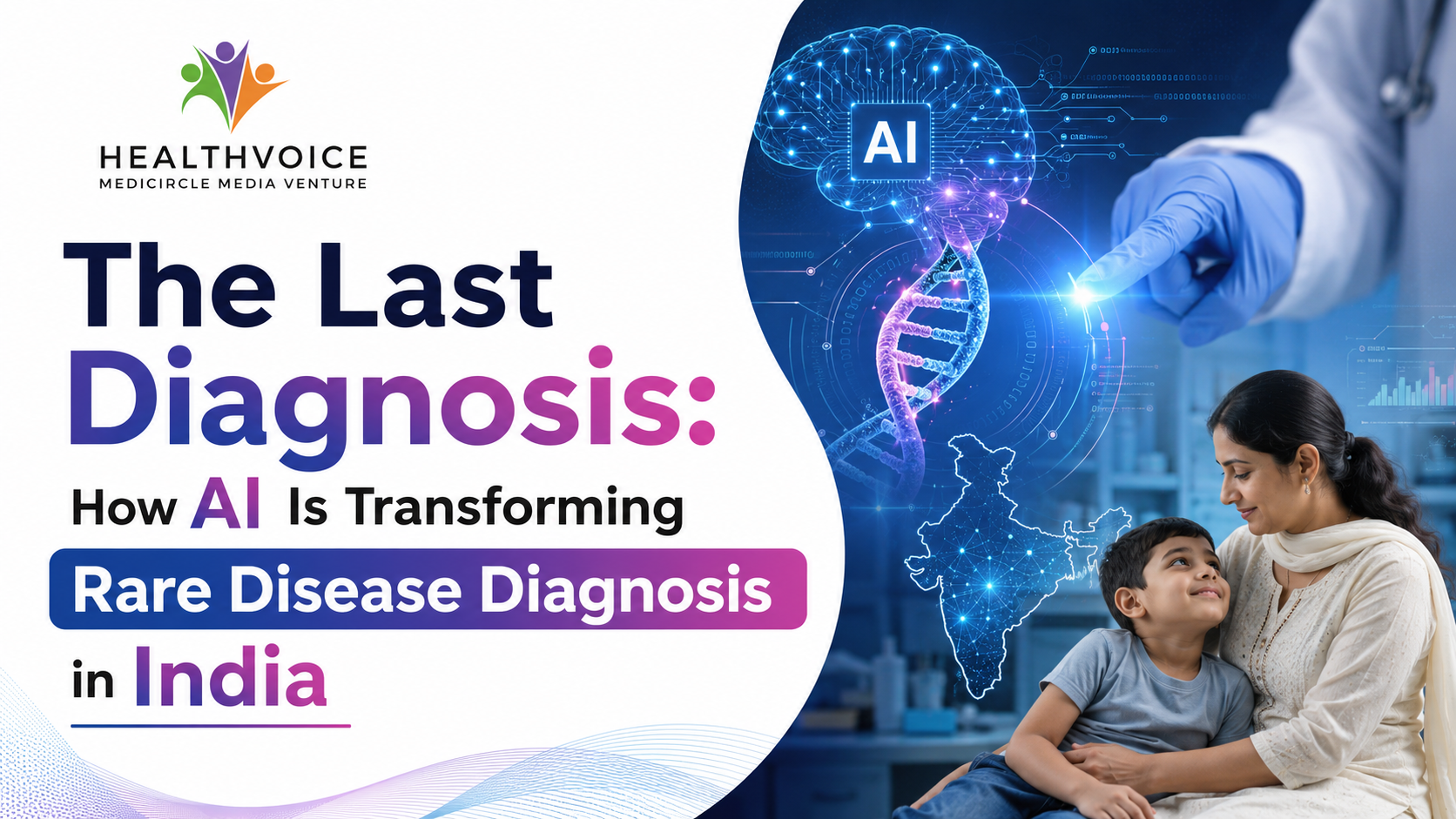
The Last Diagnosis: How AI Is Transforming Rare Disease Diagnosis in India
This article examines how AI-assisted genomic interpretation shortens rare disease diagnosis, improves variant prioritisation, and may accelerate precision medicine in India.
Introduction
For a child with an undiagnosed genetic disease, the average journey to a correct diagnosis can take nearly five years, involve more than seven specialist consultations, and include multiple incorrect diagnoses. Today, a new generation of AI-powered rare disease diagnosis tools is dramatically shortening that journey, helping clinicians identify the underlying genetic cause in days rather than years.
As artificial intelligence in genomics, whole-exome sequencing, and phenotype-based algorithms become increasingly sophisticated, healthcare professionals are witnessing a fundamental shift in how rare diseases are diagnosed. For India—with its unique genetic diversity and high burden of inherited disorders—this transformation may be even more significant.
What Is the Rare Disease Diagnostic Odyssey?The term diagnostic odyssey describes the long, frustrating path that patients with rare diseases often travel before receiving an accurate diagnosis.
Parents may first notice subtle symptoms such as poor feeding, delayed milestones, abnormal gait, developmental delay, unexplained seizures, or muscle weakness. These early signs frequently lead to years of referrals, repeated investigations, ineffective treatments, and considerable emotional and financial stress.
Globally:
- More than 300–400 million people live with a rare disease.
- Over 7,000 rare diseases have been identified.
- Nearly 80% are caused by genetic mutations.
- Average diagnostic delay ranges between 4.8 and 7 years.
This prolonged delay often results in unnecessary procedures, missed treatment opportunities, and declining confidence in the healthcare system.
Why India Is Uniquely Positioned for AI-Assisted Rare Disease DiagnosisIndia's rare disease landscape differs from many Western countries because of its highly diverse population structure.
Thousands of endogamous communities have produced recurring founder mutations, making several inherited disorders significantly more common within specific populations.
Commonly diagnosed inherited disorders include:
- Gaucher disease
- Duchenne muscular dystrophy
- Spinal muscular atrophy
- Thalassemias
- Inborn errors of metabolism
- Trinucleotide repeat disorders
Because these mutations recur within communities, AI-based pattern recognition has the potential to perform exceptionally well once trained using Indian genomic datasets.
As Indian sequencing databases continue to expand, diagnostic accuracy is expected to improve substantially.
Why Genome Sequencing Alone Was Never EnoughWhole-exome sequencing (WES) and whole-genome sequencing (WGS) have been available for years.
The real challenge has always been variant interpretation.
The Variant Interpretation Problem
A single clinical exome typically identifies hundreds of genetic variants.
The clinician must determine:
- Which variant is disease-causing
- Whether it matches the patient's symptoms
- Whether inheritance patterns fit the family history
- Whether previous scientific evidence supports pathogenicity
This process is labor-intensive and often requires experienced clinical geneticists.
AI is transforming precisely this step.
How AI Helps Diagnose Rare Genetic DiseasesModern AI-assisted variant prioritization tools combine genomic data with detailed clinical information to rapidly identify the most likely disease-causing mutation.
The analysis typically includes:
- Variant pathogenicity
- Human Phenotype Ontology (HPO) terms
- Gene-disease associations
- Population frequency databases
- Evolutionary conservation
- Family inheritance patterns
Instead of manually reviewing hundreds of variants, clinicians receive a ranked shortlist of the most likely candidates.
In many cases, the causative mutation appears within the top few results.
The Importance of Human Phenotype Ontology (HPO)Why Phenotyping Matters More Than the AI Tool
One of the strongest predictors of diagnostic success is accurate clinical phenotyping.
Human Phenotype Ontology (HPO) provides a standardized vocabulary describing patient features such as:
- Hypotonia
- Developmental delay
- Recurrent infections
- Arachnodactyly
- Seizures
- Ataxia
Well-annotated HPO profiles significantly improve AI performance.
Recent studies have shown that structured HPO documentation can nearly double the likelihood of ranking the correct diagnosis first.
This means careful clinical examination remains the most important step in the diagnostic process.
AI Tools Delivering Better Rare Disease DiagnosisSeveral next-generation AI platforms are now demonstrating impressive clinical performance.
AI-MARRVEL
AI-MARRVEL integrates genomic evidence with knowledge graphs, cross-species functional data, and multiple disease databases.
It has consistently outperformed several older variant prioritization platforms across multiple international validation cohorts.
DeepRare
DeepRare has been evaluated across more than 6,000 clinical cases involving nearly 3,000 rare diseases.
When clinical features are combined with genomic sequencing, the platform achieves approximately 69% top-ranked diagnostic accuracy, outperforming previous AI systems.
DiagAI
DiagAI has demonstrated excellent performance in identifying pathogenic variants, particularly when clinicians provide detailed HPO-based phenotyping.
Exomiser
Exomiser remains one of the most widely adopted open-source tools for clinical genetics laboratories because of its reliability, validation, and compatibility with standard sequencing workflows.
How AI Fits into the Clinical WorkflowStep 1: Clinical Evaluation
The physician performs a comprehensive examination and documents symptoms using standardized HPO terminology.
Step 2: Genome Sequencing
Whole-exome or whole-genome sequencing identifies genetic variants.
Step 3: AI-Based Variant Prioritization
The sequencing file and HPO profile are uploaded.
Within minutes, the AI platform produces a ranked list of candidate disease-causing variants.
Step 4: Clinical Interpretation
The geneticist reviews:
- Variant pathogenicity
- Clinical phenotype match
- Population frequency
- Published literature
- Family segregation studies
The AI narrows the search, but the final diagnosis remains a clinician-led decision.
Why AI Does Not Replace Clinical GeneticistsAI is an exceptionally powerful decision-support tool—not a replacement for clinical expertise.
Current limitations include:
Newly discovered disease genes
Recently identified gene-disease relationships may not yet appear in AI databases.
Structural genomic variants
Large deletions, duplications, and complex chromosomal rearrangements remain challenging for many algorithms.
Non-coding mutations
Variants outside protein-coding regions continue to be difficult to interpret.
Limited population diversity
Most AI models have been trained predominantly using European sequencing datasets, reducing confidence in underrepresented populations.
Clinical judgment remains indispensable.
The Growing Opportunity for IndiaIndia's expanding investment in genomic medicine creates ideal conditions for AI-assisted diagnosis.
Several major institutions now offer advanced molecular testing, including:
- AIIMS Delhi
- CMC Vellore
- Narayana Health
Meanwhile, the National Policy for Rare Diseases (2021) has accelerated efforts to improve diagnosis, patient registries, and genomic research.
As Indian genomic databases mature, AI systems trained on local populations are expected to outperform models developed using predominantly Western datasets.
Choosing the Right AI ToolNo single platform performs best across every clinical scenario.
Different tools have different strengths:
Exomiser
- Free
- Well validated
- Excellent for known inheritance patterns
AI-MARRVEL
- Knowledge graph integration
- Functional genomics support
- Cross-species evidence
DiagAI
- Strong pathogenicity prediction
- Particularly useful for rare missense variants
DeepRare
- Excellent for complex multisystem disorders
- Strong phenotype-driven ranking
Many genetics centers now run multiple algorithms simultaneously, comparing overlapping candidate genes to maximize diagnostic yield.
The Future of Rare Disease DiagnosisArtificial intelligence is fundamentally changing how clinicians approach rare genetic disorders.
Instead of spending weeks manually searching through hundreds of variants, physicians can focus on validating a small number of highly probable candidates.
Most importantly, AI allows healthcare professionals to spend less time searching databases and more time supporting families through one of the most important conversations in medicine—the moment a long-awaited diagnosis is finally made.
Conclusion
AI is not replacing the clinical geneticist—it is making genetic medicine faster, more precise, and significantly more accessible. As genomic sequencing becomes increasingly integrated into routine clinical care, AI-assisted variant interpretation is poised to shorten the rare disease diagnostic odyssey for millions of patients. For India, where unique population genetics and expanding genomic infrastructure intersect, the opportunity is especially profound, offering earlier diagnoses, better treatment decisions, and improved outcomes for families navigating rare genetic disorders.
 Team Healthvoice
#RareDisease #Genomics