Can Better Technology Reduce Administrative Burden for Doctors?
Better healthcare technology, including ABDM-integrated EHR systems, voice documentation tools, and workflow automation, can significantly reduce administrative burden on Indian doctors and restore clinical time.
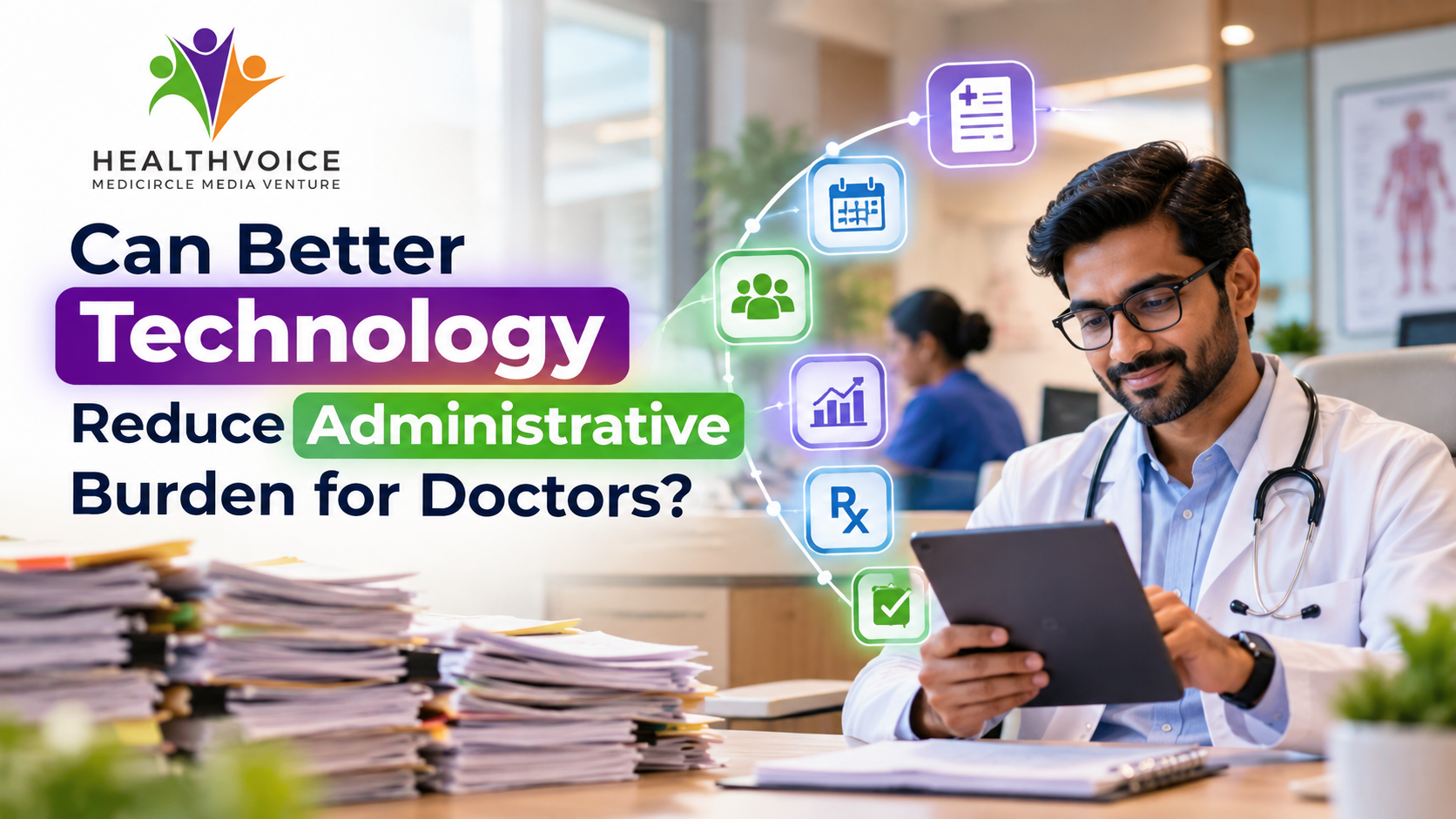
Can Better Technology Reduce Administrative Burden for Doctors?
Introduction
Across India, a quiet crisis runs parallel to the more visible challenges of healthcare access and infrastructure. Doctors, regardless of whether they practise in a corporate hospital in Mumbai or a district-level facility in Madhya Pradesh, are spending a growing proportion of their working hours on paperwork, data entry, billing processes, and compliance documentation rather than on direct patient care. This shift has measurable consequences not only for physician well-being but also for patient outcomes and the overall efficiency of the healthcare system.
The question is no longer whether this administrative burden is real. Research from multiple healthcare systems, including data emerging from Indian hospital audits and physician surveys, confirms that administrative tasks consume anywhere between 30 and 50 percent of a doctor's working day. The more important question today is whether the rapid advancement of healthcare technology in India can meaningfully reverse this trend and restore the balance in favour of clinical work.
This article examines the roots of administrative overload in Indian medical practice, explores the technology-driven solutions gaining traction, and considers what a genuinely technology-enabled future might look like for doctors working within the Indian healthcare ecosystem.
Understanding the Administrative Burden on Doctors in India
To appreciate the scale of the problem, it is important to understand what "administrative burden" actually means for a practising physician in India. It is not simply about filling out forms. The administrative load encompasses:
- Writing detailed patient notes and discharge summaries by hand or on poorly designed software systems
- Navigating insurance pre-authorisation processes for procedures under the Ayushman Bharat Pradhan Mantri Jan Arogya Yojana (AB-PMJAY) scheme
- Managing billing codes, ICD-10 classifications, and National Health Claims Exchange (NHCx) requirements
- Complying with documentation demands from the National Accreditation Board for Hospitals and Healthcare Providers (NABH)
- Responding to non-clinical queries from patients, family members, and administrative staff
- Maintaining registers and reporting data to state health departments and the National Health Mission (NHM)
For a consultant seeing 40 to 60 patients daily in a busy outpatient department, these parallel responsibilities create a compounding pressure that erodes both the quality of consultations and the mental health of the physician. The Indian Medical Association has acknowledged physician burnout as an emerging occupational health concern, and administrative overload is consistently cited as a primary driver.
Primary Causes of Growing Administrative Workload
The administrative burden on Indian doctors has intensified in recent years for several interconnected reasons.
The rollout of the Ayushman Bharat Digital Mission (ABDM) and the expansion of government health insurance schemes have introduced new documentation requirements to ensure claims are processed and audited correctly. While the intent of these schemes is to improve access to care, the documentation infrastructure around them has placed additional responsibilities on clinical staff.
At the same time, hospital accreditation standards under NABH require increasingly detailed record-keeping, policy documentation, and quality reporting. Hospitals pursuing or maintaining accreditation must demonstrate compliance across hundreds of indicators, and this documentation burden often falls on doctors in addition to their clinical responsibilities.
The growth of medico-legal awareness in India has also contributed. Doctors now maintain more detailed records as a protective measure, a necessary and understandable response to an increase in consumer complaints and legal proceedings. However, the time this requires comes directly from clinical interaction time.
Finally, many healthcare facilities, particularly in Tier 2 and Tier 3 cities, rely on fragmented or outdated systems where different departments use different software, paper records coexist with digital records, and there is no unified patient data infrastructure. Doctors in such settings often spend significant time reconciling information across systems or recreating records that should have been available digitally.
How Technology Is Addressing the Problem
The good news is that healthcare technology in India is evolving with meaningful pace, and several categories of digital tools are beginning to demonstrate real-world impact in reducing administrative workload for doctors.
Electronic Health Records and the ABDM Ecosystem
The Ayushman Bharat Digital Mission has created the foundational architecture for a federated health records system in India through the Ayushman Bharat Health Account (ABHA) identifier. When hospitals and clinics integrate ABDM-compliant Electronic Health Record (EHR) systems, patient records become portable and accessible across care settings. This reduces the need for doctors to re-document patient history at every consultation and minimises the risk of clinical decisions being made on incomplete information.
ABDM-integrated EHR platforms also support the Health Facility Registry (HFR) and the Healthcare Professionals Registry (HPR), streamlining the verification processes that previously required manual effort. For doctors working within such integrated environments, the administrative effort of maintaining consistent patient records is significantly reduced.
Voice-Enabled Clinical Documentation
One of the most promising technology applications gaining traction in Indian hospitals is ambient voice documentation, where artificial intelligence processes spoken clinical conversations and automatically generates structured clinical notes. Rather than spending 15 to 20 minutes typing notes after each consultation, a physician using a voice-enabled documentation tool can complete notes in real time, with minimal interruption to the patient interaction.
Several Indian healthtech companies and international platforms entering the Indian market are adapting these tools for local languages and medical terminology. The ability to document in Hindi, Tamil, or other regional languages while maintaining structured English-language records for insurance and regulatory purposes represents a significant step forward for Indian clinical practice.
Intelligent Workflow and Task Automation
Beyond documentation, hospital management systems powered by machine learning are beginning to automate routine administrative tasks such as appointment scheduling, prescription refills for stable chronic conditions, follow-up reminders, and routine lab report flagging. These systems reduce the number of administrative decisions that require direct physician involvement without compromising clinical oversight.
In larger hospital networks across cities like Bangalore, Hyderabad, and Chennai, integrated Hospital Information Systems (HIS) are enabling automated insurance pre-authorisation workflows. Instead of a doctor manually completing and submitting pre-authorisation forms, the system pulls relevant clinical data from the patient record, populates the required fields, and routes the request through the appropriate channel. This alone can save several minutes per patient, which adds up to meaningful time savings across a full outpatient schedule.
Telemedicine and Asynchronous Communication Tools
The expansion of telemedicine in India following the Telemedicine Practice Guidelines issued in 2020 has introduced new efficiencies in how doctors manage patient communication. Structured teleconsultation platforms allow patients to submit symptom updates, prescription renewal requests, and follow-up queries in a structured format that doctors can address efficiently in dedicated review windows rather than fielding unstructured phone calls throughout the clinical day.
This asynchronous model of patient communication respects physician time, organises non-urgent queries systematically, and reduces the informal interruptions that fragment concentration during clinical work.
Challenges to Adoption in the Indian Context
Technology alone is not a complete solution, and it is important to acknowledge the real barriers to adoption that exist within Indian healthcare settings.
Infrastructure gaps remain a significant challenge. Reliable high-speed internet connectivity, adequate power supply, and compatible devices are not uniformly available across Indian healthcare facilities. A digital documentation system that functions smoothly in a private hospital in Delhi may be entirely impractical for a community health centre in rural Assam.
Digital literacy among healthcare workers, including doctors who trained before digital systems became standard, varies considerably. Technology adoption requires not only investment in hardware and software but also sustained training, change management support, and a genuine organisational commitment to transition away from paper-based processes.
Data privacy and security concerns are increasingly relevant, particularly as patient health records become digital and interconnected. The Digital Personal Data Protection Act, 2023, creates a new compliance landscape for healthcare organisations, and doctors need to understand how patient data is being managed and protected within the systems they use.
Finally, the cost of implementing high-quality integrated systems can be prohibitive for smaller clinics and nursing homes, which collectively serve a large proportion of India's outpatient population. Affordable and scalable technology solutions designed specifically for small and mid-sized healthcare practices are still an underdeveloped segment of the Indian healthtech market.
The Path Forward for Indian Healthcare
Reducing administrative burden for doctors is not simply a matter of convenience or efficiency. It is a patient safety issue, a physician well-being issue, and a systemic quality issue. When doctors have more time and cognitive space for clinical thinking, diagnostic accuracy improves, patient communication deepens, and outcomes are better.
The Government of India's push through ABDM to build a national digital health ecosystem provides a policy foundation that did not exist a decade ago. When this foundation is combined with thoughtful, affordable, and locally adapted technology solutions, the possibility of genuinely reducing the administrative load on Indian doctors becomes realistic rather than aspirational.
Medical associations and healthcare institutions have an important role to play in advocating for technology adoption, sharing best practices across their member networks, and ensuring that the voices of practising doctors shape the design and implementation of these systems. Platforms that enable doctors and healthcare communities to engage on these issues collectively provide an important forum for this kind of professional influence.
The technology exists. The policy direction is broadly supportive. What is needed now is coordinated implementation, sustained investment in digital infrastructure, and a healthcare culture that treats physician time as the valuable clinical resource it is.
Frequently Asked Questions
Q1: How much time do Indian doctors spend on administrative tasks each day?
Studies and hospital audits suggest that Indian doctors spend between 30 and 50 percent of their working time on administrative tasks, including documentation, billing, compliance reporting, and insurance-related processes. This proportion increases in hospitals with manual or fragmented record-keeping systems.
Q2: What is the Ayushman Bharat Digital Mission and how does it help doctors?
The Ayushman Bharat Digital Mission (ABDM) is a Government of India initiative that aims to create a unified digital health ecosystem. It enables the creation of health records linked to a unique ABHA identifier, making patient data portable across care settings and reducing the need for doctors to re-document patient history during each visit.
Q3: Can artificial intelligence really reduce documentation time for doctors?
Yes. Ambient voice documentation tools powered by artificial intelligence can process spoken clinical conversations and generate structured clinical notes in real time, significantly reducing the time doctors spend typing notes after consultations. Several platforms are now adapting these tools for Indian languages and medical contexts.
Q4: What are the main barriers to healthcare technology adoption in India?
The main barriers include inconsistent digital infrastructure, especially in rural and Tier 2 or Tier 3 settings, variable digital literacy among healthcare workers, data privacy and security concerns under the Digital Personal Data Protection Act 2023, and the high cost of implementing integrated systems for smaller clinics and nursing homes.
Q5: How does reducing administrative burden improve patient care?
When doctors spend less time on paperwork and administrative processes, they have more time and mental energy for direct patient interaction, clinical decision-making, and diagnostic thinking. This leads to more thorough consultations, fewer diagnostic errors, better patient communication, and improved overall care quality.
Resources
- Ayushman Bharat Digital Mission (ABDM): Official digital health infrastructure initiative of the Government of India, covering ABHA, Health Facility Registry, and national health records standards at abdm.gov.in
- National Accreditation Board for Hospitals and Healthcare Providers (NABH): Standards and guidelines for hospital accreditation and quality management in Indian healthcare at nabh.co
- World Health Organization (WHO) India: Reports and guidance on healthcare workforce, physician burnout, and digital health transformation in the South-East Asia region at who.int/india
- Indian Medical Association (IMA): National body representing the Indian medical profession, with resources on physician well-being, policy advocacy, and professional standards at ima-india.org
Interlinking Keywords
administrative burden on doctors India, healthcare technology India, ABDM digital health, doctor burnout India, EHR systems India, telemedicine India guidelines, physician workload reduction, hospital information systems India, clinical documentation technology, healthtech India doctors
Last reviewed by:
Dr. Manthan Tripathi, HealthVoice Editorial and Medical Advisory Team, October 14, 2026.
Disclaimer
This article is intended for informational and educational purposes only. It is directed at healthcare professionals, medical associations, and healthcare decision-makers. The content does not constitute clinical advice and should not be used as a substitute for professional medical judgement. All technology-related claims are based on currently available information and may be subject to change as healthcare regulations and digital health standards in India continue to evolve. Readers are advised to consult relevant regulatory authorities and technology providers for implementation guidance specific to their clinical setting.
 Dr. Manthan Tripathi
#HealthcareTechnology #ReducingDoctorBurnout