Non-Clinical Work and the Changing Routine of Indian Doctors
Non-clinical responsibilities are reshaping the Indian doctor's day, with documentation, compliance, and digital demands reducing clinical time and increasing physician burnout across healthcare settings.
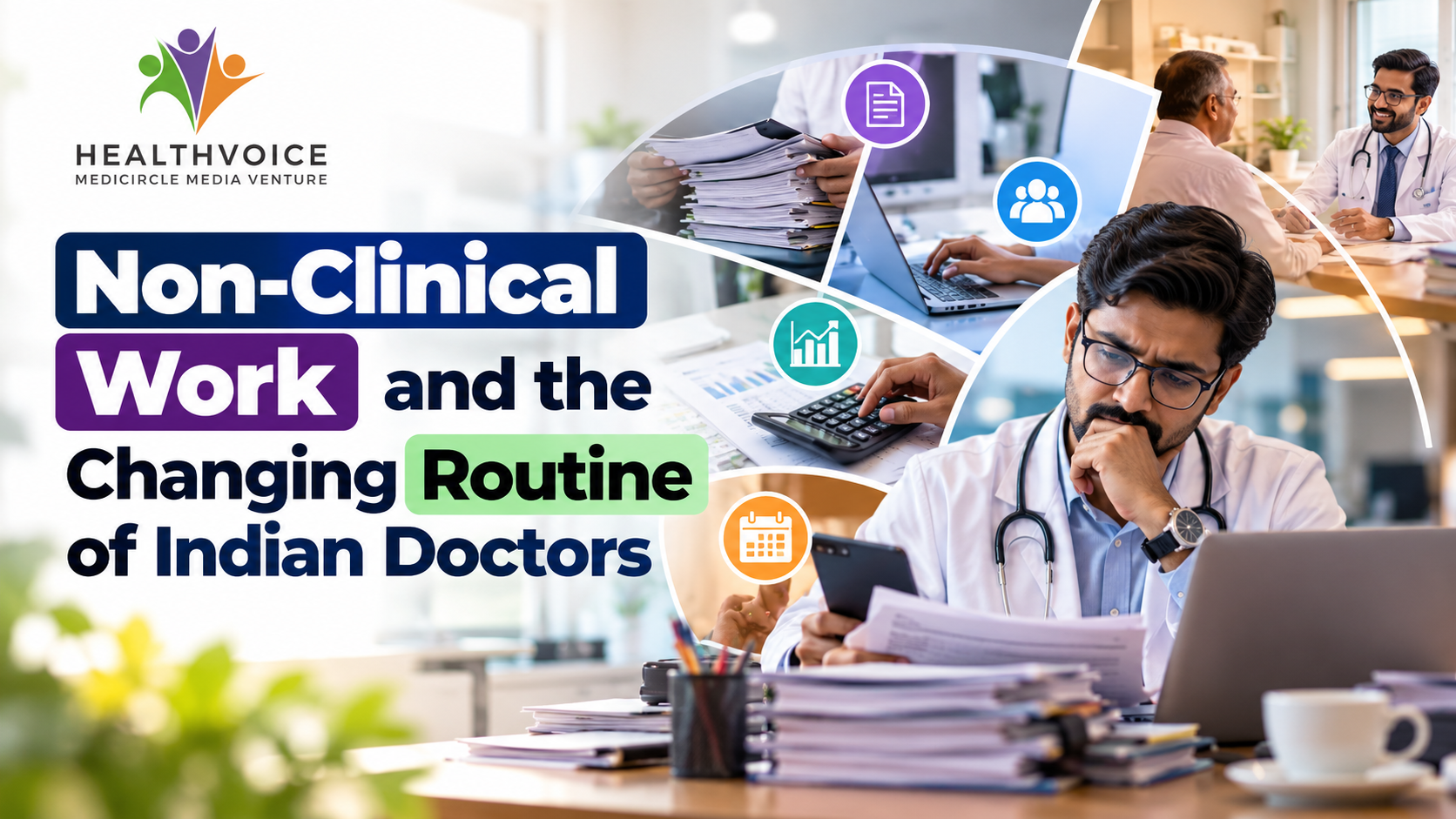
Why Non-Clinical Work Is Reshaping the Doctor's Day in India
Introduction
There was a time when a doctor's day was defined almost entirely by the patients sitting in the consultation room. Clinical decisions, diagnoses, prescriptions, and bedside conversations filled the working hours from morning to evening. That reality has shifted considerably. Today, a significant portion of a doctor's professional day is spent on work that has nothing to do with direct patient care. Reports to file, digital portals to update, compliance checklists to complete, telemedicine platforms to navigate, insurance documentation to submit, and institutional meetings to attend have quietly but firmly entered the medical routine.
This shift is not unique to India, but its implications in the Indian context carry particular weight. With a doctor-to-population ratio that continues to fall short of global benchmarks and a healthcare demand that grows every year, every hour a doctor spends away from clinical work matters. Understanding why non-clinical responsibilities have expanded so rapidly, what they include, and how they are affecting the medical profession is now a conversation that can no longer wait at the margins.
Understanding the Non-Clinical Load: What It Includes and Why It Has Grown
Non-clinical work refers to all professional responsibilities that do not involve direct examination, diagnosis, or treatment of a patient. Across Indian hospitals, clinics, and healthcare institutions, this category has grown to include documentation and electronic medical record management, insurance pre-authorisation and claim processing, regulatory and compliance reporting under frameworks such as those set by the National Medical Commission, quality audits under NABH accreditation processes, participation in hospital administration committees, telemedicine coordination, continuing medical education requirements, and increasingly, digital communication responsibilities including managing health information shared on platforms and through association channels.
Several forces have driven this expansion simultaneously. The rollout of the Ayushman Bharat Digital Mission has accelerated the adoption of digital health records and patient-linked health IDs, which requires doctors and their support staff to engage with electronic systems more extensively than before. Insurance penetration through Pradhan Mantri Jan Arogya Yojana and private health insurance has brought with it a structured documentation burden that did not exist at the same scale a decade ago. Quality accreditation standards, while valuable for patient safety, require ongoing paperwork and process documentation that falls partly on clinical staff. Regulatory frameworks from the NMC mandate continuing medical education credits, peer review participation, and professional conduct documentation that each consume time.
At the same time, India has seen a rapid growth in private hospital chains and corporate healthcare institutions where doctors work within structured administrative frameworks. Unlike independent private practice, where a doctor has more control over their schedule, employment in a large healthcare organisation brings regular reporting requirements, data entry into hospital management systems, and participation in institutional governance processes.
How Non-Clinical Responsibilities Are Affecting Doctor Well-Being
The medical profession in India already operates under considerable stress. Long consultation hours, high patient volumes, geographic disparities in healthcare access, and significant social expectations placed on doctors create a demanding professional environment. When non-clinical work begins to occupy hours that were previously available for rest, professional development, or deeper engagement with patients, the consequences become visible in measurable ways.
Physician burnout has emerged as one of the more pressing concerns in Indian healthcare discourse. Studies and surveys across postgraduate medical institutions have consistently found high levels of emotional exhaustion among doctors, and the administrative burden is frequently cited as a contributing factor. When a doctor finishes a long outpatient session and then spends the next hour completing digital documentation or resolving insurance query forms, the physical and emotional toll accumulates.
There is also the question of cognitive load. Clinical decision-making requires focus, careful reasoning, and emotional attentiveness. Switching between complex diagnostic thinking and administrative task completion repeatedly across a single workday is cognitively draining in ways that straight clinical work often is not. Many doctors, especially those in teaching hospitals and large private institutions, report that the mental energy spent on non-clinical tasks is disproportionate to the outcomes those tasks generate.
Beyond individual well-being, there is a systems-level concern. When doctors spend a meaningful part of their working hours on administrative functions, the effective availability of clinical time decreases. In a country managing a heavy burden of communicable and non-communicable diseases simultaneously, this represents a public health resource constraint that deserves serious policy attention.
The Digital Transformation Layer: Opportunity and Overhead
India's push toward digital health infrastructure has real and lasting value. The Ayushman Bharat Digital Mission, with its unified health ID framework and digitised health records, has the potential to significantly improve care continuity, reduce diagnostic duplication, and enable better population health data. These are meaningful public health outcomes.
However, digital transformation in healthcare also introduces a new category of non-clinical overhead. Doctors must now interact with hospital management software, upload records into national digital health ecosystems, verify patient credentials linked to health IDs, and navigate telemedicine platforms that carry their own workflow requirements. In many institutions, the technology infrastructure is still maturing, which means doctors spend additional time troubleshooting system issues or compensating for incomplete digital integration between departments.
Telemedicine, which expanded dramatically during and after the COVID-19 period, has added a new dimension to the doctor's schedule. While it offers greater access to patients in remote or underserved areas, it also requires separate scheduling management, digital prescription systems, and follow-up coordination protocols. Doctors who engage with telemedicine platforms outside their regular hospital hours often find that the boundary between work and personal time blurs.
The honest assessment is that digital health tools carry both a promise and a burden. The promise lies in better outcomes and greater reach. The burden lies in the adaptation, learning curve, and daily workflow changes that implementing these tools demands from already stretched clinical professionals.
What Institutional and Policy Responses Are Emerging
There is a growing recognition within Indian healthcare institutions and among policy stakeholders that the administrative burden on doctors needs structural solutions, not just individual coping strategies. Several directions are beginning to take shape, though their implementation remains uneven across the country.
Task delegation has emerged as one of the most practical responses. When non-clinical responsibilities are appropriately assigned to trained administrative staff, medical secretaries, clinical coders, and health information managers rather than being absorbed entirely by the treating physician, clinical time is protected. Some large private hospital groups in India have begun investing in dedicated documentation support roles, though this remains far more common in Tier 1 cities than in Tier 2 and Tier 3 settings.
Technology-assisted documentation, including voice-to-text medical transcription tools and AI-assisted clinical note generation, is beginning to find its way into Indian healthcare settings. These tools, when well-implemented, can reduce the time a doctor spends converting clinical observations into written records. However, they require institutional investment and careful quality oversight to ensure accuracy.
At the policy level, there is a need for deliberate attention to how regulatory compliance requirements are designed and communicated. When every new health scheme or quality framework adds documentation layers without accounting for the time cost on clinical professionals, the cumulative effect is significant. Thoughtful regulatory design that minimises duplication, leverages existing digital systems, and supports physicians in meeting obligations without excessive overhead is an area where bodies like the NMC, state health departments, and the Ministry of Health and Family Welfare can play a constructive role.
Medical associations and professional communities also have an important part to play. Advocating on behalf of their members for reasonable administrative standards, providing training resources that help doctors navigate compliance requirements more efficiently, and facilitating peer dialogue about sustainable working conditions are all meaningful contributions that associations can make.
The Importance of Professional Visibility and Community in This Context
One dimension of the non-clinical workday that deserves more attention is the role of professional communication and community engagement. Increasingly, doctors are expected to maintain a visible professional presence, contribute to healthcare education and awareness, participate in association activities, and engage with peers across digital channels. These responsibilities, while valuable, also claim time and attention.
Platforms built specifically for the medical community play a valuable role here. When doctors have access to a credible, professionally aligned space to share knowledge, stay updated on clinical and policy developments, and maintain their professional connections, the time they invest in community engagement becomes more organised and meaningful. HealthVoice, as a dedicated platform for doctors and medical associations in India, supports this dimension of professional life by creating a structured, trust-based environment where the doctor's voice and expertise are given genuine visibility and reach.
Conclusion
The expansion of non-clinical work in the doctor's day is not simply an inconvenience to be managed. It reflects bigger structural changes in how healthcare is organised, regulated, and delivered in India. Digital transformation, insurance integration, quality accreditation, and the growth of institutional healthcare have all brought real benefits alongside new responsibilities. The challenge now is to ensure that these responsibilities are distributed intelligently, supported by adequate infrastructure, and designed in ways that protect the time and energy doctors need for the work that defines their profession: caring for patients.
For Indian doctors, medical associations, healthcare institutions, and policymakers, the conversation about how clinical time is protected is ultimately a conversation about the quality and accessibility of healthcare itself. That conversation deserves the same seriousness and urgency as any clinical challenge the system faces.
Frequently Asked Questions
Q1: What is non-clinical work in the context of a doctor's professional life?
Non-clinical work includes all professional responsibilities that do not involve direct patient examination, diagnosis, or treatment. This covers administrative documentation, insurance claim processing, regulatory compliance, digital record management, committee participation, telemedicine coordination, and continuing medical education requirements.
Q2: How much of a doctor's day in India is spent on non-clinical tasks?
While precise national figures vary by setting, surveys and institutional studies consistently indicate that doctors in both public and private hospital settings in India spend anywhere between two to four hours per day on administrative and non-clinical responsibilities, depending on their role, specialty, and institutional environment.
Q3: Is the growth of non-clinical work connected to doctor burnout in India?
Yes, the administrative burden is recognised as one of the contributing factors to physician burnout. When non-clinical tasks extend the workday, reduce time for patient engagement, and consume cognitive energy that clinical work also demands, the risk of emotional exhaustion and professional dissatisfaction increases.
Q4: How is India's digital health initiative affecting the administrative load on doctors?
The Ayushman Bharat Digital Mission and related digital health frameworks have introduced new documentation requirements linked to patient health IDs and electronic medical records. While these systems aim to improve care continuity over time, they currently add a layer of workflow adaptation and digital data management to the clinical routine.
Q5: What can be done to reduce non-clinical burden without compromising healthcare quality?
Key solutions include delegating administrative tasks to trained non-clinical staff, implementing voice-to-text transcription tools, designing regulatory frameworks that minimise documentation duplication, and investing in integrated hospital management systems that reduce manual data entry. Policy-level advocacy by medical associations is also critical in shaping standards that respect clinical time.
Resources
- National Medical Commission (NMC): Official regulatory body governing medical education and professional standards for doctors in India.
- Ayushman Bharat Digital Mission (ABDM): Central government initiative for digital health infrastructure including unified health IDs and electronic medical records.
- Ministry of Health and Family Welfare, Government of India: National health policy guidelines, scheme updates, and healthcare workforce data.
- Indian Council of Medical Research (ICMR): Research-based guidelines and publications relevant to healthcare workforce and physician practice in India.
- World Health Organization (WHO) India Country Office: Global and regional data on healthcare workforce challenges and digital health transformation.
Interlinking Keywords
Doctor burnout India, non-clinical administrative burden, physician workload management, digital health documentation, NMC compliance for doctors, Ayushman Bharat Digital Mission, telemedicine for Indian doctors, medical association engagement, healthcare workforce India, doctor professional well-being
Last reviewed by:
Dr. Manthan Tripathi, HealthVoice Editorial and Medical Advisory Team, October 14, 2026.
Disclaimer
This article is intended for informational and professional awareness purposes only. It does not constitute medical advice, clinical guidance, or a recommendation for any specific institutional or regulatory action. Readers are encouraged to refer to official guidelines from the National Medical Commission, Ministry of Health and Family Welfare, and other authoritative bodies for regulatory and compliance decisions. HealthVoice publishes content to support professional dialogue within the medical community and does not represent the views of any government body or clinical institution.
 Dr. Manthan Tripathi
#NonClinicalWork #DoctorWorkloadIndia