Clinical Governance for AI Tools in Hospitals Framework
META TITLE: Clinical Governance for AI Tools in Hospitals Framework META DESCRIPTION: Discover a practical clinical governance framework for AI tools in Indian hospitals. Learn key steps, regulatory context, and ethical standards for safe AI adoption. Title: Clinical Governance for AI Tools: A Practical Framework for Hospitals Clinical Governance for AI Tools: A Practical Framework for Indian Hospitals Why Clinical Governance for AI Cannot Be an Afterthought Artificial intelligence is no longer a distant concept in Indian healthcare. From AI-powered diagnostic imaging tools in large corporate hospitals to clinical decision support systems deployed in Tier II cities, the adoption of AI in clinical settings is growing at a pace that policy and governance have yet to fully match. The Indian government has projected healthcare expenditure to reach 2.5 percent of the Gross Domestic Product (GDP) by 2025, with investments in research and innovation, including medical devices and precision medicines. Into this expanding ecosystem, AI is entering rapidly, promising to improve diagnostic accuracy, reduce physician workload, and close the urban-rural healthcare gap. Yet the speed of adoption is itself a risk. Hospitals across India are deploying AI tools with varying degrees of oversight, clinical validation, and ethical scrutiny. Without a structured clinical governance framework, the same technology that promises better patient outcomes can introduce algorithmic bias, patient data vulnerabilities, and unaccountable clinical decisions. For Indian hospitals, the question is not whether to adopt AI, but how to govern it responsibly. Clinical governance for AI is the structured system of policies, oversight processes, accountability mechanisms, and ethical safeguards that a healthcare organization puts in place to ensure that AI tools are deployed safely, effectively, and equitably. It is not a single document or a one-time committee review. It is an ongoing organizational capability that evolves as AI technologies evolve. This article presents a practical clinical governance framework for Indian hospitals, drawing on global best practices while grounding every recommendation in the realities of Indian healthcare systems, regulatory developments, and institutional dynamics. Understanding the Unique Challenges Indian Hospitals Face with AI Governance Before exploring the framework itself, it is worth understanding why clinical governance for AI is particularly complex in the Indian context. India lacks a comprehensive, dedicated AI regulation for healthcare as of 2025. The Digital Information Security in Healthcare Act, commonly known as DISHA, represents an important step toward protecting digital health data. It establishes privacy rights for patients, mandates data security standards, and proposes strict penalties for unauthorized use of health information. However, DISHA does not specifically address AI governance, algorithmic accountability, or the clinical validation of AI tools. The Medical Devices Rules of 2017 cover some software-based medical devices, but clinical decision support systems powered by AI occupy a regulatory grey area. This regulatory uncertainty places a greater responsibility on individual hospital systems and medical institutions. Governance cannot wait for a perfect legal framework. Indian hospitals need to build internal governance structures now, even as the broader policy environment continues to develop. Beyond regulation, Indian hospitals face structural challenges. There is significant variation in institutional capacity, ranging from large multi-specialty chains with dedicated informatics teams to district hospitals with limited digital infrastructure. Many clinicians have limited exposure to AI tools and even less training in evaluating their reliability or identifying when AI outputs may be incorrect or biased. Additionally, the diversity of Indian patient populations, across languages, demographics, and disease patterns, means that AI tools trained on data from other geographies may perform poorly or discriminate against certain groups when deployed here. These challenges make clinical governance not just a compliance requirement, but a clinical necessity. The Four Pillars of a Clinical Governance Framework for AI A robust clinical governance framework for AI tools in hospitals rests on four interconnected pillars: People, Process, Technology, and Operations. This structure, sometimes referred to as the PPTO model in international governance literature, provides a comprehensive lens through which a hospital can assess its readiness and build its oversight capabilities. People: Building the Right Governance Structure Governance begins with people. Any hospital deploying AI tools needs a dedicated, multidisciplinary AI governance committee. This committee should not be an ad hoc group assembled whenever a new tool is being evaluated. It should be a standing body with clearly defined roles, regular meeting schedules, and documented decision-making authority. The composition of this committee matters enormously. It should include clinical leaders who understand how AI tools interact with patient care workflows. It should include information technology professionals who can assess infrastructure readiness and data quality. Legal and compliance representatives are necessary to interpret regulatory requirements and manage liability. Importantly, ethics representation must be built in, not treated as optional. Given the diversity of Indian patient populations, expertise in health equity and bias assessment is essential. One of the most significant gaps observed in hospitals that are early in their AI journey is the absence of ethics consultation as a formal requirement before deploying AI tools. Ethical review should be mandatory for any AI tool that directly interfaces with patient care, regardless of whether it comes pre-approved by a vendor or a regulatory authority. For clinicians on the committee, basic AI literacy is a prerequisite. This does not mean every doctor needs to understand machine learning algorithms. It means they need to know how to interrogate the clinical outputs of an AI system, recognize signs of model failure, and advocate for patient safety when AI recommendations seem inconsistent with clinical judgment. Platforms like HealthVoice offer hospitals a meaningful avenue to build this kind of AI literacy and professional dialogue across the medical community. As a doctor-focused healthcare community platform, HealthVoice connects physicians, medical associations, and healthcare leaders through knowledge sharing, expert opinion exchanges, and awareness-building. Hospitals looking to educate their clinical teams on responsible AI use can leverage such platforms to share guidelines, disseminate position papers from medical associations, and foster peer conversations about AI challenges in everyday practice. Process: Governing the Entire AI Lifecycle Perhaps the most critical pillar of any governance framework is process. Governance is not just about evaluating an AI tool before it is deployed. It must cover the full lifecycle of the tool, from the moment a hospital first identifies a potential use case to the eventual decommissioning of the system. The AI governance process can be understood in four distinct stages. The first stage is problem identification and procurement. Before acquiring any AI tool, a hospital must have a clear, evidence-based reason for adoption. What clinical problem is this tool solving? Is there a well-validated evidence base for its effectiveness? Who are the key stakeholders across departments that need to be involved in the procurement decision? In Indian hospital settings, it is common for procurement to be driven by vendor presentations rather than clinical need assessments. A robust governance process reverses this tendency by centering clinical necessity and institutional feasibility before any vendor engagement proceeds. The second stage is clinical validation and adaptation. Even if an AI tool has been validated in international trials, its performance must be assessed on local data before full deployment. This is particularly important in India, where patient demographics, comorbidity patterns, and clinical documentation practices may differ significantly from the settings in which the tool was originally developed. Hospitals should conduct pilot testing on a defined subset of patients or departments, with pre-specified success metrics and a formal evaluation of equity considerations, asking specifically whether the tool performs equitably across gender, age groups, languages, and socioeconomic backgrounds. The third stage is clinical integration. When an AI tool enters clinical workflows, change management becomes essential. Staff must be trained not just in how to operate the tool, but in how to interpret its outputs critically. Clinicians need clear guidance on when to override AI recommendations and how to document those decisions. Communication channels must be established so that frontline users can report concerns, anomalies, or unexpected outputs to the governance committee. The fourth stage is lifecycle management. This is where many hospitals fail. Deploying an AI tool and then walking away creates significant patient safety risks. AI tools need continuous monitoring, including both technical monitoring of model performance and outcome monitoring of clinical impacts. There should be a defined process for updating models when patient data distributions change, and an equally clear process for decommissioning a tool that is no longer performing safely or effectively. Technology: Infrastructure That Supports Oversight Clinical governance is only as strong as the technology infrastructure that enables it. Hospitals need the digital foundation to collect, analyze, and act on governance-relevant data across the AI lifecycle. This means maintaining a centralized inventory of all AI tools deployed within the institution, tracking their intended use, data inputs, validation status, current performance metrics, and monitoring schedules. Without such a registry, hospitals quickly lose visibility into what AI is being used where, and by whom. Data quality is a foundational concern. AI tools are only as reliable as the data they process. Indian hospitals must invest in electronic health record systems that generate structured, complete, and accurate clinical data. Data de-identification and re-identification processes must be governed carefully, both to protect patient privacy under frameworks like DISHA and to enable the local validation and monitoring of AI performance. Interoperability is another critical infrastructure need. AI tools must integrate seamlessly into existing clinical information systems. When tools operate in isolation from the electronic health record, clinicians are forced to toggle between systems, disrupting workflow and increasing the risk that AI outputs will be ignored or misapplied. Operations: Making Governance Sustainable For governance to work in practice rather than only on paper, it must be operationalized with appropriate resources, incentives, and accountability structures. This begins with executive sponsorship. An AI governance committee without support from hospital leadership lacks the authority to enforce its decisions or secure the budget necessary for monitoring and training. Senior leaders must visibly champion governance as a clinical safety priority, not a bureaucratic obligation. Budget allocation for AI governance is non-negotiable. This includes funding for committee operations, staff training, technology audits, and external expert consultations when required. Hospitals should treat AI governance investment as a risk management expense comparable to biomedical equipment maintenance or clinical audit programs. Finally, governance effectiveness must be measured. Key metrics might include the time taken to complete governance review for a new AI tool, the proportion of deployed tools with active monitoring in place, the number of adverse events or near-misses attributed to AI tool performance, and clinical staff satisfaction with AI integration. These metrics create accountability and support continuous improvement. The Indian Regulatory Horizon and What Hospitals Must Do Now While India currently lacks a dedicated AI governance regulation for healthcare, the regulatory environment is shifting. The Medical Council of India has begun engaging with questions of AI accountability in clinical decision-making. The Ministry of Health and Family Welfare has shown interest in framing guidelines for healthtech and AI adoption. International frameworks such as the WHO Ethics and Governance of AI for Health provide a strong conceptual foundation that Indian hospitals can adapt to local conditions. Indian hospitals that build strong internal governance frameworks now will be better positioned when formal regulations arrive. More importantly, they will protect their patients and their clinical reputations in the interim. Hospitals should ensure that any AI tool that directly interfaces with patient care is subject to full governance review, regardless of vendor claims about pre-market validation or international regulatory approval. Compliance with one regulatory jurisdiction does not guarantee safe performance in a different clinical and demographic context. How HealthVoice Supports the Clinical Governance Conversation Clinical governance for AI is not just an internal hospital process. It requires broader professional dialogue, peer learning, and community-level engagement among doctors, associations, and healthcare institutions. HealthVoice, as a doctor-focused community platform, is uniquely positioned to contribute to this ecosystem. Through its communication and knowledge-sharing infrastructure, HealthVoice enables medical associations to publish governance guidelines and position statements that reach practicing physicians directly. It gives hospital leaders and clinical champions a trusted platform to share their experiences with AI adoption, the challenges they have encountered, and the governance solutions they have developed. For healthtech companies and pharmaceutical brands seeking to engage the medical community around responsible AI, HealthVoice offers access to a focused, credible professional audience. In a landscape where AI governance guidance is still fragmented and often inaccessible to frontline clinicians, a platform that amplifies expert voices and fosters peer-level conversations is not a luxury. It is a critical part of the broader governance infrastructure. Conclusion: Governance Is the Foundation, Not the Barrier The conversation about AI in Indian healthcare is often framed around opportunity: better diagnostics, faster care, wider reach. These opportunities are real and significant. But opportunity without governance is a risk waiting to materialize. Clinical governance for AI tools is not a bureaucratic obstacle to innovation. It is the foundation that makes innovation sustainable and trustworthy. A hospital that governs its AI tools responsibly builds the confidence of its clinical staff, the trust of its patients, and the credibility it needs to participate meaningfully in the future of digital health. Indian hospitals are at a pivotal moment. The AI tools are arriving. The governance frameworks must arrive with them. Frequently Asked Questions What is clinical governance for AI tools in hospitals? Clinical governance for AI tools refers to the structured system of policies, oversight committees, validation processes, and monitoring mechanisms that a hospital establishes to ensure that AI technologies are deployed safely, ethically, and effectively in patient care settings. It covers the entire lifecycle of an AI tool, from procurement and clinical validation to integration, performance monitoring, and eventual decommissioning. Is there a specific regulation governing AI tools in Indian hospitals? As of 2025, India does not have a dedicated AI governance regulation for healthcare. The Digital Information Security in Healthcare Act (DISHA) addresses digital health data privacy and security, while the Medical Devices Rules of 2017 cover certain software-based medical devices. However, clinical AI decision support systems exist in a regulatory grey area. Hospitals are encouraged to develop robust internal governance frameworks aligned with WHO guidance and evolving national health policy directions. How can a small or mid-size Indian hospital begin building AI governance without large resources? Smaller hospitals can begin by forming a simple, multidisciplinary AI review committee that includes a clinician, an IT representative, and an administrator. They should establish a mandatory review process for any new AI tool before deployment, maintain a basic registry of all AI tools in use, and create a simple reporting channel for clinical staff to flag concerns about AI performance. Engaging with professional networks and platforms like HealthVoice to access peer knowledge and guidance from larger institutions is a practical and low-cost starting point. ABSTRACT Clinical governance for AI tools requires structured policies, multidisciplinary oversight, validated processes, and sustained monitoring to ensure safe, ethical, and effective AI integration in Indian hospital environments.
Clinical Governance for AI Tools: A Practical Framework for Indian Hospitals
Why Clinical Governance for AI Cannot Be an Afterthought
Artificial intelligence is no longer a distant concept in Indian healthcare. From AI-powered diagnostic imaging tools in large corporate hospitals to clinical decision support systems deployed in Tier II cities, the adoption of AI in clinical settings is growing at a pace that policy and governance have yet to fully match. The Indian government has projected healthcare expenditure to reach 2.5 percent of the Gross Domestic Product (GDP) by 2025, with investments in research and innovation, including medical devices and precision medicines. Into this expanding ecosystem, AI is entering rapidly, promising to improve diagnostic accuracy, reduce physician workload, and close the urban-rural healthcare gap.
Yet the speed of adoption is itself a risk. Hospitals across India are deploying AI tools with varying degrees of oversight, clinical validation, and ethical scrutiny. Without a structured clinical governance framework, the same technology that promises better patient outcomes can introduce algorithmic bias, patient data vulnerabilities, and unaccountable clinical decisions. For Indian hospitals, the question is not whether to adopt AI, but how to govern it responsibly.
Clinical governance for AI is the structured system of policies, oversight processes, accountability mechanisms, and ethical safeguards that a healthcare organization puts in place to ensure that AI tools are deployed safely, effectively, and equitably. It is not a single document or a one-time committee review. It is an ongoing organizational capability that evolves as AI technologies evolve.
This article presents a practical clinical governance framework for Indian hospitals, drawing on global best practices while grounding every recommendation in the realities of Indian healthcare systems, regulatory developments, and institutional dynamics.
Understanding the Unique Challenges Indian Hospitals Face with AI Governance
Before exploring the framework itself, it is worth understanding why clinical governance for AI is particularly complex in the Indian context.
India lacks a comprehensive, dedicated AI regulation for healthcare as of 2025. The Digital Information Security in Healthcare Act, commonly known as DISHA, represents an important step toward protecting digital health data. It establishes privacy rights for patients, mandates data security standards, and proposes strict penalties for unauthorized use of health information. However, DISHA does not specifically address AI governance, algorithmic accountability, or the clinical validation of AI tools. The Medical Devices Rules of 2017 cover some software-based medical devices, but clinical decision support systems powered by AI occupy a regulatory grey area.
This regulatory uncertainty places a greater responsibility on individual hospital systems and medical institutions. Governance cannot wait for a perfect legal framework. Indian hospitals need to build internal governance structures now, even as the broader policy environment continues to develop.
Beyond regulation, Indian hospitals face structural challenges. There is significant variation in institutional capacity, ranging from large multi-specialty chains with dedicated informatics teams to district hospitals with limited digital infrastructure. Many clinicians have limited exposure to AI tools and even less training in evaluating their reliability or identifying when AI outputs may be incorrect or biased. Additionally, the diversity of Indian patient populations, across languages, demographics, and disease patterns, means that AI tools trained on data from other geographies may perform poorly or discriminate against certain groups when deployed here.
These challenges make clinical governance not just a compliance requirement, but a clinical necessity.
The Four Pillars of a Clinical Governance Framework for AI
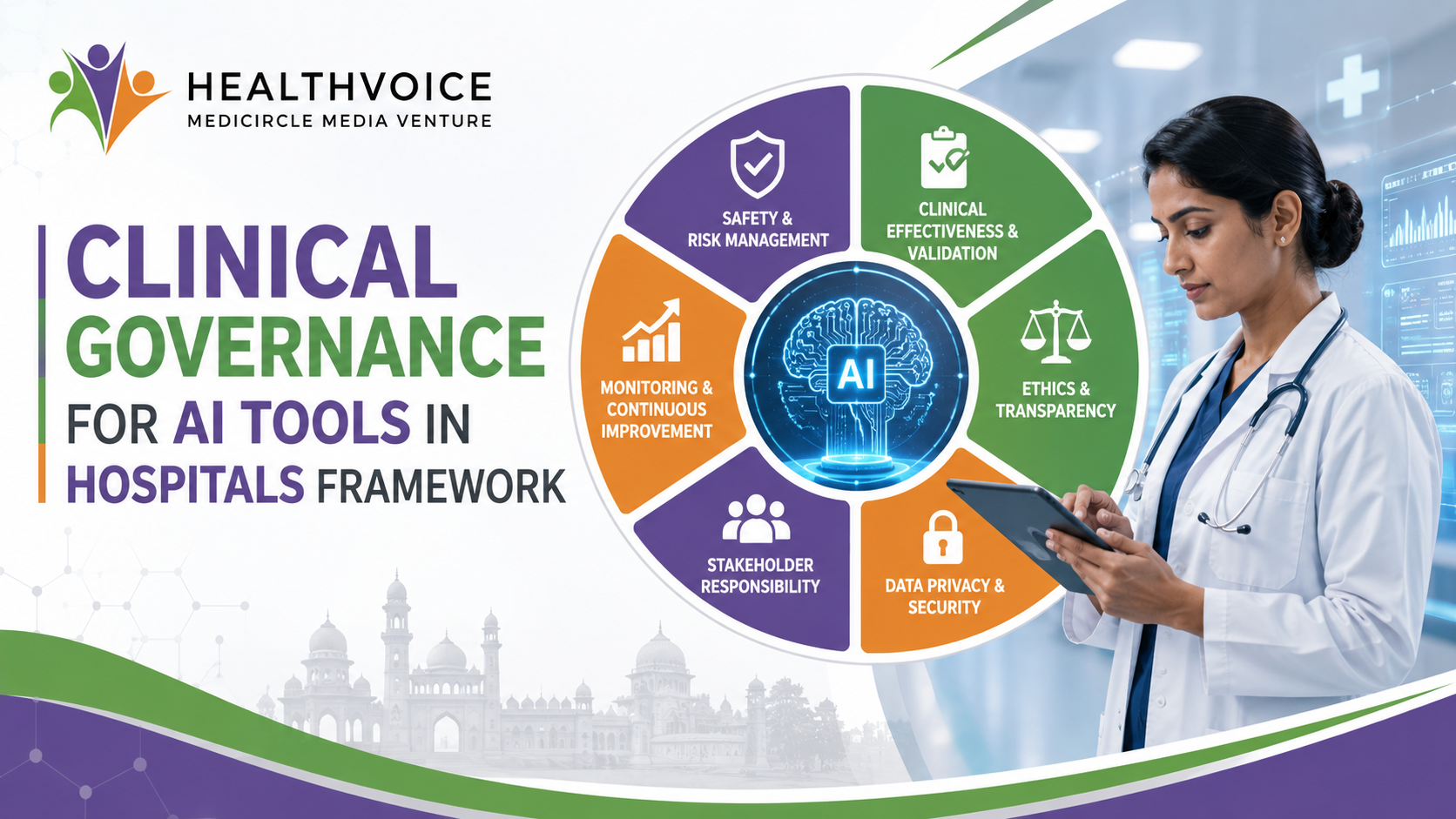
A robust clinical governance framework for AI tools in hospitals rests on four interconnected pillars: People, Process, Technology, and Operations. This structure, sometimes referred to as the PPTO model in international governance literature, provides a comprehensive lens through which a hospital can assess its readiness and build its oversight capabilities.
People: Building the Right Governance Structure
Governance begins with people. Any hospital deploying AI tools needs a dedicated, multidisciplinary AI governance committee. This committee should not be an ad hoc group assembled whenever a new tool is being evaluated. It should be a standing body with clearly defined roles, regular meeting schedules, and documented decision-making authority.
The composition of this committee matters enormously. It should include clinical leaders who understand how AI tools interact with patient care workflows. It should include information technology professionals who can assess infrastructure readiness and data quality. Legal and compliance representatives are necessary to interpret regulatory requirements and manage liability. Importantly, ethics representation must be built in, not treated as optional. Given the diversity of Indian patient populations, expertise in health equity and bias assessment is essential.
One of the most significant gaps observed in hospitals that are early in their AI journey is the absence of ethics consultation as a formal requirement before deploying AI tools. Ethical review should be mandatory for any AI tool that directly interfaces with patient care, regardless of whether it comes pre-approved by a vendor or a regulatory authority.
For clinicians on the committee, basic AI literacy is a prerequisite. This does not mean every doctor needs to understand machine learning algorithms. It means they need to know how to interrogate the clinical outputs of an AI system, recognize signs of model failure, and advocate for patient safety when AI recommendations seem inconsistent with clinical judgment.
Platforms like HealthVoice offer hospitals a meaningful avenue to build this kind of AI literacy and professional dialogue across the medical community. As a doctor-focused healthcare community platform, HealthVoice connects physicians, medical associations, and healthcare leaders through knowledge sharing, expert opinion exchanges, and awareness-building. Hospitals looking to educate their clinical teams on responsible AI use can leverage such platforms to share guidelines, disseminate position papers from medical associations, and foster peer conversations about AI challenges in everyday practice.
Process: Governing the Entire AI Lifecycle
Perhaps the most critical pillar of any governance framework is process. Governance is not just about evaluating an AI tool before it is deployed. It must cover the full lifecycle of the tool, from the moment a hospital first identifies a potential use case to the eventual decommissioning of the system.
The AI governance process can be understood in four distinct stages.
The first stage is problem identification and procurement. Before acquiring any AI tool, a hospital must have a clear, evidence-based reason for adoption. What clinical problem is this tool solving? Is there a well-validated evidence base for its effectiveness? Who are the key stakeholders across departments that need to be involved in the procurement decision? In Indian hospital settings, it is common for procurement to be driven by vendor presentations rather than clinical need assessments. A robust governance process reverses this tendency by centering clinical necessity and institutional feasibility before any vendor engagement proceeds.
The second stage is clinical validation and adaptation. Even if an AI tool has been validated in international trials, its performance must be assessed on local data before full deployment. This is particularly important in India, where patient demographics, comorbidity patterns, and clinical documentation practices may differ significantly from the settings in which the tool was originally developed. Hospitals should conduct pilot testing on a defined subset of patients or departments, with pre-specified success metrics and a formal evaluation of equity considerations, asking specifically whether the tool performs equitably across gender, age groups, languages, and socioeconomic backgrounds.
The third stage is clinical integration. When an AI tool enters clinical workflows, change management becomes essential. Staff must be trained not just in how to operate the tool, but in how to interpret its outputs critically. Clinicians need clear guidance on when to override AI recommendations and how to document those decisions. Communication channels must be established so that frontline users can report concerns, anomalies, or unexpected outputs to the governance committee.
The fourth stage is lifecycle management. This is where many hospitals fail. Deploying an AI tool and then walking away creates significant patient safety risks. AI tools need continuous monitoring, including both technical monitoring of model performance and outcome monitoring of clinical impacts. There should be a defined process for updating models when patient data distributions change, and an equally clear process for decommissioning a tool that is no longer performing safely or effectively.
Technology: Infrastructure That Supports Oversight
Clinical governance is only as strong as the technology infrastructure that enables it. Hospitals need the digital foundation to collect, analyze, and act on governance-relevant data across the AI lifecycle.
This means maintaining a centralized inventory of all AI tools deployed within the institution, tracking their intended use, data inputs, validation status, current performance metrics, and monitoring schedules. Without such a registry, hospitals quickly lose visibility into what AI is being used where, and by whom.
Data quality is a foundational concern. AI tools are only as reliable as the data they process. Indian hospitals must invest in electronic health record systems that generate structured, complete, and accurate clinical data. Data de-identification and re-identification processes must be governed carefully, both to protect patient privacy under frameworks like DISHA and to enable the local validation and monitoring of AI performance.
Interoperability is another critical infrastructure need. AI tools must integrate seamlessly into existing clinical information systems. When tools operate in isolation from the electronic health record, clinicians are forced to toggle between systems, disrupting workflow and increasing the risk that AI outputs will be ignored or misapplied.
Operations: Making Governance Sustainable
For governance to work in practice rather than only on paper, it must be operationalized with appropriate resources, incentives, and accountability structures.
This begins with executive sponsorship. An AI governance committee without support from hospital leadership lacks the authority to enforce its decisions or secure the budget necessary for monitoring and training. Senior leaders must visibly champion governance as a clinical safety priority, not a bureaucratic obligation.
Budget allocation for AI governance is non-negotiable. This includes funding for committee operations, staff training, technology audits, and external expert consultations when required. Hospitals should treat AI governance investment as a risk management expense comparable to biomedical equipment maintenance or clinical audit programs.
Finally, governance effectiveness must be measured. Key metrics might include the time taken to complete governance review for a new AI tool, the proportion of deployed tools with active monitoring in place, the number of adverse events or near-misses attributed to AI tool performance, and clinical staff satisfaction with AI integration. These metrics create accountability and support continuous improvement.
The Indian Regulatory Horizon and What Hospitals Must Do Now
While India currently lacks a dedicated AI governance regulation for healthcare, the regulatory environment is shifting. The Medical Council of India has begun engaging with questions of AI accountability in clinical decision-making. The Ministry of Health and Family Welfare has shown interest in framing guidelines for healthtech and AI adoption. International frameworks such as the WHO Ethics and Governance of AI for Health provide a strong conceptual foundation that Indian hospitals can adapt to local conditions.
Indian hospitals that build strong internal governance frameworks now will be better positioned when formal regulations arrive. More importantly, they will protect their patients and their clinical reputations in the interim.
Hospitals should ensure that any AI tool that directly interfaces with patient care is subject to full governance review, regardless of vendor claims about pre-market validation or international regulatory approval. Compliance with one regulatory jurisdiction does not guarantee safe performance in a different clinical and demographic context.
How HealthVoice Supports the Clinical Governance Conversation
Clinical governance for AI is not just an internal hospital process. It requires broader professional dialogue, peer learning, and community-level engagement among doctors, associations, and healthcare institutions. HealthVoice, as a doctor-focused community platform, is uniquely positioned to contribute to this ecosystem.
Through its communication and knowledge-sharing infrastructure, HealthVoice enables medical associations to publish governance guidelines and position statements that reach practicing physicians directly. It gives hospital leaders and clinical champions a trusted platform to share their experiences with AI adoption, the challenges they have encountered, and the governance solutions they have developed. For healthtech companies and pharmaceutical brands seeking to engage the medical community around responsible AI, HealthVoice offers access to a focused, credible professional audience.
In a landscape where AI governance guidance is still fragmented and often inaccessible to frontline clinicians, a platform that amplifies expert voices and fosters peer-level conversations is not a luxury. It is a critical part of the broader governance infrastructure.
Conclusion: Governance Is the Foundation, Not the Barrier
The conversation about AI in Indian healthcare is often framed around opportunity: better diagnostics, faster care, wider reach. These opportunities are real and significant. But opportunity without governance is a risk waiting to materialize.
Clinical governance for AI tools is not a bureaucratic obstacle to innovation. It is the foundation that makes innovation sustainable and trustworthy. A hospital that governs its AI tools responsibly builds the confidence of its clinical staff, the trust of its patients, and the credibility it needs to participate meaningfully in the future of digital health.
Indian hospitals are at a pivotal moment. The AI tools are arriving. The governance frameworks must arrive with them.
Frequently Asked Questions
What is clinical governance for AI tools in hospitals?
Clinical governance for AI tools refers to the structured system of policies, oversight committees, validation processes, and monitoring mechanisms that a hospital establishes to ensure that AI technologies are deployed safely, ethically, and effectively in patient care settings. It covers the entire lifecycle of an AI tool, from procurement and clinical validation to integration, performance monitoring, and eventual decommissioning.
Is there a specific regulation governing AI tools in Indian hospitals?
As of 2025, India does not have a dedicated AI governance regulation for healthcare. The Digital Information Security in Healthcare Act (DISHA) addresses digital health data privacy and security, while the Medical Devices Rules of 2017 cover certain software-based medical devices. However, clinical AI decision support systems exist in a regulatory grey area. Hospitals are encouraged to develop robust internal governance frameworks aligned with WHO guidance and evolving national health policy directions.
How can a small or mid-size Indian hospital begin building AI governance without large resources?
Smaller hospitals can begin by forming a simple, multidisciplinary AI review committee that includes a clinician, an IT representative, and an administrator. They should establish a mandatory review process for any new AI tool before deployment, maintain a basic registry of all AI tools in use, and create a simple reporting channel for clinical staff to flag concerns about AI performance. Engaging with professional networks and platforms like HealthVoice to access peer knowledge and guidance from larger institutions is a practical and low-cost starting point.
ABSTRACT
Clinical governance for AI tools requires structured policies, multidisciplinary oversight, validated processes, and sustained monitoring to ensure safe, ethical, and effective AI integration in Indian hospital environments.
 Team Healthvoice
#ClinicalGovernance #HealthcareAI