Clinical uncertainty and how doctors manage it
Clinical uncertainty is an everyday reality in medical practice. This article explores how doctors balance experience, technology, collaboration and trust to deliver thoughtful care amid incomplete information.
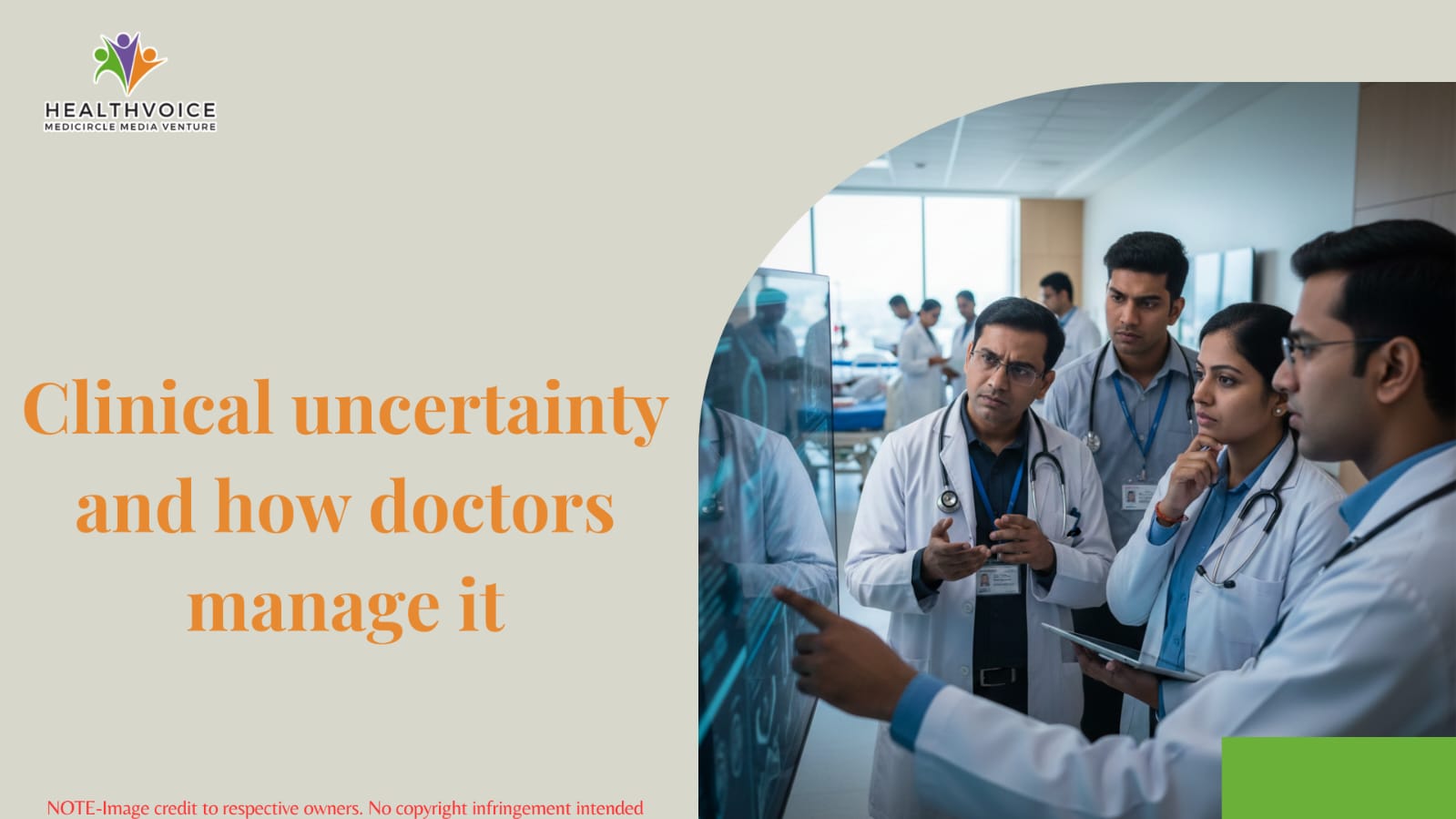
Most of us walk into a doctor’s clinic with a silent expectation that the person in the white coat has all the answers. We imagine a straightforward path from symptoms to diagnosis and a clear map drawn from years of training. The truth of medical practice is far less certain. Every day in clinics and hospitals across India physicians make critical decisions within a landscape filled with questions and probabilities.
This ever present reality is known as clinical uncertainty. It is not a flaw in a doctor’s skill. It is a fundamental part of medicine itself. In a healthcare environment as diverse and demanding as India’s managing this uncertainty skillfully is what separates good care from great care. So how do doctors do it? Let us explore the delicate balance between knowledge and the unknown and see how trust becomes the most vital tool in a physician’s kit.
Defining the undefined:
What does clinical uncertainty actually look like? It emerges when the path forward is not illuminated by clear complete information. There is a gap between what a doctor knows and what they need to know to be absolutely sure. This gap typically shows up in two ways.
First there is diagnostic uncertainty the question of what exactly is happening. A patient comes in with fever and fatigue. In a country where disease profiles overlap is it a seasonal viral infection the beginning of dengue or something less common. Tests take time symptoms can be vague and the doctor must mentally sift through a list of possibilities known as a differential diagnosis without knowing the final answer immediately.
Then comes therapeutic uncertainty the dilemma of choosing the best path forward. Even with a diagnosis the ideal treatment is not always obvious. How will this specific individual react to a particular blood pressure medication? What combination of diet exercise and medication will work best for a person with newly diagnosed diabetes? When several valid options exist each with its own trade-offs navigating this choice is a core part of a doctor’s work.
Navigating medical uncertainty:
Facing the unknown is not a passive state for a good physician. It is an active process that employs refined skills and structured thinking to protect patient safety.
Clinical Instinct and experience:
You might call it intuition but it is really pattern recognition honed by years of practice. It is that subtle feeling when a seemingly simple headache carries a feature that raises quiet concern. This instinct is not magical. It is the brain referencing thousands of past encounters. Even in an era of advancing technology this human clinical judgment remains an irreplaceable first step. It is the compass that helps decide where to look next.
Technology as a tool:
Diagnostic machines and laboratory tests are invaluable but they are aids not oracles. Thoughtful doctors use technology to narrow possibilities rather than create an illusion of absolute certainty through endless testing. A scan may be ordered to rule out the most serious concern on the list. The goal is intelligent integration allowing test results to inform the clinical conversation rather than replace it.
Strength of a second pair of eyes:
No clinician has all the answers. In complex situations collaboration becomes essential. This may involve a discussion with a colleague a multidisciplinary meeting or a digital consultation with a specialist in another city. Seeking collective wisdom brings together diverse perspectives sharpens diagnostic thinking and builds a more resilient plan for the patient.
Foundation of everything trust:
Trust is the cornerstone especially in the Indian healthcare context. When the medical path is uncertain a strong doctor patient relationship provides stability. A physician may explain that symptoms could suggest more than one possibility and outline why a particular route of investigation is chosen first. This transparency acknowledges uncertainty while demonstrating confidence in the process. It transforms care from a one sided explanation into a shared decision making journey where the patient becomes an active partner.
Learning from every outcome:
Medicine is a continuous education. Reflective doctors and strong healthcare systems learn from every case especially unexpected ones. Modern clinical review focuses less on blame and more on understanding decision pathways and system gaps. Discussing uncertain cases in a supportive environment improves protocols and sharpens clinical judgment over time turning experience into lasting wisdom.
A shared journey:
Medicine will always contain gray areas. Human biology is complex diseases present differently in each individual and medical science continues to evolve. Clinical uncertainty is not a weakness of the system. It is a natural feature of caring for human beings.
For patients understanding this reality can change the entire healthcare experience. A doctor who is honest about uncertainty often shows deeper respect and thoughtful care than one who projects absolute confidence. It is an invitation to collaborate. The goal is not perfection but the most informed and compassionate path forward taken together. In that shared journey through uncertainty true healing finds its footing.
 Team Healthvoice
#ClinicalCare #ClinicalJudgment #EvidenceBasedMedicine #EBM #MedicalDecisionMaking #SharedDecisionMaking #DoctorPatientRelationship #PatientCentricCare #UncertaintyInMedicine #ClinicalPractice #MedicalEducation #ReflectivePractice #HealthcareProfessionals #MedicineWithHeart #PatientSafety #healthvoice