Digital Health Ecosystems: Integration Challenges
A connected healthcare ecosystem relies on seamless integration between systems, processes, and stakeholders. When these elements align effectively, it improves coordination, reduces gaps in care delivery, and supports more efficient healthcare operations.
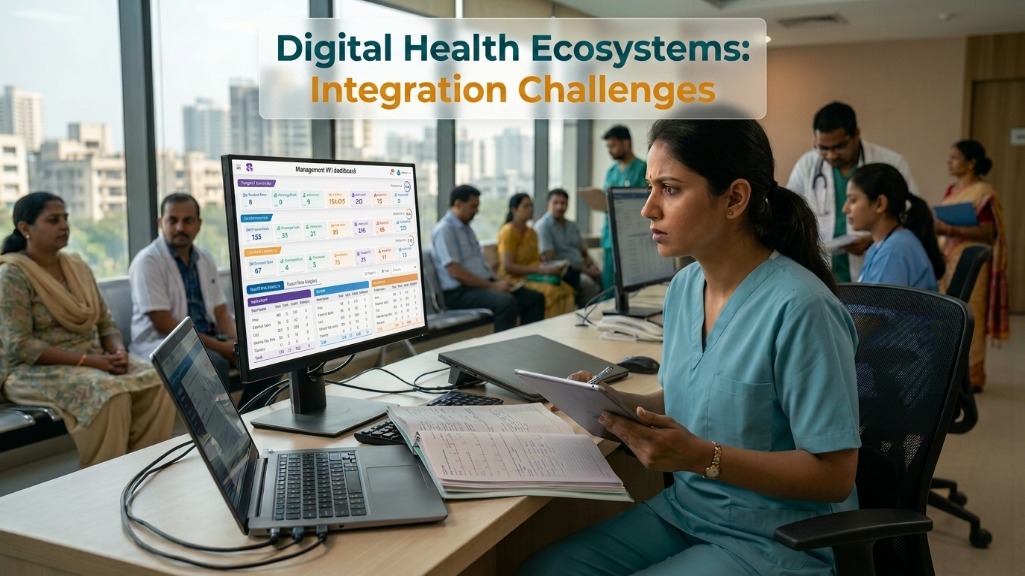
The idea of a connected healthcare ecosystem sounds efficient on paper. Hospitals, labs, insurers, and patients all linked through digital systems, sharing information seamlessly. But in reality, this connection is still uneven. Many healthcare organizations are in the middle of digital transformations, trying to bring together systems that were never designed to work with each other.
The result is not always smooth. Instead of clarity, there are gaps, delays, and overlaps. These are not just technical issues. They directly affect how care is delivered and experienced.
What A Digital Health Ecosystem Really Involves
Before understanding the challenges, it helps to step back and look at digital transformation what is in a healthcare context. It is not simply about moving from paper to digital records. It involves creating systems that communicate, adapt, and support decision-making across different touchpoints.
A true healthcare ecosystem includes multiple layers working together:
- Clinical systems managing patient records
- Diagnostic platforms generating real-time data
- Administrative tools handling billing and scheduling
- Patient-facing apps enabling communication and access
When these elements are connected effectively, care becomes more coordinated. However, building that connection requires more than technology. It requires alignment across processes, people, and priorities.
Why Integration Is More Difficult Than It Seems
On the surface, integrating systems may appear to be a technical task. In practice, it involves multiple constraints that often slow progress. Many healthcare organizations operate on legacy systems that were built for specific functions. Bringing them into a unified healthcare and digital transformation framework is not always straightforward.
Some of the most common digital health problems arise from this mismatch:
- Systems that cannot communicate with each other
- Inconsistent data formats across platforms
- Delays in updating or accessing patient information
- Duplicate records and fragmented data
These challenges are not isolated. They interact with each other, creating a workflow that feels connected but functions in fragments.
Where Digital Transformations Begin To Break Down
Most digital transformations in healthcare start with clear goals. Improve efficiency, reduce manual work, and enhance patient experience. But the execution often reveals gaps between intention and reality.
One of the biggest issues is partial implementation. Hospitals may digitize one department while others continue using older systems. This creates islands of efficiency rather than a fully connected system.
Another issue lies in coordination. Even when systems are upgraded, processes may not change accordingly. Staff continue to follow old workflows, which limits the impact of new technology.
Looking at real digital transformation examples, it becomes clear that success depends on alignment, not just adoption. Technology alone does not solve integration challenges unless it is supported by changes in how work is done.
The Role Of AI In Bridging Integration Gaps
The integration challenge has also opened the door for AI and digital transformation to play a more active role. AI is not just about automation. It is increasingly being used to connect fragmented systems and make sense of scattered data.
For example, AI can help:
- Standardize data across different platforms
- Identify inconsistencies in patient records
- Support decision-making through predictive insights
- Reduce manual intervention in repetitive processes
In the broader context of healthcare and digital transformation, AI acts as a layer that brings structure to complexity. It does not replace existing systems but helps them function more cohesively.
How Integration Challenges Affect Healthcare And Life Sciences
The impact of integration issues extends beyond hospitals. It affects the entire Healthcare and life sciences ecosystem, including research, drug development, and population health management.
When systems are not aligned, data cannot flow freely. This limits the ability to:
- Conduct large-scale clinical research
- Track patient outcomes across different stages of care
- Share insights between healthcare providers and research institutions
Inconsistent data also affects decision-making in life sciences. Without reliable integration, even advanced analytics cannot deliver meaningful results.
This is where the gap between potential and reality becomes most visible. The tools exist, but the ecosystem is still catching up.
Case Studies: Integration Challenges In Real Settings
Case Study 1: Fragmented Systems In A Multi-Specialty Hospital
A multi-specialty hospital implemented separate digital systems for patient records, diagnostics, and billing. Each system worked efficiently on its own, but they were not fully integrated.
Doctors had to switch between platforms to access patient information. Diagnostic reports were sometimes delayed in reaching the main record system. Billing teams often had to manually verify details.
The hospital had invested in digital transformations, but without full integration, the workflow remained fragmented. The issue was not the absence of technology, but the lack of connection between systems.
Case Study 2: Data Inconsistency Across Care Providers
A regional healthcare network attempted to connect multiple clinics into a shared healthcare ecosystem. While the intention was to improve coordination, differences in data formats created challenges.
Patient records from one clinic did not always align with another. Updates were not synchronized in real time, leading to inconsistencies. These digital health problems affected both clinical decisions and administrative processes.
The system was connected in structure, but not in function.
Case Study 3: Delays In Digital Adoption Within Research
In the Healthcare and life sciences sector, a research organization faced delays in accessing patient data due to limited integration with hospital systems.
Despite advancements in AI and digital transformation, data sharing remained slow and incomplete. This affected the pace of clinical studies and reduced the effectiveness of research outcomes.
The challenge was not the lack of innovation, but the inability to connect systems efficiently.
Common Mistakes That Slow Down Integration
Integration challenges often persist because of avoidable missteps. Organizations sometimes focus more on technology than on alignment.
Some common mistakes include:
- Implementing systems without ensuring compatibility
- Ignoring workflow changes during digital transformations
- Underestimating the complexity of data standardization
- Treating integration as a one-time project instead of an ongoing process
Avoiding these issues requires a more structured approach that considers both technology and operations together.
FAQs
1. What is a healthcare ecosystem in simple terms?
A healthcare ecosystem refers to a connected network of hospitals, labs, insurers, and digital systems that work together to deliver care.
2. What are common digital health problems?
Common digital health problems include system incompatibility, data inconsistency, and delays in information sharing.
3. Digital transformation what is in healthcare?
Digital transformation what is in healthcare refers to using technology to improve processes, data flow, and patient care.
4. What are some digital transformation examples in healthcare?
Digital transformation examples include electronic health records, telemedicine platforms, and AI-based diagnostics.
5. How does AI and digital transformation work together?
AI and digital transformation work together by improving data analysis, automation, and system integration.
6. Why is healthcare and digital transformation important?
Healthcare and digital transformation improves efficiency, reduces errors, and enhances patient experience.
7. What challenges exist in Healthcare and life sciences integration?
In Healthcare and life sciences, challenges include data silos, slow sharing, and lack of system compatibility.
8. Why do digital transformations fail in healthcare?
Many digital transformations fail due to poor integration, lack of alignment, and incomplete implementation.
9. Can integration challenges be fully solved?
They can be reduced significantly, but require continuous improvement and system alignment.
10. What is the future of digital health ecosystems?
The future involves stronger integration, better data sharing, and increased use of AI across the healthcare ecosystem.
Conclusion
The vision of a fully connected healthcare ecosystem is clear, but the path to achieving it remains complex. Integration challenges are not just technical barriers. They reflect deeper issues in alignment, workflow, and system design. As digital transformations continue to evolve, the focus will need to shift from adoption to connection, ensuring that systems do not just exist, but work together effectively.
 Team Healthvoice
#DigitalHealth #HealthcareTransformation