Polytrauma Care: How Protocols Improve Coordination Between Specialties
Structured polytrauma protocols align trauma surgery, orthopedics, neurosurgery, anesthesia, radiology, and intensive care around shared timelines, reducing delays and improving coordinated, patient centered outcomes across Indian trauma centers.
Introduction
Polytrauma care sits at the intersection of speed, precision, and teamwork. When a patient arrives with injuries spanning the head, chest, abdomen, pelvis, and limbs, no single specialist can manage the case alone. Trauma surgeons, orthopedic surgeons, neurosurgeons, anesthesiologists, radiologists, and intensive care specialists must all work in parallel rather than in sequence, and the margin for miscommunication is dangerously small. This is why structured protocols have become central to modern polytrauma management, not as bureaucratic paperwork but as a working language that keeps multiple specialties moving in the same direction during the most time-sensitive hours of a patient's care.
India carries a heavy burden of severe trauma. The country accounts for close to ten percent of global road traffic accidents despite having only about one percent of the world's motor vehicles, with well over four lakh accidents and more than one lakh fatalities recorded annually. Rapid urbanization, industrialization, and motorization are driving this disproportionate load, while healthcare spending as a share of GDP remains far below that of many developed nations. Against this backdrop, the way hospitals organize coordination between specialties often matters as much as the individual skill of any one department.
This article examines why coordination breaks down in the absence of protocols, how structured trauma systems close those gaps, and what Indian hospitals can do to strengthen multidisciplinary polytrauma care going forward.
Understanding Polytrauma and Why Coordination Is So Difficult
Polytrauma describes a condition where a patient sustains significant injuries across two or more body regions, often accompanied by physiological disturbances such as shock, coagulopathy, or altered consciousness. This definition has evolved considerably over the decades. Early definitions simply counted the number of injuries, but the widely referenced Berlin definition now ties polytrauma to a combination of anatomical injury severity and physiological derangement, recognizing that the body's overall response to trauma matters as much as the count of broken bones.
The difficulty in coordinating care stems directly from this complexity. A patient with a head injury, a pelvic fracture, and internal bleeding needs a neurosurgeon, an orthopedic surgeon, and a general or trauma surgeon to weigh in almost simultaneously, and their individual priorities can genuinely conflict. A neurosurgeon may want to avoid prolonged hypotension during a lengthy orthopedic procedure, while an orthopedic team may argue that early fixation reduces pulmonary complications. Without a shared framework, these tensions play out informally, often at the cost of time.
Large single center data from Indian trauma centers illustrates the scale of this challenge. In one retrospective analysis of over 3,700 consecutive trauma patients, road traffic injuries accounted for two-thirds of cases, head injuries were present in nearly 45 percent, and polytrauma accounted for close to 20 percent of the total caseload, with more than half of all patients requiring ICU admission. Numbers of this scale make it clear why ad hoc coordination between departments is simply not sustainable at busy trauma centers.
Primary Causes Behind Poor Specialty Coordination
Several recurring factors explain why coordination fails even in hospitals with strong individual specialists.
Unclear ownership of the overall treatment plan is one of the most common issues. When no single physician or protocol clearly assigns who leads the overall resuscitation and sequencing decisions, each specialty tends to advocate for its own patient rather than the whole patient. Delays in diagnostic imaging represent another major bottleneck, since CT and radiology access is often shared across departments and can become a queue rather than a coordinated resource. A recent Indian study following 250 polytrauma patients found that while airway control and cervical spine immobilization were generally timely, delays in CT imaging and suboptimal blood transfusion ratios were common, and patients with higher injury severity scores experienced significantly longer imaging delays along with markedly higher mortality.
Inconsistent transfusion practices, variable adherence to Advanced Trauma Life Support principles, and the absence of a dedicated multidisciplinary trauma team further compound these delays. In many Indian hospitals, especially outside metro and Tier 1 cities, on call specialists may be managing several other clinical responsibilities simultaneously, which naturally slows the response when a polytrauma case arrives.
Recognizing the Coordination Gaps in Practice
Coordination gaps often reveal themselves in specific, recognizable patterns. A patient may undergo repeated physical examinations by different specialties without a shared documentation trail, leading to redundant tests. Surgical decisions may be delayed while teams wait for informal verbal confirmation from another department rather than following a predetermined escalation pathway. Handover between the emergency department, operating theatre, and intensive care unit may lack a standardized format, causing important details about resuscitation status or pending investigations to be lost.
Some observable warning signs of poor specialty coordination include the following.
- Prolonged time between arrival and definitive imaging, particularly in patients with a high injury severity score
- Conflicting or delayed surgical decisions between orthopedic, neurosurgical, and general surgical teams
- Absence of a single point of coordination during the early resuscitation phase
- Repeated documentation gaps during shift changes or department transfers
Recognizing these patterns is the first step toward building protocols that specifically target them.
Diagnosis and Evaluation: Where Protocols First Prove Their Value
The earliest phase of polytrauma care, spanning the primary survey and initial diagnostic workup, is where protocol driven coordination shows its clearest benefit. The Airway, Breathing, Circulation, Disability, Exposure approach, widely known as ABCDE, gives every specialty a common sequence to follow regardless of which department is physically present first. This shared language means that a trauma surgeon, an emergency physician, and an anesthesiologist can step into the same case without needing to renegotiate priorities from scratch.
Diagnostic scoring tools reinforce this shared understanding. The Injury Severity Score, along with the Abbreviated Injury Score, gives every specialty involved a common numeric reference point for how severely injured the patient is, which in turn shapes expectations around ICU requirement, transfusion needs, and surgical staging. When radiology, surgery, and intensive care teams are all working from the same severity assessment, decisions about what to image first and which injuries take priority become considerably faster to agree upon.
Standardized imaging pathways, such as a focused assessment with sonography for trauma scan followed by staged CT imaging once the patient is stable enough, also reduce the back and forth between departments about what test is needed next. Protocol-driven imaging sequences remove much of the ambiguity that otherwise contributes to the delays documented in Indian trauma literature.
Treatment Coordination: Aligning Surgical Strategy Across Specialties
Perhaps the clearest example of how protocols improve specialty coordination lies in the evolution of fracture fixation strategy. Decades ago, early total care, meaning definitive fixation of major fractures within the first day of injury, was the dominant approach. Over time, orthopedic and trauma literature demonstrated that this strategy could worsen outcomes in physiologically unstable patients, giving rise to damage control orthopedics, where fractures are temporarily stabilized while the wider resuscitation effort continues.
This shift did not happen in isolation. It required orthopedic surgeons, intensive care specialists, and anesthesiologists to agree on shared physiological thresholds, such as lactate levels, coagulation status, and hemodynamic stability, before deciding whether definitive surgery was safe. Later refinements such as early appropriate care and safe definitive surgery pushed this collaboration even further, using specific laboratory parameters and clinical grading systems that any specialty on the team can reference and interpret consistently.
This is precisely the value that structured protocols bring to treatment planning. Rather than each specialty independently judging when a patient is fit for surgery, the team works from shared criteria. A protocol might specify that:
- Definitive orthopedic fixation proceeds once lactate clearance and base deficit fall within defined ranges
- Neurosurgical intervention is prioritized ahead of orthopedic fixation when intracranial pressure concerns are present
- Interventional radiology is engaged early for pelvic hemorrhage that is not amenable to rapid surgical control
Trauma-associated coagulopathy is another area where protocol-driven coordination between anesthesia, transfusion medicine, and surgery has measurably improved outcomes. Balanced transfusion ratios, early administration of tranexamic acid, and viscoelastic testing such as thromboelastography now guide decisions that previously depended heavily on individual clinical judgment, reducing variation between different treating teams.
Building the Multidisciplinary Trauma Team
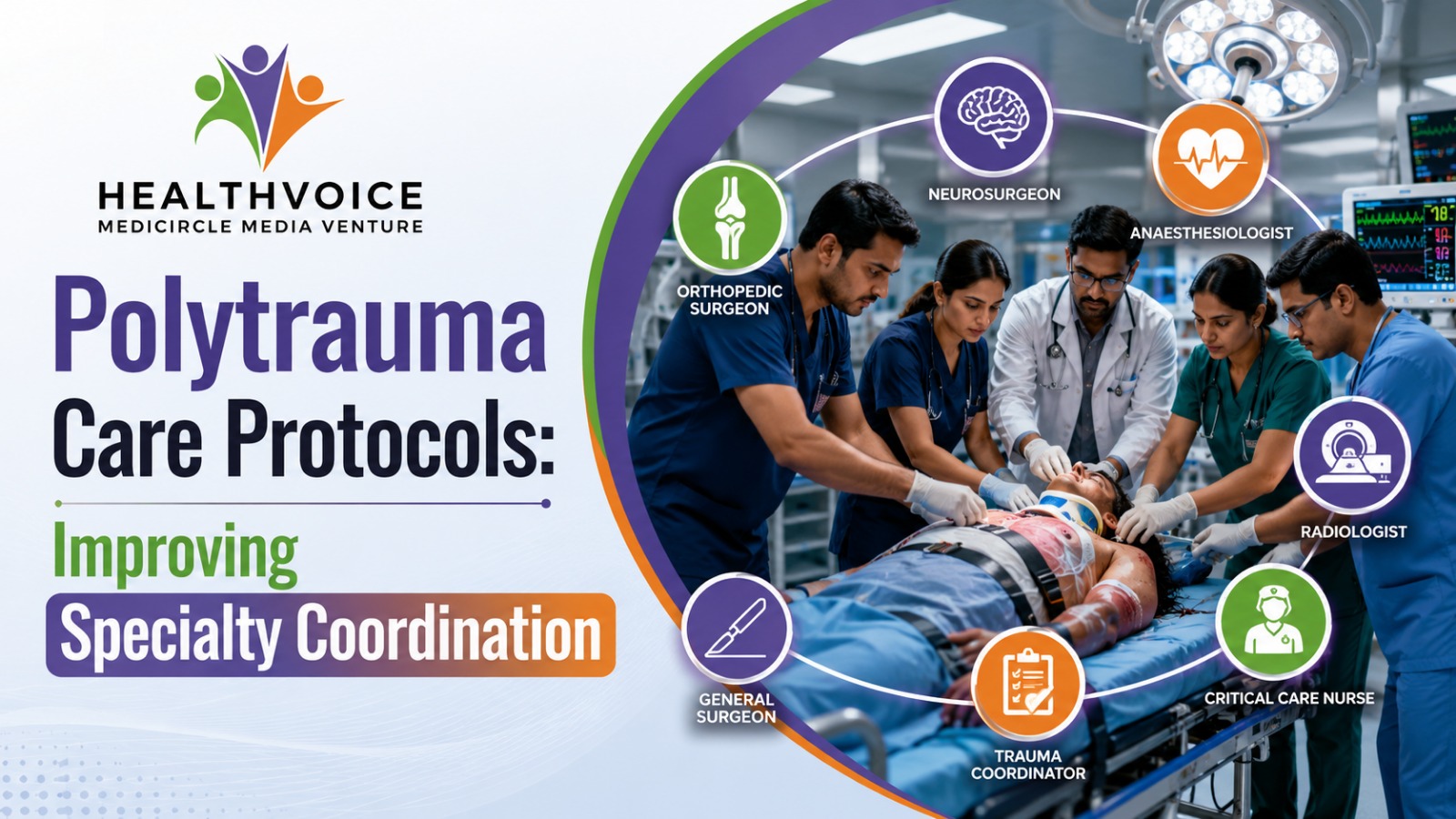
A functioning polytrauma protocol depends on a clearly defined team structure. This typically includes a trauma or general surgeon coordinating overall priorities, orthopedic and neurosurgical specialists addressing structural injuries, an anesthesiologist and intensive care specialist managing physiological stability, a radiologist providing rapid diagnostic support, and nursing staff who maintain continuity of bedside observation. Emergency medical technicians and prehospital responders form the first link in this chain, and their early stabilization efforts often determine how much ground the hospital-based team needs to recover.
Regular team meetings, shared documentation systems, and predefined communication protocols are what convert this list of specialists into an actual functioning team. Interdisciplinary training sessions and periodic simulation exercises help each department understand not just its own role but how that role interacts with the others, which is often where real-world coordination breaks down under pressure.
Prevention and System Strengthening for the Indian Context
Strengthening coordination at a system level requires attention that goes beyond any single hospital. India still lacks a comprehensive nationwide trauma registry, which limits the ability to measure outcomes and identify where coordination gaps are costing the most lives. Without such a registry, experts note there is limited visibility into the true scale of severe road traffic injuries, including how many victims suffer head injuries, spinal trauma, or amputations.
On the prehospital side, national efforts under the National Health Mission have expanded ambulance coverage, though gaps remain in trained personnel availability. A national survey found that while the large majority of hospitals had in-house ambulance services, trained paramedics needed to support those services were present in only about a third of cases, and most hospitals lacked a formal prehospital arrival notification system. Strengthening this link matters because coordination between specialties inside the hospital is only as effective as the information the trauma team receives before the patient arrives.
At the institutional level, hospitals accredited under frameworks such as NABH are increasingly building structured trauma activation criteria, defined escalation pathways, and checklist-based handover systems between the emergency department, operating theatre, and intensive care unit. These measures, while less visible than surgical technique, are often what determines whether a well-trained team of specialists actually functions as a coordinated unit when a critical case arrives.
Digital platforms are also beginning to play a supporting role in this coordination effort. Shared documentation systems, real-time access to imaging, and structured communication tools help reduce the information gaps that protocols are designed to close. In this sense, platforms that connect doctors, associations, and healthcare institutions, such as HealthVoice, contribute to the broader goal of strengthening professional dialogue around trauma systems, sharing clinical experience across specialties, and helping medical associations highlight best practices in coordinated trauma care to a wider community of practitioners.
Conclusion
Polytrauma care has moved a long way from the early, single strategy approach to fracture and injury management that dominated trauma surgery decades ago. Today, the outcomes that matter most are survival, functional recovery, and reduced complications, which depend heavily on how well emergency medicine, surgery, anesthesia, radiology, and intensive care work together under a shared protocol. For India, where the burden of road traffic injury remains exceptionally high, and system-level data is still catching up with clinical need, protocol-driven coordination between specialties is not an optional refinement. It is the difference between a hospital that treats injuries in isolation and one that treats the patient as a whole. Strengthening trauma registries, prehospital systems, and structured in-hospital communication will remain central to improving outcomes for polytrauma patients across the country in the years ahead.
Frequently Asked Questions
Q1: What is polytrauma and how is it different from having multiple fractures?
Polytrauma refers to significant injuries affecting two or more body regions with associated physiological disturbance, not simply the presence of several fractures. A patient with multiple fractures may remain stable, while a polytrauma patient often has combined injuries to the head, chest, abdomen, pelvis, or limbs along with shock, coagulopathy, or altered consciousness.
Q2: Why is a formal protocol necessary when a hospital already has skilled specialists?
Individual expertise alone does not guarantee coordinated timing. Without a shared protocol, specialists may independently prioritize their own systems, leading to delays, duplicated imaging, or conflicting decisions about surgery timing. Protocols create a common sequence and decision framework that keeps every specialty working toward the same resuscitation and treatment goals.
Q3: How does India's trauma care system compare internationally in coordination and infrastructure?
India carries a disproportionately high share of global road traffic injuries relative to its vehicle population, yet lacks a nationwide trauma registry and has variable coverage of trained prehospital personnel. Many tertiary centers have adopted internationally recognized protocols, but system-wide standardization and data collection remain works in progress.
Q4: What role does technology play in improving specialty coordination during polytrauma care?
Digital tools such as shared electronic trauma records, real-time imaging access, and structured handover systems reduce communication gaps between emergency medicine, surgery, anesthesia, radiology, and intensive care teams. Platforms that support rapid documentation and cross-specialty visibility help protocols function as intended rather than remaining theoretical.
Q5: How can hospitals in India strengthen multidisciplinary polytrauma protocols with limited resources?
Hospitals can strengthen protocols through structured trauma team activation criteria, regular simulation-based training, clear escalation pathways, and defined roles for each specialty during the golden hour. Even resource-constrained centers benefit from written protocols, checklists, and periodic case reviews that reinforce coordinated decision-making.
Resources
- Journal of Clinical Orthopaedics and Trauma: Evolving concepts and strategies in the management of polytrauma patients, covering the history and evidence behind damage control orthopedics and related protocols
- Bioinformation (2025): Assessment of polytrauma patient management in India, an Indian cohort study on ATLS adherence, imaging delays, and mortality outcomes
- Trauma Surgery and Acute Care Open: Trauma in India: current status and the path forward, reviewing prehospital and system-level trauma infrastructure in India
- PMC: Clinical Epidemiology of Trauma Patients, a large retrospective analysis from an Indian Level I trauma center on injury patterns and outcomes
- World Health Organization: Global reports and guidance on road traffic injury prevention and trauma systems strengthening
Interlinking Keywords
polytrauma management, trauma team coordination, damage control orthopedics, injury severity score, multidisciplinary trauma care, trauma care in India, ICU care for trauma patients, emergency trauma protocols
Last medically reviewed by:
Editorial Medical Review Team, HealthVoice on July 10, 2026
Medical Disclaimer:
This article is intended for informational and educational purposes for medical professionals and healthcare stakeholders. It does not constitute clinical advice and should not replace institutional protocols, professional medical judgment, or consultation with qualified specialists. Treatment decisions for polytrauma patients must always be individualized based on clinical assessment.
 Team Healthvoice
#TraumaCare #EmergencyMedicine
