Doctors Without Dissection: When Medical Education Turns Theoretical
Every new college must be judged not by its inauguration date but by its ability to deliver hands-on, ethical, and competent training from day one.
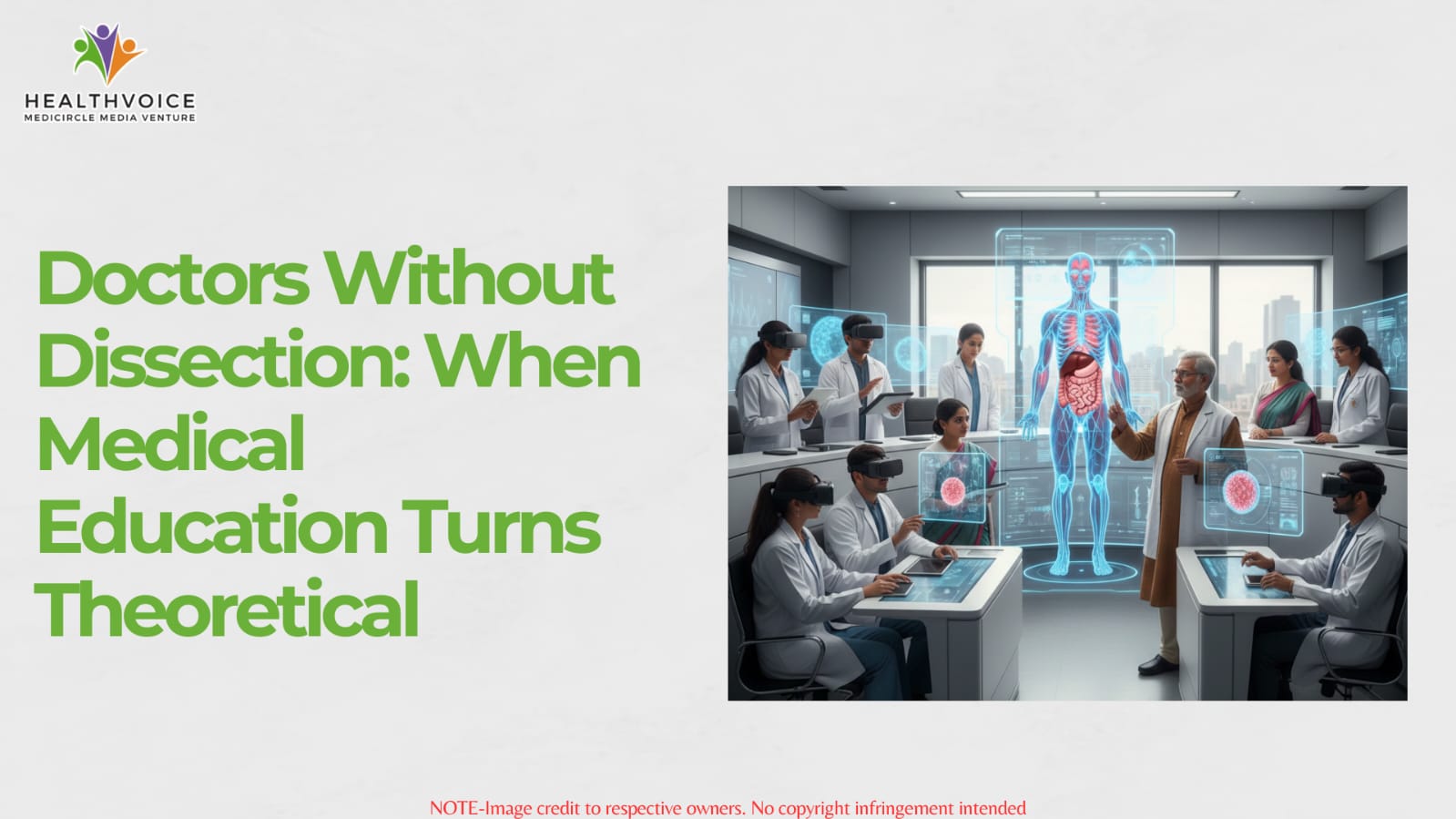
In the corridors of India’s medical colleges, the first few months of an MBBS course are meant to be transformative. This is the period when students step out of the comfort of textbooks and begin to understand that medicine is a lived science, learned through hands-on experience, observation, and disciplined practice. It is a phase where curiosity is sharpened by cadaveric dissection, laboratory work, and early exposure to the realities of the human body. When this foundation is compromised, the consequences ripple far beyond a single batch of students. The recent protest by MBBS students at ESIC Medical College, Indore, has brought this uncomfortable truth into public view and forced the medical community to ask a question that goes to the heart of medical education in India: can doctors be trained through slides alone?
According to reports carried by Dainik Jagran, first-year MBBS students at the institute have raised serious concerns about violations of norms laid down by the National Medical Commission. Three months into the academic session, students allege that teaching remains largely confined to textbooks and PowerPoint presentations, with negligible practical exposure. In protest, they have boycotted practical classes, an act that reflects not defiance but desperation. For medical students, skipping classes is rarely a first instinct. It usually comes when dialogue fails and anxiety begins to outweigh patience.
At the centre of the students grievance lies the absence of basic infrastructure required to teach core subjects such as Anatomy, Physiology, and Biochemistry. Among these, the Anatomy department stands out as the most glaring example. Students claim that no cadavers have been made available since the start of the session. Under existing NMC guidelines, medical colleges are required to maintain at least one cadaver for every ten to fifteen students to ensure adequate dissection-based learning. With fifty students enrolled in the first MBBS batch, the expectation is clear. Yet, according to the students, repeated representations have yielded no tangible outcome.
For any doctor, Anatomy is more than a subject. It is the language of medicine. Dissection is where spatial understanding develops, where variations in human structure are appreciated, and where clinical correlations first begin to make sense. Teaching Anatomy exclusively through slides may convey names and diagrams, but it cannot replace the tactile memory of tissues, the three-dimensional understanding of relationships between organs, or the discipline that dissection instils. When students say that it is impossible to truly understand human anatomy without hands-on exposure, they are not making an emotional argument. They are stating a pedagogical fact that every clinician recognises.
The concerns extend beyond Anatomy. Students have reported inadequate laboratory facilities in Physiology and Biochemistry as well. Basic equipment such as microscopes, reagents, glassware, and examination tables are allegedly missing. Practical sessions, which should involve experiments, sample analysis, and direct observation, are reportedly reduced to theoretical demonstrations through presentations. This approach directly contradicts the competency-based medical education framework that India has formally adopted, where learning outcomes are tied to skills rather than passive knowledge.
What makes the situation more distressing is the context in which these students made their choices. Many of them deliberately opted for ESIC Medical College, Indore, trusting that a centrally run institution would adhere strictly to regulatory standards. Among the fifty students in the batch, a significant number come from Hindi-medium backgrounds. Several reportedly gave up seats at established government medical colleges in cities such as Bhopal, Jabalpur, and Ratlam to join this institute. Such decisions are rarely casual. They are shaped by family sacrifices, financial planning, and the belief that the institution chosen will provide quality education that justifies those sacrifices.
For students from non-English backgrounds, early practical exposure carries even greater importance. Hands-on learning bridges language gaps and builds confidence. When education is reduced to slides and lectures, students who rely on experiential understanding are disproportionately affected. Over time, this can translate into insecurity, poor skill acquisition, and a lingering sense of inadequacy that follows them into clinical years. In medicine, confidence is closely linked to competence. Undermining one weakens the other.
The allegations raise uncomfortable questions about oversight and accountability. The NMC has repeatedly emphasised infrastructure, faculty strength, and clinical exposure as pillars of medical education reform. Competency-based training was introduced precisely to move away from rote learning. When institutions fail to provide even the minimum facilities prescribed, it challenges the credibility of the regulatory ecosystem. Approval to start a medical college is not merely a bureaucratic step. It is a public assurance that standards will be met consistently, not gradually or conditionally.
The students decision to boycott practical classes should be seen as a signal, not a disruption. It reflects fear that crucial learning time is being lost, time that cannot be recovered later. The first year of MBBS sets the tone for the entire course. Gaps created here often surface during clinical postings, internships, and even postgraduate training. Remedial teaching years later cannot fully compensate for foundational deficiencies.
In response to the protests, the Dean of ESIC Medical College, Indore, has acknowledged the concerns and assured that corrective measures are underway, requesting a week’s time to put necessary arrangements in place. While this assurance offers some hope, it also highlights a deeper systemic issue. Infrastructure and cadavers cannot be arranged overnight unless the groundwork was already in progress. The situation invites reflection on whether institutions are being allowed to admit students before they are truly ready to teach them.
Medical education is not just about producing graduates who can pass exams. It is about shaping professionals who will one day make life-and-death decisions. Teaching medicine without adequate practical exposure risks turning education into a credentialing exercise rather than a formative journey. The public often assumes that a doctor’s competence begins after graduation. In reality, it is built quietly in dissection halls, physiology labs, and biochemistry practical rooms during the earliest months of training.
Every inadequately trained batch weakens the healthcare system years down the line. Errors that appear in wards often trace their origins to gaps in understanding formed during undergraduate years. When institutions compromise on basics, the cost is eventually paid by patients who may never know why care fell short.
This episode also highlights the ethical responsibility of institutions towards students. Medical students are not just learners; they are future caregivers bound by duty and discipline. When they speak out, it reflects concern for their professional integrity as much as their education. Silencing or delaying responses to such concerns risks fostering cynicism at the very start of a medical career.
India is in the midst of expanding its medical education capacity, opening new colleges to address doctor shortages. Expansion without readiness, however, can be counterproductive. Quantity cannot come at the cost of quality. Every new college must be judged not by its inauguration date but by its ability to deliver hands-on, ethical, and competent training from day one.
The protest at ESIC Medical College, Indore, is therefore more than a local issue. It is a reminder that the soul of medical education lies in practice, not presentation. Slides may explain concepts, but only real exposure creates doctors who can think, feel, and act responsibly. For the sake of students who placed their trust in the system and for the patients they will one day serve, that distinction must never be blurred.
 Sunny Parayan
#MedicalEducation #MBBSLife #FutureDoctors #MedicalStudents #NMCGuidelines #EducationAccountability #HealthcareEducation #DoctorTraining #MedicalInfrastructure #EthicsInEducation #ReformMedicalEducation #IndianHealthcare #healthvoice
