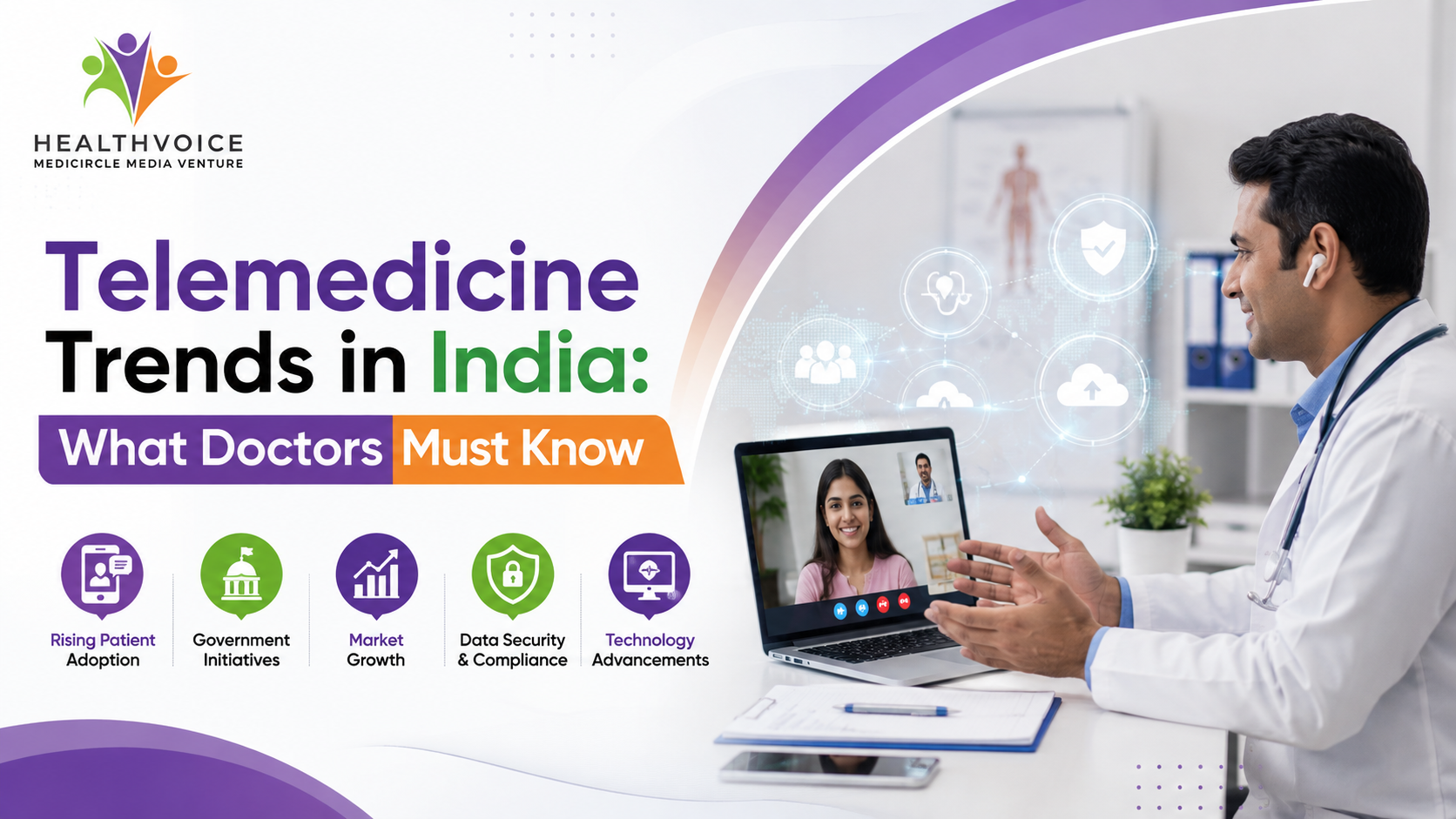
Telemedicine Trends in India: The Digital Health Revolution Doctors Cannot Ignore
India's telemedicine sector is growing rapidly, driven by government initiatives, AI adoption, and expanding digital infrastructure, transforming healthcare access for millions across urban and rural India.
Introduction
India's healthcare system is in the middle of one of the most significant shifts it has seen in decades. The way patients access doctors, how diagnoses are made, and how follow-up care is delivered are all changing at a pace that would have seemed impossible just ten years ago. At the centre of this transformation is telemedicine, a model of care delivery that removes geography as a barrier and places a qualified physician within reach of every patient, whether they live in a metro apartment or a remote village in Jharkhand.
The numbers speak with clarity. India's telemedicine sector is growing at an estimated compound annual growth rate of between 20 and 31 percent, with the market valued at approximately 1.54 billion USD in 2024. The government's eSanjeevani platform alone has served over 340 million patients since 2021, a figure that underscores just how deeply digital health has penetrated the national consciousness. With over 527 million telecom subscribers as of late 2024, the infrastructure to support virtual care is more robust than ever before.
For Indian doctors, medical associations, and healthcare institutions, understanding where telemedicine is heading is no longer optional. It is a professional and strategic necessity. HealthVoice, as a platform committed to amplifying doctor voices and supporting the medical community, presents this comprehensive review of the key trends shaping telemedicine in India today and in the years ahead.
Understanding Telemedicine in the Indian Context
Before examining trends, it is important to ground the conversation in what telemedicine actually means in India's specific healthcare environment. The World Health Organization defines telemedicine as the delivery of healthcare services using information and communication technologies where distance is a critical factor. In practical terms, this includes video consultations, audio calls, store-and-forward diagnostic transfers, remote patient monitoring, and AI-assisted symptom assessment.
India's doctor-to-population ratio remains significantly below the WHO-recommended benchmark of 1 doctor per 1,000 people. With approximately 75 percent of doctors concentrated in urban areas while nearly 65 percent of the population lives in rural regions, the structural mismatch is stark. Telemedicine does not solve this problem entirely, but it is the most effective bridge currently available.
The Telemedicine Practice Guidelines of 2020, issued by the Ministry of Health and Family Welfare in collaboration with NITI Aayog, gave legal clarity to the practice of teleconsultation in India. These guidelines permitted registered medical practitioners to conduct remote consultations using text, audio, and video modes, establishing a foundation on which the entire ecosystem now builds.
The Rise of Government-Led Telemedicine Infrastructure
No trend in Indian telemedicine can be discussed without acknowledging the scale and ambition of government-led initiatives. The eSanjeevani platform remains the most prominent example. Functioning on a hub-and-spoke model, it connects patients through 1,76,534 Ayushman Arogya Mandirs, formerly known as Health and Wellness Centres, and through an online outpatient department module. More than 57 percent of its beneficiaries are women, and approximately 12 percent are senior citizens, demographics that often find physical access to healthcare most difficult.
The Ayushman Bharat Digital Mission (ABDM) represents the broader policy architecture that supports telemedicine at a national level. By creating interoperable digital health IDs, a unified health records system, and a health facility registry, ABDM is building the digital backbone that makes seamless virtual care possible across states and specialties.
The National Tele Mental Health Programme, another significant initiative, operates 51 Tele-MANAS cells across every state and union territory. Averaging 3,500 calls per day and having received over 10 lakh calls on its toll-free helpline, this programme has proven that telemedicine can meaningfully address mental health, one of India's most underserved clinical domains.
For doctors working within or alongside public health systems, these government programmes represent both an opportunity and a growing professional responsibility. Many general practitioners and specialists are now being called upon to participate in teleconsultation rosters, expanding their practice beyond the walls of their clinics.
Artificial Intelligence and Diagnostic Innovation
Artificial intelligence is no longer a futuristic concept in Indian healthcare. It is actively changing how diseases are detected, how clinical decisions are supported, and how patient data is interpreted across distances.
In the field of tele-ophthalmology, AI-powered retinal imaging tools are helping screen patients for diabetic retinopathy in primary care settings where ophthalmologists are not physically present. Aravind Eye Care System has been a pioneer in this space, demonstrating that high-quality screening can reach patients in villages far from tertiary centres. In radiology, AI-assisted image analysis is supporting doctors in tier 2 and tier 3 cities where experienced radiologists are scarce.
The integration of 5G connectivity with AI is particularly consequential. Higher bandwidth means better-quality video consultations, faster transmission of large diagnostic files such as CT scans and MRIs, and the ability to support real-time remote procedures and robotic-assisted surgeries. As 5G rollout continues across Indian cities and eventually smaller towns, the quality and range of telemedicine services will expand considerably.
Symptom-checker tools powered by natural language processing are also being embedded into patient-facing applications, helping triage patients before they reach a doctor. When designed responsibly, these tools reduce the burden on physicians by filtering out cases that can be managed with self-care guidance, while flagging those that require urgent attention.
For Indian doctors, AI does not replace clinical judgment. It augments it. Physicians who understand how to interpret AI-assisted outputs and integrate them into their diagnostic process will be significantly better positioned in the evolving healthcare landscape.
Wearables, Remote Patient Monitoring, and Chronic Disease Management
India carries one of the world's heaviest burdens of non-communicable diseases. Diabetes, hypertension, cardiovascular disease, and chronic respiratory conditions affect hundreds of millions of Indians and require sustained, long-term clinical monitoring. This is precisely where remote patient monitoring (RPM) through wearable devices is creating a meaningful shift.
Wearable devices now enable continuous tracking of blood glucose levels, heart rate, blood pressure, oxygen saturation, and even ECG rhythms. This data can be transmitted in real time to treating physicians, alerting them to dangerous changes before a patient reaches a crisis point. For doctors managing patients with multiple comorbidities, especially in post-discharge settings, this level of continuous oversight was previously impossible without daily hospital visits.
The global remote patient monitoring market is projected to reach 56.94 billion USD by 2030, growing at a CAGR of 12.7 percent. India represents one of the fastest-growing segments within this market. The combination of affordable smartphone penetration, reducing costs of biosensor hardware, and increasing health consciousness among urban middle-class patients is accelerating adoption rapidly.
Medical associations and specialty boards are beginning to develop protocols for RPM-assisted chronic disease management. Physicians who incorporate these tools into their practice are reporting better patient adherence, fewer emergency presentations, and improved long-term outcomes, particularly among diabetic and cardiac patients.
The Private Sector's Expanding Role
India's telemedicine ecosystem is not driven by government alone. The private sector has become an equally important force, bringing with it innovation, investment, and scale.
Platforms such as Practo, mfine, and Apollo TeleHealth have built large patient networks and have demonstrated that Indians across income groups are willing to pay for the convenience and quality of virtual consultations. Apollo TeleHealth, one of the earliest and most established players, has expanded into specialist teleconsultation, remote diagnostics, and occupational health services for large employers.
Healthcare SaaS platforms are also emerging rapidly. These include e-pharmacy integrations with virtual consultations, digital prescription management systems, and real-time data-sharing platforms that connect patients, pharmacists, and doctors on a single interface. For doctors running independent practices, these tools offer an opportunity to extend their reach and manage patient populations more efficiently without significant capital investment.
Venture capital interest in Indian health technology has been sustained. Investors are actively looking at opportunities in wearable device manufacturing, AI diagnostic tools, surgical robotics, electronic health records, and mental health applications. This investment environment is creating a pipeline of new tools and services that will continue to enter the hands of both patients and practitioners.
Data Privacy, Cybersecurity, and Regulatory Evolution
As the volume of health data flowing through digital systems increases, so does the responsibility to protect it. Data privacy and cybersecurity have emerged as critical challenges for telemedicine stakeholders in India.
The National Health Authority has published a Health Data Management Policy that establishes minimum standards for data privacy, including notice and consent mechanisms, patient rights to access and erase records, and rules for the acquisition and storage of personal health information. The Ayushman Bharat Digital Mission has incorporated digital identity services and an electronic consent management architecture to ensure that patient data is shared only with verified, consented recipients.
Blockchain technology is being explored as a mechanism for securing patient records and enabling permission-based data access. By creating an immutable, decentralised record of health transactions, blockchain has the potential to give patients genuine control over who sees their medical information, a significant trust-building step for a population that is still warming to the idea of sharing health data digitally.
For doctors and institutions, compliance with data protection standards is not merely a legal obligation. It is a trust signal that strengthens the doctor-patient relationship in the virtual environment. As India moves toward comprehensive data protection legislation, healthcare providers will need to invest in compliant technology infrastructure and train their teams accordingly.
Challenges That Demand Honest Attention
No analysis of telemedicine trends in India would be complete without an honest examination of the barriers that continue to limit its reach and effectiveness.
The rural digital divide remains the most persistent challenge. While internet penetration is growing, connectivity in many interior districts is still unreliable, making video consultations difficult and sometimes impossible. The assumption that all patients have access to a smartphone with adequate data connectivity is still far from reality for a significant portion of India's population.
Digital literacy is a related concern. Patients and even some healthcare providers in smaller cities and rural areas may lack the confidence or skills to navigate telemedicine platforms effectively. Government and private organisations are investing in training and awareness programmes, but progress is uneven.
The absence of a unified cross-state licensing and regulatory framework creates friction for doctors who wish to practice telemedicine across state borders. A cardiologist in Chennai should be able to consult a patient in Assam without navigating a complex web of state-specific requirements. Regulatory harmonisation remains a priority that policymakers and medical associations need to accelerate.
Physical examination limitations also persist. Telemedicine is not appropriate for every clinical situation. Doctors must exercise sound judgment about which consultations can be safely conducted remotely and which require in-person assessment. Professional guidelines from bodies such as the National Medical Commission are essential in helping practitioners navigate these decisions responsibly.
The Future of Telemedicine in India: What Doctors Should Prepare For
The trajectory of telemedicine in India points clearly toward deeper integration with mainstream healthcare delivery rather than its existence as a parallel or supplementary system. Several developments on the horizon deserve attention from the medical community.
The continued buildout of ABDM infrastructure will eventually create a scenario where a patient's health records, prescriptions, diagnostics, and teleconsultation history are all accessible on a single interoperable platform. This will dramatically improve care coordination, especially for patients managing chronic conditions across multiple specialists.
The expansion of telemedicine into new specialty domains is also underway. Tele-psychiatry, tele-dermatology, tele-neurology, and even tele-surgical mentoring are all areas where early pilots are showing promise. Medical associations in these specialties will play a critical role in developing clinical protocols and competency standards for virtual practice.
For the broader medical community, platforms such as HealthVoice offer a space to stay connected with these developments, share clinical experiences, and engage with the conversations that will shape policy and practice. As telemedicine becomes more central to how healthcare is delivered in India, the voices of experienced doctors, specialists, and association leaders will be essential in guiding its evolution responsibly.
Conclusion
Telemedicine in India has moved well beyond its early pilot phase. It is now a structural feature of the national healthcare system, supported by government policy, private investment, and a rapidly maturing technology ecosystem. The trends examined in this article, from AI-assisted diagnostics and remote patient monitoring to government platforms and data governance frameworks, collectively point to a healthcare future that is more accessible, more connected, and more data-driven than at any previous point in India's history.
For Indian doctors, the message is clear. Telemedicine is not a disruption to be managed. It is an opportunity to extend clinical reach, deepen patient relationships, and contribute to a more equitable healthcare system. Understanding these trends, staying informed about regulatory developments, and engaging with professional communities that prioritise credible, evidence-based dialogue are the steps that will define the most effective medical leaders of the next decade.
Frequently Asked Questions
Q1: What is the current status of telemedicine in India?
Telemedicine in India is growing rapidly, led by the government's eSanjeevani platform, which has served over 340 million patients. India's telemedicine market is estimated to grow at a CAGR of between 20 and 31 percent through 2030, supported by the Ayushman Bharat Digital Mission and an expanding digital infrastructure.
Q2: Is telemedicine legal in India for doctors?
Yes. The Telemedicine Practice Guidelines 2020, issued jointly by the Ministry of Health and Family Welfare and NITI Aayog, made teleconsultation legally permissible for registered medical practitioners in India. Doctors must follow these guidelines when conducting remote consultations.
Q3: Which telemedicine platforms are most widely used in India?
The government-operated eSanjeevani is the largest telemedicine platform in India. Private platforms such as Practo, mfine, and Apollo TeleHealth are also widely used, offering specialist consultations, diagnostics, and remote patient monitoring services.
Q4: How is artificial intelligence changing telemedicine in India?
AI is being used in India to assist in early diagnosis, analyse medical images, power symptom checkers, and enable predictive health monitoring. In specialties such as radiology, ophthalmology, and dermatology, AI-assisted tools are helping doctors in smaller cities access diagnostic support that was previously unavailable.
Q5: What are the main challenges facing telemedicine adoption in India?
Key challenges include the rural digital divide, poor internet connectivity in remote areas, low digital literacy among patients and some providers, data privacy concerns, and the absence of a fully unified national regulatory framework for cross-state telemedicine practice.
Resources
- Ministry of Health and Family Welfare, Government of India (mohfw.gov.in): Official source for Telemedicine Practice Guidelines 2020 and eSanjeevani programme updates.
- Ayushman Bharat Digital Mission (abdm.gov.in): National framework for digital health identity, interoperable health records, and telemedicine infrastructure in India.
- National Health Portal of India (nhp.gov.in): Centralised source for government health programmes, telemedicine resources, and digital health policy documentation.
- Indian Council of Medical Research (icmr.gov.in): Evidence-based research publications on telemedicine applications, AROGYASREE, and healthcare delivery innovations in India.
- World Health Organization India (who.int/india): International guidelines and country-level reports on telemedicine, digital health, and healthcare workforce recommendations.
Interlinking Keywords
eSanjeevani telemedicine India, Ayushman Bharat Digital Mission, telemedicine guidelines for doctors, AI in Indian healthcare, remote patient monitoring India, teleconsultation platforms India, digital health India 2026, ABDM health records, tele-mental health India, rural healthcare telemedicine
Last medically reviewed by:
HealthVoice Medical Editorial Board on August 3, 2026
Medical Disclaimer:
The information presented in this article is intended for general informational and educational purposes only. It does not constitute medical advice and should not be used as a substitute for professional medical consultation, diagnosis, or treatment. Doctors and healthcare professionals should refer to the latest clinical guidelines issued by the National Medical Commission, the Ministry of Health and Family Welfare, and relevant specialty bodies before making clinical decisions. Patients are advised to consult a qualified and registered medical practitioner for any health concerns.
 Team Healthvoice
#TelemedicineIndia #DigitalHealthIndia