Medical Education Beyond Textbooks: Real-World Learning
Real-world clinical learning, mentorship, community health exposure, and simulation-based training are transforming Indian medical education, preparing doctors for complex, real-life healthcare challenges beyond textbooks.
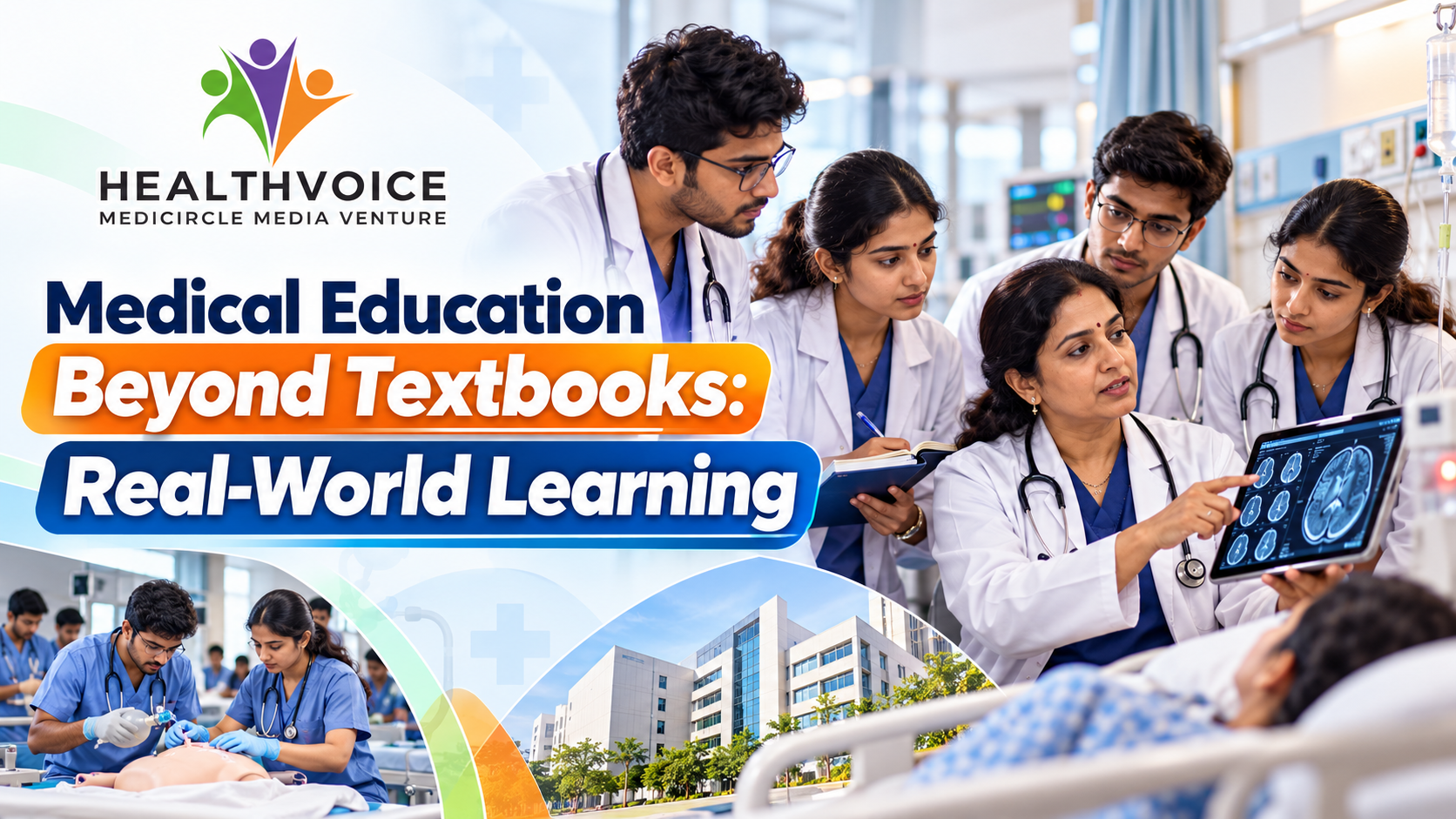
Medical Education Beyond Textbooks: Learning From Real-World Healthcare
Introduction
Medical education in India has long been built on a strong foundation of scientific knowledge, theoretical frameworks, and rigorous examinations. Yet, the most transformative learning that shapes a doctor often happens not inside a lecture hall, but in the corridors of a busy district hospital, at the bedside of a patient from a rural village, or during a night call when a diagnosis must be made with limited resources and no textbook within reach.
The conversation around medical education is shifting. Across India, medical institutions, the National Medical Commission, and healthcare communities are increasingly acknowledging that producing competent, compassionate, and practically skilled doctors requires something textbooks alone cannot offer. It requires real-world exposure, structured clinical experience, and a learning culture that values critical thinking as much as rote knowledge.
This article explores why experiential learning in medicine matters, how real-world healthcare environments shape better doctors, and what changes are already underway in Indian medical education to bridge the gap between theory and practice.
Why Textbook Knowledge Alone Is Not Enough
Medical textbooks are indispensable. They provide the anatomical frameworks, the pharmacological principles, the pathophysiological reasoning, and the diagnostic criteria that every doctor must know. No one questions their importance. However, textbooks describe conditions in ideal presentations, with clear histories and predictable symptom clusters. Real patients rarely follow that script.
A first-year intern in a government hospital in Uttar Pradesh or Bihar will encounter patients who present late, have multiple comorbidities, cannot articulate their symptoms clearly, and may not have access to every diagnostic test that a textbook recommends. The ability to navigate that clinical reality, to make sound clinical judgments under uncertainty, and to communicate effectively with patients from diverse educational and cultural backgrounds, is something that only direct experience can teach.
Research in health professions education consistently shows that clinical reasoning skills, diagnostic accuracy, and patient communication improve significantly through experiential learning. When medical students actively participate in patient care rather than passively observing it, their learning retention, their empathy, and their professional confidence all improve meaningfully.
The Current State of Clinical Training in Indian Medical Colleges
India has one of the largest networks of medical colleges in the world, with over 700 MBBS-granting institutions recognized by the National Medical Commission. Yet, the quality of clinical exposure within these institutions varies widely. Some premier medical colleges attached to large teaching hospitals provide extensive patient contact from early in the MBBS programme. Others, particularly in Tier 2 and Tier 3 cities, face challenges related to patient volume, faculty availability, and infrastructure.
The revised competency-based medical education curriculum introduced by the NMC in 2019 was a significant step toward shifting the focus from knowledge recall to skill-based and attitude-driven learning. The new curriculum mandates:
- Early clinical exposure for Phase 1 MBBS students to contextualize basic science learning
- Structured skill laboratories where students practice clinical procedures before performing them on patients
- AETCOM (Attitude, Ethics, and Communication) modules integrated throughout the programme
- Foundation courses that orient students to the healthcare system, community settings, and the doctor-patient relationship
These reforms reflect a growing institutional recognition that medical education must prepare doctors not just for examinations, but for the actual demands of healthcare delivery in India.
What Real-World Clinical Learning Actually Looks Like
Experiential learning in medicine is not simply about spending time in a hospital. It is structured, reflective, and purposeful. Several approaches have proven particularly effective in Indian and global medical education contexts.
Case-Based Learning and Bedside Teaching
Bedside teaching remains one of the most powerful tools in clinical medical education. When a faculty physician walks a group of students through a patient's history, examination findings, and clinical reasoning at the bedside, it models the thought process of an experienced clinician in real time. Case-based learning extends this approach into classroom settings by presenting complex, realistic patient scenarios that students must analyze, discuss, and resolve through collaborative reasoning.
In India, institutions like AIIMS New Delhi, CMC Vellore, and JIPMER Puducherry have long integrated rigorous bedside teaching and clinical case discussions into their training cultures. These institutions consistently produce doctors who are recognized for their clinical acumen precisely because they combine theoretical depth with practical engagement from an early stage.
Community Health Postings and Rural Exposure
One of the most distinctive and valuable aspects of MBBS training in India is the mandatory community medicine posting and rural internship component. Future doctors spend time in primary health centres, community health centres, and sometimes remote subcentres, where they encounter health problems that urban teaching hospitals rarely highlight.
A medical student doing a posting in a PHC in Rajasthan or Telangana will encounter nutritional anaemia, fluorosis, vector-borne diseases, maternal health complications, and mental health conditions going undiagnosed because of stigma. This exposure does not just build clinical skills. It builds awareness, humility, and a sense of public health responsibility that is essential for any doctor who will eventually serve the Indian population.
Simulation-Based Training
Medical simulation has gained considerable momentum in India over the past decade. Skills laboratories equipped with mannequins, laparoscopy trainers, obstetric simulators, and standardized patient models allow students and postgraduate trainees to practice clinical procedures repeatedly without risk to patients. This is particularly important for procedural skills such as intravenous cannulation, suturing, basic life support, and neonatal resuscitation.
The NMC's emphasis on skill-based learning has prompted many medical colleges to invest in simulation infrastructure, although access to high-fidelity simulation technology remains uneven across institutions.
Digital Learning and Telemedicine Exposure
The COVID-19 pandemic accelerated the adoption of digital learning tools in Indian medical education. Virtual patient encounters, digital case libraries, and online clinical reasoning platforms became necessary substitutes when physical access to hospitals was restricted. While these tools do not fully replace direct patient contact, they have expanded the range of learning experiences available to medical students, particularly those in institutions with lower patient volumes.
The integration of telemedicine exposure into medical training is also growing in relevance, given India's National Telemedicine Guidelines and the expanding role of digital health delivery under the Ayushman Bharat Digital Mission.
The Role of Mentorship in Shaping Clinical Doctors
Textbooks give knowledge. Mentors give wisdom. The relationship between a junior doctor and an experienced clinician is one of the most underappreciated elements of medical education. A good mentor does not just supervise clinical work. A mentor models professional behaviour, demonstrates how to navigate diagnostic uncertainty, shows how to deliver difficult news to a patient with compassion, and helps a young doctor understand that medicine is as much about human connection as it is about clinical science.
In India, the tradition of guru-shishya learning has deep cultural roots, and its expression in medical education through the relationship between residents and senior consultants carries real value. Platforms like HealthVoice play an important role here by connecting young doctors with experienced medical professionals, providing a space for doctors to share their clinical experiences, discuss challenging cases, and build professional networks that extend beyond their own institutions.
Challenges That Still Need Addressing
Despite meaningful progress, significant challenges remain in ensuring that all medical students in India receive high-quality real-world clinical training.
The doctor-to-population ratio in India remains below WHO recommendations, particularly in rural areas. This creates pressure on clinical faculty who must simultaneously teach and serve large patient loads. Student-to-patient ratios in some teaching hospitals can be so high that meaningful individual clinical engagement becomes difficult to ensure for every student.
There is also the challenge of assessment. If examination systems continue to reward knowledge recall over clinical reasoning and communication skills, students will naturally orient their efforts toward what is being measured. The success of competency-based medical education reforms depends heavily on assessment reform running in parallel with curriculum reform.
Mental health support for medical students and junior doctors is another area requiring urgent attention. The transition from classroom learning to clinical environments can be overwhelming. Young doctors face long working hours, exposure to suffering and death, hierarchy-related pressures, and often inadequate formal support. Building learning environments where it is safe to ask questions, acknowledge uncertainty, and seek help is essential for producing doctors who are not just clinically competent but professionally sustainable.
The Future of Medical Education in India
The future of medical education in India will be defined by how well institutions integrate knowledge, skills, professional values, and real-world readiness into a unified and coherent training experience. The NMC's competency-based curriculum is a strong foundation, but its full potential depends on consistent implementation across all medical colleges, both private and government.
International collaborations, faculty development programmes, peer learning networks, and community of practice models all have roles to play. So does the collective voice of the medical community itself. When experienced doctors share what they have learned from clinical practice, when medical associations create platforms for peer knowledge exchange, and when healthcare communities invest in mentoring the next generation, the gap between classroom learning and clinical reality begins to narrow.
Conclusion
Medical education in India is at an important crossroads. The knowledge that textbooks provide will always be the starting point, but it is real-world clinical experience, structured mentorship, community health exposure, and reflective practice that truly prepare doctors for the complex realities of healthcare in a country as diverse and demanding as India.
The goal is not to replace theoretical foundations but to ensure that every medical graduate enters independent practice having learned not just what medicine says, but how medicine is actually done. That shift, from knowledge to competence, from instruction to experience, is what will ultimately define the quality of healthcare that millions of Indians receive.
Platforms and communities that bring doctors together to share learning, clinical insights, and professional experiences, such as HealthVoice, have an important role in sustaining this culture of continuous real-world learning throughout a doctor's career.
Frequently Asked Questions
Q1: Why is real-world clinical exposure important in medical education?
Real-world clinical exposure helps medical students develop practical skills, clinical reasoning, and communication abilities that textbooks cannot fully provide. It prepares doctors to handle the complexities of actual patient care, including incomplete information, resource limitations, and the social and cultural dimensions of illness.
Q2: What is competency-based medical education and how is it different from traditional learning?
Competency-based medical education, introduced in India by the National Medical Commission in 2019, shifts the focus from memorization and exam performance to the development of defined clinical skills, professional attitudes, and communication abilities. It measures learning outcomes in terms of what a doctor can actually do, not just what a doctor knows.
Q3: How does community medicine posting benefit MBBS students in India?
Community medicine postings expose students to the health challenges of rural and semi-urban populations, including infectious diseases, nutritional deficiencies, maternal health issues, and limited healthcare access. This experience builds public health awareness and teaches students to practice medicine in resource-constrained settings, which is essential for Indian healthcare delivery.
Q4: What role does simulation-based training play in modern medical education?
Simulation-based training allows medical students and postgraduate trainees to practice clinical procedures in a safe and controlled environment before performing them on real patients. It improves procedural confidence, reduces errors, and is particularly valuable for high-stakes skills such as resuscitation, surgical techniques, and obstetric emergencies.
Q5: How can young doctors in India continue learning beyond their formal medical training?
Young doctors can continue their professional learning through peer networks, continuing medical education programmes, case discussion forums, clinical conferences, and digital healthcare communities. Platforms such as HealthVoice provide structured spaces where doctors can share clinical experiences, access expert perspectives, and stay connected with the evolving healthcare landscape in India.
Resources
- National Medical Commission (NMC): Official regulatory body overseeing medical education standards and the competency-based curriculum framework in India
- Indian Council of Medical Research (ICMR): Leading body for biomedical and health research in India, providing evidence-based guidelines relevant to clinical training
- World Health Organization (WHO) India: Publishes reports and frameworks on health workforce development and medical education reform applicable to the Indian context
- Ayushman Bharat Digital Mission (ABDM): National initiative integrating digital health infrastructure into Indian healthcare, relevant to telemedicine training in medical education
- Ministry of Health and Family Welfare (MoHFW): Central government body responsible for health policy, including guidelines governing internship, rural postings, and public health training for medical students
Interlinking Keywords
competency-based medical education India, clinical training MBBS, real-world learning for doctors, medical internship India, bedside teaching in medical colleges, NMC medical curriculum, community medicine posting, simulation-based medical training, young doctors India, HealthVoice doctor community
Last reviewed by:
Dr. Manthan Tripathi, HealthVoice Editorial and Medical Advisory Team, October 1, 2026.
Disclaimer
This article is intended for informational and educational purposes only. It is directed primarily at medical professionals, medical students, healthcare educators, and individuals interested in medical education systems in India. The content does not constitute clinical advice, medical guidance, or a substitute for professional medical consultation. Readers are advised to refer to the National Medical Commission, their respective medical institutions, and qualified healthcare educators for guidance specific to their training, curriculum, or professional development needs.
 Dr. Manthan Tripathi
#MedicalEducation #ClinicalTraining #RealWorldLearning #HealthcareEducation