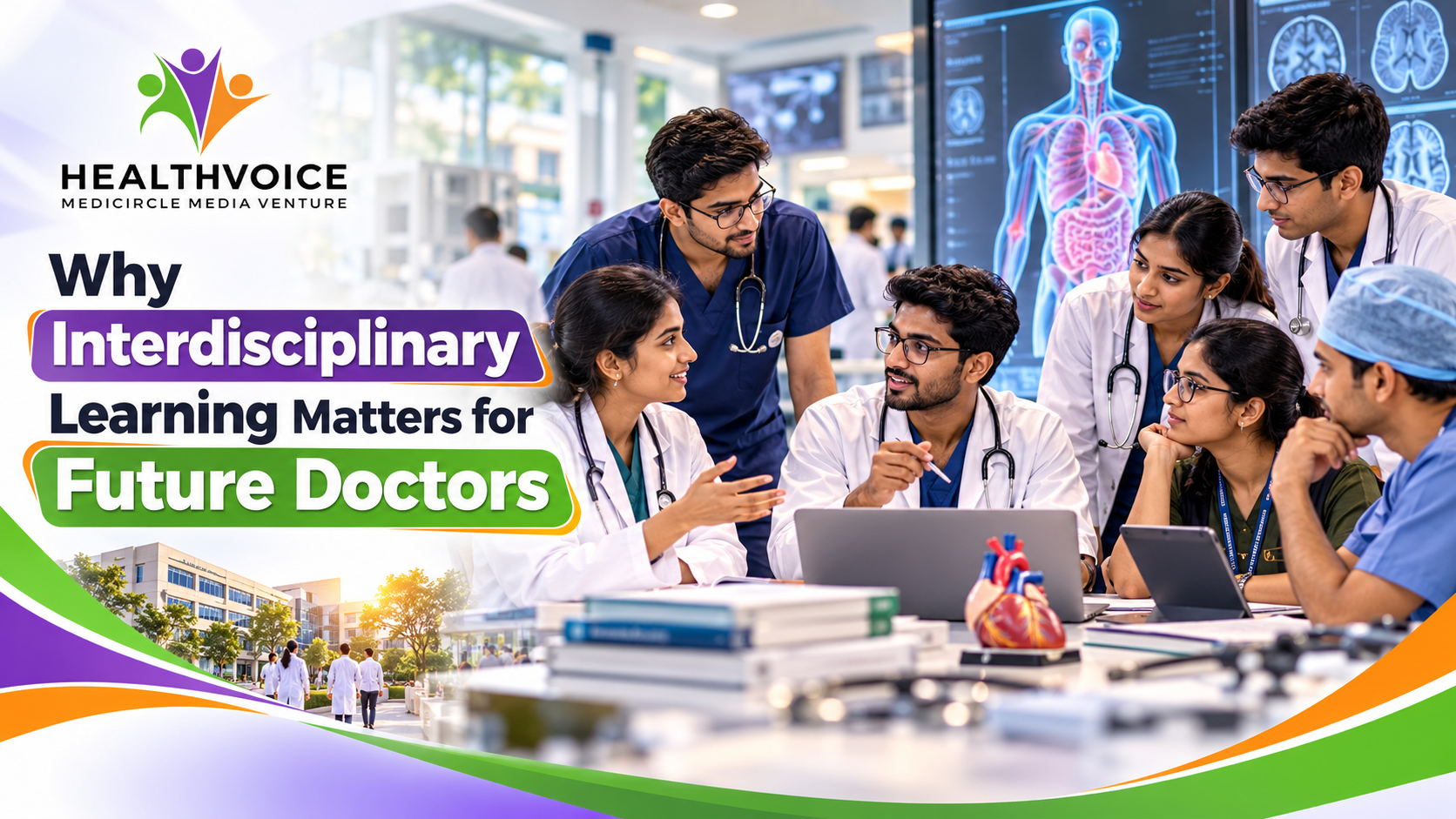
Why Interdisciplinary Learning Matters for Future Doctors
Interdisciplinary learning equips future doctors with skills beyond clinical medicine, preparing them to address India's complex healthcare challenges through holistic, collaborative, and community-oriented medical practice.
Why Interdisciplinary Learning Matters for Future Doctors
Introduction
Medical education in India is at a defining crossroads. With the National Medical Commission introducing Competency-Based Medical Education, or CBME, and healthcare challenges growing more complex every year, the traditional model of training doctors in silos is no longer sufficient. The idea that a physician needs only to master the science of human biology and clinical diagnosis is being replaced by a much broader understanding of what it means to be a healer in the twenty-first century.
Interdisciplinary learning, which refers to the deliberate integration of knowledge, skills, and perspectives from multiple fields into medical training, is rapidly gaining recognition as one of the most forward-thinking approaches in health professions education globally. For India, where a doctor may be required to address not just disease but poverty, mental health, nutrition, environmental hazards, and public health crises simultaneously, the argument for interdisciplinary medical education becomes even more compelling.
This article explores what interdisciplinary learning truly means for aspiring doctors, why it is gaining momentum in India, and how it can fundamentally shape better clinicians, researchers, and healthcare leaders for the country.
Understanding Interdisciplinary Learning in Medical Education
Interdisciplinary learning is not simply about adding extra subjects to a medical curriculum. It is about creating intentional connections between disciplines so that students understand how different domains of knowledge inform and strengthen one another. In a medical context, this could mean integrating public health principles into clinical rotations, incorporating behavioral sciences into patient communication training, or embedding bioethics into surgical and procedural training.
The distinction between multidisciplinary and interdisciplinary approaches is important. Multidisciplinary education places different subjects side by side without necessarily connecting them. Interdisciplinary education, on the other hand, actively blends these perspectives so students can think across boundaries, solve complex problems, and make decisions that account for biological, psychological, social, and systemic factors at the same time.
For medical students in India, this is particularly relevant. The burden of non-communicable diseases, infectious diseases, and lifestyle-related disorders places enormous pressure on a healthcare system that requires doctors who can think beyond a single organ system or specialty. A physician who understands the social determinants of health, the principles of health economics, the basics of digital health tools, and the importance of patient psychology is far more equipped to serve a diverse and underserved population than one trained solely in textbook pathology and pharmacology.
Why the Traditional Curriculum Is No Longer Enough
For decades, Indian medical colleges operated on a curriculum model that emphasized rote learning, subject-specific knowledge, and examination performance. While this model produced technically trained doctors, it often produced graduates who lacked exposure to communication skills, medical ethics, population health thinking, mental health awareness, and the practical realities of healthcare delivery in resource-limited settings.
Several factors have exposed the limitations of this approach:
- The rise of complex, multifactorial diseases such as type 2 diabetes, cardiovascular conditions, and mental health disorders requires doctors who can understand lifestyle, behavior, genetics, and social context together.
- Patients today are better informed and more engaged in their care, demanding doctors who can communicate clearly, empathize genuinely, and collaborate with allied health professionals.
- Healthcare delivery in India is increasingly team-based, meaning a doctor must be able to work effectively with nurses, pharmacists, physiotherapists, social workers, and public health workers.
- The rapid integration of technology, including artificial intelligence, telemedicine, and digital diagnostics, requires medical graduates who are not intimidated by innovation and can adapt to new tools.
The National Medical Commission, through its CBME framework, has acknowledged several of these gaps and made efforts to address them. However, truly embedding interdisciplinary learning into medical training requires more than curriculum revisions. It requires a shift in institutional culture, faculty development, and the way medical colleges in India assess and value learning.
Key Benefits of Interdisciplinary Learning for Aspiring Doctors
When medical training deliberately incorporates knowledge from fields such as public health, psychology, social sciences, ethics, health informatics, and communication studies, the outcomes for students and patients alike improve significantly.
One of the most direct benefits is the development of clinical reasoning that accounts for the whole patient rather than only the presenting symptom. A doctor trained in interdisciplinary thinking will consider not just what disease a patient has, but why they developed it, what barriers they face in accessing treatment, what psychosocial factors may be affecting their recovery, and what systemic changes could prevent similar cases in the community.
Interdisciplinary learning also builds stronger communication skills. Medical education programs that include training from linguistics, behavioral science, and psychology help doctors develop the ability to explain diagnoses clearly, break difficult news with sensitivity, navigate cultural differences, and support patients through difficult healthcare decisions. In a country as linguistically and culturally diverse as India, this skill is not optional.
Research aptitude improves considerably when students are exposed to methods and frameworks from multiple disciplines. A medical student trained only in clinical sciences will approach a research question very differently from one who has also been exposed to epidemiology, health economics, sociology, and data analysis. The latter is far more capable of designing impactful, community-relevant research that addresses India-specific health challenges.
Leadership and healthcare management are also strengthened through interdisciplinary exposure. Future doctors who understand health policy, institutional administration, and community engagement are better prepared to take on leadership roles in hospitals, public health programs, and healthcare organizations. India needs physicians who can lead, and leadership requires knowledge that goes well beyond anatomy and pharmacology.
Interdisciplinary Learning and India's Healthcare Priorities
India's healthcare priorities make a strong case for integrating interdisciplinary approaches at every level of medical training. Government programs such as Ayushman Bharat, the Ayushman Bharat Digital Mission, and the National Health Policy 2017 all call for healthcare delivery models that are preventive, community-oriented, and technology-enabled. These models require doctors who can think and function beyond the confines of a hospital ward.
Consider the challenge of non-communicable disease prevention in India. Addressing conditions such as hypertension, obesity, and diabetes at a population level requires doctors who understand nutrition science, behavioral change frameworks, community health worker engagement, digital health tools, and health communication strategies. None of these elements belong exclusively to clinical medicine, yet all of them are essential to effective prevention.
Similarly, India's ongoing efforts to strengthen primary healthcare through Health and Wellness Centres and the ASHA worker network require doctors who can collaborate with non-physician health workers, understand community needs, and design locally appropriate interventions. These capabilities are developed through interdisciplinary exposure, not through traditional clinical training alone.
Mental health is another area where interdisciplinary learning has transformative potential. India faces a significant mental health burden, with an estimated one in seven Indians affected by mental health conditions according to data from the National Mental Health Survey. Yet stigma, lack of awareness, and poor integration of mental health into primary care remain serious barriers. Medical training that incorporates psychiatry, psychology, social work perspectives, and community health communication can produce doctors who are more likely to screen for mental illness, refer appropriately, and support patients without judgment.
How Medical Colleges and Institutions Can Implement Interdisciplinary Learning
Implementing interdisciplinary learning in Indian medical colleges requires deliberate planning, faculty commitment, and institutional support. Several approaches have shown promise in both global and Indian contexts.
Integrated module-based teaching, where faculty from different departments co-design and co-deliver sessions around a central theme such as diabetes care, maternal health, or mental wellness, allows students to see how multiple disciplines converge on a single clinical challenge. Problem-based learning cases that require students to consider biological, psychological, social, and systemic dimensions simultaneously are particularly effective in building interdisciplinary thinking.
Interprofessional education, which brings together medical students, nursing students, pharmacy students, and allied health students for shared learning experiences, is gaining momentum in India. Institutions affiliated with universities that offer multiple health professions programs are well positioned to develop these collaborative learning environments.
Community-based learning placements in rural and urban primary care settings expose students to the real complexities of healthcare delivery, where interdisciplinary collaboration is not theoretical but essential. Postings at Health and Wellness Centres, community health programs, and urban slum health initiatives provide medical students with perspectives that classroom teaching alone cannot offer.
Faculty development is equally critical. Medical educators who were themselves trained in single-discipline silos may need structured support to design and deliver interdisciplinary content effectively. Institutions and medical associations have an important role to play in creating faculty development programs that build this capacity.
HealthVoice, as a platform that brings together doctors, medical associations, and healthcare communities, is well positioned to facilitate conversations about best practices in interdisciplinary medical education, helping institutions and educators learn from one another and accelerate the adoption of these approaches across India.
Challenges in Adopting Interdisciplinary Learning in India
Despite its clear benefits, interdisciplinary learning faces real barriers in the Indian medical education landscape. Traditional subject-specific examinations and assessment structures reward compartmentalized knowledge rather than integrative thinking. Time pressure within already packed MBBS and MD curricula leaves little room for new approaches. Faculty resistance, driven by comfort with familiar teaching methods, can slow institutional change.
Additionally, the absence of dedicated infrastructure for interprofessional learning, including shared classrooms, simulation facilities, and jointly designed course materials, limits what institutions can achieve even when the willingness exists.
Regulatory frameworks also play a role. The NMC has made positive strides through CBME, but clearer guidance and stronger incentives for institutions adopting interdisciplinary approaches would accelerate the transition. Medical associations, academic bodies, and healthcare thought leaders have an important advocacy role in pushing for policy environments that support and reward innovative medical education.
Frequently Asked Questions
Q1: What is the meaning of interdisciplinary learning in medical education?
Interdisciplinary learning in medical education refers to the integration of knowledge and skills from multiple fields, such as clinical medicine, public health, psychology, ethics, health informatics, and social sciences, into a unified learning experience. It helps students develop a broader, more holistic understanding of health and disease rather than focusing on a single subject in isolation.
Q2: How is interdisciplinary learning different from multidisciplinary learning?
Multidisciplinary learning places different subjects alongside each other without necessarily creating connections between them. Interdisciplinary learning actively integrates these subjects so that students understand how they relate to and inform one another. In medical training, this means students learn to think across disciplines when solving clinical problems rather than applying knowledge from only one field at a time.
Q3: Is interdisciplinary learning part of the NMC curriculum in India?
The National Medical Commission has introduced Competency-Based Medical Education, which incorporates several elements aligned with interdisciplinary thinking, including attitude, ethics, and communication modules, early clinical exposure, and community health postings. While full integration of interdisciplinary learning is still evolving, the CBME framework provides a foundation that supports this direction.
Q4: What subjects or fields are typically integrated into interdisciplinary medical programs?
Interdisciplinary medical programs commonly draw on fields such as public health and epidemiology, behavioral science and psychology, medical ethics and bioethics, health informatics and digital health, nutrition science, health communication, sociology, and health economics. The specific combination varies depending on the institution and program design.
Q5: How does interdisciplinary learning benefit patients in India?
Patients benefit when their doctors think beyond the immediate clinical diagnosis. A physician trained through interdisciplinary learning is more likely to consider a patient's mental health, social circumstances, nutritional status, and access to follow-up care. This holistic approach leads to more personalized, effective, and compassionate care, which is especially important in India's diverse and often resource-constrained healthcare settings.
Resources
- National Medical Commission (NMC): Official regulatory body for medical education in India, with guidelines on CBME and curriculum standards.
- Indian Council of Medical Research (ICMR): India's premier biomedical research body, publishing data and guidelines relevant to health education and clinical practice.
- World Health Organization (WHO) India: WHO's India office provides frameworks on health professions education, interprofessional learning, and health workforce development.
- Ministry of Health and Family Welfare (MoHFW): Source of national health policies, Ayushman Bharat program details, and medical education reforms.
- National Mental Health Survey of India: A landmark study providing data on the mental health burden in India, relevant to understanding the need for integrated mental health training in medical education.
Interlinking Keywords
Interdisciplinary medical education, competency-based medical education India, NMC CBME framework, future of medical training India, interprofessional education, medical college curriculum reform, holistic doctor training, medical education reforms India, young doctors India, health professions education
Last reviewed by:
Dr. Manthan Tripathi, HealthVoice Editorial and Medical Advisory Team, October 1, 2026.
Disclaimer
The content published in this article is intended for informational and educational purposes only. It is directed at medical professionals, medical students, healthcare educators, and institutional decision-makers. This article does not constitute clinical advice, institutional policy guidance, or regulatory instruction. Readers are advised to consult the National Medical Commission, their respective university guidelines, and relevant academic authorities for official guidance on medical education curriculum design and implementation. HealthVoice does not endorse any specific institution, program, or educational product.
 Dr. Manthan Tripathi
#InterdisciplinaryLearning #MedicalEducation #FutureDoctors #HealthcareTraining
