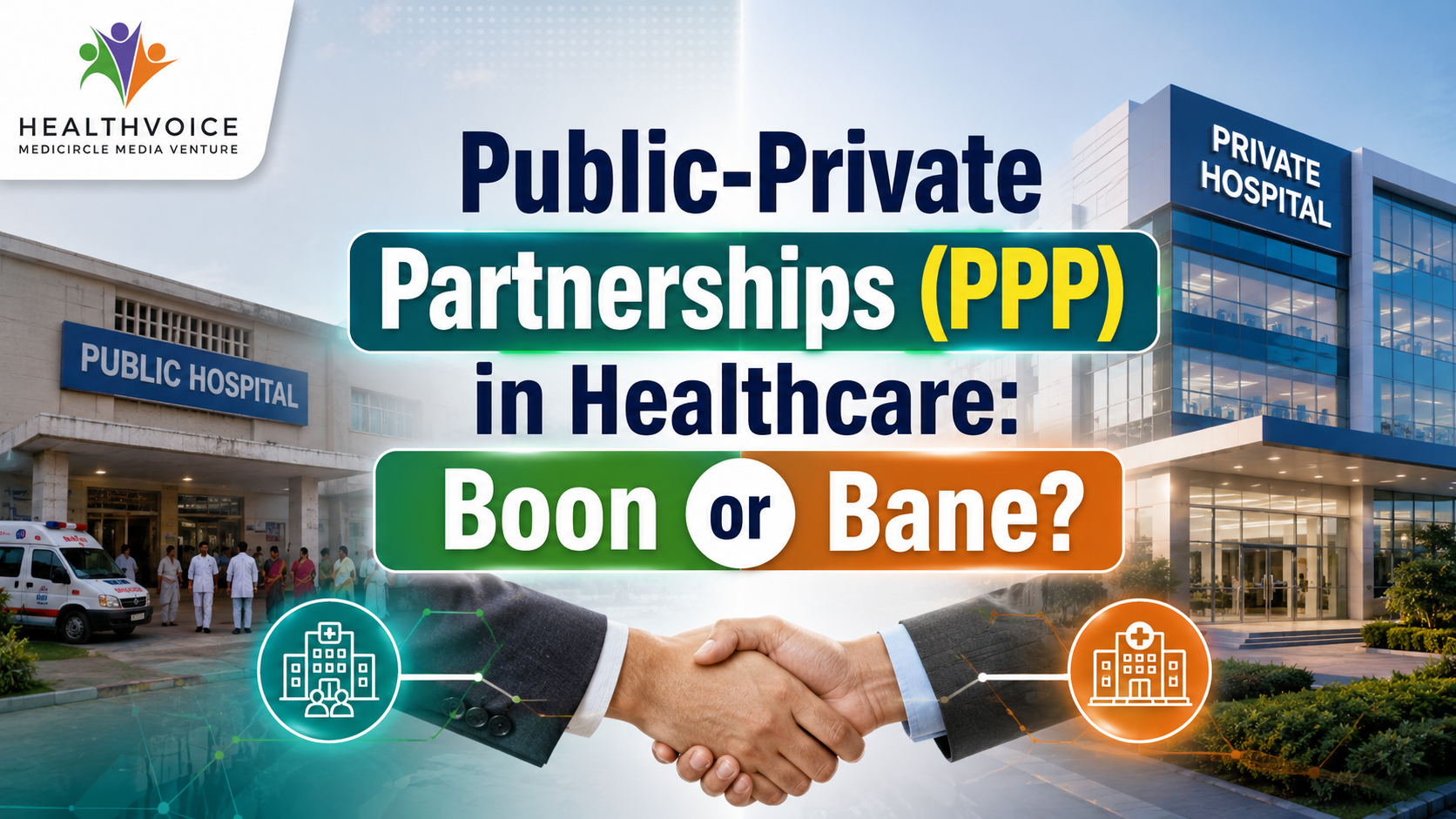
Public-Private Partnerships (PPP) in Healthcare: Boon or Bane?
Universal healthcare in developing economies often struggles to balance policy ambitions with operational realities, including overcrowded hospitals, workforce shortages, and limited access to advanced medical infrastructure. Public-Private Partnerships (PPPs) have emerged as a strategic model to bridge these gaps by combining public oversight with private-sector efficiency, innovation, and investment to improve healthcare accessibility and quality.
out-of-pocket costs.
Public-Private Partnerships (PPP) in Healthcare: Boon or Bane for the Common Man?
The delivery mechanism of universal healthcare in developing economies faces an ongoing structural paradox. While public health mandates theoretically promise free, comprehensive medical coverage for every citizen, the reality on the ground often involves crowded public facilities, long treatment delays, and critical shortages of both specialized doctors and modern diagnostic technology.
To bridge this operational capacity gap, governments have increasingly turned to Public-Private Partnerships (PPPs). Backed by central initiatives like the National Health Policy and supported by the Viability Gap Funding (VGF) scheme, states are steadily transferring the construction, maintenance, and operations of district hospitals and newly planned medical colleges to private entities.
[ THE PPP COMPETING INTEREST MATRIX ] │ ┌───────────────────────┴───────────────────────┐ ▼ ▼ [ THE INSTITUTIONAL BOON ] [ THE SYSTEMIC BANE ] • Rapid capital & tech infusion • Creeping out-of-pocket charges • 24/7 dialysate & advanced oncology nets • High tuition loops in medical schools • Lean, digitized clinical workflows • Shift from free care to insurance models • Rationale: Fixes structural delivery voids • Rationale: Profit margins vs. social equity
For the common man—particularly low-income households and daily-wage earners—this shift introduces a complex mix of outcomes. While a PPP can instantly bring advanced medical equipment like MRI scanners and dialysis units closer to remote tier-2 and tier-3 towns, it simultaneously risks turning free public safety nets into commercial, fee-based spaces.
Evaluating whether this model serves as an outright blessing or a long-term burden requires looking past superficial infrastructure improvements to examine its true impact on out-of-pocket medical costs, regulatory enforcement, and universal patient equity.
1. The Dual Realities of PPP Frameworks
The structural impact of healthcare partnerships is fundamentally split, delivering notable infrastructure improvements while simultaneously introducing real economic risks for vulnerable populations.
[ THE TWIN LAYERS OF HEALTHCARE CO-OPERATIVE REFORMS ] │ ┌───────────────────────────────┴───────────────────────────────┐ ▼ ▼ [ THE BOON: SYSTEM EFFICIENCY ] [ THE BANE: FINANCIAL RISK ] • Over 900+ free dialysis centers active • Driven by 12-14% baseline medical inflation • 6,700+ new tertiary beds added to grids • Free bed caps leave overflow cases exposed • Modern trauma labs open in rural spaces • Rising tuition fees risk future doctor supply
The Boon: Scaling Infrastructure and Operational Efficiency
When public resources are strained, the private sector offers a direct path to scaling capacity. Under structured models, the government provides land and matching capital grants (covering up to 60% of total project costs through VGF lines), while private operators bring in specialized diagnostic systems and efficient administrative workflows.
The strategy delivers clear, tangible benefits: the National Dialysis Programme has successfully set up over 900 active dialysis centers operating under PPP guidelines across 20 states, providing life-saving treatments to thousands who previously had no local access. Furthermore, these models have added over 6,700 tertiary hospital beds and modern trauma suites to historically underserved regions.
The Bane: Rising Out-of-Pocket Costs and Access Barriers
The primary risk of introducing private operations into public spaces is the inevitable conflict between corporate profit margins and social welfare goals. In many states, turning district facilities over to private managers has led to the replacement of completely free universal care with insurance-tied or fee-based billing networks.
With medical inflation tracking between 12% and 14% annually, any breakdown in partnership rules impacts the poor first. While current guidelines mandate reserving a set number of free beds for low-income patients, medical advocates point out a clear risk: once those pre-allocated beds are full, overflow patients face unexpected charges, driving up out-of-pocket healthcare expenses.
Comparative Matrix: Traditional Public Care vs. Privatized PPP Infrastructure Networks
The matrix below contrasts the baseline conditions of classic public health setups with the operational realities of co-operative private infrastructure networks.
Socioeconomic Evaluation Vector
Traditional Public Health System
Co-Operative Private Infrastructure Network
The Collective Reality for the Common Man
Technological Infrastructure
Frequently faces long procurement delays and older equipment.
Rapid deployment of modern diagnostic systems (MRI, CT).
Boon: Delivers high-precision diagnostic tools straight to rural districts.
Financial Entry Barriers
Consultations, standard labs, and basic medicines are entirely free.
Tiered fee models or insurance-tied billing structures.
Bane: Threatens the core principle of universal, cost-free public health access.
Staffing & Clinical Uptime
Vulnerable to persistent specialist shortages and absenteeism.
Highly reliable staffing schedules with clear accountability.
Boon: Ensures 24/7 medical availability for critical emergency procedures.
Total Out-of-Pocket Risk
Low immediate cost, though delayed care can lead to late-stage crisis.
High risk of unexpected charges if free bed allocations fill up.
Bane: Can trap low-income families in cycle of medical debt if rules fail.
Medical Education Cost
Low, heavily subsidized state medical college tuition fees.
Significantly higher tuition rates across private trust networks.
Bane: Drives up training costs, making it harder for poor students to become doctors.
2. A Strategic Roadmap for Balanced Governance
To ensure public-private healthcare initiatives function as a genuine support system for the common man rather than a financial burden, public health directors and state ministries must deploy a strict, multi-phase operational framework:
- Establish Independent, Non-Partisan Healthcare Regulatory WatchdogsPhase 1Dismantle unmonitored private facility operations. Launch dedicated, state-level contract enforcement units to continuously audit PPP facilities, ensuring private operators respect low-income bed allocations and maintain pricing transparency across all treatments.
- Embed Mandatory, Comprehensive Universal Insurance CapsPhase 2Protect the common man from sudden out-of-pocket costs. Ensure all co-operative clinical networks are fully integrated with public digital insurance systems like PM-JAY, requiring seamless, cashless processing for every eligible low-income family.
- Enforce Strict, Cost-Insulated Medical Education LimitsPhase 3Protect the future medical workforce from soaring costs. Set firm caps on student tuition fees within public-private medical colleges, balancing private investment returns with subsidized slots to keep medical education accessible to all backgrounds.
Actionable Strategy: Your Institutional Governance Plan
- Link Every Patient Interaction with the Universal ABHA Card Natively: Ensure all public-private facilities log care details directly through the Ayushman Bharat Digital Mission (ABDM) network. Syncing medical charts natively using a patient's ABHA ID preserves their lifelong health timeline, prevents duplicate testing, and ensures clean, transparent billing audits across both public and private systems.
- Deploy Blended Finance and Hybrid Annuity Risk Models: Move past outdated, profit-first project designs. Require state planning groups to use balanced risk-sharing models where the government funds core operational expenses over the first five years, reducing the private operator's need to generate immediate profit from vulnerable patients.
- Conduct Semi-Annual Public Health Equity Audits: Keep a continuous, objective eye on community access indicators. Bring public health experts, consumer rights groups, and medical officers together twice a year to analyze local referral rates, monitor out-of-pocket cost patterns, and adjust contract rules before patient care drops.
Frequently Asked Questions (FAQs)
Q1. What exactly does a Public-Private Partnership (PPP) mean in healthcare?
A healthcare PPP is a long-term contractual agreement between a government agency and a private entity. The state typically provides real estate or capital grants, while the private partner finances, builds, maintains, or operates medical facilities to improve public service delivery.
Q2. Why is the government increasingly shifting district hospitals toward PPP models?
Public facilities often struggle with severe resource constraints, slow equipment procurement, and chronic specialist shortages. The PPP model is utilized to bring in private capital, advanced medical technologies, and efficient administrative systems quickly.
Q3. How does the Viability Gap Funding (VGF) scheme assist public-private health setups?
The VGF scheme provides vital financial grants to infrastructure projects that are socially essential but financially difficult to sustain. The central and state governments share up to 60% of the initial construction costs equally, making the project attractive to private operators while keeping service caps manageable.
Q4. Why are medical students and healthcare unions protesting against public-private medical colleges?
Protesters worry that private operators will significantly raise tuition fees to recover their investments, making medical education unaffordable for lower-income students and creating a commercialized system that prioritizes profit over public service.
Q5. What is the difference between an infrastructure-based PPP and an integrated clinical services PPP?
An infrastructure model focuses strictly on constructing or upgrading hospital buildings, leaving clinical care to public doctors. An integrated model tasks the private partner with everything from building the facility to managing the entire medical team and delivering direct patient care.
Q6. Can a patient use their PM-JAY health insurance card at a public-private partnership hospital?
Yes, absolutely. To protect low-income families, modern PPP contracts explicitly require private operators to accept national and state health insurance cards, delivering cashless treatment paths for eligible beneficiaries.
Q7. How does high medical inflation impact the success of healthcare partnerships?
With healthcare inflation tracking at 12% to 14% annually, private operators face rising costs for medical supplies and technology. If contracts lack strict price caps, operators may pass these costs onto patients through hidden fees, creating new financial barriers.
Q8. What parameters are actively monitored on a 360-degree health equity progress card?
A holistic equity scorecard tracks data past simple bed counts, cross-referencing out-of-pocket cost trends, patient satisfaction marks across income brackets, utilization speeds of subsidized beds, average waiting times, and post-graduate doctor retention numbers.
Q9. How fast can a district see an improvement in specialized care access after launching a PPP unit?
When a facility updates its infrastructure to deploy functioning equipment, fix diagnostic tool voids, and launch structured clinical teams under a modern contract, the improvement is rapid. You can observe increased local specialized treatments and reduced travel times within 4 to 6 weeks of active system deployment.
Q10. What steps should a state health director take if a private operator violates the care contract?
The director must act swiftly: immediately issue a formal notice to correct the violation, deploy an independent auditor to review the hospital's billing logs, levy strict financial penalties as outlined in the contract, and, if the breach continues, invoke emergency clauses to return the facility to direct public management.
 Team Healthvoice
#HealthcarePPP #PublicHealthPolicy