Saving Lives on Temporary Terms: The Stagnation of Mumbai’s Super-Speciality Doctors
180 super-specialists continue to report for duty each day, manage surgical lists, supervise residents, attend academic sessions, and respond to emergencies under the same contractual terms they accepted five years ago
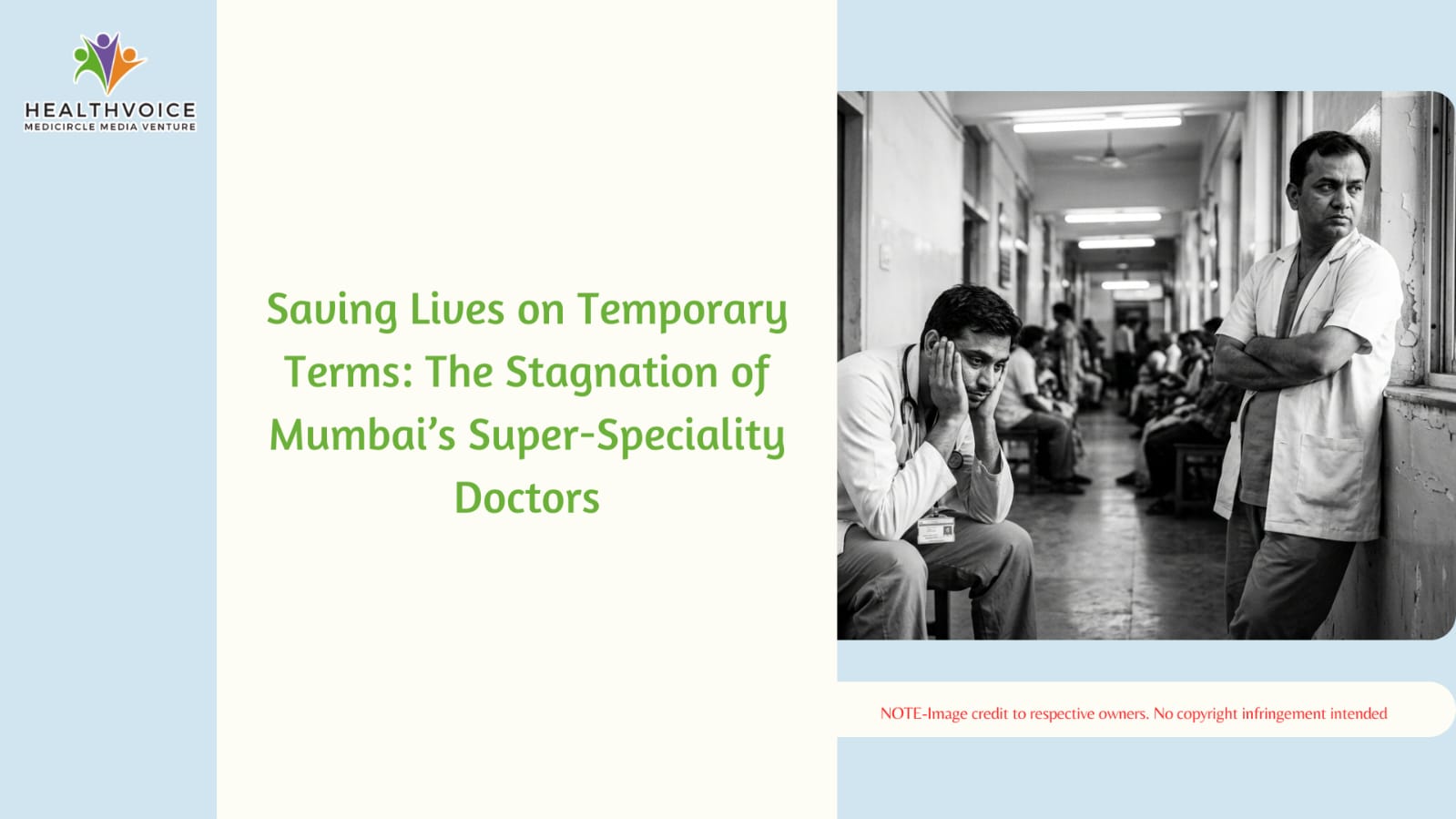
In the crowded corridors of Mumbai’s municipal hospitals, where patient queues begin before sunrise and emergency rooms rarely fall silent, nearly 180 super-speciality doctors continue to shoulder an expanding clinical burden without a single salary increment in five years. Appointed as DNB Teachers Grade 1 and Grade 2 in April 2021, these highly trained specialists have been serving under the administrative umbrella of the Brihanmumbai Municipal Corporation on renewable six-month contracts, each renewal preceded by a mandatory one-day break in service. Their fixed monthly remuneration of ₹2 lakh has remained unchanged despite rising inflation, increased patient load, and growing academic responsibilities in civic-run hospitals across Mumbai.
For a city often described as the financial capital of India, this paradox is concerning. On one hand, Mumbai’s public healthcare system caters to nearly two crore residents, in addition to migrants and patients referred from neighbouring districts. On the other, a crucial layer of its specialist workforce continues to function in a state of professional uncertainty. These doctors are not junior trainees or temporary locum consultants. They are super-specialists entrusted with managing complex surgeries, advanced diagnostics, critical care decision-making, and postgraduate medical education under the Diplomate of National Board (DNB) programme.
The story begins in 2020, when these doctors were selected to strengthen super-speciality services in municipal peripheral hospitals. Their formal appointments commenced the following year. Since then, contracts have been renewed every six months, creating a pattern of continuity without permanence. The one-day break between contracts, a technicality that prevents uninterrupted service classification, has become a symbol of systemic hesitation to regularise posts. For many doctors, the concern extends beyond salary revision. It is about professional dignity, long-term security, and institutional recognition.
Public hospital employment structures in India have long relied on contractual appointments to address workforce gaps. In theory, such arrangements provide administrative flexibility. In practice, they often create a two-tier system within the same institution. Permanent staff enjoy structured pay scales, annual increments, leave benefits, pension pathways, and promotional hierarchies. Contractual specialists, despite performing identical duties, operate outside this framework. Over time, disparities erode morale.
Mumbai’s municipal hospitals have witnessed significant growth in patient footfall over the past five years. The expansion of health insurance coverage under various government schemes has improved access. Referral chains have strengthened. Diagnostic and surgical capabilities have broadened. Super-speciality departments, once limited in scope, now manage higher case volumes and greater procedural complexity. Cardiology, neurosurgery, gastroenterology, oncology, and advanced general surgery services have expanded in peripheral facilities, reducing the load on tertiary centres. The super-specialists at the heart of this transformation have navigated escalating expectations without financial progression.
Clinical pressure is only one dimension of their role. As DNB teachers, these doctors contribute to postgraduate medical education, academic research, and examination preparation. Training a DNB candidate demands structured case discussions, operative demonstrations, journal clubs, and mentorship in research methodology. Teaching responsibilities often extend beyond working hours. Academic credibility enhances institutional reputation and attracts aspiring specialists to civic hospitals. Sustaining this academic ecosystem requires stable faculty engagement.
The absence of salary increment for five years stands in contrast to the broader economic landscape. Inflation has affected housing costs, school fees, transport expenses, and healthcare insurance premiums. Mumbai remains one of India’s most expensive cities. For specialists who have invested over a decade in medical education, including super-speciality training, financial stagnation generates understandable frustration. The demand for regularisation is therefore not framed merely as a pay hike request; it is a call for alignment between responsibility and recognition.
Last year, thousands of Class IV workers in Mumbai’s civic system secured relief through judicial intervention, leading to regularisation benefits. The super-speciality doctors now cite this precedent to argue that long-serving professionals in critical roles deserve similar consideration. Their appeal rests on equity rather than entitlement. If frontline support staff merit employment stability after sustained service, specialists managing high-risk surgical and medical cases believe their claim is equally valid.
The broader question extends beyond Mumbai. Across India, urban local bodies and state governments depend increasingly on contractual super-specialists to fill service gaps. Recruitment bottlenecks, budgetary constraints, and evolving healthcare demands have reshaped employment models. Contract-based appointments allow rapid onboarding of talent, yet prolonged reliance on temporary frameworks risks institutional fragility. When experienced specialists perceive stagnation, attrition becomes a real possibility.
Private healthcare institutions in metropolitan areas offer competitive packages, structured increments, performance-linked incentives, and clearer career trajectories. For super-specialists trained in high-demand disciplines, alternative opportunities abound. Retention within the public sector hinges on more than altruism. It requires tangible incentives, academic growth prospects, and recognition of service continuity. If civic hospitals fail to adapt, the migration of talent may accelerate, widening the gap between public and private healthcare quality.
Healthcare workforce policy must account for sustainability. Super-speciality services require years of training, often including DM, MCh, or DNB super-speciality qualifications. The pipeline for producing such experts is limited. Public hospitals serve as critical training grounds for the next generation of surgeons and physicians. Stability in faculty positions ensures continuity of mentorship, research output, and institutional memory. Short-term contracts disrupt long-range planning.
Regularisation involves fiscal implications. Municipal budgets must balance infrastructure development, primary healthcare expansion, public health campaigns, and tertiary services. However, human resources represent the backbone of service delivery. Investment in specialist retention can reduce referral costs, enhance patient satisfaction, and improve clinical outcomes. The cost of replacing experienced consultants may exceed the expenditure required for structured increments.
Patient care implications deserve particular attention. Continuity in specialist teams fosters trust. Patients undergoing chronic disease management or staged surgical procedures benefit from consistent oversight. Frequent turnover erodes therapeutic relationships and complicates follow-up care. In teaching hospitals, stable faculty presence strengthens interdisciplinary coordination and quality improvement initiatives.
The contractual structure also influences professional well-being. Six-month renewals create recurring uncertainty. Planning long-term personal commitments, home purchases, children’s education, or research projects becomes difficult without assured continuity. While ₹2 lakh per month may appear substantial in isolation, its static nature over half a decade diminishes real value when adjusted for inflation. Moreover, absence of structured leave beyond limited annual allocation restricts work-life balance in an already demanding profession.
India’s public healthcare system is navigating a period of transformation. Digital health records, telemedicine services, expanded insurance coverage, and public-private partnerships are redefining service delivery. Amid these changes, workforce stability must remain central. Policymakers often emphasise infrastructure metrics i.e. number of beds, operating theatres, and diagnostic machines. But the expertise required to utilise these assets effectively cannot be contracted indefinitely without long-term integration.
The argument for regularisation need not be framed in adversarial terms. Collaborative dialogue between civic authorities and medical representatives can yield balanced solutions. Structured pay revision linked to years of service, transparent evaluation mechanisms, and phased absorption into permanent cadres may offer pathways forward. Establishing clear eligibility criteria for conversion from contractual to full-time status can reduce ambiguity.
The case also highlights the need for national guidelines on specialist employment in public hospitals. Standardised frameworks could ensure parity across states, prevent exploitation, and promote mobility within the public sector. Professional bodies and medical associations may play a constructive role in shaping such standards.
Since Mumbai will continue to expand, its healthcare demands will intensify. Urbanisation, ageing demographics, non-communicable disease prevalence, and trauma cases will drive super-speciality requirements upward. Civic hospitals must remain competitive in attracting and retaining talent. Financial prudence and workforce justice are not mutually exclusive objectives. With strategic planning, municipal authorities can integrate both.
The doctors delegation has expressed cautious optimism following discussions with senior officials. Assurances signal willingness to engage. Implementation will test intent. For now, 180 super-specialists continue to report for duty each day, manage surgical lists, supervise residents, attend academic sessions, and respond to emergencies under the same contractual terms they accepted five years ago.
The narrative unfolding in Mumbai is emblematic of a broader national conversation about how India values its medical workforce. Public healthcare relies on commitment that often transcends remuneration. Yet commitment cannot substitute structural fairness indefinitely. When highly trained professionals remain in temporary limbo despite sustained service, the message resonates beyond one city.
Can a healthcare system aspiring to excellence afford to overlook the stability of its specialists? The answer will shape not just employment rosters, but the future quality of care delivered in municipal hospitals. For nearly two crore residents who depend on these institutions, the stakes are high. For the doctors themselves, the issue is about recognition, respect, and the assurance that dedication to public service will not remain frozen in time
 Team Healthvoice
#MumbaiHealthcare #MedicalProfession #HealthcarePolicy #BMC #MedicalEducation #HealthcareReform #HospitalAdministration #SpecialistDoctors #IndiaHealthcare #RespectDoctors #healthvoice
