The Global Doctor Shortage and What It Means for India
India faces a critical doctor shortage shaped by brain drain, urban-rural imbalance, and rising disease burden, demanding urgent policy reform, stronger medical communities, and professional support ecosystems.
Introduction
The world is running short of doctors. This is not a distant warning or a theoretical concern for the future. It is a reality that healthcare systems in dozens of countries are grappling with today, and India sits at the center of this global challenge in ways that demand serious professional and policy attention.
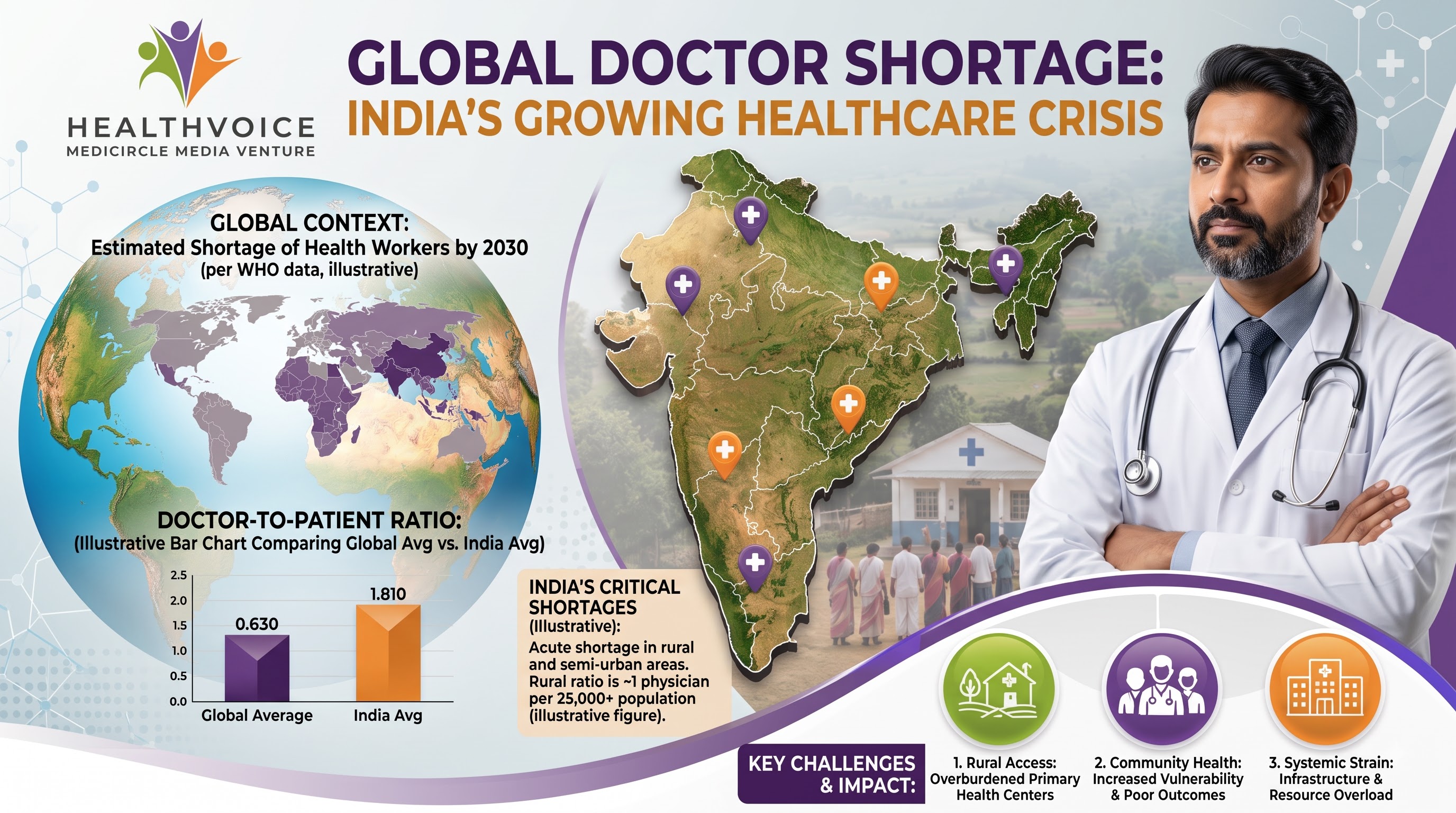
The World Health Organization (WHO) has projected a global shortage of approximately 10 million health workers by 2030, with physicians forming a significant portion of that gap. For a country like India, with a population exceeding 1.4 billion, an overburdened public health system, deep urban-rural divides, and an accelerating burden of both communicable and non-communicable diseases, the implications of this shortage are far-reaching and deeply consequential.
Understanding this crisis requires examining not just the numbers but also the structural, economic, and social factors that produce and sustain it. For doctors, medical associations, healthcare institutions, and policy leaders, this is both an urgent challenge and a defining opportunity.
Understanding the Scale of the Global Doctor Shortage
The numbers tell a sobering story. According to WHO projections, the world will need an additional 18 million health workers by 2030 to achieve universal health coverage. Physicians, nurses, and midwives account for the largest share of this deficit.
The shortage is not distributed evenly. Sub-Saharan Africa, South and Southeast Asia, and parts of Latin America carry the heaviest burden. However, high-income countries are not immune either. The United States is projected to face a shortfall of up to 86,000 physicians by 2036, according to the Association of American Medical Colleges. The United Kingdom's National Health Service has been in a sustained state of workforce crisis for several years. Canada, Australia, and several European nations are aggressively recruiting internationally trained doctors to fill domestic gaps.
This global scramble for physicians creates a ripple effect that directly affects countries like India, which trains large numbers of doctors yet struggles to retain enough of them within its own borders.
Primary Causes Driving the Physician Deficit
The global doctor shortage is not a single-cause problem. It is the result of several intersecting forces that have been building over decades.
Aging Populations and Rising Disease Burden
In high-income countries, aging populations are simultaneously increasing demand for healthcare while reducing the number of working-age doctors available to provide it. In India, while the population is relatively younger, the epidemiological transition is accelerating. India now carries one of the world's largest burdens of diabetes, cardiovascular disease, cancer, and mental health disorders, all of which require sustained physician involvement.
Medical Brain Drain
One of the most persistent drivers of India's physician deficit is the migration of trained doctors to high-income countries. The United States, United Kingdom, Canada, and Australia actively recruit doctors from India because of the high quality of their training and their English language competency. Studies indicate that a significant proportion of Indian medical graduates leave within a few years of completing their degrees, drawn by higher salaries, better infrastructure, professional recognition, and research opportunities.
This brain drain is particularly damaging because the Indian public system has already invested substantially in their training, and those skills are then deployed in systems that did not bear that cost.
Inadequate Medical Education Infrastructure
India has made notable progress in expanding medical college seats over the past decade. As of recent National Medical Commission data, India has over 700 medical colleges offering more than 100,000 MBBS seats annually. However, the quality of training remains uneven. Many newly established private medical colleges in Tier 2 and Tier 3 cities struggle with faculty shortages, inadequate clinical exposure, and infrastructure gaps. Producing a larger number of graduates does not automatically translate into a larger effective physician workforce.
Urban-Rural Maldistribution
Even within India, the existing doctor supply is deeply concentrated in urban centers. Rural India, which houses nearly 65 percent of the population, is severely underserved. Government health data consistently shows that rural primary health centers operate with a significant shortage of medical officers. Doctors trained in urban institutions are often reluctant to take up rural postings due to concerns about professional isolation, limited career growth, inadequate facilities, and safety considerations.
What This Means Specifically for India
India's doctor-to-population ratio has been a subject of ongoing debate. While official registered doctor numbers appear more favorable when viewed in aggregate, the effective ratio of practicing, accessible doctors tells a different story. Many registered doctors are retired, working in administrative roles, or concentrated in private urban practice.
The WHO recommends a minimum ratio of 1 doctor per 1,000 people. India's effective ratio in practice, particularly for government healthcare, falls well below this benchmark in most states. States like Bihar, Jharkhand, Uttar Pradesh, and Chhattisgarh face some of the most acute shortages.
The consequences of this deficit are visible in several ways:
- Overcrowded government hospitals where doctors carry unsustainably high patient loads
- Long waiting times at specialist facilities in cities, forcing patients from smaller towns to travel far for care
- High rates of out-of-pocket health expenditure because the public system cannot absorb demand
- Preventable deaths from treatable conditions in areas with no accessible physician
For the medical community, the shortage also means increasing professional burnout among practicing doctors. Reports of physician burnout in India have grown in recent years, with studies indicating that large proportions of doctors in tertiary care hospitals experience symptoms of chronic exhaustion, emotional depletion, and reduced professional satisfaction. This further accelerates attrition and compounds the problem.
The Role of Policy: What Is Being Done
The Indian government has taken several steps to address the workforce gap, though significant implementation challenges remain.
Expansion of AIIMS and Medical College Seats
The government has established multiple new AIIMS institutions across states, including Mangalagiri, Kalyani, Bhopal, Jodhpur, Raipur, and others. This has been one of the more meaningful expansions of high-quality medical education infrastructure in recent years. The number of MBBS seats has grown considerably, and the NMC has revised regulations around clinical training requirements.
ABDM and Telemedicine
The Ayushman Bharat Digital Mission (ABDM) represents one of India's most ambitious attempts to use digital infrastructure to bridge healthcare gaps. Telemedicine, accelerated significantly by the COVID-19 pandemic and the Telemedicine Practice Guidelines released by the Ministry of Health and Family Welfare in 2020, has expanded patient access to physicians without requiring physical proximity.
Platforms enabling teleconsultation have grown rapidly, and doctors in cities can now serve patients in districts where no specialist is physically present. While telemedicine is not a complete substitute for in-person care, it has meaningfully extended the reach of the existing physician workforce.
Ayushman Bharat Pradhan Mantri Jan Arogya Yojana (PM-JAY)
Ayushman Bharat has brought health insurance coverage to millions of previously uninsured Indians. However, insurance coverage alone does not create doctors. Expanding access to healthcare financing without a corresponding expansion in physician availability risks overwhelming the existing supply further.
Rural Posting Incentives
Several states have introduced incentives for doctors willing to serve in rural areas, including additional marks in PG entrance examinations, salary supplements, and housing allowances. The effectiveness of these measures has been mixed, and a more comprehensive approach to making rural medical practice professionally rewarding remains a work in progress.
The Road Ahead: Collaborative Solutions
No single intervention will resolve a shortage of this scale. The path forward requires a combination of policy reform, professional community action, technological adoption, and institutional cooperation.
Strengthening Medical Education Quality
Expanding seats without ensuring quality produces graduates who are not adequately prepared for clinical practice. Regulatory bodies, particularly the NMC, need to enforce minimum standards rigorously while also creating pathways for continuous professional development.
Retaining Talent Through Professional Recognition
Doctors who feel professionally recognized, fairly compensated, and part of a meaningful community are more likely to stay and serve. Medical associations and platforms that give doctors a voice, amplify their work, and connect them to peers play an important role in building that sense of professional belonging. Platforms such as HealthVoice, which are built specifically to connect doctors and healthcare communities, contribute to this ecosystem by giving practitioners a space for visibility, peer engagement, and credible communication.
Investing in Allied Health Workforce
Doctors cannot work alone. Expanding the supply and scope of practice of nurses, physician assistants, pharmacists, and community health workers can meaningfully reduce the pressure on physicians and extend healthcare access at the last mile.
International Collaboration Without Exploitation
India trains doctors for the world. Rather than resisting this reality, India can formalize bilateral agreements with countries that recruit Indian doctors to ensure skills transfer, educational exchange, and return migration pathways that bring experienced physicians back to India after exposure to advanced systems.
Conclusion
The global doctor shortage is a structural challenge that will not be resolved quickly or easily. For India, it sits at the intersection of historical underinvestment in public health, a dynamic but uneven medical education system, migration pressures, and a rapidly growing disease burden. The stakes are high, and the solutions must be equally substantial.
Doctors and medical communities deserve not just better policy support but also stronger professional platforms, greater public recognition, and more organized collective voices. Addressing this shortage is not only a matter of government action. It requires a healthcare ecosystem where doctors feel supported, valued, and connected, and where institutions, associations, and platforms work together to keep the profession strong and the workforce intact.
Frequently Asked Questions
Q1: How many doctors does India currently lack?
India has approximately 1.3 million registered doctors but effectively has around 880,000 in active practice. The WHO recommends a ratio of 1 doctor per 1,000 people. India's current ratio remains significantly below this benchmark, particularly in rural areas.
Q2: What is causing the global doctor shortage?
The global doctor shortage stems from aging populations requiring more care, medical brain drain from lower-income to higher-income countries, inadequate medical college infrastructure, high training costs, and uneven geographic distribution of available physicians.
Q3: How does brain drain affect India's doctor supply?
Thousands of Indian-trained doctors migrate to the US, UK, Canada, and Australia each year in pursuit of better pay, infrastructure, and professional recognition. This reduces India's effective physician pool, especially for rural and semi-urban regions.
Q4: What steps is the Indian government taking to address the doctor shortage?
The Indian government has been increasing MBBS seats across government and private medical colleges, strengthening AIIMS facilities in new regions, supporting telemedicine under ABDM, and pushing rural posting incentives through NMC regulations and state-level schemes.
Q5: Can telemedicine solve India's rural doctor shortage?
Telemedicine is a significant part of the solution but cannot work alone. It reduces barriers to specialist access for rural patients, but it requires digital infrastructure, health literacy, and primary care coordination to function effectively at scale.
Resources
- World Health Organization (WHO): Global Health Workforce reports and projections on the international doctor shortage and universal health coverage targets
- National Medical Commission (NMC), India: Regulatory data on medical college seats, MBBS enrollment, and healthcare workforce guidelines
- Ministry of Health and Family Welfare (MoHFW), Government of India: Policy documents on Ayushman Bharat, telemedicine guidelines, and rural health schemes
- Indian Council of Medical Research (ICMR): Research publications on disease burden, healthcare access, and physician workforce in India
- NITI Aayog: Health Index reports and analytical papers on state-level healthcare workforce disparities across India
Interlinking Keywords
doctor shortage in India, brain drain in Indian healthcare, rural doctor availability, Ayushman Bharat Digital Mission, NMC medical education reforms, telemedicine in India, physician burnout India, AIIMS expansion, healthcare workforce India, doctor to patient ratio India
Last reviewed by:
HealthVoice Editorial and Medical Content Team on August 27, 2026.
Medical Disclaimer:
This article is intended for informational and professional awareness purposes only. It does not constitute medical advice, clinical guidance, or policy recommendation. Readers should refer to official government bodies, regulatory authorities, and qualified healthcare professionals for specific guidance related to healthcare workforce planning and medical practice.
 Team Healthvoice
#GlobalDoctorShortage #HealthcareWorkforceIndia
