AIIMS-Bibinagar’s Struggle: Can India’s Premier Institutes Survive Without Their Core Workforce?
It reminds us that an institution is not defined by its infrastructure but by the people who bring it to life. Without them, the grandest vision collapses into silence.
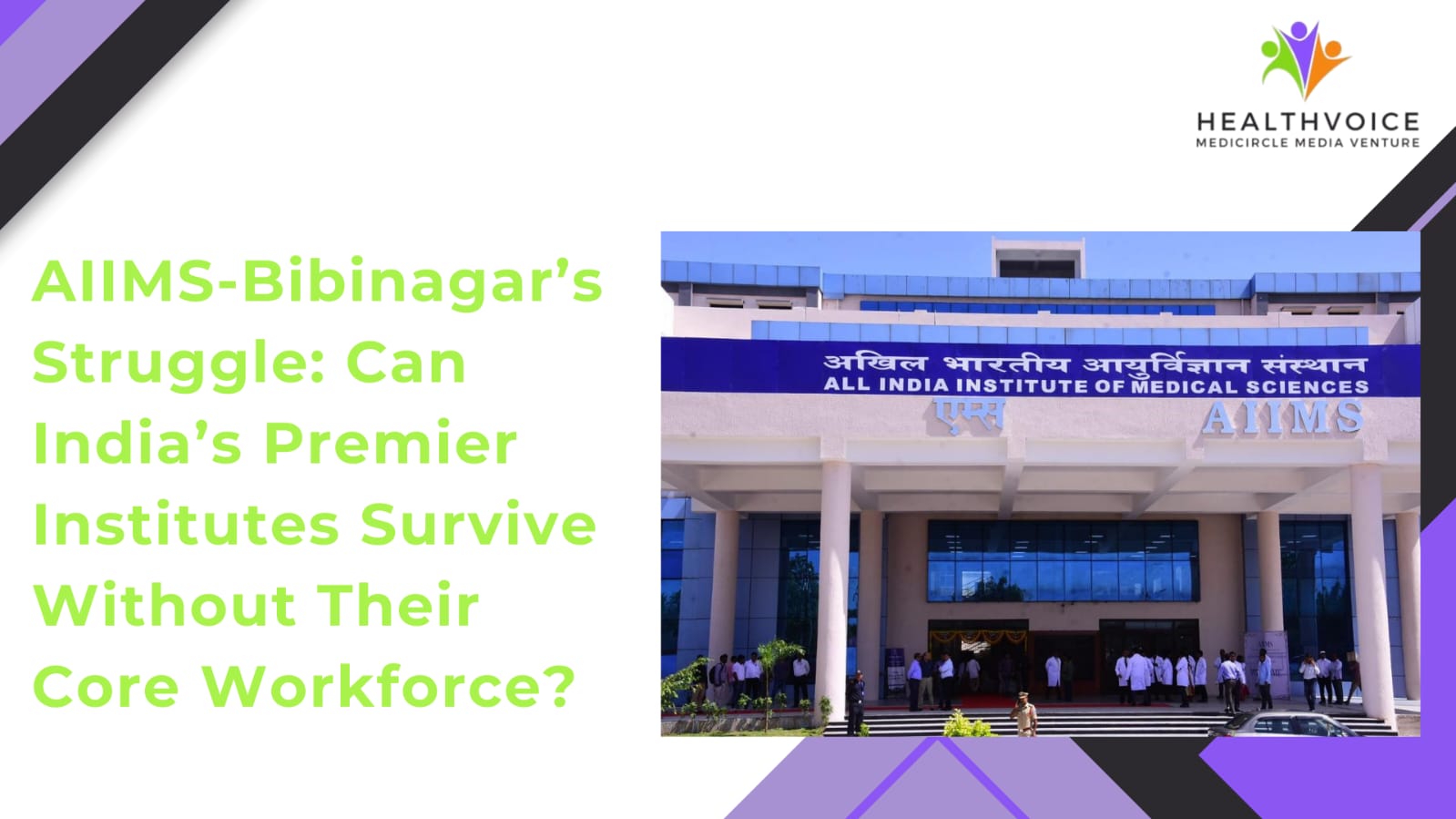
When AIIMS-Bibinagar was established in 2019, it was envisioned as a shining institution in Telangana that would carry forward the legacy of the All India Institute of Medical Sciences with centres of excellence that symbolize trust, advanced treatment, and top-notch medical education. For a young state like Telangana, AIIMS-Bibinagar was a promise of high-quality healthcare delivery, medical education at par with the best, and a hub of research that could shape the future of medicine in the region. Yet, in the span of a few years, this dream has been overshadowed by a harsh reality of crippling staff shortages that have left both doctors and patients questioning the very sustainability of the institute.
India’s healthcare professionals, policymakers, and citizens must pause to reflect on what it means when a premier institute like AIIMS, with all its stature, struggles to fill its teaching and non-teaching posts. The shortage of faculty and staff is not just a human resource problem; it is a direct challenge to medical education, patient care, and the larger healthcare system.
Numbers often reveal truths that cannot be ignored, and the figures shared by the Ministry of Health in Parliament speak volumes. AIIMS-Bibinagar has been reeling under faculty shortages since its inception. Out of the sanctioned 183 teaching posts, more than 50 remain vacant even today. To put this in perspective, the vacancies stood at 82 in 2022–23, dropped slightly to 74 in 2023–24, reduced further to 62 in 2024–25, and yet remain at 50 in 2025–26. In an institution designed to nurture the next generation of doctors and specialists, this level of shortage in teaching staff raises a troubling question of who is guiding the future doctors of India?
The problem is not restricted to faculty alone. The non-teaching workforce, which forms the backbone of hospital operations, has been equally neglected. Between 2022 and 2024, more than 450 non-teaching posts remained unfilled. In 2022, only 297 of the 971 sanctioned posts were filled. In 2023, the sanctioned posts rose to 1,366, yet only 428 were filled. By 2024, out of 1,374 posts, 899 were filled, and in 2025, just 902 were in place, leaving 472 posts vacant. These numbers are not mere statistics; they represent vacant hospital wards, delayed diagnostic services, overburdened administrative staff, and frustrated patients waiting for care.
A medical institute cannot function with empty classrooms and undermanned wards. AIIMS is not just about producing graduates; it is about shaping leaders in healthcare, advancing research, and providing care that inspires trust. When the foundation of staffing collapses, the entire structure becomes fragile.
The resignation of 19 faculty members between 2022 and 2024 further worsened the situation. These were not ordinary exits but decisions taken by senior professionals who cited professional and personal reasons. Behind such polite explanations lies a deeper truth. Faculty members leave when working conditions do not match expectations, when resources are inadequate, or when the administrative ecosystem fails to support academic and clinical aspirations. In the process, students lose mentors, patients lose experienced doctors, and the institution loses credibility.
The government has not been blind to these challenges. Minister of State for Health and Family Welfare Prataprao Jadhav outlined several measures to address the crisis. A Standing Selection Committee has been constituted in every AIIMS to accelerate recruitment. Provisions now exist to engage retired faculty from government medical colleges and Institutes of National Importance until the age of 70. A Visiting Faculty Scheme has been rolled out, allowing professors from India and abroad to serve temporarily at AIIMS-Bibinagar. These steps, though significant, raise an uncomfortable thought, are we treating symptoms instead of curing the disease?
Relying on retired faculty and visiting professors can provide short-term relief, but it is not a sustainable solution for a premier institution. AIIMS was envisioned as a self-sufficient centre of excellence with strong permanent faculty, cutting-edge infrastructure, and a culture of continuous growth. By patching the cracks with temporary measures, we risk undermining the very foundation of the institute. For students, having a rotating set of visiting faculty might expose them to diverse teaching styles, but it also denies them the continuity of mentorship. For patients, retired faculty may bring valuable experience, but the absence of young, permanent specialists compromises the long-term strength of the clinical ecosystem.
Recruitment remains the most critical challenge. While AIIMS Delhi conducts national-level examinations like NORCET for nursing officers, CRE for Group B and C staff, and INI-CET and INI-SS for junior and senior residents across AIIMS campuses, these processes often face bottlenecks in execution. Bureaucratic delays, prolonged verification procedures, and inconsistencies in policy implementation leave vacancies unfilled year after year. The demand is growing, the sanctioned strength exists, yet the seats remain empty. For a system as vast and ambitious as AIIMS, this gap is not acceptable.
At the heart of this crisis lies the question of prioritization. If India can build AIIMS after AIIMS across the country, why can it not ensure that these institutes are fully staffed? Infrastructure alone cannot heal patients. Buildings without doctors are mere monuments, and classrooms without teachers are silent halls. For AIIMS-Bibinagar, the shortage of staff threatens to reduce a dream project into an underutilized facility that fails to meet expectations.
This shortage has wider implications as well. Telangana, like many other states, continues to struggle with rising healthcare needs. The pressure of non-communicable diseases, the burden of maternal and child health, and the growing expectations of patients demand a robust tertiary care institution. AIIMS-Bibinagar was supposed to shoulder that responsibility. Instead, its limited manpower forces it to function at a fraction of its potential. This forces patients to travel to Hyderabad or even Delhi for specialized care, creating inequities in access to healthcare.
The morale of students and residents is another dimension often overlooked. Young medical students enter AIIMS with dreams of learning from the best minds in medicine, of being trained in a challenging yet inspiring environment. What happens to their aspirations when they face classrooms without enough faculty or wards without adequate support staff? Their formative years, which should have been rich with guidance and exposure, risk being diluted. A compromised medical education system ultimately leads to compromised healthcare delivery in the future.
The crisis at AIIMS-Bibinagar also forces us to reflect on the working conditions and incentives for medical professionals in government institutions. Recruitment is not merely about filling vacancies; it is about creating an environment where doctors, teachers, and staff feel valued, supported, and motivated. Competitive salaries, research opportunities, adequate infrastructure, and a supportive administrative structure are not luxuries, they are necessities. Without them, resignations will continue, and vacancies will remain.
Healthcare in India is at a crucial juncture. On one hand, the country is expanding its network of AIIMS and medical colleges. On the other, the shortage of qualified faculty and staff threatens to hollow out these institutions from within. AIIMS-Bibinagar is not an isolated case; similar reports of shortages echo from other newer AIIMS as well. If we fail to address this at a systemic level, India risks building more hospitals that look impressive on paper but remain underperforming in practice.
The road ahead requires bold decisions. Accelerated recruitment with strict timelines, transparent processes, and accountability is the first step. Incentives to retain faculty, including research grants, academic autonomy, and career growth opportunities, are equally vital. Collaboration with global institutions should not just be about temporary visiting faculty but long-term partnerships that strengthen medical education and research. Above all, there must be a shift in mindset. Healthcare is not an expense to be managed but an investment to be nurtured.
AIIMS-Bibinagar is still young, and its story is still being written. The institute has the potential to become a ray of hope for Telangana. But for that potential to be realized, India must go beyond building walls and inaugurating campuses. It must ensure that those walls are filled with doctors, nurses, researchers, and staff who are committed to excellence.
It reminds us that an institution is not defined by its infrastructure but by the people who bring it to life. Without them, the grandest vision collapses into silence.
 Sunny Parayan
#HealthcareForAll #PublicHealth #MedicalEducation #HealthcareCrisis #HealthPolicy #AIIMSBibinagar #AIIMSIndia #MedicalInstitutes #HealthcareReforms #MedicalInfrastructure #DoctorsMatter #HealthcareWorkforce #FacultyShortage #RecruitmentCrisis #HealthcareHeroes #TelanganaHealthcare #HealthcareInTelangana #HealthcareEquity #TelanganaDevelopment #InvestInHealthcare #FutureOfMedicine #StrongerHealthcare #HealthcareRevolution #MedicalExcellence #healthvoice