Is Patient Safety Now a Legal Risk: A Doctor’s Fight Against Misleading Health Claims
The debate is not about choosing sides. It is about finding a way to ensure that scientific truth, patient safety, and professional integrity remain at the centre of healthcare
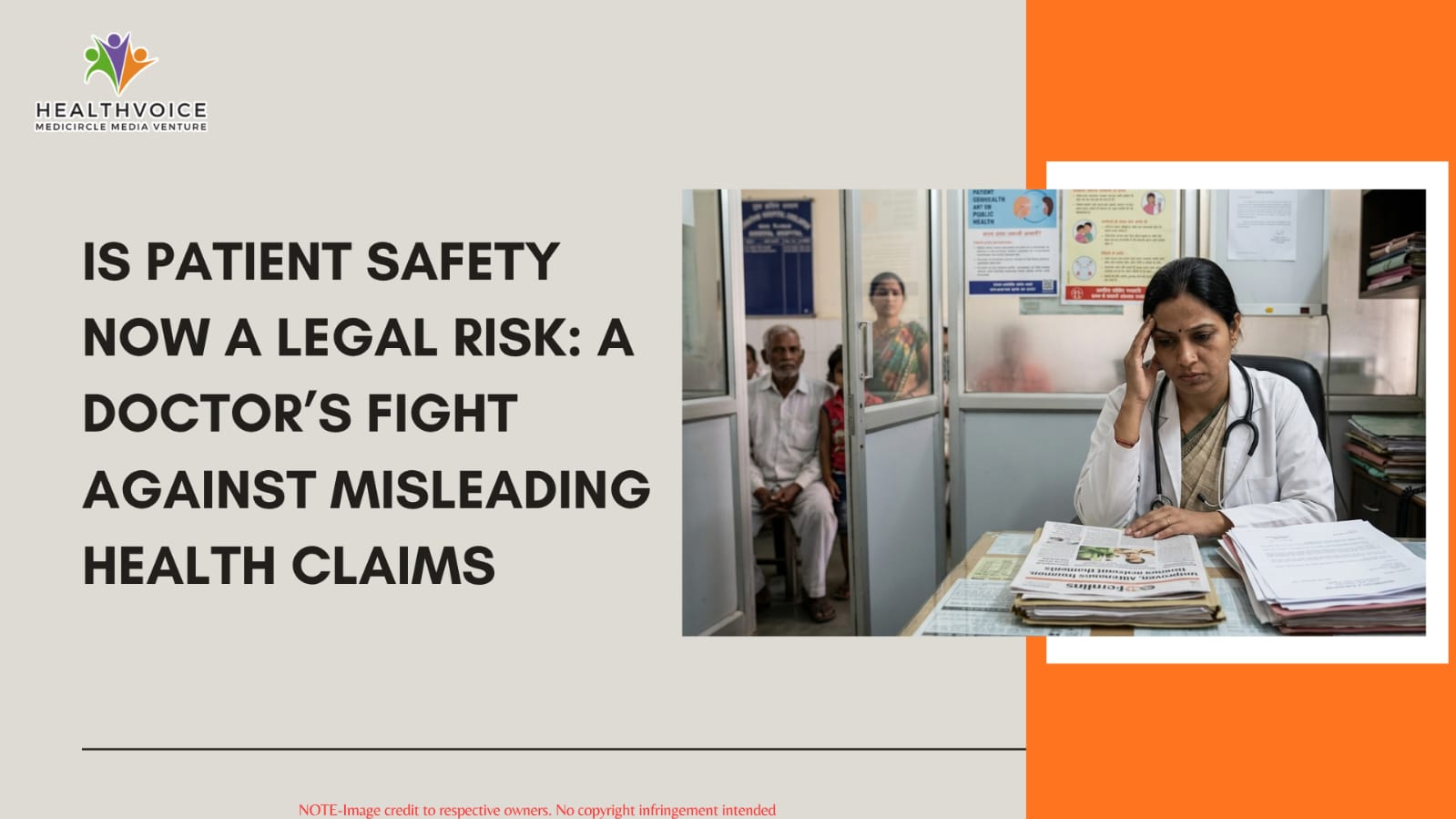
In clinical practice, there are moments when a doctor’s responsibility extends beyond the consultation room. It moves into public spaces, into conversations that may not always be comfortable, and sometimes into direct conflict with powerful commercial interests. A recent controversy involving a Hyderabad-based paediatrician has brought this tension sharply into focus, raising difficult questions about medical ethics, pharmaceutical marketing, public health advocacy, and the limits of professional speech in India.
At the centre of this unfolding episode is a debate that appears simple on the surface but carries deeper implications for healthcare professionals across the country. The issue revolves around oral rehydration products, widely known as ORS, a cornerstone of paediatric care for managing dehydration caused by diarrhoea and other illnesses. For decades, oral rehydration salts have been considered one of the most effective, low-cost, and life-saving interventions in global health. Their role in reducing child mortality is well documented, and their formulation is guided by strict standards defined by global health authorities.
In India, where childhood infections and dehydration remain significant concerns in many regions, ORS continues to be a critical part of primary care. Doctors prescribe it routinely, caregivers trust it, and public health programmes promote it as an essential household remedy. It is precisely this trust that has made the recent controversy so significant.
The situation began when a paediatrician publicly raised concerns about certain oral rehydration products being marketed in ways that could potentially confuse caregivers. Her argument was not about rejecting oral rehydration therapy itself. Instead, it focused on how some commercially available products, particularly flavored or sugar-containing variants, were positioned alongside standard ORS in pharmacies and retail settings. According to her, this created a risk that caregivers might mistake these products for medically approved oral rehydration solutions.
The concern may appear technical, but for doctors working in paediatrics, it carries serious implications. The effectiveness of ORS lies in its precise composition. The balance of glucose and electrolytes is carefully calibrated to enhance water absorption in the intestines. Deviations from this formula can reduce effectiveness, especially in vulnerable children who rely on accurate treatment during episodes of dehydration.
What followed next reflects how quickly a clinical observation can evolve into a national debate. Regulatory authorities, including the Food Safety and Standards Authority of India, issued directions restricting the use of the term “ORS” on product labels unless the formulation strictly adheres to defined standards. This move was seen by many in the medical community as a step towards protecting public health and reducing confusion in the marketplace.
However, the issue did not end there. Pharmaceutical companies whose products were part of the broader discussion responded with legal action. A notice was served to the paediatrician, alleging that her statements on social media were misleading, defamatory, and damaging to their brand reputation. The notice emphasized that their products complied with existing laws and had not been deemed unsafe by courts, including observations made in proceedings before the Delhi High Court.
The companies also argued that rebranding efforts had already been undertaken in response to regulatory directions and that the products in question should not be confused with traditional ORS. They further contended that comparing these products or suggesting equivalence was scientifically inaccurate and commercially harmful.
What makes this case particularly complex is that both sides are, in their own way, invoking legitimacy. On one hand, pharmaceutical companies are pointing to regulatory compliance, legal validation, and scientific backing. On the other, a practising clinician is raising concerns grounded in patient care, clinical experience, and potential real-world confusion among caregivers.
This is where the debate moves beyond a single case and enters a larger question: where does medical responsibility end, and where does corporate accountability begin?
For doctors, especially those in paediatrics, the stakes are deeply personal. Children represent one of the most vulnerable patient groups. Treatment decisions are often made by parents or caregivers who rely heavily on guidance from healthcare professionals. In such a setting, even minor confusion between products can lead to delays in appropriate treatment or suboptimal outcomes.
Medical associations across India have responded strongly to the legal notice. The Federation of All India Medical Association and other professional bodies have expressed concern that legal action against a doctor for raising evidence-based public health issues could create a chilling effect. Their argument is rooted in a fundamental principle of medicine: doctors have an ethical duty to advocate for patient safety, even when doing so challenges established systems or commercial practices.
From their perspective, scientific discussion must remain open, even when it is uncomfortable. Medicine has always progressed through questioning, debate, and critical evaluation. If clinicians begin to fear legal consequences for speaking about potential risks or ambiguities, the entire ecosystem of evidence-based practice could be weakened.
At the same time, the pharmaceutical industry operates within its own framework of responsibility. Companies invest heavily in research, product development, regulatory approvals, and distribution networks. Protecting brand integrity is a legitimate concern, particularly in a competitive market where misinformation can spread rapidly through digital platforms.
The rise of social media has added another layer of complexity. Doctors today are no longer confined to hospitals or clinics. Many have built large online followings where they share medical information, public health advice, and professional opinions. While this has improved health awareness among the public, it has also blurred the lines between personal opinion, professional guidance, and public influence.
A single post by a doctor can reach thousands, sometimes millions, within hours. In such an environment, the responsibility to communicate accurately becomes even more critical. At the same time, the ability to question, critique, and highlight potential risks must be preserved.
The current controversy sits precisely at this intersection. It raises a difficult but necessary question for modern healthcare: how should disagreements between clinicians and corporations be resolved in the digital age?
There is also a broader regulatory dimension to consider. India’s healthcare market is vast and diverse, with a mix of prescription drugs, over-the-counter products, and nutraceuticals coexisting in the same retail spaces. For an average consumer, distinguishing between these categories is not always straightforward. Terms like “rehydration,” “electrolyte drink,” or “ORS-like” can easily blur boundaries, especially when packaging, branding, and placement are similar.
This is why regulatory clarity becomes essential. When authorities step in to define what can and cannot be labeled as ORS, they are attempting to protect a critical public health tool from dilution or misinterpretation. Yet regulation alone cannot solve the problem if awareness among consumers remains limited.
Doctors often serve as the bridge between scientific standards and real-world understanding. Their role in explaining the difference between medically approved ORS and other hydration products becomes crucial. Any restriction on their ability to speak openly could weaken that bridge.
At the same time, this case also reminds the medical community of the importance of precision in communication. Raising concerns is necessary, but the way those concerns are articulated matters. In an era where statements can be amplified, misinterpreted, or taken out of context, clarity becomes as important as intent.
Another layer to this issue is the growing commercialisation of healthcare. As markets expand, the boundaries between health products and consumer goods often begin to overlap. Products designed for therapeutic use may be marketed alongside lifestyle beverages, supplements, or wellness drinks. This creates a grey zone where clinical relevance and consumer appeal intersect.
For paediatric care, this overlap can be particularly risky. Children’s health products often rely on parental decision-making, and marketing strategies can influence those decisions in subtle ways. Bright packaging, flavor options, and convenience may make certain products more attractive, but they do not necessarily make them medically equivalent to established treatments.
This is where the ethical responsibility of both industry and medical professionals must align. Companies must ensure that their marketing does not create confusion about therapeutic equivalence. Doctors, in turn, must communicate clearly and responsibly about what constitutes appropriate treatment.
The support extended by medical associations in this case reflects a deeper concern about the future of clinical independence. If doctors begin to feel that speaking about public health risks could invite legal challenges, many may choose silence over advocacy. Such a shift would have long-term consequences for patient safety and healthcare transparency.
At the same time, the case also serves as a reminder that healthcare is no longer a closed system. Patients, caregivers, regulators, doctors, and companies are all part of a complex ecosystem where information flows rapidly and influence is widely distributed. Managing this ecosystem requires balance, mutual respect, and a shared commitment to patient welfare.
The outcome of this controversy remains uncertain. Legal proceedings, regulatory clarifications, and professional debates will likely continue. Yet its significance lies beyond the immediate dispute. It has forced the medical community to confront uncomfortable questions about authority, responsibility, and the evolving role of doctors in public discourse.
The ORS controversy has brought this challenge into the spotlight. It has shown how a single clinical concern can evolve into a national conversation about ethics, regulation, and freedom of expression. It has also reminded us that in medicine, the simplest interventions often carry the greatest importance and protecting their integrity is a responsibility shared by all.
The debate is not about choosing sides. It is about finding a way to ensure that scientific truth, patient safety, and professional integrity remain at the centre of healthcare. Because when doctors speak, the system must decide whether it is willing to listen or prepared to respond.
 Team Healthvoice
#MedicalEthics #PatientSafety #healthvoice