Degrees Without Duty? NMC Stands Firm as Courts Push Back on Foreign Medical Graduate Rules
In an era when remote learning has revolutionized many professions, medicine remains one of the few fields where physical presence is still the gold standard.
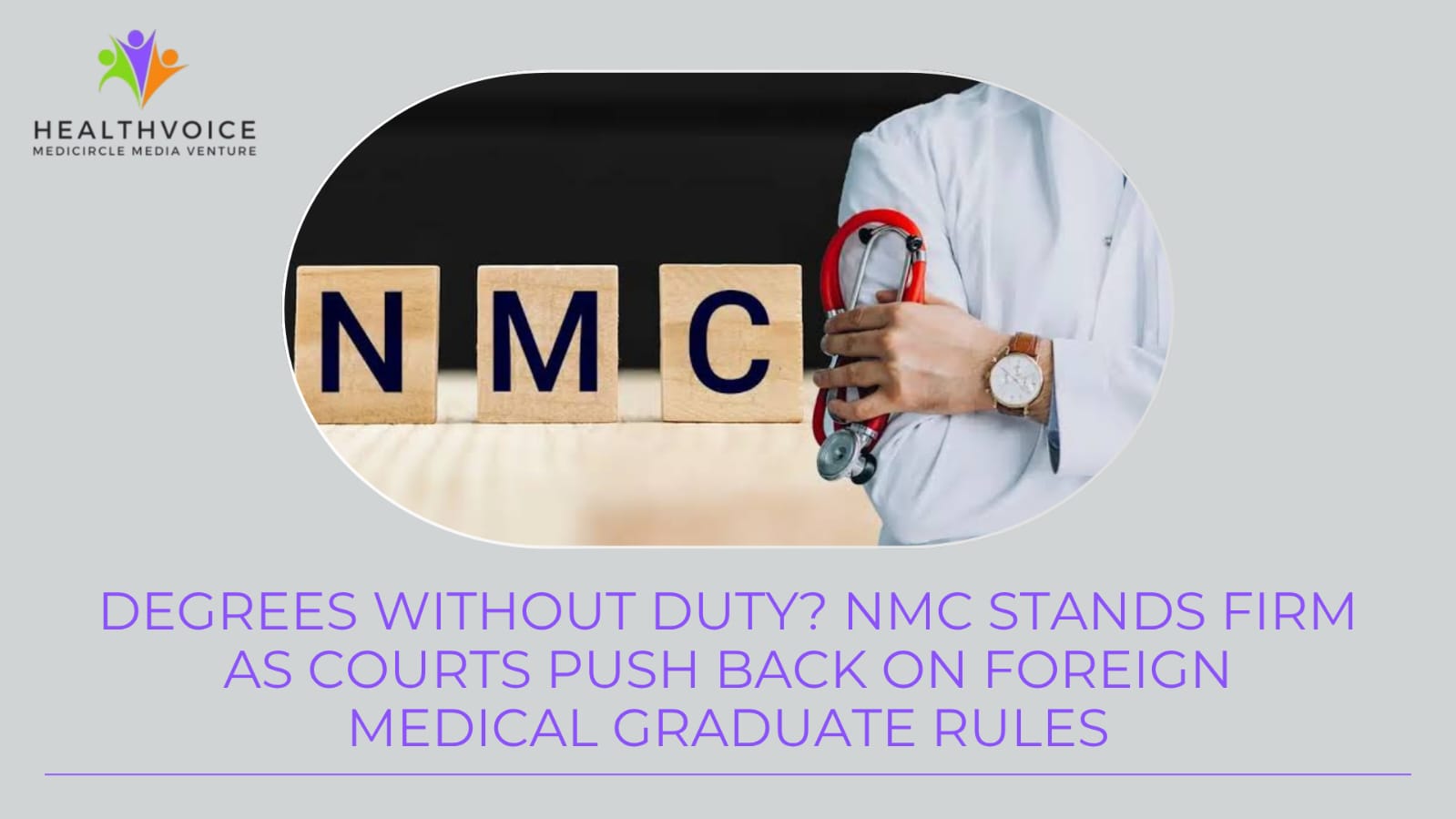
In a climate where trust in medical qualifications directly affects public safety, India’s National Medical Commission has chosen its stance with firmness: the standards that define medical training will not bend, even under the weight of court rulings or global disruptions. At the heart of the present controversy lies a question that bridges law, policy, and ethics, how far can regulatory bodies go to preserve the integrity of a profession when external crises derail conventional training paths?
This latest stand-off finds its roots in the experiences of Foreign Medical Graduates, Indian citizens who earned, or attempted to earn, their medical degrees abroad. Their journeys have been anything but ordinary. Many were midway through their education when the COVID-19 pandemic brought the world to a halt. Others faced an even grimmer disruption when the Russia-Ukraine war displaced students overnight, scattering them across borders with unfinished syllabus and interrupted clinical exposure. In an age when much of education shifted online, these aspiring doctors found themselves forced to adapt to digital classrooms in a field that, by its very nature, relies on touch, observation, and real-time human interaction.
The NMC’s position, restated in an exhaustive seven-page communication to the Andhra Pradesh government on August 7, leaves little room for ambiguity. While acknowledging the hardships faced by these students, the Commission has insisted that the hands-on, physical component of clinical training is irreplaceable. No simulation, video session, or virtual ward round can replicate the sensory and situational awareness that comes only from standing beside a patient’s bed, hearing the nuances in a cough, feeling the subtleties of a pulse, or reading the unspoken anxiety in a family’s questions. To compromise on this is to compromise on patient safety and that is a risk the regulator is unwilling to take.
The legal spark that reignited this debate came from two separate judgments by the Andhra Pradesh High Court. On July 9, the court directed the state’s Medical Council to grant permanent registration to one FMG, Katta Vamsi, even in the absence of formal authentication of his Kyrgyzstan degree by the Indian Embassy. Less than a month later, on August 4, a second verdict ordered the Council to issue detailed speaking orders for four other FMG petitioners, again in a way that seemed to ease procedural rigidity. These rulings, though grounded in individual circumstances, raised a wider question: could the courts interpretation erode national standards for licensing doctors?
Alarmed by the potential precedent, the Andhra Pradesh government moved quickly. Special Chief Secretary for Health, M.T. Krishna Babu, consulted with the state Health Minister and sought formal clarification from the NMC. The queries were precise and pointed, what was the minimum acceptable period of on-site study required to make up for months lost to online teaching? Should the standard course length abroad be officially extended for these batches? What specific details must foreign institutions include in the “compensation study certificates” that would validate the additional clinical time? And, crucially, should the state accept such certificates at face value or insist on diplomatic verification?
The NMC’s answers left no room for misinterpretation. Citing its own Foreign Medical Graduate Licentiate Regulations and the Compulsory Rotating Medical Internship Regulations of 2021, it reiterated that all FMGs must complete a full year of internship in India, and that only an offline, in-person degree from an accredited foreign university qualifies a graduate to begin that internship. For those whose degrees were disrupted by the pandemic or war, the Commission’s public notices from December 2023 and June 2024 require an additional one to two years of supervised clinical clerkship in India, duration determined strictly by passport entries that prove when the student was physically absent from their overseas campus. The intention is clear: no shortcuts, no guesswork, no exceptions based on sympathy alone.
Moreover, the regulator stressed that any certificate issued by a foreign university to make up for lost time must be precise. It should outline exactly which academic modules and clinical rotations were completed during the extended period, and this documentation must bear the authentication of the Indian Embassy in that country. Without such safeguards, the NMC argued, compliance with the July 9 court order could inadvertently create an open door for arbitrary relaxations in training requirements, undermining the very principle of uniform regulation.
Faced with the deadline to comply with the first court order the Andhra Pradesh Medical Council moved into defensive legal action. On August 7, just one day before time ran out, it filed a review petition, asking for both an extension and further clarification in light of the August 4 verdict. This legal maneuvering followed a series of in-person discussions between APMC officials and NMC representatives in New Delhi in early July, meetings aimed at finding a balance between judicial directives and regulatory rigidity. The balance, however, remains elusive. The matter now rests with the High Court once again, while the NMC holds its ground.
For those within the medical profession, the case resonates far beyond Andhra Pradesh. It cuts into the very marrow of what a medical degree should represent. The value of a doctor’s license is inseparable from the training behind it; patients must believe that every doctor they meet has undergone rigorous, consistent preparation, regardless of where their degree was earned. When a graduate’s pathway has been fractured by a global health crisis or an armed conflict the instinct to grant relief is understandable. Yet in medicine, where error can cost lives, the argument for preserving uniform, uncompromised standards gains undeniable weight.
There is also a pragmatic dimension to the NMC’s stance. The Indian public healthcare system, already stretched thin, depends on the competence of its doctors to deliver safe, effective care under high-pressure conditions. Inexperienced handling of emergencies, misinterpretation of symptoms, or incorrect execution of procedures can cause harm in ways that cannot be undone. The Commission’s insistence on prolonged clinical exposure for disrupted FMGs is rooted in the reality that a doctor’s learning curve cannot be entirely theoretical. Proficiency develops through repeated practice, under supervision, in unpredictable, real-world scenarios. Without that, the badge of qualification becomes dangerously hollow.
From the perspective of the FMGs themselves, the NMC’s requirements can seem daunting where two additional years of clerkship after returning to India can feel like a double punishment, especially for those already burdened by the financial strain of overseas education. Yet, viewed through the lens of patient safety and the social contract of medical professionalism, the demands reflect a non-negotiable truth: the title of “doctor” must be earned through demonstrated competence, not simply conferred through time spent enrolled in a program.
The courts involvement complicates the picture. Judicial orders, particularly those aiming to remedy perceived individual injustice, can sometimes inadvertently create policy loopholes. The NMC’s concern is that once one graduate is exempted from a core requirement, others will demand similar treatment, and the uniformity of standards will begin to unravel. In regulatory terms, consistency is the bedrock of fairness, both for the profession and for the patients it serves. Any deviation, however well-intentioned, can quickly spiral into a precedent that weakens the entire system.
The broader public debate is also shifting. For years, the conversation about FMGs in India focused primarily on the high failure rate in the licensing exam, a statistic often used to question the quality of certain foreign medical programs. Now, with pandemic and war disruptions in the mix, the discussion has expanded to include what counts as “adequate” training. The NMC’s current position effectively asserts that while compassion for disrupted students is warranted, it cannot extend to granting them a pass on core professional competencies.
In the coming months, the High Court’s next move will shape not just the fates of the individual petitioners but potentially the trajectory of FMG policy in India. If the judiciary leans towards a more lenient interpretation, the NMC may find itself compelled to revise its approach or seek legislative reinforcement of its rules. Conversely, if the court acknowledges the regulator’s expertise in defining training standards, it could affirm the NMC’s authority and set a strong precedent for future cases.
For now, one reality stands out: the NMC is sending a clear message that in medicine, the integrity of training cannot be retrofitted after the fact. The disruption caused by a global crisis or a geopolitical conflict may warrant accommodation in timelines, but not in competencies. The public’s trust in doctors whether trained in India or abroad depends on knowing that each has been tested not only in written exams but in the wards, clinics, and operating rooms where human life hangs in the balance.
In an era when remote learning has revolutionized many professions, medicine remains one of the few fields where physical presence is still the gold standard. The touch of a hand, the sound of labored breathing, the subtle pallor that signals distress, these cannot be captured fully on a screen. As the NMC stands its ground against legal and political pressure, it is holding to a principle that has defined medical education for centuries: the making of a doctor happens at the bedside, in the theatre, and in the chaos of real emergencies. To compromise on that is to gamble with lives, and it is a gamble the Commission, for now, refuses to take.
 Sunny Parayan
#NMCStandards #FMGPolicy #MedicalEducation #MedicalRegulation #PatientSafety #TrustInDoctors #HealthcareQuality #SafeHealthcare #MedicalEthics #DoctorIntegrity #EthicsInMedicine #HealthPolicyIndia #MedicalLicensing #MedicalEducation #healthvoice
