Doctors vs Police: Assault in Hospital That Forced Haryana Doctors to Shut OPDs
In a country where doctors frequently work under immense pressure to meet healthcare demands, ensuring their safety is essential for the stability of the entire system
In every hospital corridor, every crowded outpatient department, and every emergency ward across India, doctors carry a quiet responsibility that few outside the profession fully understand. Their work often unfolds in an atmosphere of urgency, pressure, and expectation. Families arrive with hope, fear, and desperation. Patients depend on clinical judgement and timely intervention. The healthcare system functions because doctors, nurses, and medical staff continue to serve even when resources are limited and conditions are demanding.
Incidents that disrupt this delicate balance have become alarmingly frequent. Violence against doctors has emerged as a troubling pattern within India’s healthcare landscape. Each episode raises difficult questions about the safety of healthcare professionals and the fragility of trust between medical practitioners and the society they serve.
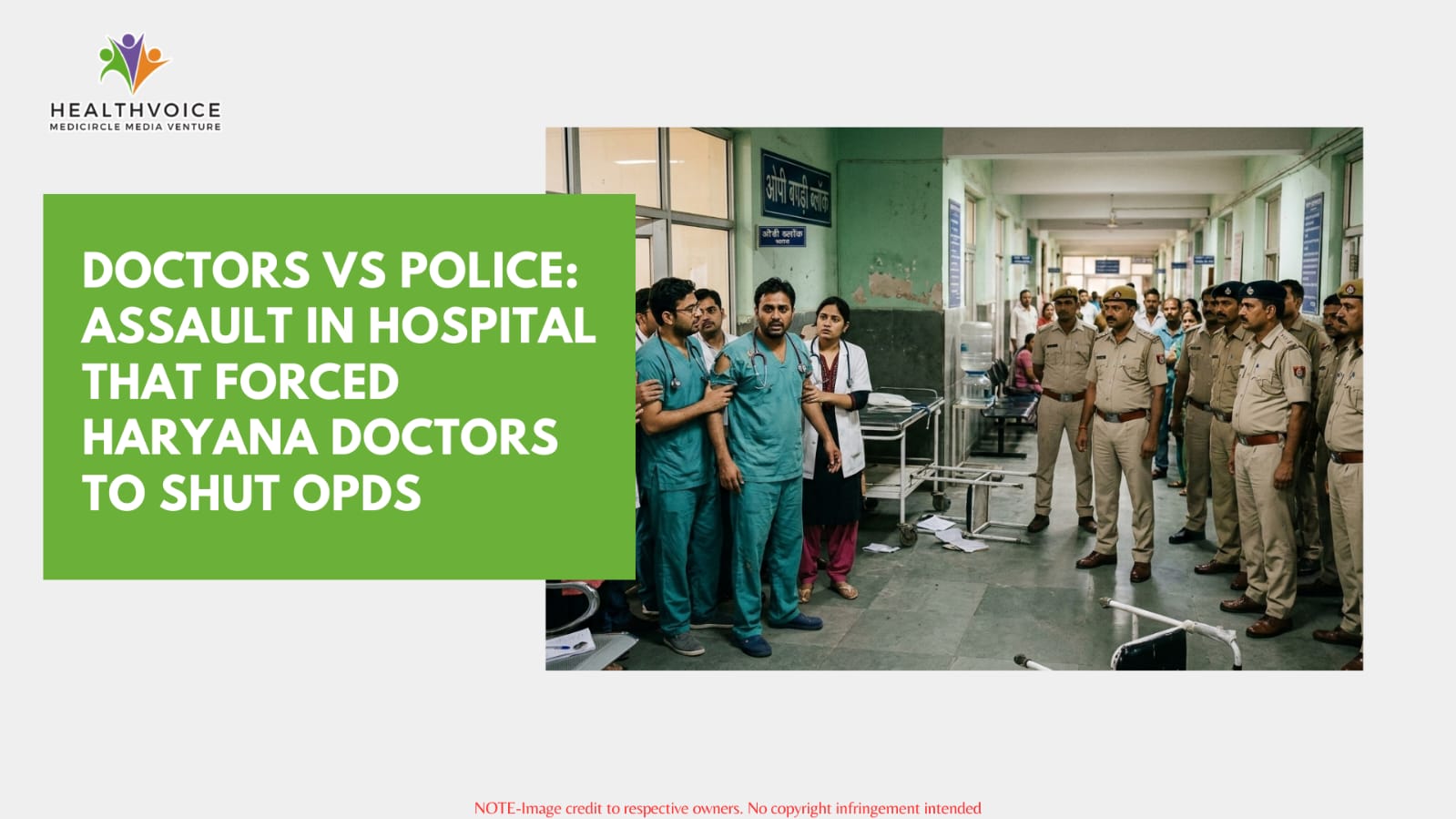
A recent incident in Haryana has once again brought this issue to the forefront. Doctors across the state announced a one-day suspension of outpatient department services in protest after an on-duty government doctor was allegedly assaulted inside a healthcare facility. The protest was organised under the leadership of the Haryana Civil Medical Services Association, which represents doctors working in government health institutions across the state.
According to reports, the incident took place at a Community Health Centre in Gharaunda, located in Karnal district. The facility, like many public health centres in India, caters to a large number of patients every day. Doctors working in such institutions often handle overwhelming workloads while attempting to deliver essential healthcare services to communities that rely heavily on public medical infrastructure.
On the day of the incident, tensions reportedly escalated following a phone conversation between the doctor and a police officer. What began as a verbal exchange soon turned into a confrontation within the hospital premises. According to accounts shared by medical associations, the situation deteriorated to the point where the doctor was allegedly subjected to verbal abuse and physical assault while performing official duties.
Witnesses and reports indicate that the officer confronted the doctor inside the health centre. CCTV footage circulating after the incident allegedly shows the doctor being grabbed by the collar and pushed while another individual attempts to intervene. The visuals have triggered widespread concern within the medical community.
The incident did not end there. The doctor was reportedly taken from the hospital to a police station and detained for a brief period. During this time, it is alleged that he was pressured into writing an apology before being released. Senior administrative officials eventually intervened, leading to his release. For many doctors across the state, the sequence of events felt deeply unsettling.
Healthcare professionals often accept that difficult situations can arise in hospitals. Families dealing with illness may experience intense emotional stress. Disagreements over treatment decisions, delays in care, or unexpected outcomes sometimes lead to confrontations. Over the years, hospitals across India have witnessed episodes of anger directed toward doctors by frustrated relatives.
However, incidents involving law enforcement authorities raise a different level of concern. Doctors argue that when those responsible for maintaining law and order become part of such confrontations, the sense of vulnerability within the healthcare workforce increases dramatically.
Following the incident, the doctors association demanded immediate legal action against the police personnel allegedly involved. The organisation called for the registration of a criminal case against the officer concerned and requested a time-bound investigation into the matter.
The protest quickly gained support from the Indian Medical Association, one of the country’s largest professional bodies representing doctors. The association expressed solidarity with the medical officer and urged the government to take decisive steps to protect healthcare professionals working in public institutions.
In its communication with the state government, the medical body appealed to Nayab Singh Saini to intervene in the matter. The association emphasised that healthcare workers must be able to perform their duties without fear of intimidation or violence.
Doctors also demanded that the case be registered under the provisions of the Haryana Medicare Service Persons and Medicare Service Institutions (Prevention of Violence and Damage to Property) Act, 2009. This legislation was introduced specifically to address attacks on healthcare workers and damage to medical facilities. It provides legal protection for doctors and hospital staff while they are on duty.
The existence of such laws reflects the seriousness of the problem. Across India, several states have enacted legislation aimed at preventing violence against doctors. These laws recognise that hospitals must remain safe spaces where healthcare professionals can work without threats or intimidation.
Despite these legal safeguards, incidents continue to occur. For many doctors, the persistence of such cases suggests that enforcement remains inconsistent. Laws designed to protect healthcare workers often fail to deliver timely justice when violations take place.
The protest in Haryana therefore represents more than a reaction to a single incident. It reflects a growing frustration within the medical community about the broader issue of workplace safety in hospitals.
Doctors frequently work under immense pressure. Public hospitals in India often struggle with limited resources, high patient loads, and staff shortages. In many districts, a small number of doctors serve thousands of patients each day. Under such circumstances, even routine medical consultations can become stressful experiences.
Patients and families, understandably anxious about health outcomes, sometimes interpret delays or treatment limitations as negligence. Misunderstandings escalate quickly in crowded hospital environments where communication becomes difficult. These situations occasionally lead to arguments and, in extreme cases, violence.
Medical professionals say that repeated incidents of aggression have begun to affect morale within the healthcare system. Young doctors entering government service often find themselves facing hostile situations despite their commitment to patient care. For many, the fear of confrontation has become an unwelcome part of daily practice.
The emotional toll of such experiences is rarely discussed outside the profession. Doctors are trained to remain calm and composed in the face of medical emergencies. They learn to deliver difficult news, handle critical situations, and manage life-and-death decisions. Dealing with physical intimidation or public humiliation can leave deep psychological scars.
Incidents like the one reported in Haryana also raise important questions about the relationship between healthcare institutions and law enforcement agencies. Hospitals rely on police assistance in situations involving medico-legal cases, emergency incidents, and public safety concerns. Cooperation between the two systems is essential for effective functioning.
When conflict emerges between medical professionals and police personnel, it disrupts this essential partnership. Doctors argue that mutual respect and clear communication are necessary to prevent such situations from escalating.
The response from authorities in the present case has been closely watched. Reports indicate that departmental action has been initiated against the police officer involved, and an inquiry is underway. Such steps may help address the immediate controversy, yet they also highlight the need for broader structural solutions.
Experts in healthcare policy have long argued that hospitals require stronger security systems and clearer protocols for handling disputes. Many large medical institutions have begun installing surveillance systems, deploying trained security personnel, and creating grievance redressal mechanisms for patients.
However, smaller public health centres and community hospitals often lack these safeguards. Doctors working in rural or semi-urban areas may find themselves dealing with tense situations without adequate support. Improving security infrastructure in such facilities remains an important priority.
Another aspect of the problem lies in public awareness. The doctor-patient relationship is built on trust. When that trust erodes, healthcare systems struggle to function effectively. Efforts to educate communities about the challenges faced by medical professionals can help rebuild understanding.
At the same time, transparency within hospitals is equally important. Patients and families expect clear communication about diagnosis, treatment plans, and possible outcomes. When information flows openly, misunderstandings become less likely to escalate into conflict.
The recent protest by doctors in Haryana serves as a reminder that healthcare systems depend on cooperation among many different actors. Governments, administrators, doctors, nurses, police personnel, and patients all play roles within this complex ecosystem.
Doctors wish to carry out their responsibilities in an environment where safety and dignity are guaranteed. Violence or intimidation, regardless of its source, undermines the spirit of medical service.
Public health experts often emphasise that protecting healthcare workers ultimately benefits patients as well. When doctors feel secure in their workplaces, they are able to focus fully on patient care. A safe environment encourages better communication, improved clinical decisions, and stronger doctor-patient relationships.
The Haryana incident therefore represents a broader conversation about respect for the medical profession. In a country where doctors frequently work under immense pressure to meet healthcare demands, ensuring their safety is essential for the stability of the entire system.
Healthcare professionals dedicate years of training to learn the science and art of healing. Their commitment often extends far beyond working hours, especially in public health facilities where the needs of patients rarely follow a predictable schedule. Society expects doctors to respond to emergencies, handle crises, and remain calm under pressure.
In return, doctors expect the assurance that the place where they care for patients will also protect them. When that assurance is shaken, the consequences ripple through the entire healthcare system.
The events unfolding in Haryana have therefore sparked a conversation that extends beyond a single hospital or district. They highlight the urgent need to strengthen the safety net around those who stand on the frontlines of healthcare.
For a country striving to improve access to quality medical services, protecting doctors is not merely a professional demand. It is a public health necessity
 Team Healthvoice
#IndiaNews #BreakingNews #IndianHealthcare #Haryana #SocialAwareness #StandWithDoctors #HealthMatters #PublicHealth #HealthCareSystem #HealthAwareness #healthvoice
