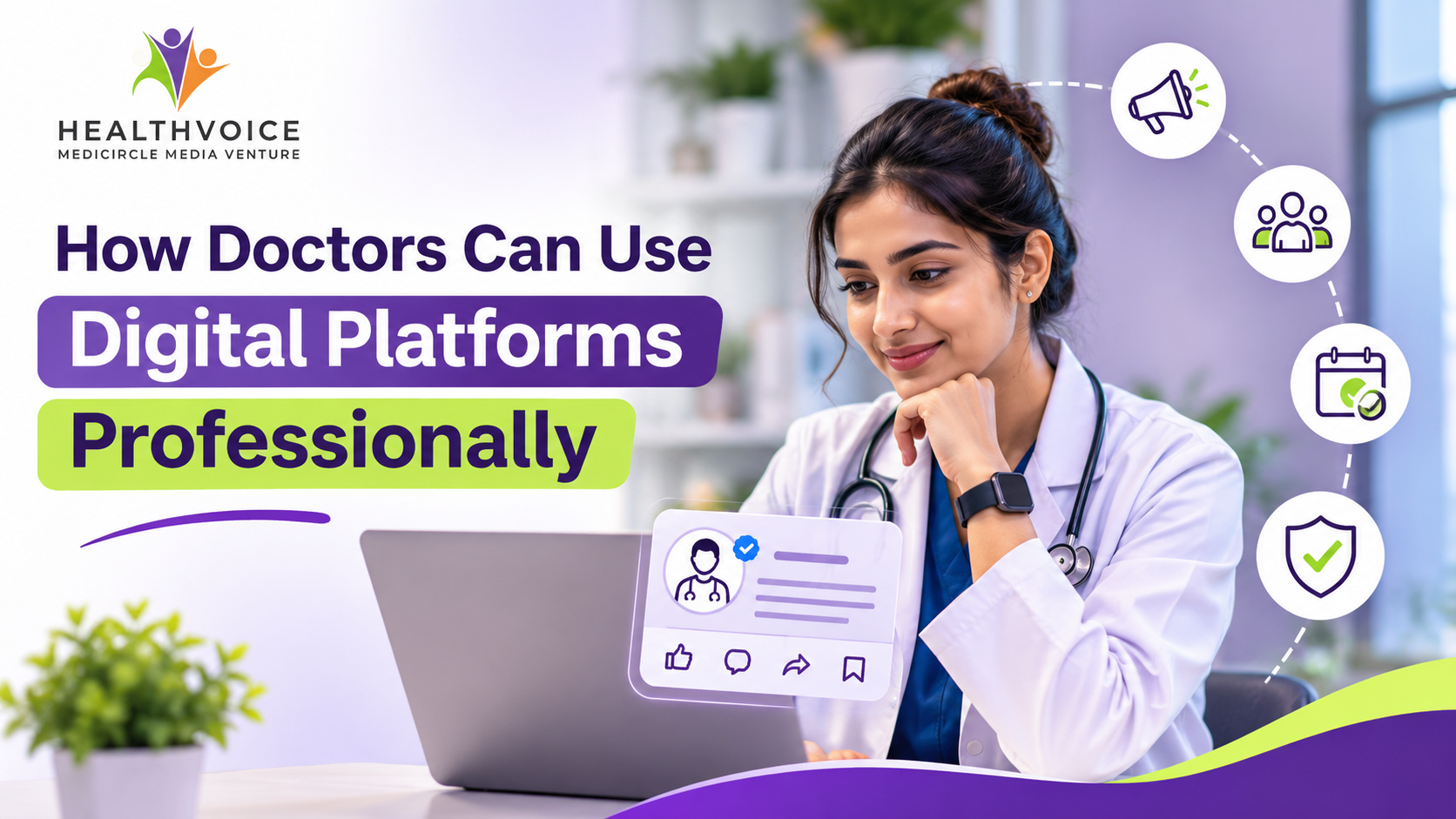
How Doctors Can Use Digital Platforms Professionally
Indian doctors can build credible digital identities by applying core medical ethics online, choosing appropriate platforms, and engaging with professional communities designed to support responsible health communication.
How Doctors Can Use Digital Platforms Without Compromising Professionalism
Introduction
The internet has permanently changed how doctors communicate, teach, and build professional identity. Across India, thousands of physicians are now navigating social media accounts, digital health communities, online consultation platforms, and professional networks alongside their clinical responsibilities. For many, the transition has been intuitive and rewarding. For others, the digital world presents real uncertainty about where the boundaries of professionalism begin and end.
The question is no longer whether doctors should have a digital presence. Most already do, in one form or another. The more important question is how to build and maintain that presence in a way that reflects the same standards of integrity, care, and credibility that define the best of medical practice.
Professionalism has always been at the heart of medicine. It includes confidentiality, ethical communication, respect for patients, evidence-based guidance, and accountability. Digital platforms do not change these principles. What they do change is the scale, speed, and visibility at which a doctor communicates. A single post can reach thousands of people within hours. That reach carries responsibility.
This article examines how Indian doctors can engage meaningfully with digital platforms, strengthen their professional identity online, and avoid the pitfalls that can damage trust or create regulatory complications.
Understanding Digital Professionalism for Doctors
Digital professionalism refers to the application of medical ethics and professional standards in all online environments. It covers everything from how a doctor represents themselves on LinkedIn or Instagram to how they respond to patient queries in public comment sections, how they write about clinical topics, and how they engage with colleagues and healthcare institutions online.
In India, the National Medical Commission (NMC) has introduced frameworks that address the digital conduct of registered medical practitioners. The Registered Medical Practitioner (Professional Conduct) Regulations emphasize that the same standards of conduct that apply in clinical settings apply equally in digital spaces. Doctors who share medical advice online, run health channels, or build public platforms are still bound by the same ethical obligations they carry inside the consultation room.
What digital professionalism is not is a reason to avoid participation. Doctors who communicate accurately, engage responsibly, and build credible digital identities are creating enormous public health value. India has a severe shortage of trusted health information accessible to ordinary people. Doctors who step into that space with authority and care are filling a gap that matters deeply.
Why Indian Doctors Are Moving Online
Several converging factors are driving Indian doctors toward digital platforms. The COVID-19 pandemic accelerated telemedicine adoption and made digital communication a clinical necessity almost overnight. Platforms like WhatsApp, YouTube, and Instagram became channels for health awareness, and patients began expecting doctors to be accessible and informative across digital touchpoints.
At the same time, the broader medical community recognized the value of digital visibility for professional growth. Association memberships, CME credits, conference participation, and peer networking all moved significantly online. Young doctors graduating from medical colleges today enter a professional environment where a digital identity is considered as relevant as a visiting card once was.
For doctors practicing in Tier 2 and Tier 3 cities across India, digital platforms have opened access to specialist communities, global medical journals, and peer networks that were previously available only to those in metro centers. The democratization of medical knowledge sharing through digital tools has been a genuine and significant development for Indian healthcare.
Key Principles for Maintaining Professionalism Online
Maintaining professionalism in digital spaces does not require a separate rulebook. It requires a thoughtful application of principles that good doctors already understand and practice.
Patient Confidentiality Must Always Come First
The most fundamental rule is that patient information is never shared online without explicit, informed consent. This means no photographs, no case descriptions with identifying details, no test results, and no clinical anecdotes that could allow even indirect identification of a patient. This obligation holds even in private or semi-private online groups, since digital content can be screenshotted, shared, or retrieved.
Accuracy and Evidence Must Drive Medical Communication
When doctors speak publicly about health topics, those communications carry a weight that ordinary social media content does not. Audiences trust physicians in a way they do not trust influencers. That trust creates a responsibility to share only information that is accurate, evidence-based, and appropriately qualified. Claims that go beyond established clinical evidence, recommendations that substitute for a proper consultation, or health advice tied to commercial products without disclosure are all serious professional risks.
Disclosure and Transparency Build Trust
If a doctor is associated with a pharmaceutical company, medical device brand, healthcare startup, or any organization with a commercial stake in health decisions, that association must be disclosed clearly when discussing related topics online. The Medical Council of India and the NMC have both emphasized transparency around commercial relationships as a critical element of medical ethics. The Advertising Standards Council of India (ASCI) also has specific guidelines that apply when medical professionals make public health claims tied to products or services.
Tone and Conduct Reflect the Profession
Online spaces can be polarizing, and doctors are not immune to being drawn into heated discussions about policy, clinical controversies, or public health debates. While informed disagreement and respectful debate are healthy and necessary, personal attacks, dismissive language, or behavior that degrades the dignity of patients, colleagues, or institutions reflects poorly not only on the individual but on the medical profession as a whole. Professionalism online means communicating with the same restraint, accuracy, and respect that one would apply in a formal clinical or academic setting.
Choosing the Right Digital Platforms for Medical Engagement
Not all digital platforms serve the same purpose, and doctors benefit from being intentional about where they invest their professional digital presence.
General social media platforms such as Instagram, Facebook, and YouTube offer enormous reach for health awareness content. When used well, these platforms help doctors educate the public, build health literacy, and establish a recognizable professional identity. The risks are proportionate to the reach: misinformation spreads quickly, comment sections can generate unsolicited diagnostic requests, and the informal culture of social media can gradually erode professional tone if not managed carefully.
Professional platforms such as LinkedIn serve a different function. For doctors, LinkedIn is a space for career milestones, thought leadership, networking with healthcare administrators, and connecting with industry and policy communities. The audience and norms of LinkedIn support a more formal register, which makes it a natural fit for certain types of professional communication.
Doctor-specific platforms represent a third and increasingly important category. Platforms built specifically for the medical community, such as HealthVoice, provide a structured environment where doctors can share expertise, engage with associations, connect with peers, and build professional visibility within a framework designed to reflect the values of the medical profession. These platforms are designed to amplify the doctor's voice while maintaining the credibility and ethical standards that general social media often struggles to protect.
For Indian doctors serious about building a sustainable and credible digital presence, a combination of a focused general platform for public health awareness and a dedicated professional platform for community engagement and peer networking is often the most effective approach.
Common Digital Mistakes Doctors Must Avoid
Understanding what not to do is as important as knowing best practices. Several patterns of behavior are known to create professional, legal, and reputational risk for doctors online.
- Responding to medical queries in public comment sections with specific diagnoses or prescriptions, even with good intentions, creates liability and sets a precedent that is difficult to manage at scale.
- Sharing screenshots or descriptions of patient interactions, even with names removed, can in many contexts still constitute a breach of confidentiality.
- Endorsing health products, supplements, or wellness services on social media without clear disclosure violates both NMC ethics norms and ASCI guidelines.
- Creating urgency or fear around health conditions to drive traffic or consultation bookings compromises the trust-based foundation of the doctor-patient relationship.
- Engaging in public disputes with other doctors, hospitals, or healthcare brands damages professional reputation and can have legal consequences under defamation law.
Awareness of these risks does not mean avoiding digital engagement. It means approaching engagement with the same care and professional judgment that every clinical decision deserves.
How HealthVoice Supports Ethical Digital Engagement for Doctors
HealthVoice has been designed specifically to address the gap between a doctor's need for digital visibility and the professional standards that must accompany that visibility. For Indian doctors and medical associations, the platform provides a space where professional voice is amplified without compromising the integrity that defines medical practice.
Through HealthVoice, doctors can share expertise on clinical topics, highlight professional achievements, engage with association communities, stay informed about healthcare industry developments, and connect with peers and healthcare brands in a context that is purposefully structured around credibility and ethical communication.
Medical associations in India benefit equally from the platform, gaining tools to engage members meaningfully, promote events, share policy updates, and strengthen the collective professional voice of their communities. For healthcare brands and pharmaceutical companies seeking to reach a highly relevant and trusted medical audience, HealthVoice provides access within a framework that protects both doctors and their communities from exploitative or misleading engagement.
The platform reflects a belief that digital visibility and professional integrity are not competing values. They are complementary, and when managed well, mutually reinforcing.
Conclusion
India's doctors are uniquely positioned to shape public health understanding, build professional communities, and demonstrate the possibilities of ethical digital engagement at scale. The digital world is not a threat to medical professionalism. It is an extension of the responsibility that comes with medical practice.
When doctors approach digital platforms with clarity of purpose, adherence to ethical principles, and a commitment to accuracy and transparency, they build a form of professional authority that extends their impact far beyond the walls of the clinic. For the millions of Indian patients who seek health guidance online, that authority represents a genuine and significant form of care.
Professional platforms like HealthVoice exist to support exactly that vision: a connected, credible, and community-driven medical profession that uses the power of digital communication in the service of better health outcomes and stronger professional bonds.
Frequently Asked Questions
Q1: Can doctors advertise their services on social media in India?
Doctors in India are permitted to maintain a digital presence and share professional information, but direct advertising of clinical services in a manner that solicits patients is restricted under NMC professional conduct regulations. Any paid promotional content linked to health services must clearly disclose the commercial nature of the communication and must not make unverified claims about treatment outcomes.
Q2: What should a doctor do if a patient asks for medical advice in a public comment section?
The recommended approach is to acknowledge the query respectfully, avoid providing specific clinical guidance in a public forum, and direct the person to book a formal consultation. Responding with diagnostic or treatment recommendations in a comment section creates both ethical and legal risks and sets a precedent that is difficult to sustain professionally.
Q3: Are there NMC guidelines specifically about doctors' behavior on social media?
The NMC's Registered Medical Practitioner (Professional Conduct) Regulations address the conduct of doctors in professional communication broadly, and digital communication falls within that scope. While a dedicated standalone social media policy has been a subject of ongoing discussion, the existing ethical framework applies clearly to online behavior, including patient confidentiality, accuracy of medical claims, and commercial disclosures.
Q4: How can a doctor build a credible digital presence without spending too much time on it?
Consistency and focus matter more than volume. Choosing one or two platforms aligned with professional goals, publishing well-considered content on a realistic schedule, and engaging with a professional community platform such as HealthVoice for peer visibility allows doctors to maintain a meaningful digital presence without letting it consume clinical time. Quality of engagement consistently outperforms quantity.
Q5: Is it safe for doctors to discuss controversial clinical topics or medical policy debates online?
Informed, evidence-based participation in clinical and policy discussions is valuable and important for the health of the medical profession. Doctors should approach such discussions with factual grounding, respectful language, and a clear acknowledgment of areas of genuine scientific uncertainty. Personal attacks, unverified claims, and language that could be construed as defamatory should always be avoided, both for professional integrity and legal protection.
Resources
- National Medical Commission (NMC): Official regulatory body for medical education and practice standards in India, including professional conduct norms for registered practitioners.
- Advertising Standards Council of India (ASCI): Guidelines for responsible advertising and public communication by healthcare professionals and health brands.
- Ministry of Health and Family Welfare (MoHFW): National health policy frameworks and telemedicine practice guidelines relevant to digital health engagement.
- Indian Medical Association (IMA): Professional association resources on ethics, digital conduct, and community engagement for Indian doctors.
- World Health Organization (WHO) Digital Health Resource Centre: Global frameworks and research on digital health communication, misinformation, and professional standards in health information.
Interlinking Keywords
digital professionalism for doctors, doctor online presence India, NMC professional conduct, medical ethics social media, doctor digital platforms, HealthVoice doctor community, telemedicine guidelines India, medical association digital engagement, doctor personal branding India, healthcare communication ethics
Last reviewed by:
Dr. Manthan Tripathi, HealthVoice Editorial and Medical Advisory Team, November 16, 2026.
Disclaimer
The information presented in this article is intended for general professional awareness and educational purposes only. It does not constitute legal advice, regulatory guidance, or a substitute for consulting the official publications of the National Medical Commission, the Indian Medical Association, or other relevant regulatory bodies. Doctors are advised to review the latest applicable conduct regulations directly from official sources before making decisions about their digital engagement practices. HealthVoice does not assume liability for actions taken based on the content of this article.
 Dr. Manthan Tripathi
#DigitalProfessionalism #DoctorsOnDigitalPlatforms